eBook - ePub
Victims, Perpetrators, and the Role of Law in Maoist China
A Case-Study Approach
- 213 pages
- English
- ePUB (mobile friendly)
- Available on iOS & Android
eBook - ePub
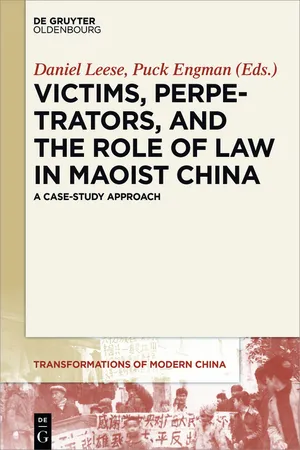
Victims, Perpetrators, and the Role of Law in Maoist China
A Case-Study Approach
About this book
No detailed description available for "Victims, Perpetrators, and the Role of Law in Maoist China".
Information
Xu Lizhi
1 Beyond “Destruction” and “Lawlessness”
The Legal System during the Cultural Revolution
Translated and edited by Daniel Leese
Chinese domestic interest in the question of the Cultural Revolutionary legal system and related research has been going on for over forty years, at least if one takes the appearance of the big-character poster “On Socialist Democracy and the Socialist Legal System”1 in Guangzhou back in 1974 as a starting point. Since then, there have been two periods of increased public and scholarly attention. The first phase began immediately after the end of the Cultural Revolution when, in the process of contemplating the lessons to be drawn from the movement, a discussion emerged on the question of the legal system during the Cultural Revolution. Many writings on this period still contain elements of this discussion.2 The second phase commenced in the late 1990s when the legal system during the Cultural Revolution became a subject of special interest in the field of legal history. Key publications of this period all contain special sections on the development of the legal system during the Cultural Revolution.3 Since the turn of the millennium, a few more articles on the subject have been published.4 There have also been several debates regarding the question of crime during these years,5 yet overall, there has been no substantial new research on this subject.
There is a fairly obvious tendency in current debates and research on the Cultural Revolutionary legal system. Most participants analyze the period from the angle of “negating” the Cultural Revolution and therefore emphasize the destruction of the legal system. The aforementioned big-character poster by the Li Yizhe group is a case in point. The authors take the standpoint that, by the summer of 1968, the socialist legal system was destroyed through the perversion of the existing structures by the Lin Biao Clique. The result is described as a situation of “lawlessness” (wufa wutian). Research after the Cultural Revolution has basically followed this line of reasoning and has taken the destruction of the legal system as the dominant model of explanation. The situation of the legal system during this period has accordingly been characterized as “complete destruction” or “extreme destruction.”6 Others have used phrases such as the “complete erosion of the legal system,” the “legal system’s demolition” or have described it as “unworthy of being mentioned” because “democracy and the legal system were completely ruined.”7 Finally, some scholars have analyzed the period from the angle of “rule of man” vs. “rule of law.” During the Cultural Revolution, the CCP accordingly displayed a “legal nihilism” that emphasized “rule of man” and neglected “rule of law.” The terms are used both as analytical categories to explain a major reason for the emergence of the Cultural Revolution as well as a description of frequently witnessed phenomena during this period.8
This trope of “destruction,” which these writings employ, is built on the assumption that the socialist legal system built after 1949 was abandoned, ceased to function, or at least came to be fundamentally altered during the Cultural Revolution. Phenomena of turmoil doubtlessly existed at the time and current scholarly literature has mostly focused on an analysis of these instances. The resulting discursive framework and scholarly agenda has accordingly been primarily focused on revealing the destruction of the legal system. This research tendency is closely related to the peculiar nature of the object of analysis. Chinese society during the period of the Cultural Revolution was special in so far as appearance and reality were often bifurcated. Developments on the surface and internal working procedures differed enormously. The destruction of the legal system took place mostly on the surface and thus quickly garnered scholarly attention, not least because it is comparatively easy to describe.
The emergence of this research trend is also related to the official evaluation of the period. After the end of the Cultural Revolution, the official negation of the movement, as well as the emphasis on showcasing its destructive impact on existing structures and the public order, has had a major influence on scholarship. This tendency has also had a positive aspect. By revealing the destruction wrought by the Cultural Revolution, contemporary experiences could be summarized as a warning for later generations. Yet to describe this period solely in terms of destruction raises suspicions of partiality. The Cultural Revolution was a movement conducted under CCP control and built on the premise of keeping the foundations of state and society in place. The aim of the movement was to stabilize the dictatorship of the proletariat and to hinder a “capitalist restoration.” It was not a revolution aimed at overturning the system as such. Within Party theory and institutions, the post-1949 legal system was always closely entwined with the people’s democratic dictatorship and the dictatorship of the proletariat. Thus, why would Cultural Revolutionary authorities have aimed at completely discarding the legal system with its close relation to the dictatorship of the proletariat which was, after all, massively strengthened during the Cultural Revolution? According to our current understanding, the legal system built up before the Cultural Revolution suffered attacks and even partial destruction during the late 1960s. But from a macroscopic point of view, it was nowhere as serious as a collapse or near breakdown of the legal system. While destruction did take place, other parts of the legal system continued working within certain limits and some functions of the system were even strengthened.
Basic Characteristics of the Legal System and the Question of Continuity
The Chinese “socialist legal system,” prior to the Cultural Revolution, was a fairly special type of legal system. Scholars were previously of the opinion that it should be classified as part of the continental civil law tradition and not as a distinctive type of legal system. This viewpoint has some truth to it. Formally speaking, the Chinese “socialist legal system” is a system that puts existing laws into practice. It therefore definitely shares some characteristics with the civil law tradition. But if one analyzes some of its essential features, significant differences come to the fore. The Chinese “socialist legal system” clearly has some special characteristics that set it apart from other legal systems. First, the legal system operates within the limits of political restrictions, as it was formed and developed under the rules and guidance of political principles. Second, the legal system was founded on the precondition of disbanding China’s previous legal system and setting one up anew in accordance with revolutionary theories. From the previous legal order, only a few parts were kept that did not touch upon questions of ideology. Third, the laws were painstakingly drawn up by the Party-state upon coming to power; the organically grown part is minor. Private law has therefore been overshadowed by public law. Fourth, the legal system is of relational character. Laws only have absolute authority within a predefined range. Fifth, the system’s changeability has been considerable. Conflicts between the legal system’s “socialist” attributes and its “regular” or “professional” components were bound to appear. The constant tug of war between these two different sets of components led to numerous changes over time.
Due to these special characteristics of the “socialist legal system,” it is legitimate to view it as a distinct type of legal system that differs from its modern Western counterparts. This legal system, just like the socialist system and the dictatorship of the proletariat, was a product of the international communist movement and appeared in all socialist countries. The system emerged in embryonic form in the base areas controlled by the CCP prior to 1949.9 By the mid-1950s, it had developed into a basic framework, encompassing the following four parts: legal principles, a system of legal sources, a judiciary, and a legal order. This framework experienced some setbacks, such as when some “professional” principles that had been written into the 1954 Constitution came to be criticized in the late 1950s. Although this led to some disorder in the establishment of legal institutions, the basic structure and main pillars of the system continued to exist.
During the Cultural Revolution period, the legal system experienced severe shocks. Major changes took place with regard to nearly every aspect of the legal system, yet the basic structure was by no means destroyed. The Cultural Revolutionary leadership circles did not reject the former legal system outright. The 1954 Constitution was fully confirmed10 and the elements that had previously constituted the legal system, i.e. the legal principles, legal sources, the judiciary, and the legal order, still remained in place. There were no essential changes in any of these four areas. Only with regard to parts of the legal system’s structures, its role and function, and implementation, did there appear some variations from previous practice. The main characteristics of the pre-Cultural Revolution legal system, such as the interference of politics in legal affairs, the fact that law obtained absolute authority only within predefined spaces, and the volatile character of the legal system were all upheld during this period. Several of these traits were even strengthened, as will be shown in the following sections of this chapter by looking at the four parts of the legal system in closer detail.
The Continuation of Legal Principles
Within the Chinese “socialist legal system,” legal principles assume a highly important role. Principles of political character especially play both a regulatory and guiding function, touching upon all aspects of the legal system. Among the political principles, the most important ones are the guiding role of Marxism-Leninism and Mao Zedong Thought, the leadership of the CCP, the dictatorship of the proletariat, and the socialist path. These later coalesced into the “four cardinal principles.”11 They still represent the fundamental principles that the CCP has uniformly upheld in assuming power and governing the country. The principles emerged in the process of establishing a “socialist” legal system and came to assume a fundamental guiding role with regard to the creation of every part of the legal system, as well as during the implementation of all types of legal measures. Every measure with legal relevance that the CCP adopted before and after coming to power was decided on, carried out, and completed according to the guiding function of these principles. This applied, for example, to the abolishment of the Republican legal system and the cleansing and reeducation of remaining judicial personnel, and to setting up Party groups within courts and procuratorates. The importance of politics was also visible in having to implement judicial work in accordance with the Party’s guiding principles and policies, as well as in adhering to the Party’s concrete decisions and instructions. Furthermore, the adoption of the Constitution and other laws and regulations followed the overarching necessity of carrying out socialist transformation and exercising class dictatorship. The influence of these principles was further visible in the naming practices of judicial institutions: the word “people’s” was added to the names of courts and procuratorates in order to symbolically demonstrate that they followed the basic principle of being instruments of the people’s democratic dictatorship, even beyond the actual act of establishing these institutions. Simultaneously, it also reflected the guiding function of the Marxist theory of “sovereignty of the people.”12
In addition to the four cardinal principles, two other relatively important political principles deserve mention. One is the principle of the mass line, which demands that judicial work serve the masses and rely on the masses.13 The masses should be drawn into legal activities by way of taking part in case investigations, adjudication, and the actual implementation of sentences. The other principle is the distinction between two different types of contradictions.14 Within judicial work, a distinction had to be drawn between friend/enemy contradictions and contradictions among the people. Cases were to be dealt with based on the respective nature of the contradiction. Friend/enemy cases accordingly were to adopt the method of dictatorship, while cases of contradictions among the people were to be handled through critical education. Legal sanctions were perceived only as a supplementary measure.
Of course, within China’s “socialist legal system” there also existed several professional principles. Among ...
Table of contents
- Cover
- Title Page
- Copyright
- Contents
- Acknowledgements
- Introduction: Politics and Law in the Early People’s Republic of China
- 1 Beyond “Destruction” and “Lawlessness”: The Legal System during the Cultural Revolution
- 2 The Intelligence Sleeper Who Never Was: Han Fuying and Case 5004
- 3 A Different Category of Life: The Counterrevolutionary Case of a Rural Schoolteacher
- 4 Vetting the People’s Servant: On the Principles of Revolutionary Integrity
- 5 A Policeman, His Gun, and an Alleged Rape: Competing Appeals for Justice in Tianjin, 1966–1979
- 6 From Denial to Apology: Narrative Strategies of a “Perpetrator” after the Cultural Revolution
- 7 The Floating Fate of a Rebel Leader in Guangxi, 1966–1984
- Contributors
- Index
Trusted by 375,005 students
Access to over 1.5 million titles for a fair monthly price.
Study more efficiently using our study tools.
Frequently asked questions
Yes, you can cancel anytime from the Subscription tab in your account settings on the Perlego website. Your subscription will stay active until the end of your current billing period. Learn how to cancel your subscription
No, books cannot be downloaded as external files, such as PDFs, for use outside of Perlego. However, you can download books within the Perlego app for offline reading on mobile or tablet. Learn how to download books offline
Perlego offers two plans: Essential and Complete
- Essential is ideal for learners and professionals who enjoy exploring a wide range of subjects. Access the Essential Library with 800,000+ trusted titles and best-sellers across business, personal growth, and the humanities. Includes unlimited reading time and Standard Read Aloud voice.
- Complete: Perfect for advanced learners and researchers needing full, unrestricted access. Unlock 1.5M+ books across hundreds of subjects, including academic and specialized titles. The Complete Plan also includes advanced features like Premium Read Aloud and Research Assistant.
We are an online textbook subscription service, where you can get access to an entire online library for less than the price of a single book per month. With over 1.5 million books across 990+ topics, we’ve got you covered! Learn about our mission
Look out for the read-aloud symbol on your next book to see if you can listen to it. The read-aloud tool reads text aloud for you, highlighting the text as it is being read. You can pause it, speed it up and slow it down. Learn more about Read Aloud
Yes! You can use the Perlego app on both iOS and Android devices to read anytime, anywhere — even offline. Perfect for commutes or when you’re on the go.
Please note we cannot support devices running on iOS 13 and Android 7 or earlier. Learn more about using the app
Please note we cannot support devices running on iOS 13 and Android 7 or earlier. Learn more about using the app
Yes, you can access Victims, Perpetrators, and the Role of Law in Maoist China by Daniel Leese, Puck Engman, Daniel Leese,Puck Engman in PDF and/or ePUB format, as well as other popular books in History & 20th Century History. We have over 1.5 million books available in our catalogue for you to explore.