During World War II, Croatia became a fascist state under the control of the Ustasha Movement - allied with Nazi Germany and Fascist Italy. Here, Goran Miljan examines and analyzes for the first time the ideology, practices, and international connections of the Ustasha Youth organization.
The Ustasha Youth was an all-embracing fascist youth organization, established in July 1941 by the `Independent State of Croatia' with the goal of reeducating young people in the model of an ideal `new' Croat. This youth organization attempted to set in motion an all-embracing, totalitarian national revolution which in reality consisted of specific interconnected, mutually dependent practices: prosecution, oppression, mass murder, and the Holocaust - all of which were officially legalized within a month of the regime's accession to power. To this end education, sport, manual work and camping took place in specially established Ustasha Youth Schools. In order to justify their radical policies of youth reeducation, the Ustasha Youth, besides emphasizing national character and the importance of cultural and national purity, also engaged in transnational activities and exchanges, especially with the Hlinkova mladez [Hlinka Youth] of the Slovak Republic. Both youth organizations were closely modelled after the youth organizations in Nazi Germany and Fascist Italy.
This is a little studied part of the history of World War II and of Fascism, and will be essential reading for scholars of Central Europe and the Holocaust.
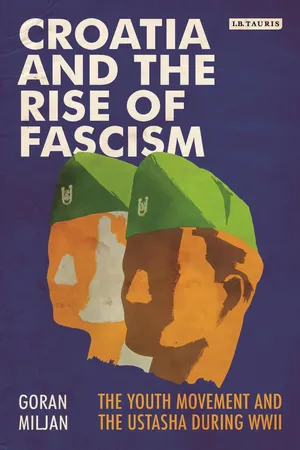
eBook - ePub
Croatia and the Rise of Fascism
The Youth Movement and the Ustasha During WWII
- 288 pages
- English
- ePUB (mobile friendly)
- Available on iOS & Android
eBook - ePub
About this book
Information
CHAPTER 1
ON FASCISM
Their [Ustashas’] extreme nationalism led them to emphasize a few points of singularity, but nothing either in theory or practice that was not consistent with generic fascism.1
Fascism and Totalitarianism
An effort to explain and understand fascism is not an easy one. Often, scholars, intellectuals, and politicians have come up with different suggestions and definitions of what fascism was, and how to define it.2 In fact, Payne argues that fascism is “one of the vaguest of the major political terms” and the term fascist served as “one of the most frequently invoked political pejoratives”.3 Emilio Gentile suggests that there were three periods of renewal in fascist studies: from the 1960s until the 1970s when fascism was seen as an anti-modern and anti-historical phenomenon, during the 1980s when Payne depicted fascism as modern and revolutionary, and in the 1990s there was a turn towards more theoretical aspects of fascism, its cultural and aesthetic aspects, as well as its ideology, a period marked by Roger Griffin’s book The Nature of Fascism.4 In his book, A History of Fascism, Payne provided a typological definition of fascism, arguing that fascism consists of three important aspects: (i) the fascist negations, (ii) ideology and goals, and (iii) style and organization.5 On the other hand, Griffin elaborated on the theory of generic fascism providing a concise one-sentence definition of fascism as “a genus of political ideology whose mythic core in its various permutations is a palingenetic form of the populist ultra-nationalism”.6 Griffin’s book was highly influential and debated. In fact, its popularity and influence is evident in the use of term consensus in fascist studies, a consensus based exactly on Griffin’s approach and definition. Both authors, as well as other influential scholars of fascism, do agree that fascism is to be viewed and considered, not as a reactionary ideology, but rather as a modern and revolutionary ideology which fought for its place against the dominant liberal paradigm, against which it pitted its own idea of “spiritual national regeneration in a post-liberal organic community”.7 However, when thinking about Griffin’s influential definition and his “fascist minimum”, the question which arises is that of whether it is possible to define the eclecticism and various manifestations of fascism with such a conscise one-sentence definition. The question is that of “ideal-type” definitions and whether the ideas encompassed within such definitions can embrace and explain all their differences and national idiosyncrasies.
While Griffin’s work and definition undoubtedly influenced fascist studies, there are scholars who criticize his approach and definition. For example, Michael Mann has argued that Griffin omits and neglects power organizations “without which ideas cannot actually do anything”.8 Mann further stresses that when probing into the problems of what fascism was and how to explain it, scholars must take fascist values seriously, but also while doing so they must add to its values “programs, actions, and organizations”.9 In fact, Mann’s argument is somewhat similar to that of David D. Roberts, in concluding that collective actions and organizations are the key to understanding the impact of fascism. While the debates concerning the definition of fascism remain on-going, and as such will continue to impact our understanding and research connected to it, scholars should not avoid engaging with them in order to provide new insights into different aspects and different national case-studies. In this line, Iordachi is right in arguing that no definition or approach to fascism, be it deductive or inductive, should exclude the other. On the contrary, they should work in complementary fashion, be based on new methodological approaches and shed light on new case-studies, especially those viewed as peripheral and still under-researched. Thus the engagement should consist of a dialogue
over the key theoretical and methodological issues involving their relationship between the theory and the history of fascism, and between the fascist ideology and its various forms of implementation.10
Fascist movements claimed to owe their existence to their leaders who took upon themselves to organize and lead their movements. This was further accentuated by their leaders appropriation of special titles, such as Il Duce, der Führer, the Căpitanul, the Poglavnik, which served to strengthen and emphasize their status of being perceived and acknowledged as “the chosen ones”.11 Given this aspect, it comes as no surprise that in all major research dealing with various aspects of fascism, either in its movement or regime phase, the concept of charisma is important and to an extent an almost unavoidable research variable. Numerous books and articles dealt with the special position of fascist leaders and tried to encompass the meaning of charisma and its applicability to various fascist movements and regimes. In 2006, a journal, Totalitarian Movements and Political Religion, issued a special issue dedicated to this subject,12 and that same year Aristotle A. Kallis published his article “Fascism, Charisma, and Charismatisation: Weber’s Model of Charismatic Domination and Interwar European Fascism”.13 However, while the concept itself was often applied to the core fascist movements and regimes in Italy and Germany, it was not until Iordachi’s book, Charisma, Politics, and Violence: The Legion of the “Archangel Michael” in Inter-war Romania, that the concept was applied to the so-called peripheral fascist movements and regimes.14
Generally speaking, it is possible to detect the transformation of the notion of charisma “from religious idea to sociological to general usage”.15 Nowadays, the term is applied to virtually every situation in which a certain person, political or civil, is involved.16 However, it was in the late nineteenth and early twentieth century that scholars started using this concept. Max Weber first used the term charisma outside religious connotations when he defined charisma as a
certain quality of an individual personality by virtue of which he is set apart from ordinary men and treated as endowed with supernatural, superhuman, or at least exceptional powers or qualities.17
His elaboration was different from the writings of St. Paul, where charisma was restricted to a small Christian community. According to the Epistles of St. Paul, the word charisma meant the gift of God’s grace within certain individuals with the purpose “to create unity, to strengthen community and to build the church”.18 Weber’s usage of the term is more general, and thus is arguably applicable across cultures and throughout history.19 His concept of charisma remained focused on a person, a leader, preserving the basic form of its religious aspect; that of an individual bestowed with God’s grace. Besides the individual’s grace, as a necessary prerequisite, Weber also placed a great emphasis on the belief and recognition of this by followers and by the leader himself.20 Thus, Weber took the notion of charisma and applied it to a modern society, with an individual at the center. In a somewhat similar form, charisma was often applied and explained in fascist studies in determining the role and perception of a leader amongst his closest associates and society in general, the so-called Führeprinzip.21 However, while an individual can claim his/her position as superior, it is his/her followers who need to recognize it as such. Even Weber argued this when he stated that it is “the duty of those to whom he addresses his mission to recognize him as their charismatically qualified leader”.22 However, the question here is larger than the mere recognition by followers. In order to understand charisma and charismatic relations, scholars, according to Kallis, need to pay attention to that
special position that many fascist leaders eventually occupied in the political and psychological structures of their movements which alludes to an exceptional degree of charismatisation by the community of their followers.23
Kallis argues that charisma and charismatization need to be viewed as a rationally pursued and developed process.24 And while leaders undoubtedly held prominent positions in various fascist movements, usually explained through the above-mentioned Führerprinzip, Iordachi, on the other hand, argues that such focus can be seen as a reduction of the concept of charisma. In his call for reconceptualization of charisma, Iordachi claims that it is necessary to recover its original religious connotations as well as to reexamine its social connotations and its link with national communities and ideologies.25 Furthermore, Iordachi sees the concept of charisma as
an ideology that regards the nation as an elect community of shared destiny living in a sacred homeland which, on the basis of a glorious past, claims a divine mission leading to salvation through sacrifice under the guidance of a charismatic leader.26
What Iordachi demonstrates is that the interwar charismatic nationalism was based and structured on the idea of a chosen, glorious national community led by its charismatic leader’s divine mission towards salvation. In line with Iordachi’s view, one of the key arguments presented in this book is that the relations established between the Poglavnik and his core followers were based on similar ideas of a glorious past, sacred homeland, of the imminent need for national salvation, regeneration, and the creation of a “new”, “better”, more “natural”, primordial Croat. Thus, the Poglavnik and his elite considered themselves the vanguards of the Croatian nation and the symbol of national salvation and regeneration. Once they established their regime, this view of the Ustasha as the symbol of change, of something new, better, and eternal was to be recognized, acknowledged and accepted by the youth as the embodiment of the “new” Croat – the Ustasha.
The second, often highly contested, concept used in this work is that of totalitarianism. Ever since the end of World War II, scholars have tried to define totalitarianism both as an ideology and as a political system. The concept itself produced a high number of scholarly debates which led to the fact that these became more prominent and numerous than the scholalry research results and the answers given.27 A politician and journalist, Giovanni Amendola, coined the term in Italy in 1923. By referring to the changes of election laws requested by Benito Mussolini, Amendola stated that what is taking place here is a totalitarian system, sistema totalitaria.28 During the Cold War period, totalitarianism as a concept became disputed as having no meaning and a heuristic purpose. In fact, during this period totalitarianism was proclaimed dead several times, but nevertheless managed to resurface in scholarly investigations.29 Its complete reemergence can be dated to the year 2000 when international journal Totalitarian Movements and Political Religions was established and in which authors like Peter Grieder,30 Emilio Gentile,31 Tzvetan Todorov,32 Roger Griffin,33 Vassil Girginov,34 and others reasserted totalitarianism as a useful category in historical research, especially within fascist studies.
After World War II, two analytical models of totalitarianism became dominant. The first one was developed by Hannah Arendt and the second one by Carl J. Friedrich and Zbigniew K. Brzezinski. In her book The Origins of Totalitarianism Arendt used her development...
Table of contents
- Cover
- About the Author
- Title Page
- Dedication
- Contents
- List of Illustrations
- Introduction
- 1. On Fascism
- 2. The Interwar Period, 1918–41
- 3. The “Prophet”
- 4. The “New” Croat: The Ustasha
- 5. Education and the Youth
- 6. The Cult of Youth
- 7. The Youth and “New Europe”
- Conclusion
- Notes
- Bibliography
- Index
- eCopyright
Trusted by 375,005 students
Access to over 1.5 million titles for a fair monthly price.
Study more efficiently using our study tools.
Frequently asked questions
Yes, you can cancel anytime from the Subscription tab in your account settings on the Perlego website. Your subscription will stay active until the end of your current billing period. Learn how to cancel your subscription
No, books cannot be downloaded as external files, such as PDFs, for use outside of Perlego. However, you can download books within the Perlego app for offline reading on mobile or tablet. Learn how to download books offline
Perlego offers two plans: Essential and Complete
- Essential is ideal for learners and professionals who enjoy exploring a wide range of subjects. Access the Essential Library with 800,000+ trusted titles and best-sellers across business, personal growth, and the humanities. Includes unlimited reading time and Standard Read Aloud voice.
- Complete: Perfect for advanced learners and researchers needing full, unrestricted access. Unlock 1.5M+ books across hundreds of subjects, including academic and specialized titles. The Complete Plan also includes advanced features like Premium Read Aloud and Research Assistant.
We are an online textbook subscription service, where you can get access to an entire online library for less than the price of a single book per month. With over 1.5 million books across 990+ topics, we’ve got you covered! Learn about our mission
Look out for the read-aloud symbol on your next book to see if you can listen to it. The read-aloud tool reads text aloud for you, highlighting the text as it is being read. You can pause it, speed it up and slow it down. Learn more about Read Aloud
Yes! You can use the Perlego app on both iOS and Android devices to read anytime, anywhere — even offline. Perfect for commutes or when you’re on the go.
Please note we cannot support devices running on iOS 13 and Android 7 or earlier. Learn more about using the app
Please note we cannot support devices running on iOS 13 and Android 7 or earlier. Learn more about using the app
Yes, you can access Croatia and the Rise of Fascism by Goran Miljan in PDF and/or ePUB format, as well as other popular books in History & European History. We have over 1.5 million books available in our catalogue for you to explore.