eBook - ePub
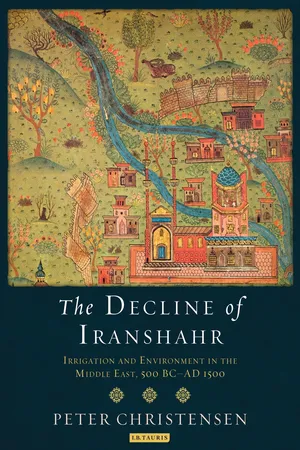
The Decline of Iranshahr
Irrigation and Environment in the Middle East, 500 B.C. - A.D. 1500
- 368 pages
- English
- ePUB (mobile friendly)
- Available on iOS & Android
eBook - ePub
The Decline of Iranshahr
Irrigation and Environment in the Middle East, 500 B.C. - A.D. 1500
About this book
The history of the Middle East is traditionally structured around the rise and fall of dynasties and states. The widely perceived view is that after the glories of an earlier golden age the region went into a steady and prolonged decline: populations decreased, ancient cities decayed and nomadism spread at the expense of civilized culture. In this pioneering text Peter Christensen challenges this story of decline. Long out of print but now reissued with a new introduction by the author, this important work is both a foundational text in the environmental history of the Middle East and a pioneering reassessment of traditional ideas about the historical processes of Iran and the Middle East region.
Information
Part 1
Starting Points: Themes and Sources
Chapter 1
A Melancholy Prospect
In the winter of 1834–1835 James Baillie Fraser, Scottish landowner, man-of-letters, and sometime political agent, made a journey to the Mesopotamian floodplain. Once this had been the center of great empires and the heartland of brilliant classical Muslim civilization. Now Fraser found a dreary wasteland studded with the crumbling remains of ancient towns and irrigation works. In the shadow of the Taq-é Kisra, the ruin of the palace of the Sassanian kings, wandering Arabs grazed their herds. Altogether it was “really a melancholy prospect,” Fraser thought.1
Yet it was hardly an unexpected one. As early as the 17th century, when the Ottoman military machine showed the first signs of weakness, the Europeans had convinced themselves that the Middle East had entered a phase of decadence and progressive decline. Within the Ottoman Empire the defeats did cause some critical introspection, but the observers thought that the situation could be salvaged by adjusting and by returning to the virtues of the past. The Europeans, however, saw the Ottoman decline as inevitable and irreversible.2
They did so because the Ottoman decline fitted well with other ideas emerging in early modern Europe. History was now thought of in terms of progress: Europe’s history, despite all temporary setbacks, was characterized by progress, understood as cumulative change for the better in material as well as in moral terms. As mentioned, the Europeans were used to think of Islam, i.e. the Middle East, as the absolute opposite of Europe, the inverted reflection of Europe. So it followed logically that the opposite of progress, decline, must characterize the history of Middle East.3 With such a premise, it was not difficult to find confirming evidence.
At close quarters the Europeans could see how military defeats and creeping decadence in the state and the civil society transformed the dreaded Ottoman Empire. Eventually it became the “sick man” who survived only because his European neighbors could not agree on how to divide his estate. In the remoter parts of the Middle East conditions were even worse. Fraser is but one example of how European diplomats, spies, advisers, antiquarians, and other travellers could report back to the European public that the Middle East was indeed in a state of material and moral decline. Few doubted that this sad condition should be ascribed, ultimately, to defects inherent in Middle Eastern society. The Europeans had come to see progress as a virtually natural process. If a society had not evolved in the same positive way as had Europe, there had to be something wrong with it. The defects or obstacles could be several: superstition, ignorance, tyranny, absence of private property, unfavorable environments, or barbarian invasions. The Middle East, which had experienced a veritable slide down the evolutionary ladder, apparently had such defects in plenty.
The defects most frequently emphasized by the Europeans in explaining the plight of the Middle East can be listed roughly under four headings. First, climatic changes. According to this theory decrease in rainfall and gradual dessication had led to the desertification of large areas formerly cultivated. At the same time pastures disappeared, a process which contributed to the recurrent invasions of Central Asian nomads. The theory was widely popularized by the American geologist Ellsworth Huntington. As member of the Pumpelly Expedition to Turkistan (1904), Huntington had observed the countless sand-buried remains of ancient towns and this led him to the conclusion that in the past climatic conditions had been more favorable.4
Second, nomadic invasions. In its simplest form this explanation states that the incursions of the Middle Ages, and especially the Mongol onslaught of the 13th century, caused such extensive material and demographic losses that the Middle East was unable to recover. This is really a paraphrase of the medieval horror stories of Mongol savagery and rests on the assumption that nomadism and settled agriculture are antagonistic ways of life. In the continual struggle between the two, the nomads allegedly enjoy the advantage of an inherent military superiority: they are born to fight on horseback, and their way of life breeds in them endurance and discipline.
Similar assumptions lie behind more recent theories of nomad destructiveness. However, emphasis is put not so much on the individual attacks as on the cumulative effect of nomadic pressure. A constant birth surplus forces the nomads to expand; this leads to bedouinization of areas under cultivation and thus to a reduction of the material basis for civilized life.5
Third, there is Islam. Ever since the 12th century, when church propagandists first drew a distorted picture of Islam as the perverted reflection of Christianity, Europeans have defined the societies of the Middle East as Muslim societies. In these, all aspects of life are completely dominated by religion. Islam therefore attained a central position within the field of Orientalism. By definition it was “the great synthesizing agent,” as The Cambridge History of Islam puts it, the all-embracing religion which ultimately caused the decline of Middle Eastern civilization.6
A modern exponent for this deeply rooted idea was Gustav von Grunebaum, and since he organized oriental studies in the United States after World War II, his opinions came to exert considerable influence on the direction of research. His argument can be summarized as follows: Islam does not duly distinguish between that which belongs to God and that which belongs to Caesar. Therefore it has stipulated norms for all aspects of social life. Unfortunately Islam is, or in any event very quickly became, obscurantist, fatalistic, irrational, and several other unpleasant things. This is evident from its rejection of the “Hellenistic legacy.” Islam has therefore retarded economic development and contributed to political violence and the establishing of totalitarian, reactionary regimes.7
Finally, there is the Oriental Despotism. This is the oldest and yet still the most current theory of why the Middle East and the rest of Asia stagnated and declined. Like the images of Islam sketched out above, Oriental Despotism rests on the assumption of an essential difference between Europe and Asia. However, the distinction is geographical and political rather than religious. Even in antiquity authors like Herodotus and Aristotle had argued that on the endless plains of Asia there had evolved a particular form of political organization: it was arbitrary and centralized and very different from the European states which were governed by law. We need not follow the evolution of this idea in detail. By the 18th century the Europeans, while observing the Ottoman military retreat and the chaotic conditions of Mughal India, had associated despotism with decline. From here the argumentation went as follows:
In the Asian empires political power is centralized and unrestricted. This may be because the empires were originally founded on conquest, or because their very size makes centralization a necessity if they are to be administered in an efficient manner. In any case the basic security of life and property known to Europe is lacking. In Asia all people live in constant peril of losing everything, including their lives, without warning. Hence, no one will produce any more than is necessary for the maintenance of life and the paying of taxes. The subjects have no incentives to carry out long-term investments in technological improvements or innovations. As for the rulers, they are usually more interested in elephants and dancing girls than in economic development. Therefore the state’s iron grip on social life leads to stagnation or decline.8
Despotism also became associated with irrigation. Adam Smith suggested that despotism had originated from the need for large-scale irrigation, and this idea was later elaborated within the Marxist tradition. The key argument is that it takes a large labor force to construct and maintain large irrigation works. To mobilize and discipline this labor force Asian societies had to evolve strong, centralized political leadership. However, once in control of the distribution of water resources, this leadership (and its extensive bureaucracy) assumed control over all other aspects of social life. As the subjects were forced into permanent and total submission, the “hydraulic trap” closed and put a stop to further development.
The first of these four explanatory themes, climatic change, can be dismissed. Admittedly our knowledge of past climatic conditions in the Middle East leaves much to be desired. However, most specialists agree that no significant overall changes have occurred over the last millennia. This has nothing to do with climatic fluctuations: i.e. recurring variations in relation to a statistical average. Such fluctuations have always posed a threat to agriculture in Iranshahr.9
The invasion theories have also been criticized in recent decades. Nomadism and settled agriculture are not as distinct and antagonistic as the theories would have it. Rather, the two ways of life might as soon be viewed as end points in a continuum of methods of subsistence. In Iranshahr, it is certainly difficult to find empirical evidence to support the theory of progressive bedouinization. It has even been argued that Iranshahr was in fact understocked with nomads and that the immigrations of the Middle Ages were an economic advantage because they opened up environmental zones hitherto unexploited.10
If our view of nomads has become more differentiated, the idea persists that the Mongols and Timur-é Lenk did inflicted serious damage on the Middle East. Western scholarship may now have acknowledged that the reports from the Middle Ages are exaggerated. Certainly the destructions were much more localized than previously assumed. Nevertheless, while nomadic invasions are no longer considered the only factor, they are still brought in to explain the decline.11 We shall...
Table of contents
- Cover
- Title Page
- Contents
- Preface to the New Edition
- List of Tables
- A Note on Transliteration and Measures
- Acknowledgments
- Introduction: Universal History, the Middle East, and the Environmental Perspective
- Part 1. Starting Points: Themes and Sources
- Part 2. "The Heart of Iranshahr": Mesopotamia and Khuzistan
- Part 3. The Oases on The Iranian Plateau
- Part 4. Sistan
- Conclusion
- Abbreviations used in Notes and Bibliography
- Bibliography
- Notes
- Index
- eCopyright
Trusted by 375,005 students
Access to over 1.5 million titles for a fair monthly price.
Study more efficiently using our study tools.
Frequently asked questions
Yes, you can cancel anytime from the Subscription tab in your account settings on the Perlego website. Your subscription will stay active until the end of your current billing period. Learn how to cancel your subscription
No, books cannot be downloaded as external files, such as PDFs, for use outside of Perlego. However, you can download books within the Perlego app for offline reading on mobile or tablet. Learn how to download books offline
Perlego offers two plans: Essential and Complete
- Essential is ideal for learners and professionals who enjoy exploring a wide range of subjects. Access the Essential Library with 800,000+ trusted titles and best-sellers across business, personal growth, and the humanities. Includes unlimited reading time and Standard Read Aloud voice.
- Complete: Perfect for advanced learners and researchers needing full, unrestricted access. Unlock 1.5M+ books across hundreds of subjects, including academic and specialized titles. The Complete Plan also includes advanced features like Premium Read Aloud and Research Assistant.
We are an online textbook subscription service, where you can get access to an entire online library for less than the price of a single book per month. With over 1.5 million books across 990+ topics, we’ve got you covered! Learn about our mission
Look out for the read-aloud symbol on your next book to see if you can listen to it. The read-aloud tool reads text aloud for you, highlighting the text as it is being read. You can pause it, speed it up and slow it down. Learn more about Read Aloud
Yes! You can use the Perlego app on both iOS and Android devices to read anytime, anywhere — even offline. Perfect for commutes or when you’re on the go.
Please note we cannot support devices running on iOS 13 and Android 7 or earlier. Learn more about using the app
Please note we cannot support devices running on iOS 13 and Android 7 or earlier. Learn more about using the app
Yes, you can access The Decline of Iranshahr by Peter Christensen in PDF and/or ePUB format, as well as other popular books in Historia & Historia antigua. We have over 1.5 million books available in our catalogue for you to explore.