During World War II, jazz embodied everything that was appealing about a democratic society as envisioned by the Western Allied powers. Labelled `degenerate' by Hitler's cultural apparatus, jazz was adopted by the Allies to win the hearts and minds of the German public. It was also used by the Nazi Minister for Propaganda, Joseph Goebbels, to deliver a message of Nazi cultural and military superiority. When Goebbels co-opted young German and foreign musicians into `Charlie and his Orchestra' and broadcast their anti-Allied lyrics across the English Channel, jazz took centre stage in the propaganda war that accompanied World War II on the ground. The Jazz War is based on the largely unheard oral testimony of the personalities behind the German and British wartime radio broadcasts, and chronicles the evolving relationship between jazz music and the Axis and Allied war e orts.
Studdert shows how jazz both helped and hindered the Allied cause as Nazi soldiers secretly tuned in to British radio shows while London party-goers danced the night away in demimonde `bottle parties', leading them to be branded a `menace' in Parliament. This book will appeal to students of the history of jazz, broadcasting, cultural studies, and the history of World War II.
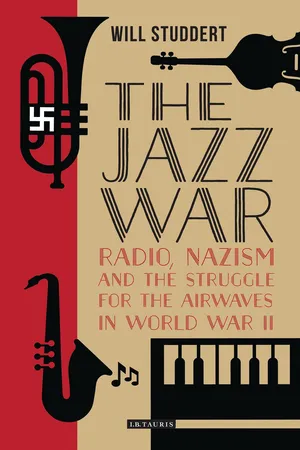
eBook - ePub
The Jazz War
Radio, Nazism and the Struggle for the Airwaves in World War II
- 256 pages
- English
- ePUB (mobile friendly)
- Available on iOS & Android
eBook - ePub
About this book
Information
CHAPTER 1
THE ‘CULTURAL BLACKOUT’: SEPTEMBER 1939 — JULY 1940
Those who listen to the wireless will tell you that at present we can pick up in England from eight to ten German stations daily. If our own broadcasts are not attractive, if the news is dry, if the entertainment is mediocre, and if the music is of a low standard, which is what people complain of, the listener just turns the button and he gets a foreign broadcast. He may very well tune in to a German programme for its entertainment value, but he also gets a full measure of German propaganda, skilfully delivered and in excellent English. Do not let us undervalue the possible effects of this.
Sir Samuel Hoare, House of Commons, 11 October 19391
On 2 September 1939, Melody Maker ran a front-page article explaining how war – should the crisis in Poland ‘break the wrong way’ – would affect the jazz world and its protagonists.2 That same day, a 17-year-old Romford schoolgirl observed in a diary kept for Mass Observation that, on a cinema visit, newsreel footage of Chamberlain was wildly applauded, whilst Mussolini’s appearances were greeted with hissing. ‘What an anticlimax it would be,’ she noted, ‘if there were no war!’3 At 11 o’clock the next morning, however, the British ultimatum to Hitler expired, and war was declared, with France joining Britain as its own ultimatum expired at 5 pm.4 The American CBS network’s Berlin correspondent William L. Shirer opened his evening broadcast with the words, ‘Hello. The war is on,’ and reported that German radio was ‘playing a stirring piece from the Fourth Symphony of Beethoven. Sometimes the music stops and the proclamations which the German Führer issued at noon today are re-read [. . .] Then the music goes on and people huddle close to their sets for the next piece of news.’5
The German population met the declaration of war with ‘reluctant loyalty’6 rather than widespread popular enthusiasm,7 and Shirer found ‘no excitement [. . .], no hurrahs, no throwing of flowers – no war fever, no war hysteria’ on the streets of Berlin.8 Nonetheless, the quick succession of military victories in the early months of the war, skilfully exploited by Goebbels in popular newsreels, ensured a growing degree of national consensus.9 The initial British propaganda strategy was largely disingenuous, with the BBC’s European Service concentrating its efforts on attacking Hitler and insisting that a Nazi victory was impossible10 – an unconvincing message in the months of the Blitzkrieg. In the first year of the war, the Nazis were conducting their propaganda campaign from a position of strength, supported as it was by mounting victories, and the BBC’s morality lectures to the German people – described by the contemporary American sociologist Kenneth Burke, apparently without irony, as ‘a liberal university of the air’11 – could only hope to appeal to ‘the infinitesimal few’ who hoped that Hitler would fail.12
Britain
Melody Maker and the BBC
While German radio was co-opting Beethoven to inspire a martial mentality amongst the populace, the 9 September 1939 edition of Melody Maker found the British jazz journal in a similarly warlike spirit. The front page was divided into two parts: ‘Our Job Now’ highlighted the new responsibilities acquired by the musical press, and ‘Your Job Now’ reminded British musicians of their role in maintaining morale. Even the heroes of the comic strip Billy Plonkit and His Band, a weekly feature following the exploits of a hapless jazz group, were mobilised for the cause. Their wartime debut showed Plonkit’s group marching in khaki uniforms, complete with rifles and kit bags, and the bandleader staring determinedly into the unknown future. The nonchalant caption states: ‘Cheerho, Fellers. We’ve got a gig in Poland!’13
This militarisation of the Plonkit strip was symbolic of the general mobilisation of the British jazz scene that was already underway,14 although the gravity of the situation was tempered with a tongue-in-cheek approach to international developments which, to paraphrase the historian Martin Doherty, arguably represented ‘bravado disguised as humour disguising fear’.15 Melody Maker quipped that the feuding dance musicians Bert Ambrose and Jack Harris were rumoured to be about to sign a non-aggression pact,16 and the South-West London Rhythm Club announced the assembly of a ‘Supreme War Council’, which had reached the unanimous decision that they should ‘continue to grind out jazz propaganda each Sunday between 3 p.m. and 6 p.m. at their headquarters’, and invited members of newly defunct rhythm clubs to join for no extra cost.17
Indeed, one week earlier, Melody Maker had already insisted that jazz would be an active protagonist in the coming conflict:
It is argued that jazz, in particular, being a virtual prerogative of youth, will be practically stilled by the mobilisation of the young men who now create it. That is a fallacy. Come what may, there will not even be a lull in jazz. [. . .] Music, indeed, comes right into its own in times of national menace: much more so than in times of prosperity, because it is the main prop of any country’s morale, and nothing can be so important to a State as that its people should be inspirited to endure danger and stress with buoyant cheerfulness.18
But if much of the journal’s humour upon the outbreak of war revolved around the juxtaposition of the macro-significance of international politics with the micro-significance of musical politics, it nonetheless also earnestly and adamantly acknowledged the potentially crucial role that musicians could play in the war. The technical editor, Dan S. Ingman, emphasised this on 9 September, albeit via a series of crude analogies with the practices of ‘jungle savages’ that resembled the language used in Nazi attacks on jazz music and belied the Melody Maker’s generally progressive stance regarding racism:19
Music has been used as an incentive to fighting men from time immemorial. If we are to believe that the savages of the jungle are merely a reflection of our earlier selves, then we can say with confidence that from the earliest dawn of time mankind has used music to stir himself up.
The throbbing of jungle tom-toms has a stimulating effect on the warriors who dance to it. Savage tribes the world over prepare themselves for battle with music of some kind.20
Although clumsily made, Ingman’s case for the importance of music during wartime was valid. During the first weeks of the war, however, a ‘cultural blackout’ was imposed as part of restrictive air-raid precautions, ceasing all television and commercial radio broadcasts,21 and closing football grounds, theatres, public museums and cinemas,22 as well as many places of nocturnal entertainment.23 The BBC Home Service was the Corporation’s sole radio channel, and even this was reduced to a skeleton staff, with most employees being sent home. Melody Maker’s criticism of the new limited service was vehement; now publishing monthly in order to save paper, in its October edition the journal attacked the BBC’s ‘Great Wartime Flop’ and bemoaned ‘the deplorable drop in the standard of broadcast entertainment since the war’.24
In the same edition, B. M. Lytton-Edwards, the pseudonymous writing team Mary Lytton and Bettie Edwards, observed pessimistically that ‘it looks extremely probable to me that the gramophone alone will keep us amused during the war.’25 Gramophone sales in Britain doubled during September and October 1939,26 and the BBC’s shortcomings were raised in Parliament by Labour MP Arthur Greenwood:
In these rather dull and dreary days there is something to be said for increasing brightness. [. . .] I hear everywhere complaints about the ‘weeping Willy’ programmes that we have been given. We have to remember that in the conditions of war, with the limitations there are in public entertainment outside the homes, the B.B.C. becomes the main avenue of public entertainment for millions of our people. In these days of train restrictions, lighting restrictions, restrictions here, there and everywhere, and the determination on the part of the Government to make the life of everybody as miserable as possible, it would be well if we could have some brighter entertainment from the B.B.C.27
The BBC’s output was centred on the Canadian organist Sandy MacPherson, whose popularity could not prevent growing frustration at the lack of variety on the airwaves.28 Its Variety Department, which had been evacuated to an ostensibly secret location code-named ‘Exbury’ (Bristol),29 also employed one new band every two weeks, beginning with the renowned dance band of Jack Hylton,30 whose first broadcast was praised by Edgar Jackson in Melody Maker as sounding ‘just like a first-rate American outfit, the brass being really superb’. Jackson was less enthused by the ‘Swing Ramblers’, a new group that performed on two consecutive nights in September, complaining that ‘as far as I can ascertain this combination was recruited from the BBC Variety Orchestra. If that’s wrong I have sincerely to apologise, for more laughably amateurish attempts at swing I have never heard.’31
Yet Melody Maker’s Oct...
Table of contents
- Cover
- About the Author
- Title Page
- Dedication
- Contents
- List of Figures
- Glossary
- List of Abbreviations
- Acknowledgements
- Introduction
- 1. The ‘Cultural Blackout’: September 1939 – July 1940
- 2. ‘Hot’ War: July 1940 – December 1941
- 3. Turning the Psychological Tide: December 1941 – February 1943
- 4. ‘Total Radio Warfare’: February 1943 – May 1945
- Postscript
- Notes
- Bibliography
- Index
- eCopyright
Trusted by 375,005 students
Access to over 1.5 million titles for a fair monthly price.
Study more efficiently using our study tools.
Frequently asked questions
Yes, you can cancel anytime from the Subscription tab in your account settings on the Perlego website. Your subscription will stay active until the end of your current billing period. Learn how to cancel your subscription
No, books cannot be downloaded as external files, such as PDFs, for use outside of Perlego. However, you can download books within the Perlego app for offline reading on mobile or tablet. Learn how to download books offline
Perlego offers two plans: Essential and Complete
- Essential is ideal for learners and professionals who enjoy exploring a wide range of subjects. Access the Essential Library with 800,000+ trusted titles and best-sellers across business, personal growth, and the humanities. Includes unlimited reading time and Standard Read Aloud voice.
- Complete: Perfect for advanced learners and researchers needing full, unrestricted access. Unlock 1.5M+ books across hundreds of subjects, including academic and specialized titles. The Complete Plan also includes advanced features like Premium Read Aloud and Research Assistant.
We are an online textbook subscription service, where you can get access to an entire online library for less than the price of a single book per month. With over 1.5 million books across 990+ topics, we’ve got you covered! Learn about our mission
Look out for the read-aloud symbol on your next book to see if you can listen to it. The read-aloud tool reads text aloud for you, highlighting the text as it is being read. You can pause it, speed it up and slow it down. Learn more about Read Aloud
Yes! You can use the Perlego app on both iOS and Android devices to read anytime, anywhere — even offline. Perfect for commutes or when you’re on the go.
Please note we cannot support devices running on iOS 13 and Android 7 or earlier. Learn more about using the app
Please note we cannot support devices running on iOS 13 and Android 7 or earlier. Learn more about using the app
Yes, you can access The Jazz War by Will Studdert in PDF and/or ePUB format, as well as other popular books in History & World War II. We have over 1.5 million books available in our catalogue for you to explore.