eBook - ePub
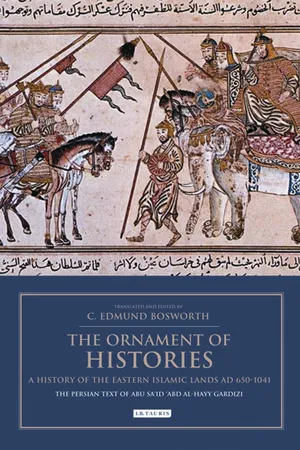
The Ornament of Histories: A History of the Eastern Islamic Lands AD 650-1041
The Persian Text of Abu Sa‘id ‘Abd al-Hayy Gardizi
- 192 pages
- English
- ePUB (mobile friendly)
- Available on iOS & Android
eBook - ePub
The Ornament of Histories: A History of the Eastern Islamic Lands AD 650-1041
The Persian Text of Abu Sa‘id ‘Abd al-Hayy Gardizi
About this book
Abu Sa'id 'Abd al-Hayy Gardizi was an author and historian living in the mid-eleventh century at the height of the Turkish Ghazvanid dynasty. His only known work, The Ornament of Histories ('Zayn al-akhbir'), is a hugely ambitious history of the Eastern Islamic lands AD 650-1041, spanning what is now Eastern Iran, Afghanistan and parts of the Central Asian Republics and Indo-Pakistan subcontinent. Gardizi's text is an extremely rare source of primary information about the rise of Islamic faith, culture and military dominance in these regions, and represents a significant contribution to our understanding of the early Islamic world. This is the first English translation of the original Persian text, and is accompanied by an introduction and commentary which details the historical, geographical and cultural context.
Information
PART ONE: THE ARAB GOVERNORS
[M 156]
[Chapter Ten] Concerning the Table of the Governors of Khurasan
In regard to the governors of Khurasan, in ancient times a different arrangement prevailed. From the time of Afrīdūn to that of Ardashīr Bābakān, there used to be one single military commander (sipāhsālār) for the whole [Persian] world. When Ardashīr came to power, he appointed four military commanders for the [Persian] world: one for Khurasan; one for the western lands (i.e. Fars and Khuzistan); one for Nīmrūz (i.e. Sistan); and one for Azerbaijan. He appointed four wardens of the marches (marzbāns) for Khurasan: one for Marw Shāyigān; one for Balkh and Tukhāristān; one for Transoxania; and one for Herat, Pūshang and Bādghīs.1 When the Muslims seized control of the Persian realm and Khurasan passed into the Muslims’ hands, all those customs and practices of the Magians (mughān) were swept away.
During the time of our Prophet, may God pray over him and grant him peace, the Muslims had not extended their domination over Khurasan, nor likewise in the caliphate of Abū Bakr Ṣiddīq, may God Most High be pleased with him. When ՙUmar, may God Most High be pleased with him, succeeded to the caliphate, he sent Khālid b. al-Walīd to the Persian lands to subdue them. When Khālid reached the plain of Qādisiyya, the Persian army advanced towards him on the orders of Yazdajird b. Shahriyār, and the commander of the army was Rustam b. Farrukh. A battle took place there, and the adherents of Islam were victorious. They defeated the Magians and made large numbers of them captive, selling them as slaves. Yazdajird fled and was killed at Marw Shāhigān. The Muslim forces entered Iraq (i.e. ՙIrāq-i ՙAjamī, western Persia) and continued onwards in the same fashion, continually conquering cities, till they reached Khurasan.
During ՙUmar’s caliphate, no-one penetrated as far as Khurasan. When ՙUthmān, may God be pleased with him, succeeded to the caliphate, he sent ՙAbdallāh b. ՙĀmir b. Kurayz to Khurasan. ՙAbdallāh b. ՙĀmir sent ՙAbdallāh b. Khāzim as commander of his advance guard. They (i.e. the Muslim troops) went by the Fars, [M 157] Kirman (text, Gurgān) and Ṭabasayn road.2 They subdued the Ṭabasayn, and the people of the Ṭabasayn became the first ones of Khurasan to become Muslims. After him, other governors kept coming and made various conquests, up to the present time.
I have set down here the names of each governor and the cities of each administrative region; the names of the caliphs during the time of their tenure of power; the duration of each governorship; and the date of the beginning of each governorship. I have put them into tabular form here so that the information may be more speedily found and more easily come to hand. The table is as follows:
[Here Gardīzī inserts his table, at H 93–8, M 157–9, with a total of seventy-six entries, from ՙAbdallāh b. ՙĀmir b. Kurayz to his patron the Ghaznavid Sultan ՙAbd al-Rashīd.]
[H 101, M 160]
Chapter Eleven Concerning the Historical Accounts of the Governors of Khurasan
I shall now relate the historical accounts concerning the governors of Khurasan in the same order as I set them down in the table. Success comes from God!
ՙAbdallāh b. ՙĀmir b. Kurayz
He was ՙAbdallāh b. ՙĀmir b. Kurayz b. Rabīՙa b. Ḥabīb b. ՙAbd Shams.3 ՙUthmān b. ՙAffān, may God be pleased with him, had made Abū Mūsā al-Ashՙarī governor of Basra, but he now took the charge away from him and gave it to ՙAbdallāh b. ՙĀmir, entrusting to him the governorship of Khurasan also. ՙAbdallāh b. ՙĀmir sent forward ՙAbdallāh b. Khāzim al-Sulamī as commander of his advance force. He set out for the Ṭabasayn via the route through Fars and Kirman and subdued the Ṭabasayn, their people becoming Muslims.
Other authorities relate that ՙAbdallāh b. ՙĀmir travelled to Qūmis and then to Gūyān (i.e. Juwayn) and halted there. Then [from] there he came to Āzādwār and made a peace agreement (i.e. with its people). He seized the daughter of Milḥān Gūyānī and presented her to ՙAbdallāh b. Khāzim as a wife. ՙAbdallāh had three sons by her, Muḥammad, Mūsā and Ṣāliḥ. ՙAbdallāh b. ՙĀmir came to Nishapur, accompanied by Aḥnaf b. Qays, Muhallab b. Abī Ṣufra and a group of the leading men of Basra. He subdued Quhistān, Abarshahr (i.e. Nishapur), Ṭūs and Sarakhs from amongst the towns of Khurasan in the year 29 [/649–50]. He sent Ḥātim b. al-Nuՙmān al-Bāhilī with a force of 4,000 Arabs and 1,000 Persians to attack the Hephthalites (Hayṭalān),4 and in the course of the fighting Aḥnaf was wounded in the head, and from that wound fluid ran down into his eyes. [H 102]
He built the fortress (dizh) of Aḥnaf (i.e. Qaṣr Aḥnaf) near Marw al-Rūd,5 and took the town of Marw al-Rūd on the basis of a peace agreement. ՙAbdallāh [M 161] b. ՙĀmir likewise made a peace agreement with the dihqān of Herat on the basis of a tribute of fifty purses of dirhams. When it was the year 31 [/651–2], he went off on the Pilgrimage and appointed Qays b. al-Haytham al-Sulamī as his deputy over Khurasan, but when ՙAbdallāh came to [the caliph] ՙUthmān, the latter kept him there in his own entourage.
Umayr b. Aḥmar al-Yashkurī
ՙUthmān then sent out Umayr b. Aḥmar as governor of Khurasan. Umayr sent Maՙmūr b. Sufyān al-Yashkurī to perform the Muslim worship in the citadel of Merv. He remained governor of Khurasan for some time. He established a policy of commandeering people’s houses for his troops and made it a customary practice. The reason for this was that Umayr b. Aḥmar had established himself at the gate of Merv in an encampment of tents. The weather became very cold, and the dihqāns of Merv feared that Umayr and his troops would perish from the cold. So they gave them accommodation in their own houses. But after several days had passed, they regretted what they had done and formulated the plan of seiz...
Table of contents
- Cover
- Title Page
- Dedication
- Contents
- Preface and Acknowledgements
- Abbreviations of Journals, etc., cited
- Introduction
- Translation of the Text
- Part One: The Arab Governors
- Part Two: The Tahirids and Saffarids
- Part Three: The Samanids
- Part Four: The Early Ghaznavids
- Notes
- Select Bibliography
- Indices
- eCopyrights
Trusted by 375,005 students
Access to over 1.5 million titles for a fair monthly price.
Study more efficiently using our study tools.
Frequently asked questions
Yes, you can cancel anytime from the Subscription tab in your account settings on the Perlego website. Your subscription will stay active until the end of your current billing period. Learn how to cancel your subscription
No, books cannot be downloaded as external files, such as PDFs, for use outside of Perlego. However, you can download books within the Perlego app for offline reading on mobile or tablet. Learn how to download books offline
Perlego offers two plans: Essential and Complete
- Essential is ideal for learners and professionals who enjoy exploring a wide range of subjects. Access the Essential Library with 800,000+ trusted titles and best-sellers across business, personal growth, and the humanities. Includes unlimited reading time and Standard Read Aloud voice.
- Complete: Perfect for advanced learners and researchers needing full, unrestricted access. Unlock 1.5M+ books across hundreds of subjects, including academic and specialized titles. The Complete Plan also includes advanced features like Premium Read Aloud and Research Assistant.
We are an online textbook subscription service, where you can get access to an entire online library for less than the price of a single book per month. With over 1.5 million books across 990+ topics, we’ve got you covered! Learn about our mission
Look out for the read-aloud symbol on your next book to see if you can listen to it. The read-aloud tool reads text aloud for you, highlighting the text as it is being read. You can pause it, speed it up and slow it down. Learn more about Read Aloud
Yes! You can use the Perlego app on both iOS and Android devices to read anytime, anywhere — even offline. Perfect for commutes or when you’re on the go.
Please note we cannot support devices running on iOS 13 and Android 7 or earlier. Learn more about using the app
Please note we cannot support devices running on iOS 13 and Android 7 or earlier. Learn more about using the app
Yes, you can access The Ornament of Histories: A History of the Eastern Islamic Lands AD 650-1041 by C. Edmund Bosworth in PDF and/or ePUB format, as well as other popular books in History & Middle Eastern History. We have over 1.5 million books available in our catalogue for you to explore.