Choice Outstanding Academic Title 2018
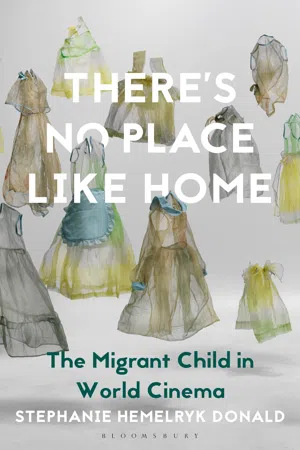
The Wizard of Oz brought many now-iconic tropes into popular culture: the yellow brick road, ruby slippers and Oz. But this book begins with Dorothy and her legacy as an archetypal touchstone in cinema for the child journeying far from home. In There's No Place Like Home, distinguished film scholar Stephanie Hemelryk Donald offers a fresh interpretation of the migrant child as a recurring figure in world cinema. Displaced or placeless children, and the idea of childhood itself, are vehicles to examine migration and cosmopolitanism in films such as Le Ballon Rouge, Little Moth and Le Havre. Surveying fictional and documentary film from the post-war years until today, the author shows how the child is a guide to themes of place, self and being in world cinema.
- 288 pages
- English
- ePUB (mobile friendly)
- Available on iOS & Android
eBook - ePub
About this book
Trusted by 375,005 students
Access to over 1.5 million titles for a fair monthly price.
Study more efficiently using our study tools.
Information
1
The Dorothy Complex
One
Emma Wilson has referred to the ‘missing child’ in cinema, and called for a ‘new [cinematic] politics of childhood’.1 The starting premise for my response to this is that Dorothy from The Wizard of Oz (1939) is an exemplary actor in the cinematic politics of childhood. Her role in a fantasy film, based on a fantasy book for children,2 acts out a version of mobility and homelessness that allows a certain kind of hope whilst revealing other, less positive feelings in the film’s text. ‘Dorothy’ is an agent more than a character. Her story is not one of character progression and individual fulfilment. Rather, she broaches different scales and types of childhood and child mobility: forced migration, fantasies of escape, quests and, simply, running away from home. Dorothy offers a rhetorical principle or framework of resonance; a structure of attention for seeing the cinematic child through one particular but recurrent, symptomatic trope – the intrepid, intrusive ‘orphan’ girl on the yellow brick road dancing and darting between home, arrival and return, girlhood and maturation – what I am calling the Dorothy Complex. Dorothy is a starting point for a discussion of child migration and cinema since 1939, drawing both on films that cite The Wizard of Oz directly and others that I have found easier to understand with the Ur-text in mind.
Dorothy Gale, from (Lynan) Frank Baum’s The Wonderful Wizard of Oz, first published in 1900, is a country girl, an orphan living with her uncle and aunt in impoverished Kansas. She is swept up in a tornado and deposited (with her farmhouse) in a fantastical land, which she shortly comes to discover is named Oz. On arrival she is immediately hailed a heroine as her house has landed, fatally, on the Witch of the East who was, as she is informed joyfully by the newly liberated Munchkins, a tyrant. Oz itself comprises many smaller lands, or regions, including Munchkinland and the Emerald City. Dorothy travels down the yellow brick road through these lands in order to achieve her immediate goal, namely to find her way back to Kansas. She achieves this goal, and lands back in the dingy sepia-toned Kansas muttering ‘There’s no place like home’. On her whirlwind visit to the Land of Oz Dorothy copes magnificently with the challenges of the foreign, the strange and the downright dangerous. Yet, despite her triumphs, she chooses to go home, and indeed everything she does in Oz she does in order to go home because Oz is, as Salman Rushdie has commented, ‘anywhere and everywhere’ but not ‘the place where we began’.3 Dorothy’s return to Kansas is a return migration to a place that will now be always disappointing but always formative to her being-in-the-world. It is not that she has really left home, but that home has been clarified, through the fantasy of travel, as both necessary and impossible.
The genesis of Baum’s original story was the Great Depression or ‘Panic’ of 1893 and pro-worker progressive politics of the late nineteenth century.4 Dorothy’s Kansas was a wasteland of poverty and low opportunity, but also a land ready for changes to working-class culture as the pre-1924 wave of new immigrants negotiated ways of being American and avoiding starvation. A magical escape to Oz would seem just the thing for a fairytale for American children of the era, while the political allegories embedded in the structure of the work would not go amiss for adult readers. In 1961 Henry Littlefield, in an article that has informed many subsequent analyses, noted that ‘Baum’s immortal American fantasy encompasses more than heretofore believed’.5 Littlefield pointed out that the plight of the Tin Woodman – to work harder and harder but without benefit to himself, and (when the rain sets in) to be rusted as though stilled by a localised great depression – is the plight of the working man in Baum’s America, while Dorothy is an exponent of mid-Western optimism – a remnant of the romance of happier economic prospects.6 Littlefield’s perceptions are important on two counts. First, his allegorical reading reminds us that the original book was a fairytale of its time and, second, he notes that Oz is not the panacea of the woes of Kansas, it is just a more sharply delineated version of its tragedy. The fairytale is in essence a fantasy of the real, through which direct political allegories but also indirect fantasies of the human condition can be communicated between generations. Perhaps not coincidentally, the 1939 film adaptation coincides with tail end of the deeper and longer Great Depression (1929–39) experienced by the next generation of Americans, with its great tornados of grit swirling out of the dust bowls that Kansas and other central and south-western states became. Millions left their barren farms, blown out by dust storms; ‘Toto,’ Dorothy says after the tornado sets her down ‘someplace where there isn’t any trouble’, ‘I’ve a feeling we’re not in Kansas anymore’. Littlefield’s allegorical interpretation does not argue against the queering of the 1939 film in the work of Alexander Doty and others; indeed the queering of the text is precisely what allows cinema to open up the wide terrain on which both Baum’s and Judy Garland’s Dorothy make their multiple claims on the cinematic imagination and the social imaginary.7
Oz may be claimed as pure fantasy or it may be termed a fantastic representation of Kansas, of America and of the possibility of the Other in Technicolor, but with the same cast of principal characters – just more dangerous, more exotic and yet, oddly, more manageable. Dorothy and the tempest from Kansas have more power than the wickedest witches in Oz. The Wicked Witch of the East is flattened by Dorothy’s falling house; the Wicked Witch of the West can be melted with a handy bucket of water. And, of course, this is Dorothy as portrayed by a 17-year-old Judy Garland – an actress already deemed by MGM as too womanly to be sufficiently childlike, too dangerously sexual for a family film. Garland’s breasts were therefore bound flat and her hair braided so that the filmic Dorothy offers the sign of girlhood, but also the barely disguised promise of the woman. This Dorothy is more delightful than Baum’s for the viewing adult, as the power of the child is excused in a barely disguised woman’s body, which is in turn reduced by the gaze of those who might see her as an available child. In a similar folded paradox, Oz is more excellent than Kansas, for Oz is a place where Dorothy, teenager/child/migrant, can take control, solve her problems and those of others, and leave with a click of her heels.
The present argument is not so much concerned with how we can understand the various manifest or latent intentions of the book or film however, but rather to question what they have wrought collectively and what they make possible in subsequent cinematic work on migration. In particular, I hope to explain in this opening chapter how Dorothy can be interpreted as an archetypal cinematic touchstone for the migrant child and how her presence registers as a signature in many films dealing with the reorientations (or queering) of global history since the end of the Word War II. Taking my cue from Salman Rushdie’s comments on Dorothy’s mantra, to whit: ‘There’s no place like home … except of course for the homes we make, or the homes that are made for us, in Oz; which is anywhere and everywhere, except the place where we began’,8 I argue that Dorothy’s prewar hopefulness returns within the traumatic narratives of postwar childhoods in Europe, China and Australia, specifically as such childhoods have included periods of forced migration, de-colonisation and re-colonisation. Dorothy’s signature, traced in the closing stages of pre-war Hollywood dreaming, loses its American specificity as it reappears across world cinema but gains a sense of the child at large in a brave new world. The idea of ‘signature’ I have borrowed from Giorgio Agamben’s work on method in the humanities. It is the performative movement in his methodological triplet: paradigm, signature and the archaeology of method itself.9 I use it here to indicate a lighter touch and a softer set of transcultural expectations than might be attached to the archetype alone, ‘the sign signifies because it carries a signature that necessarily predetermines its interpretation and distributes its use and efficacy according to rules, practices and precepts that it is our task to recognize.’10
An archetype generally assumes a pre-formed narrative trajectory pursued by a protagonist in a formal relationship with the verbal and written traditions of the culture in question. The resulting story has thus a synchronic coherence and depth of reference for readers or audience, while retaining a diachronic freshness to the specific tale or plotline. The archetype may also – and this has been argued to be the case in Chinese literature, an argument I borrow in the first instance for Chinese film – refer not so much to the forward motion and cyclical nature of pre-loved narratives as to a shared understanding of relationships, abstractions and non-narrative qualities of person or place, ‘movement and stillness, elegance and baseness, joy and sorrow, union and separation, harmony and conflict, … prosperity and decline’.11 Such relational archetypes may be described in film through quite simple narrational techniques, as I suggest below in regards to Ning Ying’s Railroad of Hope (2002), while the classic archetypal protagonist might be conveyed through character traits, plot choices, events and forms of closure.
A key archetype and one which has provided the most well-known ‘complex’ of European literary thought, and that touches both definitions, is the Oedipus myth. The Oedipus complex resonates with the Confucian horror of inappropriate relationships (its psychopathology forms the basis of the child’s murderous attacks on his mother in Zhang Yimou’s 1988 Ju Dou),12 as well as defining a European sense of impossible desire that simultaneously repels and attracts. The notion of a queered archetype manifesting the ur-form for the expression of childhood transitions is somewhat counterintuitive but, combined with the idea of signature, it begins to account for Dorothy’s returns in world cinema. Thus, I call the transnational reiteration of this signature the ‘Dorothy Complex’, by which I mean the various configurations of the character, relationships and narrative that make up the structure of fantasy that is ‘Dorothy’ in and beyond The Wizard of Oz. It is a structure of fantasy that we are tasked to ‘recognise’, however it is distributed across our cultural fields of identification. I further suggest that while the signature of Dorothy inscribes many films that attempt the scripting of maturation (the journey from child to adult), it is at its most intense when mapped onto narratives of migration. The recurrence of narrative patterns is then grounded in new specificities of space, time and movement, articulating the chronotopes of nationality and belonging, to account for both arrival and return and for multiple encounters along the way. As such, the Dorothy Complex provides a framework of resonance for cinematic fantasies of transition, migration and growing up across a complex world that is differentiated and yet intimately connected by the logic of movement. Dorothy, created in 1900 and filmed in 1910, 1912 and 1939, prefigures and valorises the child migrants of the post-World War II period.13 Her adventures and her persona are at the heart of a fantasy structure in cinema, reiterating both the impermanence and multiplicity of home.
To ground my claim for the Dorothy Complex as a facilitating signature-archetype for childhood transition, I simultaneously suggest that the migrant child is a major trope in world cinema. Reflecting my interest in the intense politicisation of both the category of childhood and of the child migrant, this move draws on the work of Chen Kuan-hsing, who has suggested ‘Asia’ as method – for him a geopolitical approach to re-framing perspectives and analyses of global change.14 Chen’s Asia-as-method (fangfa) is a key stage of the post-colonial project, whereby the global system of referential value re-positions Asia as central to its own narrative, and removes the West to the margins. I proffer childhood ‘as method’; however one does not want to make of this too perfect an analogy. Asia is not a child to the so-called West’s adult (although infantilisation – which is a different phenomenon – is a stratagem of racism and colonial management), but it is useful to understand Chen’s concept as a springboard from which to consider childhood as another valid, internally referential cultural and social system, one that is central to its own narrative and that removes adulthood to the margins; or one could term this a flattened ontology, as does cultural geographer Nicola Ansell in a powerful analysis of the macro and micro scales of global experience.15 The flattened ontology of childhood is a spatial-temporal construct, specific to the enunciation of childhood in academia, policy and in wider discourses of cultural value. It entails a horizontal re-scaling of experience for which the key points of reference are drawn from children’s lives and ontological capacities and affordances. The global, national, regional, local and familial are not excluded but they do not necessarily assume the same dimensions that they might in adult visions of pertinence and meaning. Fellow geographers Tisdall and Punch have expanded on Ansell’s intervention, nominating ‘becoming’ and ‘being’ as equivalent human conditions, and quoting director Ang Lee’s simple but socially radical perspective: ‘Lee (2001) … takes a predominantly historical approach … to argue that adults lack finished stability in terms of their working lives and intimate relationships. With adults in a perpetual search as human becomings, then children and young people are equally in this “age of uncertainty”.’16 This comment is a sociological plea to eschew the false dichotomy between childish being and adult being, and to refute the idea that children are ‘becoming’ while adults have ‘become’. The space of being where adult and child are most difficult to discern as useful, discrete or combined categories are the teenage years, when bodily development, social expectations and responsibilities and hormonal stresses are intense, creating an alternating state of being that is neither child nor adult.
In the cinematic realm the slippage between adult, teenager and child is performative and spectatorial, produced by both the sexual maturity implied in the actor’s (I use this as a gender neutral term) performance and through the ways in which the actor is perceived within the script. This perception is dominated by spectators who wish to read her (him) as sexually available without releasing the imagined power of adult over child. Such ambiguity is not necessarily unknowing or uncritical. It is central to films such as Ang Lee’s The Ice Storm (1997); and Lance Daly’s Kisses (2008), both featuring girls who are pre-pubescent but who reveal (in very different ways) close familiarity with sexual behaviours and dangers. In The Ice Storm, Wendy is a predator on a younger boy, while in, Kisses, Kylie is herself preyed on by older men, including close family members. The dilemma is in such scenarios of youthful desire on the one hand and implied carnal knowledge on the other.17 How are we to look at the...
Table of contents
- Cover
- About the Author
- Title Page
- Contents
- List of Figures
- Acknowledgements
- Introduction
- 1: The Dorothy Complex
- 2: The Red Balloon and Squirt’s Journey: story-telling with child migrants
- 3: Once My Mother, Welcome and Le Havre: breath and the child cosmopolitan
- 4: Little Moth and The Road: precarity, immobility and inertia
- 5: Landscape in the Mist
- 6: The Leaving of Liverpool: Empire and religion, poetry and the archive
- 7: Diamonds of the Night
- Afterword: where have all the children gone?
- Notes
- Bibliography
- Filmography
- Index
- eCopyright
Frequently asked questions
Yes, you can cancel anytime from the Subscription tab in your account settings on the Perlego website. Your subscription will stay active until the end of your current billing period. Learn how to cancel your subscription
No, books cannot be downloaded as external files, such as PDFs, for use outside of Perlego. However, you can download books within the Perlego app for offline reading on mobile or tablet. Learn how to download books offline
Perlego offers two plans: Essential and Complete
- Essential is ideal for learners and professionals who enjoy exploring a wide range of subjects. Access the Essential Library with 800,000+ trusted titles and best-sellers across business, personal growth, and the humanities. Includes unlimited reading time and Standard Read Aloud voice.
- Complete: Perfect for advanced learners and researchers needing full, unrestricted access. Unlock 1.5M+ books across hundreds of subjects, including academic and specialized titles. The Complete Plan also includes advanced features like Premium Read Aloud and Research Assistant.
We are an online textbook subscription service, where you can get access to an entire online library for less than the price of a single book per month. With over 1.5 million books across 990+ topics, we’ve got you covered! Learn about our mission
Look out for the read-aloud symbol on your next book to see if you can listen to it. The read-aloud tool reads text aloud for you, highlighting the text as it is being read. You can pause it, speed it up and slow it down. Learn more about Read Aloud
Yes! You can use the Perlego app on both iOS and Android devices to read anytime, anywhere — even offline. Perfect for commutes or when you’re on the go.
Please note we cannot support devices running on iOS 13 and Android 7 or earlier. Learn more about using the app
Please note we cannot support devices running on iOS 13 and Android 7 or earlier. Learn more about using the app
Yes, you can access There's No Place Like Home by Stephanie Hemelryk Donald in PDF and/or ePUB format, as well as other popular books in Médias et arts de la scène & Histoire et critique du cinéma. We have over 1.5 million books available in our catalogue for you to explore.