- 320 pages
- English
- ePUB (mobile friendly)
- Available on iOS & Android
eBook - ePub
About this book
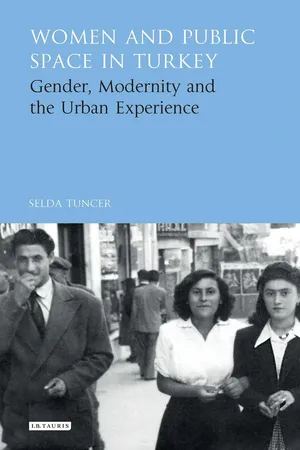
Turkey's process of `modernization' developed rapidly during the second half of the twentieth century. New social and legal reforms were institutionalized and political and economic changes located the country as a more liberated, `Western-style' society. Women and Public Space in Turkey provides a historical understanding of women's experiences of this modernization between 1950 and 1980, a vital period in which their participation in urban public life expanded through higher education and employment. Selda Tuncer examines the precise conditions that enabled women to leave the home and reveals how they perceived and experienced urban public space and social relations. Drawing on interviews with two generations of women from Ankara, and using personal family photographs, the book provides invaluable insights into women in a predominantly Muslim society who are living in a highly secular social context. Tuncer specifically focuses on women's everyday experiences and discusses how the relationship between women and public space was actually controlled and regulated by different notions of `domestication', especially in the micro-politics of daily life. The book sheds new light on the gendered processes of nation-building, socio-cultural transformations, and the crucial connections between gender, modernity and the urban experience in a non-Western context.
Information
CHAPTER 1
INTRODUCTION
This book is a social history of women in Ankara, the capital city of Turkey, between 1950 and 1980. It develops a critical feminist understanding of the Turkish modernity experience from the perspective of gender and space relations. Specifically, it explores how middle-class women from different generations experienced public spaces in their everyday lives. How, and in what ways, did they participate in modern public life in the birthplace of a newly founded nation-state?
One of the foundational aims of the Turkish modernisation process was to increase women’s access to public space. In order to achieve this, a series of legal reforms were undertaken, including the adoption of the Swiss Civil Code, the abolition of polygamy and women’s suffrage; there were also social reforms like a nationwide campaign for girls’ education. All these paved the way for women to enter education and work, which significantly improved their status in society and increased their participation in public life. The position of women in society, and their participation in public life, are topics that have been studied at length, but research exploring how women participated in the nascent public life of a modernising city – and in what ways they experienced public space and public culture in their everyday lives – constitute a small portion of the existing literature. The aim of this book is to explore women’s everyday access to and use of urban public space in diachronic perspective, with the main objective being to highlight women’s own accounts of it; that is, to understand how they perceive and relate to the public as ‘the outside world’ in its most inclusive sense and, equally important, how they interpret and narrate their experiences. The second goal of this book is to provide a comprehensive historical account of women’s lives and their relationship with public space. The importance of the historical approach lies in understanding the separation of private and public space, which is critical when examining how women experience and relate to such spaces. A historical analysis, according to Bondi and Domosh, will permit an understanding of ‘how and why these terms have been constructed in particular ways at certain key moments in the past, and that this understanding can illuminate what is at stake in contemporary constructions.’1
Needless to say, the notion of public space has attracted the attention of a wide range of disciplines and areas of inquiry, which consequently leads to diverse usages of the term so as to take into account different concerns and raise different issues. The term ‘public’ has several distinct but related meanings depending on the context within which it is used; most of these meanings are not directly related to space, but rather denote types of interaction and activity that are defined as distinct from both the state and the private realm of the home. Therefore, the dominant concept has become that of the public sphere ‘as the political site separate from, and often critical of, the state and economy’.2 However, this book frames the concept of public space – primarily with reference to spatial practices and everyday experiences – without neglecting the connections between the two concerning the inclusive and exclusive nature of the public realm. In other words, this book approaches women’s relationship with urban public space through the socio-spatial meanings attributed to it. It is assumed that perception influences the definition of public space, as well as the nature and structure of the institutions that regulate it. As Peter Goheen observes, citing Sharon Zukin, ‘the public has the power to decide what it finds acceptable and desirable’,3 and coming from this perspective will enable us to examine public space as a site of contested meanings, symbols and identities. Space and spatial arrangements can gain meaning and value through how they are perceived and experienced, although these processes of creating and negotiating meaning cannot be thought of as unrelated to identity construction and its implications. Identities are ‘constituted by and constitute the public spaces of the city.’4 Social actors of diverse ages, sexes, classes and races use urban public space for different purposes, and with different visions of society. Therefore, it would be more useful to conceive public space ‘as constituted by difference and inherently unstable and fluid’ rather than adopting Habermas’s notion of the public sphere as ‘a potential space for consensus, rationality and implicit homogeneity’.5 In this regard, everyday practices can serve as fruitful ground for studying the potency of public space. Prominent scholars like Lefebvre, de Certeau and Jacobs have all paid particular attention to the notion of the everyday and everyday life, considering this terrain as the link between the public realm and urban space.6 Since everyday practices beyond the control of state have subversive potential, they can engender and enforce change in various societal milieus; for this reason, there is need to develop a deep understanding of everyday life that follows ‘a more flexible and a more dynamic model’ of social and political agency.7
Given this framework, it is clear that the issue of when and how urban public space is used is of particular importance for understanding women’s engagements with the city. Since women and men are located differently in space, power cannot be considered independent of spatial relations, or indeed gender relations. The hegemonic spatial order is male and heterosexual, which (re)produces the exclusion and inequality of women. There are dominant spatial orderings in particular spaces that are mainly male and heterosexual, and which (re)produce the exclusion and inequality of women. This makes recording women’s behaviour in urban daily life crucial for understanding the nature of their access to and experience of public space. It should be emphasised that ‘urban’ is the key spatial scale through which gender is performed and constructed,8 yet to obtain a comprehensive picture of women in the city, it is important to explore women’s negotiation of access to, as well as their contestation of the spatial and gender boundaries of the male-built city environment. Although women face structural disadvantages in urban life, it also provides opportunities to contest and appropriate public space. As feminist scholar Elizabeth Wilson points out, the city should be considered as ‘a contradictory and shifting space which can be appropriated by women’.9 Contrary to commonly held assumptions in urban scholarship, women are not thoroughly excluded from urban space, as they take full advantage of various public and semi-public spaces, including streets, parks, cafes, department stores and other recreational areas. Examining the spatial patterns of women’s use of the city, and their behaviour in urban daily life, will contribute to an understanding of how they negotiate the contradictions and tensions built into the urban environment, as well as the everyday tactics and organised acts of resistance through which they proactively tackle inequality and (re)make urban public culture. Here, the focus on the everyday is especially important because women’s experiences of the urban reside in the everyday.10 Thus, this book is about the ordinary public places in which women’s various everyday spatial behaviours are carried out. In order to develop a comprehensive understanding, I will examine not only how urban public spaces are used and experienced by women, but also what kinds of gendered social relations they produce, as well as what kinds of meanings they inscribe in Turkish history.
In non-Western societies, whose experiences of modernity are distinctive, women’s relationship with public space becomes more critical since the project of modernisation has occurred in varying forms in such societies. In the case of Turkey, the equal participation of women and men in public life constitutes one of the foundational notions of the experience of modernity, which is certainly related to the fact that women were at the centre of its project of modernisation. With the first attempts to modernise the Ottoman Empire in the Tanzimat period (1839 – 1876) – framed as a project of Westernisation – the status of women, and relations between men and women, became one of the most important topics of discussion. With the transition from empire to secular republic in 1923, women became the national symbol of Westernisation, characterised as the carriers of culture and civilisation. In this context, the increasing access of women to the public realm has been considered as an indicator of the success of the Turkish modernisation project; it has thus also become a subject of focus in the academic arena. A significant body of literature has accumulated on the subject of women’s position in society, and their relationship with the public sphere, although the majority of these works have focused on the socio-economic and political aspects of gender relations. Only a limited number are concerned with the socio-spatial dimension; many of these have focused on domestic life and private space owing to the centrality of the house in the social order, and its designation as a female place.11 Although in feminist literature the act of exiting the home and participating in public life is often emphasised, and is always linked to women’s empowerment and emancipation, there is very little grounded research analysing under what conditions women leave the home and enter public space. Research that takes a broad approach to investigating women’s participation in urban public life, and in what ways they access and use public space in their everyday lives, still constitutes a small portion of the existing body of literature. This book provides a historical account of women’s lives and their experiences of public space, with particular emphasis on the conditions under which they exit the home. It thus contributes to debates about the urban experience and the gendered construction of the public and private realms, claiming that women’s relationship with public space is central to the nation-state ideology with its distinctive experiences in non-Western societies.
Moreover, this book departs from, while at the same time complementing, much of the scholarship on women in the Middle East, which has focused primarily on the presence of veiled women in public space, and which in turn has meant participation in public life was examined through the lens of religious doctrine and sanctions.12 These works have made a great contribution to discussions on the politics of public space, illustrating the tense relationship between modernity, Islam and women; however, there is a critical gap in the literature on how women are located within public space irrespective of the veil, and in what ways they enter, experience and appropriate public space and public culture in their everyday lives. Accordingly, this book intends to help fill this research gap by exploring how women in a predominantly Muslim society, while living in a highly secular social context, experience public space and public culture. The discussion of women in this particular group – that is, the traditional middle class, being educated and employed – uncovers the intermingling of modern lifestyles with inherited traditions and religious practices in everyday life. Most research examining urban middle-class women has concentrated on their participation in political, educational and professional life, on the assumption that they benefited first and foremost from the Republican reforms. This relates to the fact that existing studies of Turkish modernity have emphasised its macro-structural processes and dimensions, leaving aside the everyday life experiences that might shed light on the daily struggles of women to enter the public realm. In this regard, the book assumes that the impact of the Turkish modernity project can, by and large, be measured by penetrating the everyday lives of women, and should be read with particular focus on the micro-processes and practices of everyday life. Thus, this study provides invaluable insight into how the everyday urban public experiences of middle-class women from different generations were shaped by patriarchal traditions that produce certain social and moral codes of public behaviour that are intrinsic to both religious and secular ideologies.
It is important to note that the development of the middle class was an inherent part of the modernisation project and the construction of the nation-state in Turkey. The nation-building project assigned a special role to the state and state apparatuses, and so the historical development of the middle class went hand-in-hand with state-led modernisation.13 This was not unique to the Turkish experience of modernity, but was common among non-Western societies, especially in the Middle East. In his work linking the emergence of an urban middle class to the historical experience of modernity in the Eastern Mediterranean, Keith David Watenpaugh argues that ‘being modern and being middle class became intertwined, if not one and the same thing, in the consciousness and praxis of members of the emergent middle classes’.14 Indeed, in the case of the Turkish modernisation process, the formation of a national middle class was regarded as fundamental to the institutionalisation of the Republican reforms, along with the implementation of the national economy.15 Accordingly, the social engineering of the reformist state was intended to help create a middle class, while aiming to achieve a new and better society. Within the context of this nation-building process, in which the institution of the family – but specifically the middle-class family – was given a central place, both women and men were expected to consciously contribute, but urban middle-class women in particular occupied a central role, being responsible for putting gender ideology into practice and transmitting it to the next generations.
This investigation of women’s experience of urban public space is based in the capital city of Ankara, owing to its symbolic centrality in the process of Turkish modernisation. The socio-spatial significance of Ankara is that, having been named capital with the proclamation of the Republic, the city was an important component of its strategy towards a new nationalist ideal of Westernisation.16 Significantly, as Gönül Tankut emphasises, Ankara constituted the first and foremost example of the production process of public/ness and the model of public citizen in Turkish cities.17 In this context, the plan to transform Ankara into a modern city cannot be seen merely as a structural or spatial transformation; it should be regarded as the projection of the public individual and his/her spaces.18 This does not mean that there was no idea or experience of public/ness before the foundation of the Republic, but the significance of the Republican era as a continuation of the Tanzimat modernisation process lies in the fact that it led to the breaking of the community system of societal organisation and the emergence of civil society, and consequently urban planning, in Turkey.19 Therefore, Ankara can be considered fertile ground for exploring women’s experiences of public space and what kind of roles they played in the formation of contemporary Turkey’s urban public culture.
However, the great majority of the works on Ankara have concentrated on the early Republican period and the Second World War, such that very little is known about urban culture and daily life there from the 1950s onwards. By focusing on the period between 1950 and 1980, a more mature phase of the Turkish modernisation process comes to light. This three-decade span was one of the most crucial periods in both the political history and the urbanisation process of the Republic, during which cities underwent great transformations through increased industrialisation and enormous growth in both the size and population of cities. This period saw great changes in every domain of society, and was a turning point particularly for Turkey’s political regime and its economic relations. In 1950, the single-party system was replaced by a multi-party parliamentary democracy, with the success of the Democrat Party (DP) bringing to an end the rule of the Republican People’s Party (CHP). The new government, whose electoral success was based on overwhelming support from the peasantry and the private sector, quickly abandoned state-based development and the restrictions of a closed economy in favour of economic liberalism and integration with the global market. This process of liberalisation led also to an increasing dependency on the United States with the flow of American funds into Turkey. These changes in the economic and political realms put Turkey on a new path towards modernisation,20 and brought an abrupt end to the ideal of creating a national bourgeoisie. In contrast to the previous period, the DP’s understanding of modernity highlighted religious and traditional elements, and tended towards populism. Tekeli interpreted this transformation as a shift from ‘a radical modernity project’ that started with the foundation of the Republic and lasted until the 1950s, to ‘a populist modernity pr...
Table of contents
- Cover
- Title Page
- eCopyright
- Dedication
- Contents
- List of Figures
- Acknowledgements
- 1. Introduction
- 2. Women, Nation-State and Public Space
- 3. The Story of the Field
- 4. The Herstory of the City: Women’s Everyday Life inAnkara, 1950 – 1980
- 5. Going Public: Women’s Access to Public Space in Ankara
- 6. Women and Negotiated Spaces in Urban Everyday Life
- 7. Across Generations: Shifting Moralities and the Cost of Freedom
- 8. Conclusion
- Appendix
- Notes
- Bibliography
- Index
Trusted by 375,005 students
Access to over 1.5 million titles for a fair monthly price.
Study more efficiently using our study tools.
Frequently asked questions
Yes, you can cancel anytime from the Subscription tab in your account settings on the Perlego website. Your subscription will stay active until the end of your current billing period. Learn how to cancel your subscription
No, books cannot be downloaded as external files, such as PDFs, for use outside of Perlego. However, you can download books within the Perlego app for offline reading on mobile or tablet. Learn how to download books offline
Perlego offers two plans: Essential and Complete
- Essential is ideal for learners and professionals who enjoy exploring a wide range of subjects. Access the Essential Library with 800,000+ trusted titles and best-sellers across business, personal growth, and the humanities. Includes unlimited reading time and Standard Read Aloud voice.
- Complete: Perfect for advanced learners and researchers needing full, unrestricted access. Unlock 1.5M+ books across hundreds of subjects, including academic and specialized titles. The Complete Plan also includes advanced features like Premium Read Aloud and Research Assistant.
We are an online textbook subscription service, where you can get access to an entire online library for less than the price of a single book per month. With over 1.5 million books across 990+ topics, we’ve got you covered! Learn about our mission
Look out for the read-aloud symbol on your next book to see if you can listen to it. The read-aloud tool reads text aloud for you, highlighting the text as it is being read. You can pause it, speed it up and slow it down. Learn more about Read Aloud
Yes! You can use the Perlego app on both iOS and Android devices to read anytime, anywhere — even offline. Perfect for commutes or when you’re on the go.
Please note we cannot support devices running on iOS 13 and Android 7 or earlier. Learn more about using the app
Please note we cannot support devices running on iOS 13 and Android 7 or earlier. Learn more about using the app
Yes, you can access Women and Public Space in Turkey by Selda Tuncer in PDF and/or ePUB format, as well as other popular books in History & Middle Eastern History. We have over 1.5 million books available in our catalogue for you to explore.