- 290 pages
- English
- ePUB (mobile friendly)
- Available on iOS & Android
eBook - ePub
About this book
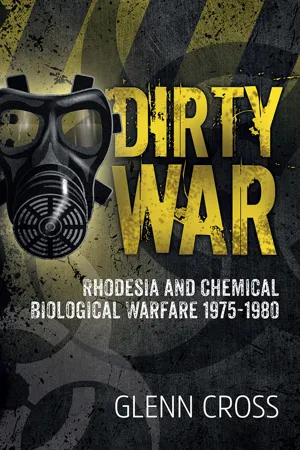
Dirty War is the first comprehensive look at the Rhodesia's top secret use of chemical and biological weapons (CBW) during their long counterinsurgency against native African nationalists. Having declared its independence from Great Britain in 1965, the government—made up of European settlers and their descendants—almost immediately faced a growing threat from native African nationalists. In the midst of this long and terrible conflict, Rhodesia resorted to chemical and biological weapons against an elusive guerrilla adversary. A small team made up of a few scientists and their students at a remote Rhodesian fort to produce lethal agents for use. Cloaked in the strictest secrecy, these efforts were overseen by a battle-hardened and ruthless officer of Rhodesia's Special Branch and his select team of policemen. Answerable only to the head of Rhodesian intelligence and the Prime Minister, these men working alongside Rhodesia's elite counterguerrilla military unit, the Selous Scouts, developed the ingenious means to deploy their poisons against the insurgents. The effect of the poisons and disease agents devastated the insurgent groups both inside Rhodesia and at their base camps in neighboring countries. At times in the conflict, the Rhodesians thought that their poisons effort would bring the decisive blow against the guerrillas. For months at a time, the Rhodesian use of CBW accounted for higher casualty rates than conventional weapons. In the end, however, neither CBW use nor conventional battlefield successes could turn the tide. Lacking international political or economic support, Rhodesia's fate from the outset was doomed. Eventually the conflict was settled by the ballot box and Rhodesia became independent Zimbabwe in April 1980. Dirty War is the culmination of nearly two decades of painstaking research and interviews of dozens of former Rhodesian officers who either participated or were knowledgeable about the top secret development and use of CBW. The book also draws on the handful of remaining classified Rhodesian documents that tell the story of the CBW program. Dirty War combines all of the available evidence to provide a compelling account of how a small group of men prepared and used CBW to devastating effect against a largely unprepared and unwitting enemy. Looking at the use of CBW in the context of the Rhodesian conflict, Dirty War provides unique insights into the motivation behind CBW development and use by states, especially by states combating internal insurgencies. As the norms against CBW use have seemingly eroded with CW use evident in Iraq and most recently in Syria, the lessons of the Rhodesian experience are all the more valid and timely.
Information
1
Rhodesia’s Deteriorating Security Environment
‘The more we killed, the happier we were. We were fighting terrorists’.1
Ian Smith, Rhodesian Prime Minister
Given the exhaustive treatment of the Rhodesian War elsewhere, this chapter is meant only to convey a broad understanding of Rhodesia’s deteriorating strategic situation as a backdrop to the Rhodesian CBW program. The rationale for Rhodesia’s adoption of chemical and biological weapons lies in the regime’s inability to defeat decisively a growing guerrilla insurgency through conventional arms alone. Although the Rhodesian Security Forces were able to dominate the conventional battlefield, the guerrilla forces continued to grow in size and capabilities. Other factors increased the stresses on the Rhodesian Security Forces as the conflict progressed: demands on the small European-origin population in Rhodesia for manpower and resources, and the economic constraints of internationally imposed sanctions, sapped the will of the white Rhodesians – leading to a net exodus from the country in the late 1970s. In early 1979, with the creation of Zimbabwe-Rhodesia – led ostensibly by Bishop Abel Muzorewa – the political consensus underpinning the legitimacy of Rhodesian rule began to unravel. Furthermore, international pressure for a settlement was mounting.
Following the collapse of Portuguese colonial rule in Mozambique, ZANLA established safe havens there – effectively opening a second front along Mozambique’s 1,200km-long border with Rhodesia.* These guerrilla safe havens in Mozambique outstretched the limited ability of Rhodesia’s small Security Forces to cope with the increasing threat, so the Rhodesians turned to unconventional techniques to combat the expanding threat. To understand the changing strategic environment facing the Rhodesian leadership, we need to briefly explore the evolution of the Rhodesian conflict.
The origins of the Rhodesian conflict
The origins of the Rhodesian conflict must be viewed in the overall context of British decolonization of Africa. World War II had been an enormous drain on Britain’s financial, material and manpower resources – making the post-war burden of maintaining its far-flung empire overwhelming and, ultimately, unsustainable. In 1960, the British Government adopted a policy of decolonization, as announced by British Prime Minister Macmillan in his ‘Wind of Change’ speech to the South African Parliament.2 By the mid-1960s, the British had granted Independence to most of their colonial possessions in Africa – including Ghana (1957), Guinea (1958), Nigeria (1960), Sierra Leone (1961), Tanganyika (1961, later Tanzania), Uganda (1962), Kenya (1963), Zambia (1964), Malawi (1964), The Gambia (1965), Botswana (1966) and Swaziland (1968).
At the time of Macmillan’s ‘Wind of Change’ speech, Southern Rhodesia was part of the Federation of Rhodesia and Nyasaland, which was created on 1 August 1953. The federation united the British protectorates of Northern Rhodesia (now Zambia), Nyasaland (now Malawi) and the self-governing colony of Southern Rhodesia (now Zimbabwe). In creating the federation, the United Kingdom sought to create an economically viable country resistant to socialist political influences, and yet capable of transitioning to eventual majority rule. Most of the political and economic power in the federation rested in the hands of Europeans living in Southern Rhodesia. Although the white settlers in Southern Rhodesia had pushed for an amalgamation of the three territories, the British Government would only agree to a federation under a UK-appointed colonial governor responsible for external relations, defense, the currency and intra-territorial issues. A federal prime minister governed the policies of the federation, but the territorial governments ruled each territory separately. Growing African resentment over the dominance of European politicians ruling from the federal capital at Salisbury fueled an emerging African nationalism that forced the dissolution of the Central African Federation (CAF) on 31 December 1963.
With the dissolution of the federation, the United Kingdom granted Independence under majority rule to Zambia and Malawi, but denied Rhodesia Independence until agreement on a mechanism for eventual majority rule was reached. Even after the collapse of the CAF, Rhodesian politicians claimed that the United Kingdom had promised Independence to Rhodesia in exchange for Salisbury’s acquiescence to the dissolution of the federation. They labeled Britain’s refusal to grant Rhodesian Independence as a betrayal of the purported promise – and as unjust in the face of Zambian and Malawian Independence. When British officials countered that majority rule was a prerequisite for Independence, Rhodesians argued that, as a self-governing and self-financing colony, London had no right to dictate the terms of Independence to Rhodesia.
Rhodesia’s failure to gain a negotiated Independence from Great Britain led to increasing domestic pressures for the Unilateral Declaration of Independence (UDI). Although London and Salisbury continued to negotiate about Rhodesia’s Independence, neither side could find an acceptable middle ground. The British position was that Independence was contingent on agreement regarding a process that would move Rhodesia to majority rule; the Rhodesian position was that Britain should grant Independence based on Rhodesia’s 1961 constitution, which guaranteed a privileged position for the European minority for the foreseeable future. With both sides firmly entrenched – and no compromise in sight – the Rhodesian Cabinet signed the UDI on 11 November 1965. Britain immediately declared Rhodesia’s UDI illegal; London announced that the colony was in rebellion and presented its case to the United Nations Security Council, which also condemned the Rhodesian action. Later, after declaring Rhodesia’s UDI to be a threat to international peace, the United Nations announced international sanctions against Rhodesia. Over the next decade, the sanctions themselves were largely ineffectual as long as Mozambique and South Africa continued to trade with Rhodesia. Rhodesia also mounted highly successful (albeit costly) sanctions-busting operations. Through most of the period from 1965 to the mid-1970s, the Rhodesian economy prospered and productivity grew, as did personal incomes (for at least the European population). Until the late 1970s, taxes remained low and the standard of living for the European population remained relatively high, despite shortages of some imported luxury goods. The global recession that hit the world economy in the late 1970s; the closure of the Mozambique border to trade after the Portuguese withdrawal in 1974; and South African manipulation of Rhodesian trade all combined to have a more serious impact on the Rhodesian economy and warfighting abilities than did the UN sanctions.
Before Rhodesia’s Declaration of Independence, the African nationalist leaders in Rhodesian detention met with British Prime Minister Harold Wilson in 1965. At that meeting, Wilson responded negatively when African leaders asked if London was prepared to use military force to retain its control of Rhodesia. Failing to garner any assurances from Wilson, the African nationalist leadership was convinced about the inevitability of the UDI.3 Wilson reportedly offered the nationalist leaders a gradual transition to majority rule, which was unacceptable in light of the African leaders’ demands that Britain immediately – and unconditionally – impose majority rule in Rhodesia by force if necessary.4
The first phase of the conflict (1965 to 1969)
Unable to organize any effective resistance, the immediate reaction of the African nationalist parties* to the UDI was muted.5 The African uprising in Rhodesia – anticipated by the nationalist leaders in response to the UDI – did not materialize.6 According to the BSAP history:
whilst there was no reaction initially, nationalist violence flared up in different parts of the country after a few days and ineffectual attempts were made to promote a ‘general strike.’ The situation quickly returned to normal due to the lack of organisation amongst the nationalists at large in Rhodesia, their poor lines of communication with the ‘north’ and the general lack of ‘second string’ leaders.7
Despite their opposition to the UDI, the nationalist leadership faced limited options.8 The first strategy adopted by the nationalist leaders was to employ cadres trained overseas9 to conduct operations aimed at disrupting law and order in Rhodesia; to terrify the white population; and to ignite a ‘wave of civil disorder by the Blacks’.10 The purpose behind these attacks was to demonstrate to London and Salisbury that the Rhodesian authorities were incapable of protecting the populace from these terrorist tactics – thereby forcing Britain to retake control of the colony and grant immediate majority rule.
Early in the conflict, the nationalists grossly underestimated the capabilities of the BSAP to respond to the small numbers of guerrillas sent on sabotage and terror missions inside Rhodesia. In 1965, the BSAP successfully dismantled the ZANU network tasked with launching a large-scale terrorist campaign targeted mainly against Rhodesia’s urban centers.
The Rhodesians had effectively emasculated guerrilla capabilities inside Rhodesia, as described in a BSAP chronology:
In May 1965, pre-emptive arrests of most of the 38 Z.A.N.U. terrorists, trained in Ghana and returning to Rhodesia by legitimate means via various ports, forestalled a plan by Ndabaningi Sithole to bring about wide-scale terrorism and sabotage in Rhodesia with special emphasis on the urban areas. The arrest of Russian trained Z.A.P.U. intelligence agent and leading party member Edward Bhebe, in Bulawayo in July 1965, led to the further arrest of 18 Z.A.P.U. saboteurs who had successfully infiltrated the country by various means.11
Based on their previous experiences, the Rhodesians expected that the African nationalist strategy would remain focused on disrupting law and order – a strategy that the Rhodesian authorities were well equipped to combat. The Rhodesians accurately perceived that the African nationalists were unprepared to conduct a general insurgency at this stage:
The Africans were not organized for serious insurrection, having depended on world opinion, British intercession, and the winds of change … If the nationalists had switched tracks to immediate and widespread terror, assassination, and orchestrated chaos, perhaps the Europeans might have given way or the timid fled or the British been forced to intervene, albeit reluctantly. The nationalists, however, were not organized for such an effort, did not at first perceive the necessity, and instead followed an ultimately self-defeating source of moderate disorder that could be repressed and that led to even greater African frustration.12
By 1966, the nationalists concluded that the British would not forcibly wrestle control of the colony from the Rhodesian authorities. This realization led the nationalists to adopt a new strategy, 13 which was based on the belief that the nationalists would have to seize control of Rhodesia if they wanted to transform the country into an Ind...
Table of contents
- Cover
- Title
- Copyright
- Dedication
- Contents
- List of Figures
- Credits for Figures
- Preface
- Acknowledgments
- List of Terms and Abbreviations
- Maps
- Introduction
- 1. Rhodesia’s Deteriorating Security Environment
- 2. The Rhodesian CBW Effort
- 2. The Rhodesian CBW Effort
- 3. South Africa’s Role in Rhodesian CBW
- 4. Rhodesian Anthrax Outbreak
- 5. Lessons and Legacy
- Appendices
- Bibliography
Trusted by 375,005 students
Access to over 1.5 million titles for a fair monthly price.
Study more efficiently using our study tools.
Frequently asked questions
Yes, you can cancel anytime from the Subscription tab in your account settings on the Perlego website. Your subscription will stay active until the end of your current billing period. Learn how to cancel your subscription
No, books cannot be downloaded as external files, such as PDFs, for use outside of Perlego. However, you can download books within the Perlego app for offline reading on mobile or tablet. Learn how to download books offline
Perlego offers two plans: Essential and Complete
- Essential is ideal for learners and professionals who enjoy exploring a wide range of subjects. Access the Essential Library with 800,000+ trusted titles and best-sellers across business, personal growth, and the humanities. Includes unlimited reading time and Standard Read Aloud voice.
- Complete: Perfect for advanced learners and researchers needing full, unrestricted access. Unlock 1.5M+ books across hundreds of subjects, including academic and specialized titles. The Complete Plan also includes advanced features like Premium Read Aloud and Research Assistant.
We are an online textbook subscription service, where you can get access to an entire online library for less than the price of a single book per month. With over 1.5 million books across 990+ topics, we’ve got you covered! Learn about our mission
Look out for the read-aloud symbol on your next book to see if you can listen to it. The read-aloud tool reads text aloud for you, highlighting the text as it is being read. You can pause it, speed it up and slow it down. Learn more about Read Aloud
Yes! You can use the Perlego app on both iOS and Android devices to read anytime, anywhere — even offline. Perfect for commutes or when you’re on the go.
Please note we cannot support devices running on iOS 13 and Android 7 or earlier. Learn more about using the app
Please note we cannot support devices running on iOS 13 and Android 7 or earlier. Learn more about using the app
Yes, you can access Dirty War by Glenn Cross in PDF and/or ePUB format, as well as other popular books in History & 20th Century History. We have over 1.5 million books available in our catalogue for you to explore.