An account of the little-known involvement of Royal Marines as they engaged the new Bolsheviks immediately after the Russian Revolution.
After three years of great loss and suffering on the Eastern Front, Imperial Russia was in crisis and on the verge of revolution. In November 1917, Lenin's Bolsheviks (later known as "Soviets") seized power, signed a peace treaty with the Central Powers and brutally murdered Tsar Nicholas (British King George's first cousin) and his children so there could be no return to the old order. As Russia fractured into loyalist "White" and revolutionary "Red" factions, the British government became increasingly drawn into the escalating Russian Civil War after hundreds of thousands of German troops transferred from the Eastern Front to France were used in the 1918 "Spring Offensive" which threatened Paris. What began with the landing of a small number of Royal Marines at Murmansk in March 1918 to protect Allied-donated war stores quickly escalated with the British government actively pursuing an undeclared war against the Bolsheviks on several fronts in support of British trained and equipped "White Russian" Allies.
At the height of British military intervention in mid-1919, British troops were fighting the Soviets far into the Russian interior in the Baltic, North Russia, Siberia, Caspian and Crimea simultaneously. The full range of weapons in the British arsenal were deployed including the most modern aircraft, tanks and even poison gas. British forces were also drawn into peripheral conflicts against "White" Finnish troops in North Russia and the German "Iron Division" in the Baltic. It remains a little-known fact that the last British troops killed by the German Army in the First World War were killed in the Baltic in late 1919, nor that the last Canadian and Australian soldiers to die in the First World War suffered their fate in North Russia in 1919 many months after the Armistice.
Despite the award of five Victoria Crosses (including one posthumous) and the loss of hundreds of British and Commonwealth soldiers, sailors and airmen, most of whom remain buried in Russia, the campaign remains virtually unknown in Britain today. After withdrawal of all British forces in mid-1920, the British government attempted to cover up its military involvement in Russia by classifying all official documents. By the time files relating to the campaign were quietly released decades later there was little public interest. Few people in Britain today know that their nation ever fought a war against the Soviet Union. The culmination of more than 15 years of painstaking and exhaustive research with access to many previously classified official documents, unpublished diaries, manuscripts and personal accounts, author Damien Wright has written the first comprehensive campaign history of British and Commonwealth military intervention in the Russian Civil War 1918-20.
"Allied intervention in the Russian Civil War remains forgotten. Wright's book addresses that oversight, interspersing the broader story with personal accounts of participants." —
Military History Magazine
eBook - ePub
Churchill's Secret War With Lenin
British and Commonwealth Military Intervention in the Russian Civil War, 1918–20
- 576 pages
- English
- ePUB (mobile friendly)
- Available on iOS & Android
eBook - ePub
Churchill's Secret War With Lenin
British and Commonwealth Military Intervention in the Russian Civil War, 1918–20
About this book
Information
Topic
HistoriaSubtopic
Historia del siglo XXPart I
North Russia: Murmansk (‘SYREN’ FORCE) 1918–19
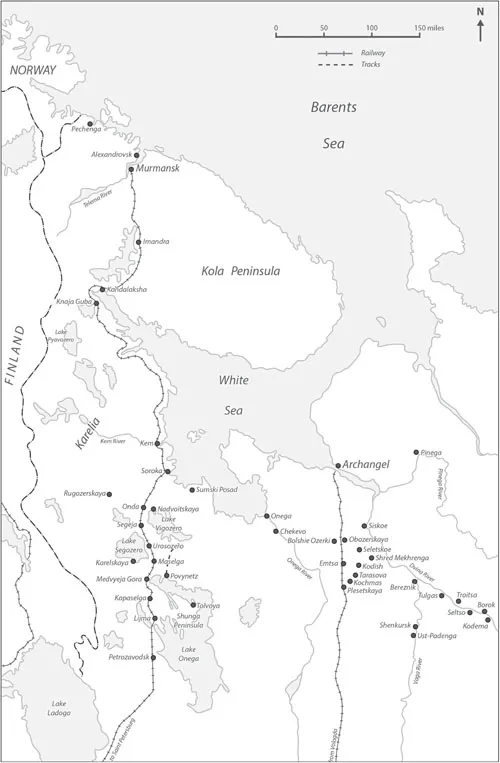
Map 1. North Russia, 1918–19
1
Murmansk: Operations in Karelia, March 1918–January 1919
The first landing of British troops on Russian soil was, quite ironically as it turned out, at the request of a local soviet council. In a confused series of events the Bolsheviks mistakenly believed that peace talks had broken down with Germany at Brest-Litovsk and that the Germen envoy was refusing to sign the treaty. This revelation, if proven to be true, would consequently mean that Germany could carry out its threat to advance eastwards from Finland (where thousands of German troops were based) towards Murmansk. The Murmansk soviet, fearing German attack on the town, requested that the Allies land troops to help in its defence.
Also at stake was the vital Murmansk–Petrograd Railway, the only link with the then Russian capital. From Moscow Commander of the Red Army Trotsky sent a telegram to the Murmansk soviet stating, ‘The peace negotiations have apparently broken off. It is your duty to do everything to protect the Murmansk Railway … You must accept any and all assistance from the Allied missions.’1
The commander of the Murmansk soviet, Alexei Mikhailovich Yuryev, probably viewed this message with a certain amount of relief. A former ship’s stoker and revolutionary, he was by no means a servient Bolshevik, and was independently minded and sometimes clashed on ideas with Moscow. Critical for the defence of Murmansk was that along with Allied help would come Allied troops and along with Allied troops would come desperately needed arms and supplies. In a reply to Bolshevik Foreign Commissar Chicherin, Yuryev wrote, ‘Can you supply the region with food, which we are now lacking, and send us a force sufficient to carry out your instructions? If not, there is no need to lecture us. We ourselves know that Germans and Allies are imperialists, but of the two evils, we have chosen the lesser.’2
The Allies feared that if the Germans captured Murmansk they would have a ready made U-boat base from which the shipping lanes of the North Atlantic could be menaced unhindered, as the U-boats would not have to pass through the North Sea, heavily blockaded by Allied warships. It would have been politically disastrous if these troopships were sunk.
In February 1918 commander of the Royal Navy White Sea Squadron, Rear Admiral Thomas Kemp CB, CMG, CIE, Royal Navy (RN), requested an expeditionary force of 6, 000 men to ensure the security of Murmansk. His request was denied as at the time every able-bodied man was needed on the Western Front. On 2 March the local soviet met with Kemp and a French Army captain to agree on the defence of Murmansk. It is questionable if Trotsky alone authorised Yuryev to ask for Allied help and allow a landing of foreign troops, but regardless, the telegram to the Murmansk soviet was later used as evidence in his trial under Stalinist rule.
Since the beginning of the First World War there had always been one of His Majesty’s ships stationed in the Arctic to patrol shipping lanes and sweep for mines. The first British ship sent to North Russia was the battleship HMS Jupiter, followed by cruiser HMS Vindictive and battleship HMS Glory, which had been sent to Murmansk in the winter of 1917–18 to act as guard ship for the port.
In January 1915 the Admiralty had received a request from the Imperial Russian government for assistance in the form of an ice breaking ship to keep the Arctic sea passage to Archangel via the White Sea open during the winter months. The Russian icebreaker had broken down and could not be repaired for some time.
HMS Jupiter (Captain Drury St. Aubyn Wake, RN) was a Tyne Guard ship, an old Majestic Class battleship that had been commissioned in 1895. Having left the UK for Archangel on 5 February 1915, Jupiter freed several ships in the White Sea that had been trapped in the ice. On several occasions Jupiter herself became icebound en route to Archangel. One of the merchant ships freed from the ice on 2 April was the SS Thracia, filled to the brim with vital war material for the Russian Army. The crew of Jupiter received a salvage bounty for the rescue, and remained stationed in the White Sea until May 1915 when the repaired Russian icebreaker resumed its post. The Tsar was extremely thankful for the efforts of Jupiter’s crew and awarded Imperial Russian orders to the ship’s officers and the Medal of Zeal to her crew.3
Murmansk was little more than a frontier town in 1918.The port had been founded at the request of the British government in September 1915 to receive Allied arms and supplies to support Russia’s war against the Central Powers on the Eastern Front.The town was constructed with British financial and technical assistance on the site of an existing fishing village and was initially named ‘Romanov’ in honour of the Tsar. The workers were mainly Chinese and Korean labourers but thousands of German and Austro-Hungarian prisoners of war were used as forced labour to construct a railway from Murmansk to Petrograd, many of the prisoners dying of starvation and disease in the process.It was said that a man died for every sleeper of the railway laid. Neither Murmansk township nor the railway were completed before the Tsar’s abdication in 1917.
Due to the Gulf Stream Murmansk is ice-free year round whereas the only other port available to the Allies in European Russia, Archangel on the White Sea, is ice bound five months of the year.Even if Archangel was not encumbered by winter ice, it did not have the manpower, facilities or railways to effectively distribute the supplies it received. By the end of 1917 there were 12, 000 tonnes of explosives and 200, 000 tonnes of war supplies (which could have been put to good use by the desperately pressed Allies in France) lying exposed and rotting in and around Archangel’s Solombola dock. At Murmansk, in 1916 alone over 600 ships landed more than one million tonnes of coal and over one and a half million tonnes of war supplies at Murmansk harbour but in the process lost 36 ships to U-boat attack. Nearly five million tonnes of war supplies were delivered to Russia by the Arctic convoys in the First World War, one million tonnes more than in 1939–45.
On 6 March 1918, a party of 130 Royal Marines and handful of sailors commanded by Major Henry Fawcett, Royal Marine Light Infantry (RMLI), disembarked at Murmansk harbour from HMS Glory. The battleship was the flagship of the British squadron in the Arctic commanded by Rear Admiral Kemp.The Marines marched into the town to an old log cabin that had been previously occupied by Russian sailors. They spent the next few weeks doing little more than repairing damage to their quarters and generally cleaning up the area as the sailors had left it in poor condition.
Reports received by Admiral Kemp of Germans advancing across the frontier towards Murmansk convinced the Admiralty that a threat to the town was imminent. Accordingly the cruiser HMS Cochrane (Captain James Farie, RN) was detached from the Grand Fleet to Murmansk whilst the French sent cruiser Amiral Aube and the United States cruiser USS Olympia to reinforce Kemp’s Arctic Squadron.
Already in Murmansk harbour were Russian battleships Chesma and Askold, though through poor maintenance and upkeep both ships were unseaworthy, the Chesma partially aground. The Askold had an interesting history. It had narrowly escaped destruction in the Russo–Japanese war of 1905 and in 1915 was sent to the Dardanelles to participate in the Gallipoli campaign. After the failure at Gallipoli, Askold was sent to Toulon and then Devonport for refitting. Whilst in Toulon, Russian exiles living in France influenced the crew and upon arrival at Murmansk Askold’s crew mutinied, murdered the ship’s captain and imprisoned its officers, right under the nose of the British ships in the harbour. This incident led to the other Russian ships in the harbour, including Chesma, following suit. Through them utineers’ neglect over the following weeks the commandeered ships became increasingly unseaworthy, however their guns remained serviceable, and that along with several hundred mutinous Russian sailors meant that the ships posed a real threat to the security of Kemp’s squadron.
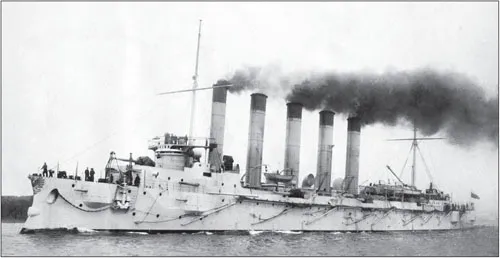
1. Distinctive five-funnelled Russian cruiser Askold. Having seen service during the Russo–Japanese war of 1905 and in the Pacific and Mediterranean 1914–17, Askold was seized by the British at Murmansk and rechristened HMS Glory IV. (Public domain)
Across the border from Murmansk, Red and White Finns had been engaged in a three month struggle for power in which the Whites had emerged as victors. The Red Finns however were by no means beaten and bands of Red Finns continued to harry the Whites from within Finland. In April1918, German-backed White Finnish troops pushed a band of Red Finns across the frontier into Russian Karelia. At request of Murmansk soviet leader Yuryev, Royal Marines from HMS Cochrane were despatched south along the Kola Inlet to the town of Kandalaksha.The presence of the improvised armoured train carrying the Marines was enough to dissuade the White Finns from pursuing any further and they fled back across the border. No shots were fired and there were no casualties.
Two weeks later Marines and sailors from HMS Cochrane fought the first British action during military intervention in the Russian Civil War. On 2 May the Murmansk soviet learned that a party of White Finns had captured Pechenga on the northern coast of the Murman Peninsula. It was feared that the White Finns would hand the town over the German forces advancing from Finland who would use the bay as a U-boat base. Admiral Kemp ordered Cochrane north to land 40 Marines under the command of Captain Vincent Brown, Royal Marine Artillery (RMA), a veteran of operations on the Western Front with the Royal Marines’ siege guns, and an additional 100 British sailors and 40 Red Guards from Murmansk under Commander John Scott, RN, who would be awarded the DSO for his command of the defence of Pechenga.
The Red Guards were immediately despatched with two Maxim guns to occupy the three villages at the head of the Kola Inlet a few kilometres from Pechenga. Fifteen civilians with local knowledge were recruited as ‘frontiersmen’, expert trackers and skiers, to assist the Allied force and a running fight with the White Finns ensued. The Finns were excellent soldiers and were well camouflaged against the snow in white smocks. Equipped with skis, they were able to move much quicker than their opponents and initially forced the Marines and sailors from Cochrane to retreat.
On 6 May the Allied force at Pechenga was bolstered by the arrival of 35 Marines from HMS Glory with a Lewis gun section whilst 30 sailors returned to Cochrane taking with them a handful of White Finnish prisoners that had been captured. A naval 12 pdr was also landed with a naval crew from Cochrane. The White Finns used the only telephone line in the area for communications and the Marines were able to tap into it and with the help of local interpreters were able to discover their plans. The Marines went into action again on 8 May, Captain Brown and his men on sleighs and the frontiersmen on skis. Arriving at Lake Variema at 1500 and using information acquired on the telephone line and translated by the frontiersmen, the party set off for the Gubernatorski River, White Finnish scouts withdrawing as they approached.
In the early hours of the morning the small force reached the river and hut around which the enemy were camped.The Finns came rushing out of the house and the surrounding area.The Marines left their sleighs and advanced in open order, two lines of 15 men 10 paces apart with a Lewis gun on each flank.The Ross rifles that the Marines had been issued were frozen from the trip but the Lewis guns performed excellently. The Finnish force, numbering about 200, advanced under covering fire on the flanks on skis forcing the Marines to retire. The local reindeer sleigh drivers would have fled the oncoming Finns leaving the Marines stranded had it not been for the quick thinking of a Marine corporal who threatened to shoot the drivers if they moved. As the Marines reached the sleighs the Finns were only 100 yards distant, the Finns were apparently wary of the Lewis guns and did not continue their pursuit. As the Marines headed back to Pechenga they encountered the Royal Navy landing party and the remaining 40 Marines marching towards the location of the skirmish. Upon hearing the gunfire Commander Scott had headed out to reinforce Captain Brown’s party only to encounter ...
Table of contents
- Cover
- Title
- Copyright
- Dedication
- Contents
- List of Acronyms for Military Units and Formations
- Acknowledgements
- Foreword
- Introduction
- Part One: North Russia: Murmansk (‘SYREN’ FORCE) 1918–19
- Chapter 1. Murmansk: Operations in Karelia, March 1918–January 1919
- Chapter 2. Murmansk: General Maynard’s Offensive, February–April 1919
- Chapter 3. Murmansk: Railway Offensive, May–July 1919
- Chapter 4. Murmansk: Lake Onega Operations, June–September 1919
- Chapter 5. Murmansk: Final operations, August–October 1919
- Part Two: North Russia: Archangel (‘ELOPE’ FORCE) 1918–19
- Chapter 6. Archangel: Occupation and Operations August 1918–September 1919
- Chapter 7. Archangel: Dvina River Front September–December 1918
- Chapter 8. Archangel: Railway Front September 1918–September 1919
- Chapter 9. Archangel: Vaga River Front January–September 1919
- Chapter 10. Archangel: Dvina River Front January–June 1919
- Chapter 11. Archangel: Dvina River Front June–July 1919
- Chapter 12. Archangel: Dvina River Front August 1919 offensive
- Chapter 13. Archangel: Dvina River Front September 1919: Final Operations
- Part Three: Russia 1918–20: Campaigns on other fronts
- Chapter 14. Siberia: April 1918–February 1920
- Chapter 15. Eastern Baltic: December 1918–December 1919
- Chapter 16. South Russia and Crimea: November 1918–May 1920
- Chapter 17. Turkestan and Caspian: August 1918–May 1920
- Chapter 18. Spies and Secret Agents: November 1917–August 1918
- Chapter 19. Moscow Prisoners of War: August 1918–October 1920
- Appendices
- II British and Commonwealth Known Prisoners of War of the Soviets
- III Roll of Australians known to have served in Russia 1918–20
- IV Roll of South Africans & Rhodesians known to have served in Russia 1918–20
- V Roll of New Zealanders known to have served in Russia 1917–20
- VI NREF Order of Battle including Allied Contingents, 15 December 1918
- VII Allied Dispositions Archangel Command, Midnight 9 August 1919
- VIII His Majesty’s Ships, North Russia, March 1918–October 1919
- IX British Forces in North Russia, March 1918–October 1919
- X His Majesty’s Ships, RN Eastern Baltic Fleet December 1918–December 1919
- XI Participants in the Raid on Kronstadt Harbour, 18 August 1919
- Bibliography
Trusted by 375,005 students
Access to over 1.5 million titles for a fair monthly price.
Study more efficiently using our study tools.
Frequently asked questions
Yes, you can cancel anytime from the Subscription tab in your account settings on the Perlego website. Your subscription will stay active until the end of your current billing period. Learn how to cancel your subscription
No, books cannot be downloaded as external files, such as PDFs, for use outside of Perlego. However, you can download books within the Perlego app for offline reading on mobile or tablet. Learn how to download books offline
Perlego offers two plans: Essential and Complete
- Essential is ideal for learners and professionals who enjoy exploring a wide range of subjects. Access the Essential Library with 800,000+ trusted titles and best-sellers across business, personal growth, and the humanities. Includes unlimited reading time and Standard Read Aloud voice.
- Complete: Perfect for advanced learners and researchers needing full, unrestricted access. Unlock 1.5M+ books across hundreds of subjects, including academic and specialized titles. The Complete Plan also includes advanced features like Premium Read Aloud and Research Assistant.
We are an online textbook subscription service, where you can get access to an entire online library for less than the price of a single book per month. With over 1.5 million books across 990+ topics, we’ve got you covered! Learn about our mission
Look out for the read-aloud symbol on your next book to see if you can listen to it. The read-aloud tool reads text aloud for you, highlighting the text as it is being read. You can pause it, speed it up and slow it down. Learn more about Read Aloud
Yes! You can use the Perlego app on both iOS and Android devices to read anytime, anywhere — even offline. Perfect for commutes or when you’re on the go.
Please note we cannot support devices running on iOS 13 and Android 7 or earlier. Learn more about using the app
Please note we cannot support devices running on iOS 13 and Android 7 or earlier. Learn more about using the app
Yes, you can access Churchill's Secret War With Lenin by Damien Wright in PDF and/or ePUB format, as well as other popular books in Historia & Historia del siglo XX. We have over 1.5 million books available in our catalogue for you to explore.