A biography of a British pilot set against the backdrop of the Royal Navy's fight to regain control of its aviation after the First World War.
The establishment of the RAF came at a cost—and it was the Royal Navy that paid the price. In 1918 it had been pre-eminent in the technology and tactics of employing aircraft at sea, but once it lost control of its own air power, it struggled to make the RAF prioritize naval interests, in the process losing ground to the rival naval air forces of Japan and the United States.
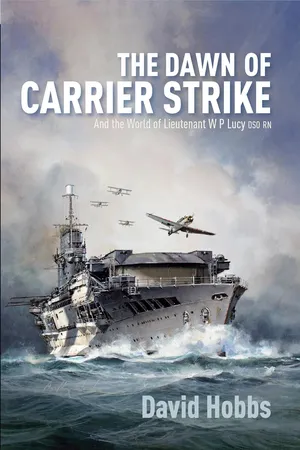
This book documents that struggle through the cash-strapped 1920s and '30s, culminating in the Navy regaining control of its aviation in 1937, but too late to properly prepare for the impending war. However, despite the lack of resources, British naval flying had made progress, especially in the advancement of carrier strike doctrine. These developments are neatly illustrated by the experiences of Lieutenant William Lucy, who was to become Britain's first accredited air 'ace' of the war and to lead the world's first successful dive-bombing of a major warship. Making extensive use of the family archive, this book also reproduces many previously unseen photographs from Lucy's album, showing many aspects of life in the Fleet Air Arm up to the end of the Norway campaign. The inter-war concentration on carrier strike would be spectacularly vindicated during World War II—and it was the Royal Navy that had led the way.
- 400 pages
- English
- ePUB (mobile friendly)
- Available on iOS & Android
eBook - ePub
About this book
Information
Subtopic
Military & Maritime HistoryIndex
HistoryTable of contents
- Cover
- Title
- Copyright
- Contents
- Foreword
- Acknowledgements
- Glossary
- 1 RAF Contingents in His Majesty’s Ships
- 2 Politics and the Trenchard/Keyes Agreement
- 3 Joining the RN as an Officer and Training to be a pilot
- 4 Technology: Ships, aircraft, Weapons and Tactics
- 5 Doctrine, Operations and Exercises
- 6 Observers
- 7 Progress in the United States Navy
- 8 The Inskip Award
- 9 The Air Branch of the Royal Navy in 1939
- 10 Royal Navy aircraft in 1939
- 11 Squadron Command
- 12 Naval Aviation in the First Months of the Second World War
- 13 The German Invasion of Norway and Strike Operations from RNAS Hatston
- 14 HMS Furious: The First Strike Carrier in Action
- 15 HM Ships Ark Royal and Glorious in Action Off Norway
- 16 Killed in Action
- 17 Heavy Losses After the Withdrawal from Narvik
- 18 Retrospection
- Notes
- Bibliography
Trusted by 375,005 students
Access to over 1.5 million titles for a fair monthly price.
Study more efficiently using our study tools.
Frequently asked questions
Yes, you can cancel anytime from the Subscription tab in your account settings on the Perlego website. Your subscription will stay active until the end of your current billing period. Learn how to cancel your subscription
No, books cannot be downloaded as external files, such as PDFs, for use outside of Perlego. However, you can download books within the Perlego app for offline reading on mobile or tablet. Learn how to download books offline
Perlego offers two plans: Essential and Complete
- Essential is ideal for learners and professionals who enjoy exploring a wide range of subjects. Access the Essential Library with 800,000+ trusted titles and best-sellers across business, personal growth, and the humanities. Includes unlimited reading time and Standard Read Aloud voice.
- Complete: Perfect for advanced learners and researchers needing full, unrestricted access. Unlock 1.5M+ books across hundreds of subjects, including academic and specialized titles. The Complete Plan also includes advanced features like Premium Read Aloud and Research Assistant.
We are an online textbook subscription service, where you can get access to an entire online library for less than the price of a single book per month. With over 1.5 million books across 990+ topics, we’ve got you covered! Learn about our mission
Look out for the read-aloud symbol on your next book to see if you can listen to it. The read-aloud tool reads text aloud for you, highlighting the text as it is being read. You can pause it, speed it up and slow it down. Learn more about Read Aloud
Yes! You can use the Perlego app on both iOS and Android devices to read anytime, anywhere — even offline. Perfect for commutes or when you’re on the go.
Please note we cannot support devices running on iOS 13 and Android 7 or earlier. Learn more about using the app
Please note we cannot support devices running on iOS 13 and Android 7 or earlier. Learn more about using the app
Yes, you can access The Dawn of Carrier Strike by David Hobbs in PDF and/or ePUB format, as well as other popular books in History & Military & Maritime History. We have over 1.5 million books available in our catalogue for you to explore.