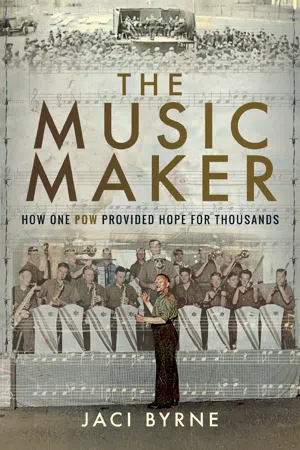
On 8 May 1945, 46-year-old Drum Major, Henry Barnes Jackson, staggered towards his American liberators. Emaciated, dressed in rags, his decayed boots held together with string, he'd been force-marched for twenty days over the Austrian Alps after five heinous years as a POW in Nazi labor camps. He collapsed into his liberators' arms, clinging to his only meaningful possession—his war diary. Having already experienced the horrific nature of battle in the First World War, Jackson continued as a drum major in the Territorial Army, as well as leading a dance band throughout the 1920s. Following Britain's declaration of war against Germany in 1939, he went off to war once again and was captured during the Allied retreat to Dunkirk in 1940. When the Germans learned of his musical abilities, he was put in charge of forming a band. They called him the 'Kapellmeister, ' literally, 'the man in charge of making music', and over the next five years, Jackson and his fellow bandmates would entertain the Germans with concerts and shows in various labor camps throughout occupied Poland. In this captivating testament to human endurance, Jackson's granddaughter has used his personal diary and photographs to tell the unforgettable and gripping true story about the life and times of a humble man who, through his passion for music, overcame extreme adversity.
- 240 pages
- English
- ePUB (mobile friendly)
- Available on iOS & Android
eBook - ePub
About this book
Information
Topic
StoriaSubtopic
Biografie in ambito storicoCHAPTER 1
OFF TO WAR AGAIN
1939
Whitehaven, England
There are times in a man’s life when he must search deep inside himself. When he must strip away all that he thinks he is—or isn’t— and rely on his very essence in order to survive. War is one of those times, perhaps the most fundamental of times. I know this, having served my country before.
I was but a mere boy when I ran away from home and my job at a colliery to fight Jerry in World War I—foolish lad that I was back then. The recruitment officer knew I was too young; I could see it in his smirk when I turned up to enlist. God, one look at my scrawny body, scraggly neck and sunken chest and he would have known—of course he would have. But the two bob and sixpence I waved under his nose for taking underage chaps the likes of me did the trick. Britain was getting desperate for men and, with a wink and a wave of his hand, the recruitment officer pointed me to the long line of new recruits. He said the food would do me some good—fatten me up a bit.
By the time I returned at the end of 1918 from what was named The Great War, I had just turned 20 years of age, but I felt like an old man, I can tell you. There had been nothing ‘great’ about it. The wind had been knocked out of me and I was no longer as puffed up as a toad by cockiness—more like a subdued pet frog. Working down the Haig Pit here in Whitehaven alongside my dad had been a haven compared to the muddy trenches I’d come to call my home. At least at the colliery I’d been able to return to a comfortable home to eat and sleep after work. At war, we’d bunkered down like scared rabbits in a warren, huddled together in dark, damp tunnels deep underground, tons upon tons of dirt above us as we attempted to sleep in airless quarters far underneath the trenches where we fought by day. As for the food, well, I certainly didn’t ‘fatten up’.
My poor dad and mam were so pleased to see me return in one piece that they forgave me everything, and my skipping off to fight was never mentioned again. Still, I was pleased that we’d defeated the Germans, not that the bastards were admitting anything of the sort. They said it was simply an armistice—or something just as stupid. Said they could’ve won had they continued on fighting—said they’d been forced into agreeing to the terms of the armistice. But our country stood firm in the belief that Germany would never again be a threat to Britain.
How wrong we were.
Ever since that Hitler fellow in Germany became Fuhrer in August 1934, the pompous little man had continued to stir the pot; ranting and raving about the fact that we hadn’t actually defeated Germany in The Great War and blaming the Jews for undermining him. Then in late 1938, after Germany had reoccupied the Rhineland and annexed Austria, Hitler turned his attention to Sudetenland in Czechoslovakia. We Brits were getting increasingly anxious. Where would Hitler set his sights on next?
In order to prevent another war, our prime minister, Neville Chamberlain, tried to appease Hitler by meeting him in Munich to sign an agreement, in effect giving Hitler Sudetenland on the promise that he would not invade the whole of Czechoslovakia. The prime minister arrived back in Blighty satisfied that he had achieved his goal of lasting peace. It was to be one of his greatest misjudgements.
Hitler had lied. Germany took Czechoslovakia in March 1939, and invaded Poland on 1 September the same year.
On 3 September 1939, Chamberlain gave a long speech from the cabinet room of Number 10, Downing Street in London which was broadcast on the wireless all over Britain. He told us that we were again at war with Germany. I shall never forget his closing words, which I have memorised: ‘Now may God bless you all. May He defend the right. It is the evil things that we shall be fighting against—brute force, bad faith, injustice, oppression, and persecution—and against them, I am certain that the right will prevail.’
Being a drum major in the Territorial Army, I knew it was only a matter of time before I was called upon to serve my country. That time came in mid-September, and my first thought was: Two wars in one lifetime, so much for never having to face the Jerries again, and I prayed, along with the rest of my countrymen and women, that Chamberlain would be proven correct. That God would be on our side. I was no churchgoing man, but I knew I would certainly need His assistance if I was to make it through another war.
I was ordered to join my battalion, 5th Border Regiment, in the Wooler region in Northumberland, North-East England, and was advised that I would likely be in regimental aid, helping the poor chaps who were injured. I was not so stupid as to think there wouldn’t be plenty of them. No, experience had taught me that much. I was no longer a naïve young lad; in fact, my fellow comrades considered me an old soldier, being that I was the ripe old age of 40.
I looked on the brighter side, which for me always meant the musical side. I was to lead the drum and bugle corps during drills, and I could take along my music sheets and some instruments to accompany me, which I hoped would offer my fellow men some entertainment during whatever leisure time we had.
The wife and our youngest girl were on holidays, visiting relatives in the south of England when I received my orders. Young Joan had been sick, the wife Mabel also sick before her, both of them hospitalised, and they needed the break to help them recuperate. When I contacted Mabel to tell her the news, I told her to stay where she was; that the eldest girl, Nelly, could continue to watch over her sisters and my dad. But the wife wouldn’t hear of it and insisted on returning home. She is a good one, my wife—she was a strong woman in those days, and I needed her to stay strong, because she had to take full control as caretaker of the Whitehaven Town Hall, a position we shared.
I left Whitehaven on 29 September, a day shy of my 41st birthday. My Mabel led the farewell party, her beautiful liquid-centred toffee-brown eyes as sad as a lost dog’s, my four daughters and my dear old dad all lined up on Bransty Railway Station beside her. Nine-yearold Joan jumped from one foot to the other on gangly legs, her red hair flashing in the sunlight, and I noted that she was already head and shoulders above her poor older sister Mona, 16, who was born with a ‘growth defect’. My eyes swept over our third eldest daughter, Betty, who, although only 14, was a true beauty. She bore all of her mother’s attractive features apart from one difference—her striking blonde hair. Rather a headstrong young woman was Betty but, no doubt about it, she was me all over in temperament. Not so the eldest daughter, 18-year-old Nelly, who was more like her mam in nature; sensible and far more compliant than her sister Betty. But there we have it. They were all there to bid me farewell. And, for that, I felt very honoured.
I choked up when I saw the boys from my local band arrive and when they broke into a tune to farewell me, their old bandleader, I had to swallow rapidly in order to keep my welling emotions in check. I didn’t want the memory of me sobbing like a sissy remaining with them throughout the war. My band! How I’d loved every moment of being a part of it: the street parades, the conducting, the concert halls, balls and dances. Well, it was no longer to be and it saddened me that my Golden Age of Music, as it was then named, was over.
The drummer, my dearest mate and Mabel’s younger brother, 26-year-old Ernie, had a tear in his eye. He was like a son to me, the son I’d never had. He hadn’t been called up as yet, but I suspected it would only be a matter of time. Not so for some of the lads in the band who were staying behind for various reasons: age, reserved occupations, medical conditions and the like. They all assured me they would keep an eye on my family, and in them I had complete confidence. We were a close-knit lot in Whitehaven.
My emotional old dad was the last to hug me goodbye. He pressed a small gold clock into my hand, his consumptive cough masking his last words. I turned quickly to leave before I completely broke down.
And I was off. With a final wave as the train shunted out, I tried to take in everyone’s features. I wanted—needed—an image firmly imprinted in my mind, although I couldn’t help but wonder how much this picture would change by the time I returned. And, make no mistake, I was determined to return.
The train stations I passed through on my way to Wooler were filled with similar scenes to Bransty, and my spirits were buoyed by the crowds waving flags and calling out in patriotic cheers as I made my way to join my battalion. I finally settled back into my seat, my mind still focused on who I had left behind; foremost my darling wife.
Ah, my wife…
It was in the main street of Whitehaven, in April 1919, when I first saw her—my Mabel. I still love saying that—my Mabel. I’d taken a lunchbreak from work to get a bite to eat and perhaps down a quick pint of stout, and there she stood, patiently waiting her turn at the counter of Penney’s Fish and Chip Shop. Oh, my Lord, was she ever a good-looking lass. She took the very breath out of me and I could hardly manage to voice my order for a tuppence worth of chips. Mabel Cranston was, and remains to this day, the finest woman ever to be put on this earth—and I’ll not be disputed on that fact.
The first thing I noticed were her large brown eyes; they were ever so expressive, so much so they shone with every smile. Yes, her features were angelic, only to be matched by her soul, and I swear you could not have met a real angel to rival her, not even if you’d visited Heaven. And Mabel’s skin, oh, it was so soft. Like rich, creamy milk. Her pert little nose was perfectly positioned on that wonderful face, and her naturally blushed cheeks looked as if they’d been smeared with ripe strawberries. As you can see, I fell hard, and it took me going to the local chippy many times in the hope of seeing her before I did once more. I was eating that many chips it was a wonder I wasn’t the size of a barrel when I finally bumped into Mabel again, and by that time I was in such an anxious state I just blurted out a request for a date. Well, when Mabel nodded her head in the affirmative, I was dancing in clover.
But that was all in the past. The train began to slow, releasing hisses and sighs, smoke whirling through the air, and my thoughts returned to the present and to the task ahead. I was no longer a family man; I was now a soldier of war. My heart would not get me through the weeks, months, and perhaps years that lay ahead. From that moment forth I knew I had to start thinking with my head.
Wooler to Felton
By early December, after two months of basic training and lectures, which we found relatively undemanding, we moved from Wooler to the Felton area to undergo more intense training; Felton being a town approximately 30 miles south of Wooler. Our training schedule was certainly ramped up during our six-week stay at Felton, and the weather also made it hard going as winter came early and it was the coldest in living memory with many heavy snowfalls and ice making for challenging conditions.
1940
Felton to Swindon
In mid-January the battalion left Felton and headed for Camp Chiseldon in Swindon, Wiltshire, in the south-west of England, to make our final preparations for war. We moved by road and, despite the weather still being atrocious and our lorries sliding every which way, we arrived safely.
We were housed in timber huts, which were very cold—frigidly so—as the big freeze across Britain was still on, chilling us all to the bone. Having only one small heater per hut and the showers being icy cold, the pipes often completely frozen, it was rough going, but the food wasn’t too bad, and we couldn’t complain due to there being rationing on throughout Blighty at the time. So, we were mindful of that, of what our families were enduring, and camp spirits remained high.
Our company commander at Chiseldon was named Captain Sewell, and he proved to be a fine chap and quickly gained the respect of all. Camp Chiseldon indeed brought back memories to me, and I was familiar with the drill from the last war: practice on the firing range, using live hand grenades on the bombing range, and combat training in the nearby woods and local countryside. There was only one major change from the training schedule for The Great War and that was motor training—driving motorcycles, lorries and Bren gun carriers—our troops’ general mode of getting around in the last war being on foot or on horseback. To add to all this, I found I was to study first aid and the basics of medicine in order to be in regimental aid, and so my days and nights were full with not too much time spare to pine for my family.
Speaking of families, the locals in Swindon were wonderful people, very tolerant of the thousands of troops amassed in their locale, and they kindly offered accommodation to the wives and girlfriends of soldiers when they visited. I’m sad to say my Mabel wasn’t among those visitors, seeing as she had so much on her hands, what with her having to look after our girls, my dad, and tending to her demanding duties at the town hall. Still, as I said previously, I also had much on my plate with the intensity of training and my medical studies, and if there was any shard of time left to me, I played my music. I managed to put on a few musical shows which, as I’d hoped, were much appreciated by all the troops. As had long been the case, none of the lads called me by my proper name, Henry Jackson (Harry to my family and friends at home) when off duty, rather by my nickname ‘Drummie’, and there was many a night when that name was called out in good cheer. It was very humbling indeed.
I’m delighted to report that on completion of training for overseas service we were given final embarkation leave of 48 hours. At the end of March, the lads and I gleefully jumped aboard trains and headed home, the atmosphere jubilant as we sang and laughed all the way and, oh, what a joy it was to see my family once more before I headed off to war.
CHAPTER 2
BLOODY BATTLES AND GRAND PIANOS
1940
England
18 April—We are as ready for war as we will ever be and our battalion leaves Swindon early this morning. Now that Germany has invaded neutral Denmark and Norway, the call for arms becomes more desperate than ever. We arrive at Southampton docks this same day and board a troopship. After getting instructions on the use of lifeboats, we find our bunks and drop our kits before getting some grub.
The ship sails at night and anchors in the dark Solent and Southampton Water. I’m restless, so I go up on deck to clear the old head. The weather is cloudy and rain drizzles, but every now and again I can see glimpses of the half-moon through the clouds. I like to think I can see the face of the man in the moon smiling down on us. My gaze shifts to the deep, swollen black waters below, and I breathe in the salty air, and then watch on in awe as more and more ships anchor close by. I’m comforted by the sheer might of our force. As the last ship arrives, I retire for the night, for I shall need to be well rested for the days, weeks and months ahead—as I am now a man at war.
France
20 April—It’s a mighty show of strength as our convoy of troopships, including the HMS Ben-my-Chree, the pride of the Isle of Man Steam Packet Company, arrive at Le Havre, France at first light today. This is the same port I landed at during the last war, and once again, as with Camp Chiseldon, memories flood back to me. I have to admit to my nerves jumping with a right mix of excitement and trepidation. Excitement at the thought of serving my country, as one can’t help but be swept along with the fervour now infiltrating the ship, but trepidation for the imminent war I am about to enter.
This same night we board lorries and travel for three days to a small village called Bouessay in the north-west of France. This place gives no impression of war.
23 April—We set up our regimental aid post in a small two-room house that appears to have been occupied up until very recently. The larger room leads out to the main street via glass doors and has two sizeable beds in it, which will be perfect to accommodate our wounded. The smaller room has a huge barrel in it, and later in the day, when Lieutenant Sergeant Crosby and I arrive back at the house, we learn that the barrel contains undiluted whisky—our medical officer is in a proper dilemma because he cannot get any sense out of an orderly, who has sampled the whisky, and he finds him wandering around in a complete stupor. More men arrive to witness the scene, and it’s an amusing distraction. After we have tired of the orderly’s antics, and he falls into deep slumber on the floor, we are all allowed a small tot of whisky, which is enough to blow our bloody heads off. We have ourselves a merry old time for a short while, but the rest of the night is a bit of a blur! Somehow, we find our way to a shed to sleep, the larger room of the house being occupied by the medical officer and another officer.
The following day we are told that we are to stay here in Bouessay for six weeks of training on the tactics of war on foreign soil. Many of the boys feel this is not necessary, that they are well and truly ready to take on the Germans, some muttering their disappointment, and others not so quietly espousing their fervour to do battle with Jerry—their eagerness to kill. They complain at being further from the firing line than they would like to be. I keep my mouth shut. While I don’t wish to douse the lads’ zeal for action, experience has taught me that being on the front line is anything but fun. Indeed, some men are acting as if they’re simply about to take a thrill ride at Butlins Holiday Camp.
On the third day the officers find themselves a better billet and an orderly, a driver, the medical officer’s batman and I grab their beds. We just start to get down to it when we’re called out. A Royal Army Medical Corps dispatch rider has run into four men, two having to be transported to hospital. Then, as ...
Table of contents
- Cover
- Title
- Copyright
- Dedication
- Contents
- Prologue
- Chapter 1 Off to War Again
- Chapter 2 Bloody Battles and Grand Pianos
- Chapter 3 Captured by the Jerries
- Chapter 4 The Nightmare March and the Labour Camps
- Chapter 5 Sad News from Home
- Chapter 6 Keeping Our Spirits Up
- Chapter 7 Russia Changes Sides
- Chapter 8 Defiance within the Camp
- Chapter 9 Stomach and Heart Aches
- Chapter 10 Inhumanity and Tragedy
- Chapter 11 The War Seems Interminable
- Chapter 12 Desperation Takes Its Toll
- Chapter 13 Living on Hope
- Chapter 14 A Long Wait
- Chapter 15 Germans in Retreat
- Chapter 16 Another Long March
- Chapter 17 It’s Over
- Chapter 18 Blighty!
- Chapter 19 Home to Whitehaven
- Chapter 20 Not the Expected Homecoming
- Chapter 21 Still Puzzled
- Chapter 22 Blackpool
- Chapter 23 Dancing to Forget
- Chapter 24 Back to Face the Music in Whitehaven
- Chapter 25 Life and Weddings Roll On
- Chapter 26 A Good and Decent Human Being
- Summer Time Is Nearly Over
- Names and Addresses of Men in Drum Major Jackson’s World War II Diary
- Author’s Note
- Acknowledgements
- Plate section
Trusted by 375,005 students
Access to over 1.5 million titles for a fair monthly price.
Study more efficiently using our study tools.
Frequently asked questions
Yes, you can cancel anytime from the Subscription tab in your account settings on the Perlego website. Your subscription will stay active until the end of your current billing period. Learn how to cancel your subscription
No, books cannot be downloaded as external files, such as PDFs, for use outside of Perlego. However, you can download books within the Perlego app for offline reading on mobile or tablet. Learn how to download books offline
Perlego offers two plans: Essential and Complete
- Essential is ideal for learners and professionals who enjoy exploring a wide range of subjects. Access the Essential Library with 800,000+ trusted titles and best-sellers across business, personal growth, and the humanities. Includes unlimited reading time and Standard Read Aloud voice.
- Complete: Perfect for advanced learners and researchers needing full, unrestricted access. Unlock 1.5M+ books across hundreds of subjects, including academic and specialized titles. The Complete Plan also includes advanced features like Premium Read Aloud and Research Assistant.
We are an online textbook subscription service, where you can get access to an entire online library for less than the price of a single book per month. With over 1.5 million books across 990+ topics, we’ve got you covered! Learn about our mission
Look out for the read-aloud symbol on your next book to see if you can listen to it. The read-aloud tool reads text aloud for you, highlighting the text as it is being read. You can pause it, speed it up and slow it down. Learn more about Read Aloud
Yes! You can use the Perlego app on both iOS and Android devices to read anytime, anywhere — even offline. Perfect for commutes or when you’re on the go.
Please note we cannot support devices running on iOS 13 and Android 7 or earlier. Learn more about using the app
Please note we cannot support devices running on iOS 13 and Android 7 or earlier. Learn more about using the app
Yes, you can access The Music Maker by Jaci Byrne in PDF and/or ePUB format, as well as other popular books in Storia & Biografie in ambito storico. We have over 1.5 million books available in our catalogue for you to explore.