An in-depth look at the lives of illegitimate children and their parents in England in the later Middle Ages.
For the nobility and gentry in later medieval England, land was a source of wealth and status. Their marriages were arranged with this in mind, and it is not surprising that so many of them had mistresses and illegitimate children. John de Warenne, earl of Surrey, married at the age of twenty to a ten-year-old granddaughter of Edward I, had at least eight bastards and a complicated love life.
In theory, bastards were at a considerable disadvantage. Regarded as 'filius nullius' or the son of no one, they were unable to inherit real property and barred from the priesthood. In practice, illegitimacy could be less of a stigma in late medieval England than it became between the sixteenth and late twentieth centuries. There were ways of making provision for illegitimate offspring and some bastards did extremely well—in the church, through marriage, as soldiers, and a few even succeeding to the family estates.
The Legitimacy of Bastards is the first book to consider the individuals who had illegitimate children, the ways in which they provided for them and attitudes towards both the parents and the bastard children. It also highlights important differences between the views of illegitimacy taken by the Church and by the English law.
"Informative and well researched . . . A great resource for those who want to learn more about the late medieval period and illegitimate children." —
Adventures of a Tudor Nerd
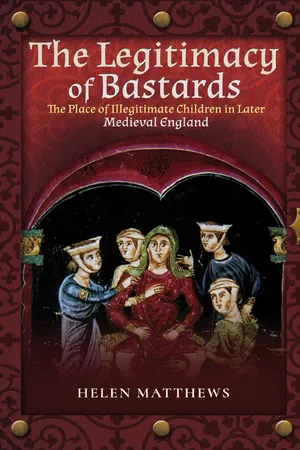
eBook - ePub
The Legitimacy of Bastards
The Place of Illegitimate Children in Later Medieval England
- 248 pages
- English
- ePUB (mobile friendly)
- Available on iOS & Android
eBook - ePub
The Legitimacy of Bastards
The Place of Illegitimate Children in Later Medieval England
About this book
Information
Chapter 1
Bastardy in Theory: The Legal Context
a proof might indeed be made in the court of Christianity, which in some cases is
contrary to the law and customs of England.
contrary to the law and customs of England.
(Bracton, IV)
In 1381 Sir John Ipstones (d. 1394) dispossessed Maud Swynnerton, the young granddaughter of Nicholas Beck, of the manors of Hopton and Tean (Staffordshire). In the subsequent court case, Sir John contended that he was the nephew and next heir of Nicholas Beck. His argument was that on Beck’s death, his two daughters, Elizabeth and Margaret had entered as his heiresses, but that both had died without heirs of their bodies and that Maud was illegitimate. As Maud’s mother, Elizabeth Beck, had married Robert Swynnerton, it is probable that Ipstone argued that the marriage was invalid because the couple were related within the prohibited degrees. The matter was eventually referred to the Bishop of Coventry and Lichfield and although the legal argument proved untenable, Ipstones managed to remain in possession for the next seven years. Maud was supported by her father-in-law, Sir Richard Peshale, who had a long-standing grudge against the Ipstones family. By the time Peshale died in 1388, Maud was already a widow, and Ipstones seized an opportunity. He and a group of armed men abducted Maud and forced her to marry his own son, William. Ipstones was a powerful, if not notorious, man in the locality and it proved difficult for Maud’s relatives to take action against him. In December 1390 he managed to secure a papal dispensation absolving William Ipstones and Maud from the sentence of excommunication they would have incurred for both marrying in secret without the publication of banns and for being within the prohibited three degrees of kinship. The dispensation decreed that the couple were to be separated for a time and might then remarry, after which past and future children would be declared legitimate. Ipstones thus effected a fait accompli in which both claimants to the property were united in marriage and the legitimacy of their offspring was a matter of record. This case illustrates how both canon law and common law approaches to illegitimacy had an impact on the lives and estates of the landed classes: matters relating to marriage and legitimacy were reserved for the Church, but when it came to property, illegitimacy was simply one factor which could be used tactically in a dispute. Violence was of course another.
The word ‘legitimate’ derives from the Latin lex, leg- meaning ‘law’. In order to understand the implications of illegitimacy in late medieval England it is therefore necessary to turn to the law. Illegitimacy was a complex issue, which impinged on the lives of the nobility and gentry in several ways. They might have had bastard children of their own, for whom they wished to provide. They might even have wished to favour the children of a second marriage over those of an annulled first marriage, as in the case of Richard FitzAlan, Earl of Arundel (d. 1376), who ensured that the son of his annulled first marriage was declared to be illegitimate so that he would have no right of inheritance. Illegitimacy might have been raised in a dispute over property rights, with bastardy alleged against the person or an ancestor of one or other party, or even both. Members of the landowning classes might have also had tenants who were illegitimate; a situation which could have positive or negative implications for the landowner, depending on the circumstances. Illegitimacy meant that an individual was technically fillius nullius, the child of no one, so legally had no relatives or heirs other than their own children. An illegitimate tenant who died without an heir of his/her body (legitimate child of his/her own) could therefore provide a windfall, as the property would then pass to the lord by the process known as escheat. On the other hand, a tenant of unfree status might claim freedom as a result of his or her illegitimacy, since they could not inherit unfree status.
A further cause of the legal complexity was that rather than a single law code dealing with illegitimacy and inheritance, there were two overlapping and sometimes conflicting law codes. As the events of the Council of Merton had made clear, church, or canon law, which determined the validity of marriage, and the English common law, which dealt with property rights, did not agree on certain crucial points. The result was a complex situation in which a child might be regarded as legitimate by the Church but not by the courts for the purpose of inheritance or vice versa. This provided opportunities for canny individuals to exploit the situation for their own benefit.
Canon Law
In order for the legitimacy or otherwise of the offspring of a marriage to have become a concern, there first needed to be a clear understanding of what constituted a valid marriage. Sara McDougall has recently shown that it was only after the requirements of a valid marriage were finally resolved in the early-thirteenth century that the concepts of legitimate and illegitimate children as we now understand them developed. Prior to that, legitimacy of offspring could be defined more by lineage than by marriage laws, with the status of the mother proving a significant factor.
During the twelfth century, the canon law view of marriage gradually evolved as it became accepted that Church courts had jurisdiction over the validity of marriage, and a body of case law developed as a consequence. The fundamental concern of the Church was with the spiritual nature of marriage and the salvation of souls. During the second half of the twelfth century, judgements on marriage cases by Pope Alexander III (1159–1181) stressed the need for the free consent of the bride and groom (and no one else) in order to make a valid marriage. A Christian couple who were free to marry could create a permanent lifelong bond simply by exchanging vows in the present tense, or by exchanging vows in the future tense and subsequently consummating the marriage. David d’Avray has pointed out that the western Christian marriage tradition which evolved over the 800 years from St Augustine of Hippo in the fifth century to the pontificate of Innocent III in the early-thirteenth century was unlike that of any other major civilization in that it combined indissolubility with monogamy. Other marriage systems either permitted polygamy or allowed for divorce.
Innocent III (1198–1216) sought to translate the notion of the indissolubility of marriage that had evolved over the course of the preceding centuries into one that could be applied in practice. Any rule-based system inevitably leaves room for creative interpretation and the discovery of loopholes. As the idea of the indissolubility of marriage gained ground, the elites continued to change marital partners making use of the legal loophole provided by the rules on forbidden degrees of relationship (consanguinity). Degrees of relationship were counted by the number of steps from the common ancestor, so that a brother and sister sharing a common parent would be related in the first degree, and first cousins, sharing a common grandparent, would be related in the second degree and so on. Until the early-thirteenth century, the number of forbidden degrees of relationship that would invalidate a marriage was seven. A couple related in the seventh degree shared a common great-great-great-great-great-grandparent—a level of connection which provided ample opportunity for the discovery of a hitherto unknown relationship with an unwanted spouse. The Fourth Lateran Council (1215) reduced the number of prohibited degrees of relationship that invalidated a marriage to a more practical number of four. It was rather more feasible to identify those sharing a common great-great-grandparent. The council also called for the public announcement of banns prior to marriage so that any potential impediments could be brought to light before the marriage took place. It stopped short, however, of declaring clandestine marriages invalid, as the doctrine that free consent was sufficient to make a marriage prevailed. In the absence of banns, there could be no presumption of good faith should an impediment subsequently come to light, but the inclusion of many of Alexander III’s decisions in a compilation of case law issued in 1234 ensured that the doctrine of free consent remained legally binding throughout the medieval period and beyond.
From the thirteenth century therefore there was a body of canon law which explained what constituted a valid marriage. It also clarified what constituted an impediment to marriage which could be used as grounds for subsequent annulment. Consanguinity was not the only such impediment. Other impediments which caused a marriage to be annulled included those in which the consent given by the bride and groom was compromised in some way. This could be because one of them had previously formed a contract of marriage with a third party, or they were incapable of giving meaningful consent because they were under age or mentally incapable, or had only consented under duress. Children below the age of seven were not deemed capable of consenting to marriage. Those aged between seven and puberty (notionally twelve for girls and fourteen for boys) could give future consent which became binding if the parties had intercourse or gave present consent when they reached puberty. Until puberty they were not considered to have the physical capacity to contract a binding marriage. Another lack of physical capacity, impotence, could also be an impediment if the other party was unaware at the time of consenting to the marriage. These impediments also had implications for the subsequent status of any children of an annulled marriage.
Whilst the word ‘bastard’ was used indiscriminately, in England at least, and without any offensive intent, to describe anyone of illegitimate birth, different types of bastards had different rights under canon law. Canon lawyers classified children into four groups according to the marital status of the parents and whether or not the union of the parents was ‘natural’, that is, not subject to any impediment, such as being related within the prohibited degrees. Children who were born of a lawful marriage were both natural and legitimate; those born outside marriage to parents who were free to marry were merely natural and not legitimate; adopted children were legitimate only but not natural; whilst those who were born of a prohibited union, or whose paternity was unknown were neither legitimate nor natural, and were known as spurii. These distinctions had practical implications, particularly with regard to spurii who were regarded as inferior to natural illegitimate children and unlike them, could not be legitimated by the subsequent marriage of the parents.
In continental Europe, the legal system was generally based on the ius commune, a combination of canon law and Roman law, which incorporated the canon law distinction between different types of illegitimacy. Naturales had some limited rights of inheritance (one-twelfth of the father’s property, by testament if there were legitimate heirs or on intestacy if there were no legitimate heirs), but spurii could neither inherit from their fathers nor even receive gifts during the father’s lifetime. Whilst there were local variations, which will be covered in more detail in Chapter Five, the main principles of canon law relating to legitimacy were incorporated into civil law relating to inheritance. Legitimation of bastards was also possible in certain circumstances, though there were still distinctions in the forms of legitimation available to naturales and spurii. Such legitimation transformed the legal status of the bastard though, in those countries or cities where illegitimacy was regarded as a stigma or taint, a legitimated bastard might still be barred from political office or membership of a guild.
Common Law
English common law, however, took a somewhat different approach and, as noted in Pollock and Maitland’s classic History of English Law before the Time of Edward I: ‘in our English law bastardy cannot be called a status or condition’. Nevertheless, the thirteenth-century treatise on The Laws and Customs of England, known as Bracton borrowed from canon lawyers in describing the different types of children, subdivides natural and legitimate children according to whether they were heirs on the side of either or both parents, or not at all. For the author of Bracton, it was the distinction between children who were heirs and those who were not that was the crucial point, rather than that between different types of illegitimate children. The important issue was whether a child was eligible to inherit, which was a consequence of legitimacy, rather than the legitimacy itself. If a child was illegitimate, and therefore unable to inherit, reasons for illegitimacy were not so important.
Yet this did not necessarily mean that the circumstances of birth were completely irrelevant. They could be of crucial importance. The validity of a marriage, and hence the legitimacy of children, was held to be a matter for the Church courts. However, common law and canon law differed on a number of crucial issues. Canon law held that natural children were legitimated if parents subsequently married, but this was not the case in English common law. As a result, a different verdict on the illegitimacy or otherwise of an individual could be found depending on the court in which the case was heard. Thus, although the reasons for illegitimacy did not affect the status of a person once he or she had been proved to be illegitimate, the need to ensure that the determination of legitimacy was in accordance with common law meant that it was important that the reasons for an allegation of bastardy were clearly specified. There is plenty of evidence that mistakes could and did happen in practice, either by accident or design.
Although closely connected, legitimacy and the right of inheritance were slightly different issues. Common law inheritance followed the rules of male primogeniture and whilst a legitimate child was eligible to inherit, younger sons and daughters would not necessarily do so directly, although there was always the possibility that they or their descendants might eventually inherit as a result of a failure in the main line. This absence of any right to collateral inheritance was the main disadvantage that distinguished the bastard from legitimate younger children. The other, which did not disadvantage the bastard so much as their legitimate half-brothers and sisters, was that if they had been given a share of the family property and later died with no heirs of their bodies, or if their direct line of issue failed, there would be no common law right of inheritance for their legitimate siblings and their descendants. In a case from the reign of Edward II it was even noted that ‘if the issue of a bastard die without heir of his body the bastard is said to die without heir; and this holds good down to the fifth degree, when one can make a resort without mentioning the bastard’. Prior to 1290, this did not matter too much in practical terms, as property would have been granted by means of subinfeudation. This meant that the property was granted so that the bastard would hold the property of the father and his heirs, and would therefore escheat or revert to them should he die without heir of his body. In simple terms, person A might grant land to person B, who would hold it of A. If B died without an heir of his body the land would escheat back to A. However, B might grant some of this land to person C, who would hold it of B. If C then died without heir of his body, it would escheat to B. Over time, the process of subinfeudation inevitably led to very complex landholding arrangements. In 1290 the statute Quia Emptores simplified matters so that any property granted was held directly of the superior lord from whom the grantor had held it and the grantor was removed from the chain. After Quia Emptores, if B granted the land to C, C would hold it directly of A and B and his heirs would no longer have any interest in the property. One effect of this was that any property granted to a bastard son would no longer escheat to the father and his right heirs if the bastard died without legitimate issue, but was alienated for good. As a result of Quia Emptores, from the late-thirteenth century onwards various legal devices evolved that would enable a donor greater control over the distribution of his property after his death.
Differences in Practice
From the above it can be seen that the Church was concerned with internal matters in terms of the intentions and good faith of the couple whereas the common law was more concerned with outward signs such as the formal marriage ceremony. For the Church, marriage was a sacrament, and good faith was important. The common law was concerned with the inheritance of real property and was therefore more interested in the evidence of marriage than the spiritual bond. The different priorities of canon law and common law informed their approaches to determining legitimacy. In general, the Church was more tolerant of bastards born outside lawful wedlock, provided that they were ‘natural’, whereas common law was more favourable to those born within wedlock, whether natural or not. Both codes had some difficulty in dealing with the children of marriages that were subsequently annulled.
Our understanding of both codes is derived from legal treatises, which are more theoretical in content, and the records of actual legal cases. For the English common law, as well as the formal record of cases, we also have less formal accounts in the form of the Year Books, notes made by law students observing the proceedings, which provide an insight into arguments actually made in court. The Year Book accounts are particularly helpful in showing how those involved actually understood the law, and how this understanding and practice evolved over time.
Accounts of legal cases demonstrate that individuals at all levels of society had some basic understanding of the requirements of a valid marriage and were likely to have been aware of issues relating to the legitimacy or otherwise of their children and the potential legal pitfalls and loopholes, but the complexity was such that there was plenty of work for the growing legal profession. The convoluted nature of the laws relating to bastardy meant that litigants often went to some lengths to avoid mentioning it in court at all, or tried to manipulate the discrepancy between the two legal codes by phrasing a plea in such a way as to avoid use of the word ’bastard’, claiming instead that an individual was not ‘not the son of’ the supposed parent or that his father had not been married to his mother.
The approaches taken by the canon and common law in different sets of circumstances are described below.
Single man and single woman who were free to marry but did not do so
Children born of unmarried parents who were free to marry (those born ex soluto et soluta) were illegitimate by both canon and common law, being born outside wedlock. Such children were natural but not legitimate (nat...
Table of contents
- Cover
- Title
- Copyright
- Contents
- Acknowledgements
- Foreword
- Introduction
- Chapter 1 Bastardy in Theory: The Legal Context
- Chapter 2 A Case Study of Bastardy in Practice: The Warenne Family and After
- Chapter 3 Sexual Misconduct: Marriage and Adultery; Bastard-bearers and their Social Status
- Chapter 4 The Inheritance of Bastards
- Chapter 5 Social Status, Career and Opportunities for Bastards
- Chapter 6 The End of an Era?
- Glossary
- Annex: Dramatis Personae
- Bibilography
- plate
Trusted by 375,005 students
Access to over 1.5 million titles for a fair monthly price.
Study more efficiently using our study tools.
Frequently asked questions
Yes, you can cancel anytime from the Subscription tab in your account settings on the Perlego website. Your subscription will stay active until the end of your current billing period. Learn how to cancel your subscription
No, books cannot be downloaded as external files, such as PDFs, for use outside of Perlego. However, you can download books within the Perlego app for offline reading on mobile or tablet. Learn how to download books offline
Perlego offers two plans: Essential and Complete
- Essential is ideal for learners and professionals who enjoy exploring a wide range of subjects. Access the Essential Library with 800,000+ trusted titles and best-sellers across business, personal growth, and the humanities. Includes unlimited reading time and Standard Read Aloud voice.
- Complete: Perfect for advanced learners and researchers needing full, unrestricted access. Unlock 1.5M+ books across hundreds of subjects, including academic and specialized titles. The Complete Plan also includes advanced features like Premium Read Aloud and Research Assistant.
We are an online textbook subscription service, where you can get access to an entire online library for less than the price of a single book per month. With over 1.5 million books across 990+ topics, we’ve got you covered! Learn about our mission
Look out for the read-aloud symbol on your next book to see if you can listen to it. The read-aloud tool reads text aloud for you, highlighting the text as it is being read. You can pause it, speed it up and slow it down. Learn more about Read Aloud
Yes! You can use the Perlego app on both iOS and Android devices to read anytime, anywhere — even offline. Perfect for commutes or when you’re on the go.
Please note we cannot support devices running on iOS 13 and Android 7 or earlier. Learn more about using the app
Please note we cannot support devices running on iOS 13 and Android 7 or earlier. Learn more about using the app
Yes, you can access The Legitimacy of Bastards by Helen Matthews in PDF and/or ePUB format, as well as other popular books in Social Sciences & British History. We have over 1.5 million books available in our catalogue for you to explore.