Kristine Lilly is a legendary athlete: she played midfielder for the United States Women’s National Soccer Team for over twenty-three years. This included five FIFA World Cups and three Olympic Games. She was inducted into the US Olympic Hall of Fame in 2012 and the US Soccer Hall of Fame in 2014. Before that, she won four national championships at The University of North Carolina. During this remarkable career, Lilly gained unprecedented insights into how high-performing teams work together, on and off the field.
In Powerhouse: 13 Teamwork Tactics that Build Excellence and Unrivaled Success, she teams up with Dr. John Gillis Jr. to help readers and their businesses:
• Transform
• Empower
• Achieve
• Motivate
Using Lilly and Gillis’s insights, readers can revolutionize teams in their organizations so that they can achieve sustainable excellence and peerless success. The tactics they share, supported by Dr. Lynette Gillis’s academic research, dig deep into the dynamics of collaborative work and highlight the actions readers can take to empower their teams.
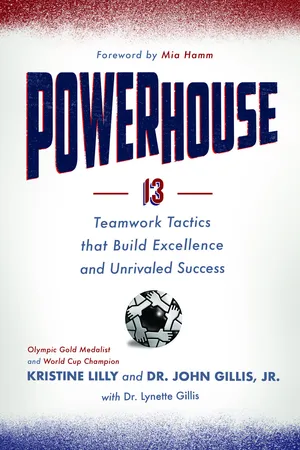
eBook - ePub
Powerhouse
13 Teamwork Tactics that Build Excellence and Unrivaled Success
- 223 pages
- English
- ePUB (mobile friendly)
- Available on iOS & Android
eBook - ePub
Powerhouse
13 Teamwork Tactics that Build Excellence and Unrivaled Success
About this book
Information
Pillar 1:
TRANSFORM
To build a powerhouse, you first need to transform the group of selected individuals into team members. To thoroughly change the character of this group into the appearance of a team and not a TINO, you need these team members to align to a team direction. This team will then work together to achieve their goals. These initial essential tactics are critical to team formation, but many teams forget to focus on these fundamentals, failing to transform. When you effectively transform, a group of individual contributors becomes a high-performing powerhouse.

Brandi Chastain celebrates after scoring the penalty kick to win the 1999 World Cup in the Rose Bowl on July 10th. “This is one of the most expressive and emotional photos,” Kristine said. “It still fills me with so much emotion.” (Credit: Barnimir Kvartuc/ZUMAPRESS/isiphotos.com)

Selecting Exceptional Team Members
“Each team has their own character, and you must be willing to accept team member differences. It’s important to accept each person’s uniqueness, while embracing the ultimate objective and goal of the team.”
—Brandi Chastain
When Kristine was only sixteen years old and a junior in high school, she was asked to join the US Women’s National Soccer Team (USWNT), which changed her life. She not only would also be a part of arguably one of the most successful sports teams ever, but she would join forces with individuals who would accept and support one another to be the best.
During her first trip with the USWNT, to China, Kristine scored the first goal of her international career, and she became the youngest player to ever score a goal for the national team. This trip began Lilly’s journey with the USWNT that would last over two and a half decades, including over three hundred games and over three hundred thousand minutes of game time. Just before her retirement in 2011, Kristine became the oldest player to ever score for the USWNT. As of 2018, she still holds the record for both the youngest and oldest player to score a goal for the USWNT.2 This incredible feat illustrates that Lilly’s remarkable skill never diminished, or as Kristine said at her US Soccer Hall of Fame (HOF) induction in 2015, “Scoring your first goal makes you feel like you belong. Scoring your last goal makes you feel like you still belong.”
Kristine’s exceptional play in high school and then on her regional team captured the attention of the US Women’s National Team coach, Anson Dorrance. Anson asked her, Mia Hamm, Linda Hamilton, Julie Foudy, and Joy Fawcett to join the USWNT. These young players would join forces for seventeen years and understand what it means to be part of a team. Mia Hamm, who also became Kristine’s teammate at the University of North Carolina in 1989, summed up what it means to be a on a winning team, “I was a member of a team, and I relied on the team. I defer to it and sacrifice for it, because the team, not the individual, is the ultimate champion.” For these young players, knowing only the most exceptional athletes from all over the country would come together gave them the drive, connection, and respect for the teams they created together.
Why Selection Is Important
A team’s effectiveness is dependent on its collective and complementary team member skills. For businesses, attracting, hiring, and retaining high-quality employees is an ongoing focus. Talent acquisition can be an arduous and high-pressure process: companies must create employee value propositions to attract key prospects, identifying future employees who will “fit” with organizational culture and contribute, and the stakes are high. Beyond the significant cost-per-hire, a wrong hire can threaten further damage to teams.
To create a powerhouse on the field or in the boardroom, the first tactic you need to learn is how to select team members effectively. You need to identify high-potential individuals, recruit to build or buy talent, and go for green and gray.
Build High-Potential Individuals
In 1986, Kristine didn’t know that there was a US Women’s National Soccer Team. The USWNT had just played its inaugural match a year prior under the direction of Coach Mike Ryan in Jesolo, Italy. The game was by all accounts not very memorable, as the USA lost to Italy 1–0.3
Coach Anson Dorrance had been hired to take over from Ryan, and he was determined to replace the founding team’s collection of largely unknown players with strong, indelible athletes. Coach Dorrance was known for his skill for identifying talent for his team at The University of North Carolina. Each was a player with high potential who brought strengths to the team. These young women, in regional play, had already demonstrated an internal drive and a desire to learn and grow. Dorrance envisioned future roles for them, seeking potential to develop and establish the foundation for the USWNT for years to come.
Value Potential
In order to correctly identify high potentials, Dorrance had to select players based more on the person’s technical and tactical skills instead of their physical characteristics, such as height and strength. Kristine and Mia, being five foot four and five foot five, respectively, did not mean that they had less talent than a player nearly six feet tall like Michelle Akers, and Dorrance knew to value their quick thinking and speed. As research of soccer player selection in Switzerland showed, it can be challenging for many coaches to think long term in regard to their players; there is immediate pressure on short-term success in sport.4 However, in soccer and in business, a long-term and process-oriented approach to recruitment will result in better results at the top levels. High-potential individuals selected for their long-term impact on the team rather than short-term wins can lead to a reputation for high quality as well as a sustainable achievement record.
In the business world, talent acquisition mirrors the struggle for assembling winning teams in soccer. Employers may overlook an applicant with a high potential to benefit the organization in the long term, instead hiring based on immediate need and short-term pressure. To effectively hire for potential, a company needs to not only assess an applicant’s skill and experiences—what a resume details—but also assess for potential, which is harder to ascertain. Talent acquisition professionals use employee referrals, psychometric assessments, references, and other background measures to try and identify this “black box.” When a leader forsakes a process-oriented and organic employee development approach, they are effectively deciding that they don’t want to “build” or develop a candidate’s potential over time. This potential is more valuable for your organization to identify for long-term performance. Winning today—on the field and in business—is important; yet, building a team to win at the elite levels tomorrow requires hiring for potential now.

Everybody, even professional recruiters and coaches, makes mistakes from time to time. However, if you’ve come to realize that one of your new team members is not a good choice, you should act swiftly.
Hiring or recruiting a person to your team who is not aligned to your values can have a negative effect on other team members’ morale and confidence. Bad hires have a ripple effect throughout the organization, dragging overall team performance down. The wrong person keeping a chair warm doesn’t only underperform in their role; they make high-potential teammates resentful, increase conflict, and can even lead to turnover. If you determine that you’ve made a bad hire, it’s better to terminate the wrong hire immediately and rehire to find the right fit for your team, than to try to force a bad hire to work out. As a smart colleague of mine once said, “If an employee or team member isn’t right, you should free up their future.” By removing them from your team, not only do you preserve your team’s integrity and open up the possibility for a good recruit to replace them, you also give the “bad” hire the opportunity to find a place where they fit and succeed.
If you don’t, you are deciding that you don’t care about winning anytime soon: victory is significantly delayed when a bad hire gets to stick around.
Buy Talent
While the tactic of hiring high potentials leads to organic career development growth over time, most companies still find themselves with capability gaps that must be addressed immediately by acquiring experienced hires. If building talent isn’t quite possible on your schedule, your other option is to “buy” a new team member in the competitive war for talent.
In addition to being a sport, professional soccer is a business. Better field performance leads to higher revenue. The more money that comes to a team from winning, the more teams can in turn increase their wages and “buy” quality talent. This investment in talent then leads to even better field performance.
To learn about buying talent, let’s look at Manchester United (ManU), one of the most financially successful professional male soccer teams.5 When the Premier League was founded in 1992, this club won four of the first six annual titles and got second place the other two years. Even today, they dominate the soccer merchandise market and sell match tickets at premium prices despite being in a crowded market with twenty other teams because their brand is one of the strongest. As their team won over the past decades, revenues grew. The financial outcomes of millions in profits are healthy for any company. However, in the professional soccer industry where most clubs report a pretax loss, their results are staggering.
In the English football Premier League, unlike baseball, basketball, or American football, the organization does not attempt to provide parity between teams and balance the competition by redistributing income, installing a maximum wage, or controlling player transfers. Successful teams must spend money to acquire talent and continuously harvest their profits to buy talent in order to preserve their competitiveness on the field. The quality of the team increases the amount of revenues that allow teams to acquire highly talented players, resulting in improved performances on the field. So, when we talk about ManU’s success when the Premier League was founded, the story actually started three years earlier. That summer, ManU went on a spending spree to buy talent with five key experienced players: Gary Pallister, Neil Webb, Paul Ince, Mike Phelan, and Danny Wallace. For ManU, these talented players built their teamwork over three years and established a reputation for winning and a loyal fan base in a crowded and competitive marketplace. These are the players that set the foundation that would propel them to a winning culture for the next several decades.
Compete with A-Team Talent
How can you ensure that your company will thrive in a competitive environment like ManU? Your business will compete against similar organizations for revenue, profitability, and clients. Having A-Team talent can help you win against your competitors.
The need for agility and competitiveness underscores your company’s need to hire high-potential individuals, future stars, in order to succeed against your competitors, but sometimes your organization may not have the ability to wait for your recruits to develop their potential. In these situations, you can take a play from ManU and buy talent for an immediate, short-term impact on your organization.
We do mean “buy” quite literally. C-Team players are readily available at cheap prices; however, A-Team players typically require higher salaries, bigger sign-on bonuses, and attractive benefits packages. You’ll need to invest financially in them in order to recruit them effectively. A-Team employees can also be harder to find, especially because they tend to be already employed by other organizations who are trying hard to retain them. However, if you decide to use this strategy and make the investment to attract one of these A-Team individuals, you hopefully will end up removing a lot of the uncertainty and time that “building” players can involve. Ideally your investment will contribute to a solid team that consistently generates more revenue for you. In turn, this will help you to buy more high-level talent to keep your business successful in the short term while you build your high-potential individuals to improve your company’s long-term performance.
Go Green and Gray
When Kristine was a freshman at UNC, members of the soccer team had a fitness test to run 7 ¼ laps in 12 minutes, or else they could not play in a game. Their fitness test was not loved, but it was a benchmark hopefuls needed to pass to be on the team. The test measured the player’s fitness levels, but it also built respect and trust among the team. With a lap to go, as a “green” inexperienced player, Kristine was really struggling. Tracey Bates Leone, a “gray” senior on the team, decided to help by running backward next to Kristine and encouraging her, even though this meant Tracey would have a slower finish time on the fitness test that she, too, had to pass. Both were able to pull each other through and finish the lap on time.
Kristine and Tracey would also be teammates on the USWNT. Kristine, still green, eventually ended up earning the starting role over the same gray player, Tracey Bates Leone, wh...
Table of contents
- Cover
- Title Page
- Copyright Page
- Contents
- Foreword
- Preface
- Introduction
- Pillar 1: Transform
- Pillar 2: Empower
- Pillar 3: Achieve
- Pillar 4: Motivate
- Afterword
- About the Authors
Trusted by 375,005 students
Access to over 1.5 million titles for a fair monthly price.
Study more efficiently using our study tools.
Frequently asked questions
Yes, you can cancel anytime from the Subscription tab in your account settings on the Perlego website. Your subscription will stay active until the end of your current billing period. Learn how to cancel your subscription
No, books cannot be downloaded as external files, such as PDFs, for use outside of Perlego. However, you can download books within the Perlego app for offline reading on mobile or tablet. Learn how to download books offline
Perlego offers two plans: Essential and Complete
- Essential is ideal for learners and professionals who enjoy exploring a wide range of subjects. Access the Essential Library with 800,000+ trusted titles and best-sellers across business, personal growth, and the humanities. Includes unlimited reading time and Standard Read Aloud voice.
- Complete: Perfect for advanced learners and researchers needing full, unrestricted access. Unlock 1.5M+ books across hundreds of subjects, including academic and specialized titles. The Complete Plan also includes advanced features like Premium Read Aloud and Research Assistant.
We are an online textbook subscription service, where you can get access to an entire online library for less than the price of a single book per month. With over 1.5 million books across 990+ topics, we’ve got you covered! Learn about our mission
Look out for the read-aloud symbol on your next book to see if you can listen to it. The read-aloud tool reads text aloud for you, highlighting the text as it is being read. You can pause it, speed it up and slow it down. Learn more about Read Aloud
Yes! You can use the Perlego app on both iOS and Android devices to read anytime, anywhere — even offline. Perfect for commutes or when you’re on the go.
Please note we cannot support devices running on iOS 13 and Android 7 or earlier. Learn more about using the app
Please note we cannot support devices running on iOS 13 and Android 7 or earlier. Learn more about using the app
Yes, you can access Powerhouse by Kristine Lilly,Dr. John Gillis, Jr.,Dr. Lynette Gillis in PDF and/or ePUB format, as well as other popular books in Business & Workplace Culture. We have over 1.5 million books available in our catalogue for you to explore.