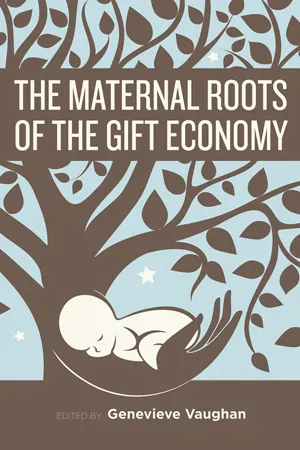
The idea of a free gift economy has become important in the movement for alternative economics, however the connection with women and especially with mothers has not been widely understood. The conference "The Maternal Roots of the Gift Economy, " held in Rome in 2015, brought together women and men from around the world to discuss this important issue.In a moment when the values of Patriarchy and the market seem to have triumphed, the values of mothering and care are more sorely needed than ever. This book explores many aspects of the gift paradigm from a variety of points of view, taking into account theory and practice, activism and spirituality, as well as the experience of Indigenous societies North and South where maternal values are still at the centre for both women and men. Readers will find abundant evidence of ways of thinking and being that are possible beyond the Patriarchal Capitalism that is now threatening the existence of life on Mother Earth. The book is divided into four sections: Theory, Practice, Practice in Non-Western Realites and Spiritualities. Articles are by well-known scholars and activists from around the world and include: Luciana Percovich, Mariam Irene Tazi-Preve, Erella Shadmi, Simone Woerer, Susan Petrilli, Kaarina Kailo, Heide Goettner-Abendroth, Barbara Alice Mann, Coumba Touré, Diem LaFortune, Vicky Noble, and many more.
- English
- ePUB (mobile friendly)
- Available on iOS & Android
eBook - ePub
The Maternal Roots of the Gift Economy
About this book
Information
Topic
EconomiaSubtopic
Teoria economicaPart I: Theory
1.
Providing a Rationale for Peace
Providing a Rationale for Peace
The Maternal Gift Economy
I WOULD LIKE TO BEGIN with a big picture broad-stroke delineation of the issue of the gift as I see it: Our society today is based on two economies, not just one economy with “externalities.” The domestic economy is a gift economy with mothering practice as its core. The market economy is superimposed upon the domestic economy and takes its sustenance from it while distributing scarce goods to it through monetized exchange.1 This economic characterization allows us to depersonalize and de-sentimentalize mothering/gifting so that we can see it as structural, with a logic of its own that contrasts with the do ut des logic of the market. In Marxist terms, the economic structure of gifting would have a superstructure of values and ideas. I believe that what we consider the moral values of care are the superstructure of the gift economy. These values are difficult to uphold in the present situation because gift and exchange are locked into a parasitic embrace that appears to be a symbiosis.
Marcel Mauss’s three-step process of giving-receiving-giving back necessarily begins with the two-step process of giving-receiving in the life of every human, because infants cannot perform the third step of giving back. The point of view can shift from giver to receiver, but the trajectory of the gift is unilateral. It is possible to trace a spectrum of gifts from the most thoroughly unilateral, to the benignly reciprocal, to symbolic gift exchange, to forced reciprocity, to manipulative gifting for power over others, and to market exchange where gifts are transformed into profit by manipulation and exploitation. There are many gradations in this spectrum and I can only suggest their complexity here. However, if we do not have the idea of unilateral gifting as the first step, we lack the beginning of the spectrum and so cannot recognize the gradations as such, with the result that we only see a disorderly jumble of kinds of gifts, which we then attempt to classify. This is one important aspect of recognizing the maternal root of the gift economy. On the other hand, recognizing the economic character of mothering allows us to formulate a maternalist materialism.
There are offshoots of the exchange paradigm that we do not recognize as such. For example, individual violence and reprisal, and military attacks and counterattacks function according to the logic of exchange. Justice as payment for crime is an exchange (contrasted with restorative justice). Vengeance is of course an exchange. Experiencing guilt is putting oneself in the exchange mode, preparing oneself to pay. The marriage market and the idea of human capital translate gift potentialities into exchange paradigm language. The porn trade2 and the commodification and trafficking of women, children, and body parts all demonstrate the parasitism of exchange on gifting. In fact the whole system of global capitalism developed parasitically by plundering the native lands of the Indigenous peoples of the Americas and extracting the forced “gifts” of Indigenous and African slave labour.3
SOME SPECIFICATIONS OF POSITIVE UNILATERAL GIVING
Unilateral gift giving together with its complement, unilateral receiving constitute a life-enhancing economic mode of distribution. We learn it in early childhood from our mothers’ care. Every further mode of distribution is an elaboration, complication, or contradiction of the logic of “free” gifts. Maternal giving is focused on the needs of the child who creatively (not passively) receives what s:he4 is given. Every child lives for a time in this maternal gift economy because s:he cannot provide for h:erself and cannot exchange equivalents for what s:he is being given. Direct giving and receiving mediate the child’s world; they create relations of mutuality and trust, and form the basis of attachment. These relations are established much earlier than the relations of debt and obbligation that are typical of adult exchange. When the unilateral gift is repeated and passed on to others, it connects people in community. Both sharing and working together on common projects require that we identify others’ needs and act to satisfy them without expecting an equivalent return. Even if, within the sharing community, one may expect that what goes around comes around, the interaction is not interrupted by equal exchange and continues to be sustained by the logic of the unilateral gift. When reciprocity is not regulated by authority but by needs at various levels (material, psychological, symbolic), the logic of the gift continues to be foremost.
Exchange follows the opposite logic. Giving in order to receive an equivalent cancels the other oriented gift. The purpose of the free gift is to satisfy the need of the other. The purpose of exchange is to satisfy one’s own need, using the satisfaction of the need of the other as means. The distinction between the two may seem simplistic, but confusing them gives rise to many problems.5 In fact, gift and exchange constitute two opposing logics, and are the basis of two paradigms that contradict but are also intertwined with each other.
By giving gifts, mothers6 create co-muni-ty7 on the physical level in the sense, in that by not only by birthing children, but also by nurturing them, they create the bodies of the people in the community. They do the same thing on the social level in that they also create or co-create their childrens’ (and in part their own) minds and identities. In infancy, satisfying physical needs is not separate from satisfying psychological needs. We might even say that before exchange, there is not a division between the material and the mental. Later, more abstract, gifting communication is informed by this early communication where mind and body are still integrated.8
The fact that children do survive implies that they have been nurtured by someone: a mother or other relative, a paid caregiver, or even an entire village. It is the capacity to sustain life and thus create positive human relations that makes maternal gift giving the core process of material and verbal communication. The process of exchange makes the satisfaction of needs contingent on the calculation of equivalence between products, and it requires categorization, quantification, and measurement. It is as different from gifting as apples from oranges, and it has very different relational consequences.
Children do not usually begin to understand the market, exchange, and money until they are four or five years old.9 Yet children definitely do interact with their caregivers who give to them and whose gifts they actively receive. Even as infants they interact communicatively, giving and receiving gestures, smiles, and sounds in rhythmic turn-taking “protoconversations,” which have been studied and even mapped with musical scores by researchers (Trevarthen, “Communication,” Photoconversation). In fact, protoconversation appears to be a cultural universal, with mothers and children interacting in this way in every society where it has been studied. I emphasize that these are turn-taking gifting interactions based on imitation, not obligation.
Children do not practice quid pro quo exchange. They do not and cannot give back an equivalent product for the gift that has been given to them. Thus early childhood care takes place in what for the child is a gift economy, which is provided and put into practice by the mother. Even if in some cases the motherer is a caregiver who is paid for h:er work, for the child, the nurturance is free. S:he does not understand the exchange of equivalents and the constraint of the return. This requires that the caregiver follow suit.
Breast milk is the original prototypical gift. Nursing constitutes need-satisfying material communication between bodies from the beginning. It can be substituted by bottle-feeding, which also ideally involves holding and closeness. Either way, the need-satisfying gifts of milk evolve into gifts of solid food, and with the child’s growth and new ways of interacting, new needs for attention and care arise.
Why do we not count this as economic? Partly it is because we overemphasize exchange and money, and we see them as economic. But if “free” is a mode of distribution, a mother producing milk free with the body is also a mode of production. The problem is that this free economic mode is not generalized to the production of other goods, and in fact it is taken over and exploited by the economy based on quid pro quo exchange.
The free gift is transitive. Nutriment passes from one person to another first internally in the womb through the umbilical cord, and then externally from the mother’s breast to the mouth of the child. Then there are many additional kinds of services including cleaning the child, keeping her warm, and feeding her solid food. The fact that the mother feeds and cares for the child gives value to the child and permits her to thrive. I call this value that is given to the other by unilaterally satisfying her needs the “gift value.” It is a third kind of valu...
Table of contents
- Cover
- Copyright
- Title Page
- Dedication
- Table of Contents
- Acknowledgements
- Introduction
- Part I: Theory
- 1. Providing a Rationale for Peace
- 2. The Great Ladies of Gift and Abundance
- 3. The Perversion of Maternal Gift-Giving
- 4. Mothering as an Alternative to Equality Feminism, Post-Humanism and Post-Genderism
- 5. Philosophy of the Gift
- 6. Is Care a Gift?
- 7. Recent Contributions to Gift Theories
- 8. To Receive, That Is, to Give
- 9 Conceptual Foundations of the Gift Economy
- 10. The Crisis of the Gift
- 11. On The Gift in the Heart of Language by Genevieve Vaughan
- Part II: Practice
- 12. Nashira
- 13. The Wanderland
- 14. The Gender Impact of Neo-Liberal Policies
- 15. The Gift Economy in Maternity and Childbirth
- 16. The Gift, Women, and the Internet
- Part III: Practice in Non-Western Realities
- 17. The Relationship between Modern Matriarchal Studies and the Gift Paradigm
- 18. From Traditional Values to Tangible Gifts in Mosuo Society
- 19. The Mother-Father Aspects of The Twinned Cosmos
- 20. Maternal Roots, Paternal Roots, Spiritual Roots
- 21. Traditional Forms of Adoption in Africa
- 22. Adoption Patriarchal Capitalist Style
- Part IV: Spirituality
- 23. The Gift of Bread and Female Shamanism
- 24. The Great Gift of Indigenous Sacred Medicine
- 25. Dancing to the Breath of the Yogini
- 26. The Natural Gift of Female Healing
- 27. The Maternal Gift Economy as Sustainable Human Development
- Contributor Notes
Trusted by 375,005 students
Access to over 1.5 million titles for a fair monthly price.
Study more efficiently using our study tools.
Frequently asked questions
Yes, you can cancel anytime from the Subscription tab in your account settings on the Perlego website. Your subscription will stay active until the end of your current billing period. Learn how to cancel your subscription
No, books cannot be downloaded as external files, such as PDFs, for use outside of Perlego. However, you can download books within the Perlego app for offline reading on mobile or tablet. Learn how to download books offline
Perlego offers two plans: Essential and Complete
- Essential is ideal for learners and professionals who enjoy exploring a wide range of subjects. Access the Essential Library with 800,000+ trusted titles and best-sellers across business, personal growth, and the humanities. Includes unlimited reading time and Standard Read Aloud voice.
- Complete: Perfect for advanced learners and researchers needing full, unrestricted access. Unlock 1.5M+ books across hundreds of subjects, including academic and specialized titles. The Complete Plan also includes advanced features like Premium Read Aloud and Research Assistant.
We are an online textbook subscription service, where you can get access to an entire online library for less than the price of a single book per month. With over 1.5 million books across 990+ topics, we’ve got you covered! Learn about our mission
Look out for the read-aloud symbol on your next book to see if you can listen to it. The read-aloud tool reads text aloud for you, highlighting the text as it is being read. You can pause it, speed it up and slow it down. Learn more about Read Aloud
Yes! You can use the Perlego app on both iOS and Android devices to read anytime, anywhere — even offline. Perfect for commutes or when you’re on the go.
Please note we cannot support devices running on iOS 13 and Android 7 or earlier. Learn more about using the app
Please note we cannot support devices running on iOS 13 and Android 7 or earlier. Learn more about using the app
Yes, you can access The Maternal Roots of the Gift Economy by Genevieve Vaughan in PDF and/or ePUB format, as well as other popular books in Economia & Teoria economica. We have over 1.5 million books available in our catalogue for you to explore.