![]()
Organized
Violence
Capitalist Warfare
in Latin America
Edited by
Dawn Paley and
Simon Granovsky-Larsen
© 2019 University of Regina Press
All rights reserved. No part of this work covered by the copyrights hereon may be reproduced or used in any form or by any means — graphic, electronic, or mechanical—without the prior written permission of the publisher. Any request for photocopying, recording, taping or placement in information storage and retrieval systems of any sort shall be directed in writing to Access Copyright.
Printed and bound in Canada at Friesens. The text of this book is printed on 100% post-consumer recycled paper with earth-friendly vegetable-based inks.
Cover design: Duncan Campbell, University of Regina Press
Text design: John van der Woude, jvdw Designs
Copy editor: Kirsten Craven
Proofreader: Rhonda Kronyk
Indexer: Jenn Harris
Library and Archives Canada Cataloguing in Publication
Title: Organized violence : capitalist warfare in Latin America / edited by Dawn Paley and Simon Granovsky-Larsen.
Names: Paley, Dawn, 1981- editor. | Granovsky-Larsen, Simon, editor.
Description: Includes bibliographical references and index.
Identifiers: Canadiana (print) 20190055898 | Canadiana (ebook) 20190056010 | isbn 9780889776289 (hardcover) | isbn 9780889776104 (softcover) |
isbn 9780889776111 (pdf) | isbn 9780889776128 (html)
Subjects: lcsh: Violence—Economic aspects—Latin America.
Classification: lcc hn110.5.z9 v5 2019 | ddc 303.6098—dc23
10 9 8 7 6 5 4 3 2 1
University of Regina Press, University of Regina
Regina, Saskatchewan, Canada, s4s 0a2
tel: (306) 585-4758 fax: (306) 585-4699
web: www.uofrpress.ca
We acknowledge the support of the Canada Council for the Arts for our publishing program. We acknowledge the financial support of the Government of Canada. / Nous reconnaissons l’appui financier du gouvernement du Canada. This publication was made possible with support from Creative Saskatchewan’s Book Publishing Production Grant Program.
Contents
List of Tables, Figures, and Illustrations
Maps: Conflict Sites Featured in the Book
Introduction: Organized Violence and the Expansion of Capital
Simon Granovsky-Larsen and Dawn Paley
Part I: Central and South America
Chapter 1: Extreme Energy Injustice and the Expansion of Capital
Mary Finley-Brook
Chapter 2: “The Most Dangerous Country in the World”: Violence and Capital in Post-Coup Honduras
Tyler Shipley
Chapter 3: Under Siege: Peaceful Resistance to Tahoe Resources and Militarization in Guatemala
Luis Solano
Chapter 4: Deadly Soy: The Violent Expansion of Paraguay’s Agro-Extractive Frontier
Arturo Ezquerro-Cañete
Chapter 5: “And Then the Palm Farmers Came”: Violence and Women’s Resistance in the Colombian Afro-Pacific Region
Paula Balduino de Melo
Chapter 6: Coal and Conflict: Transnational Investment, Violence, and the Extraction of Mineral Resources in Colombia
Rosalvina Otálora Cortés
Part II: Mexico
Chapter 7: Oil, Gas, and Guns: War, Privatization, and Violence in Tamaulipas, Mexico
Guadalupe Correa-Cabrera and Carlos Daniel Gutiérrez-Mannix
Chapter 8: Legal and Illegal Violence in Mexico: Organized Crime, Politics, and Mining in Michoacán
Ana Del Conde and Heriberto Paredes Coronel
Chapter 9: Criminal Violence and Armed Community Defence in Mexico
Antonio Fuentes Díaz
Chapter 10: Lázaro Cárdenas, Michoacán: From Mining Enclave to Global Hub
Patricia Alvarado Portillo
Chapter 11: Elites, Violence, and Resources in Veracruz, Mexico
Michelle Arroyo Fonseca and Jorge Rebolledo Flores
Chapter 12: Punitive Dispossession: Authoritarian Neoliberalism and the Road to Mass Incarceration
Elva F. Orozco Mendoza
Conclusion: Violence, Expansion, Resistance
Simon Granovsky-Larsen and Dawn Paley
Acknowledgements
About the Contributors
List of Tables, Figures, and Illustrations
Table 1.1. Tenets of Energy Justice
Table 1.2. Assassinated Anti-Dam Activists by Country, 2000–2016
Table 1.3. Comparative Analysis of Three Dams
Table 1.4. Review of ifc Oversight of Dinant Corporation, Honduras
Table 1.5. Comparative Analysis of Toxic Hotspots
Table 1.6. Local Energy System-Conflict Interactions
Table 1.7. Energy Injustice, Structural Violence, and Conflict Triggers
Table 4.1. Paraguay, Land Surface Dedicated to Soy Production by Department (Hectares), 1991–2015
Table 7.1. Homicides in Tamaulipas, 2000–2017
Figure 1.1. Anti-Dam Activists Murdered in Latin America, 2008–2015
Figure 7.1. Homicides in Tamaulipas, 2000–2017
Figure 10.1. Methamphetamine Interdiction and Iron Mining Production, World and Michoacán, 2006–2014
Illustration 5.1. Location of Tumaco, Colombia, and Surrounding Rivers
Illustration 7.1. Tamaulipas: A Strategic Mexican Border State
Illustration 7.2. Hydrocarbons in Tamaulipas i
Illustration 7.3. Hydrocarbons in Tamaulipas ii
Illustration 7.4. New Infrastructure in Tamaulipas
Illustration 7.5. Violence in Tamaulipas
Maps
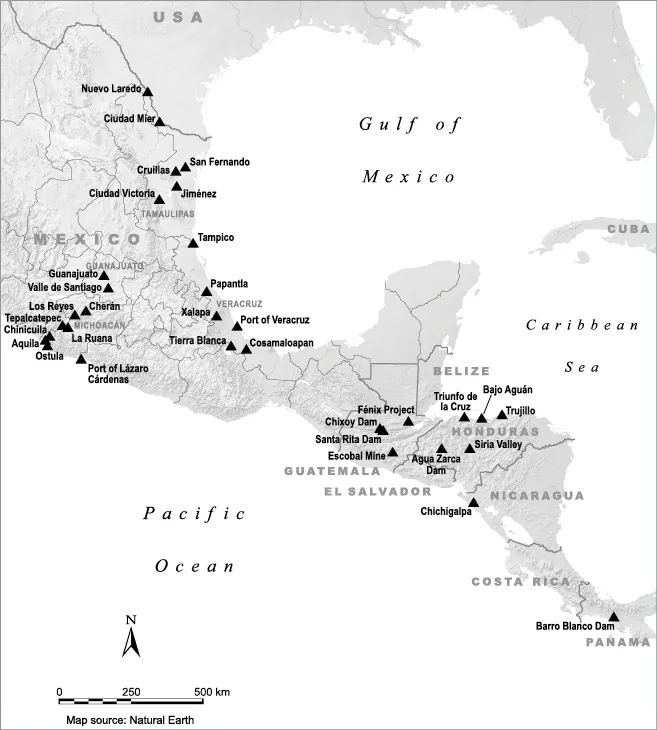
Map 1: Featured Conflict Sites in Mexico and Central America
Map 2: Featured Conflict Sites in South America
Introduction
Organized Violence and the Expansion of Capital
Simon Granovsky-Larsen and Dawn Paley
In early 2007, a public prosecutor in a suit with short, spiky hair, backed by hundreds of police and dozens of individuals with their faces covered to prevent identification, entered the lakeside lands occupied by Indigenous Q’eqchi’ people near the town of El Estor, Guatemala. Conflict had been ongoing for generations (Grandin 2004), and it came to a head again after local people grew tired of subsisting on tiny lots, and began to build houses on farmlands claimed at the time by Vancouver-based mining company Skye Resources. The lands had lain fallow for decades before Syke Resources attempted to reactivate the project, which was sold to Hudbay in 2008 and again to the Solway Group in 2011.
Filmmakers and journalists—including one of the editors of this volume—documented the evictions, which escalated from forced removal of community members by hired labourers, to the participation of soldiers and the burning of houses the next day, to the gang rape of eleven women in a more remote community days later. Following the dramatic and painful incidents in 2007, Adolfo Ich Chamán was shot and hacked to death by company security guards in 2009, and Germán Chub was shot and paralyzed in the same incident (see chocversushudbay.com).
The spectacular and organized violence set off against Q’eqchi’ people near Lake Izabal ten years ago was intended to clear the way for a nickel mine: Skye Resources planned to restart the Fénix Project, first floated by the Canadian mining company Inco in the 1960s. An array of state and non-state armed actors has participated in repressive violence in the region since the first arrival of Inco. During the evictions in early 2007, Guatemala...