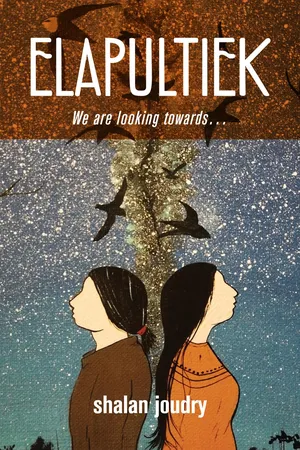
![]()
Scene 1
Meeting
(A camp fire in the middle of the woods close to an abandoned cabin with a tall brick chimney. Nat is tending the fire, dressed in a long cultural skirt. A smudge bowl and drum are close by. She sings a drum song before beginning.)
NAT: Wela’lioq. Wela’lioq to the earth, air, water, fire. Wela’lioq to the landscapes that influenced our history. Wela’lioq to all of the plants and animals who have made these lands what they are and continue to give up their lives to feed us. Wela’lioq to our ancestors, who survived incredible challenges and went on to birth new generations and passed on livelihoods so that we could be here today. Wela’lioq to not only the earth world but also the sky world. Thank you, Nakuset and Tepkunset, for lighting our way, day and night. And thank you, wela’lin to this fire. (She makes an offering to the fire.)
NAT: Grandmother, Nukumi, this isn’t how I thought I would be starting my fast, without you. I hope wherever you are in the spirit world that you’re taking care of Grandfather. What’s my path? I need your help in this fast to find a vision.
BILL (Calls from forest): Hello!
(Bill ENTERS with a pack and clipboard, startling Nat.)
BILL: Hi there. I didn’t mean to frighten you. I’m a biologist with the research institute. I’m here to count the endangered chimney swifts. Sorry, again. It looks like I’ve disturbed your campfire. Looks cozy.
(Nat is silent.)
BILL: Have you seen the chimney swifts?
NAT: Excuse me?
BILL: Chimney swifts. (Pulls out a guidebook from his pocket.) Here. They’re a small bird that nests and roosts in brick chimneys. They migrate and they’re just coming back from the south, joining each night now in the chimneys before they pair up to mate and nest in a few weeks. (Looks up to the sky.) They come back to the roost at dusk. There’s a few up there.
NAT: You can’t be here right now.
BILL: I’m conducting research, with permission. I’m here tonight, and then four more times over the next month. Did I introduce myself? I’m Bill, and you are?
NAT: Nat.
BILL: As in Natalie?
NAT: No.
BILL: Okay, Nat.
NAT: When do you come back next?
BILL: In five days. I don’t mean to push you out. You can stay. It’s really quite remarkable. They come clustering in the sky more and more until the group of them is swarming in this circle and then at some point they all spiral down the chimney.
NAT: Yeah.
BILL: Off they go to feed a little longer. They’ll all be back in a few minutes. What do you do, Nat? Are you in school?
NAT: I’m a singer.
BILL: What do you sing?
NAT: Drum songs.
BILL: You’re an Aboriginal? Micmac?
NAT: Mi’kmaw. Yes.
BILL: Okay. Good for you.
NAT: There’s some over there.
BILL: Yes. I’d say there’s about thirty swifts in the group now. (Looks to his clipboard.) I didn’t fill this in yet. Wind speed 3, I’d say. Cloud cover 40 percent. Temperature 17. State of chimney: weakened, possibly internally damaged.
NAT: What are you going to do with the papers?
BILL: Save the originals and copy them to send to the aerial insectivore specialists at Maritimes SwiftWatch. They coordinate the count nights.
NAT: Do you give the data back to the community here?
BILL: Other biologists do the stewardship part.
NAT: Then why are you at this spot, instead of just asking us in our community to do this? This is Mi’kmaw reserve land.
BILL: Actually, this is private land. The reserve boundary is right over there. This is where I come to monitor them. I speak with the landowner each spring to let him know I’ll be here by his old cabin.
NAT: I was always told this was reserve until the river. My grandparents used to bring me here. We always camp –
BILL: The property boundary is over there. They’re almost ready to dive in. I have to pay attention now.
(Silence.)
BILL: There we go. One!
(Bill jots on his papers. Nat looks to where the chimney/ birds are.)
BILL: Two more … ten, twenty, thirty, forty, fifty. Three. Wow, that was amazing. Two more.
NAT: There’s three more.
BILL: They’ll go in.
NAT: So this is all you do, count them and write it down?
BILL: There they go. Yes, I record the data and we analyze them and discuss it all at recovery team meetings.
NAT: But all you do here is count them? I can do that so you don’t have to. I’ll call the SwiftWatch people and let them know. Maybe I can bring some youth and it can be a youth project.
BILL: That’s quite all right. I have this covered.
NAT: Or we count and ask the Elders –
BILL: This is my job. I’m a biologist.
NAT: What’s the definition of a biologist?
BILL: Someone who studies the living world.
NAT: In that case, I’m a biologist.
BILL: Also, usually that means someone who’s formally trained in –
NAT: I would say my grandparents are biologists and my father, too.
BILL: (Scoffs.)
NAT: Nemultes, Bill!
(Nat EXITS.)
![]()
Scene 2
Counting Begins
BILL: Wind speed? I would say about a 1. Cloud cover 20 percent. Temperature 16 degrees.
(Nat ENTERS with safari clothes on.)
NAT: Metowlein, Bill?
BILL: Good evening, Nat. So we meet again.
NAT: E’he. Weli-wela’kw … Teke’k-ti. Kewji. Katu’ki’l? Epsin? Teknamuksin-ti. Peso’l. Ankapte’n koqowey ala’tu. (Takes out her clipboard.) I got the SwiftWatch forms.
BILL: You don’t have all the data.
NAT: For last time? Yes I do. Sixty-three, wasn’t it?
BILL: The protocol is to arrive a half-hour before dusk. You’re late.
NAT: I was checking on them up the river.
(Both are preparing their notes.)
BILL: Did you take biology in high school, Nat?
NAT: Grade ten, yes. But I was also taught differently by Mi’kmaw Elders and woodspeople.
BILL: Oh?
NAT: Elders taught me that some of what you call “non-living” are actually animate things to us. Like how we call sweatlodge rocks grandfathers because of their energy.
BILL: Science gives us an objective view.
NAT: ...