The phrase, “Canada is a nation of immigrants,” has been repeated so frequently that it has become a cliché; however, this fact has shaped and formed every aspect of Canada. Since Samuel de Champlain brought the first settlers to Port Royal in 1605, newcomers have crossed the Atlantic Ocean, and now the Pacific, to make this northern land their permanent home.1 For the most part, the First Nations peoples welcomed the newcomers but with tragic and devastating long term impacts. Throughout most of Canadian history, 16–20% of the population has been foreign-born. As these newcomers lived and worked, they also aged and eventually died in their new land. They aged in their homes and communities that they built themselves and with a steady stream of young immigrants, the aging of the older immigrants went unnoticed.
In recent years, two interesting demographic trends have been silently progressing. First, the Canadian population has been aging as the post war baby-boomers approach their senior years. Second, with greater choice, couples are having fewer children resulting in a population growth that is based upon immigration. These trends combine to form a new group of aging immigrants that seems to have evaded notice (Durst, 2005).
For those studying aging, the gerontologists have been slow to recognize ethnicity or culture as a relevant issue in the psycho/social process of aging. For many studying diversity, culture and ethnicity, social researchers have failed to recognize aging as a relevant variable. As recently as 1980, the public policy report called A Profile of Canada’s Older Population neglected ethnicity as a subject matter. Although social science researchers have always been interested in ethnicity and aging, little consideration has been given to the combined impact of these two intersecting variables. These developments have created a new field in social gerontology called Ethno-gerontology: the study of the influence of ethnicity, national origin and culture on individual and population aging (Chappell, Gee, McDonald & Stones, 2003). In recent decades, the source countries of immigrants have changed from European to Asian regions resulting in a significant increase in visible minorities. Elderly Canadians no longer appear the same. The senior populations are no longer homogeneous and have diversity in religion, values and customs.
Defining “Senior”: It Looks Different the Closer One Gets!
Aging and attitudes towards aging are culturally specific and change over time (McPherson, 2004). The connotations towards terms such as elder, old, and senior vary from highly regarded and respected to disdained and mocked. In western society, the gifts and gags associated with aging demonstrate a discriminatory “agism” not present in other cultures. With western emphasis on youth, elderly are often dismissed. About 100 years ago, Chancellor Otto von Bismark of Germany noted that the average life expectancy of his citizens was a mere 65 years of age. Feeling that a person did well to live that long, he implemented his retirement and pension programs for citizens aged 65 years. Over time, life expectancy has increased and yet his benchmark did not change. Anyone 65 years of age or older is considered in a broad nebulous category as “senior.” In China and other Asian countries with its youthful demographics, men are expected to retire at 60 years of age and women at 55 years.
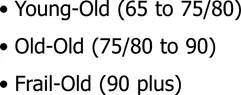
Curiously, “old age” is frequently considered as a single stage of life – infant, child, youth, young adult, mature adult and old age. A retired individual is “a retired senior” regardless of whether he is 65 or 95 years of age, representing a 30-year lifespan. It could be considered as similar to combining a 5-year-old child as part of the same life stage as a 35-year-old adult. Or, it would be similar to placing a 20-year-old adult and a 50-year-old together. The issues facing each age are very different and do not allow for simple comparisons. In order to address this problem, the “seniors” category is subdivided into three stages of aging: the young-old (65 to 75/80), the old-old (75/80 to 90) and the very-old or frail-old (over 90) (Suzman and Riley, 1985).
Figure 1 Stages of Seniors’ Aging
In spite of these categories, chronological age is a weak criterion for clustering or classifying individuals. It does not allow for individual and cultural diversity in economic, health and social capacities and deficiencies. For example, in Vietnam most women are expected to retire at 55 years of age and men at 60 years of age. With 50% of the population less than 25 years of age and the country having serious unemployment issues, “seniors” are expected to retire, giving their employment opportunities to younger persons with families. In many cultures including most Asian, elders are viewed with respect and as possessing special wisdom that begins before 65 years of age (Sung, 2001). In spite of the limitations of using chronological age, these age categories do allow statistical clustering and the application and analysis of census data.
As any parent will know, a child’s growth and development are most dramatic in the first 5 years of life. Other than these first years, the physical and mental changes during the last thirty years of life are more significant than at any other period. The three groups differ in important and significant ways but they all experience loss. Over time, persons experience financial loss (income, savings, increasing health costs), physical loss (strength, hearing, seeing, mobility), emotional loss (family, friends, death, isolation, loneliness) and mental loss (memory, cognitive, emotional control). The young-old often remain active, and normally, enjoy full and rewarding roles and activities. For some, this stage can be extremely expressive and creative. They are more like the “middle-aged” but with more time and sometimes more disposable money! The old-old experience increasing loss but can enjoy fulfilling lives with environmental and social supports. The very old are often physically and mentally impaired and need extensive supports sometimes from formal institutions (Schaie & Willis, 1998). They are often referred to as the “frail elderly” and these are the individuals who enter long-term care, regardless of their chronological age.
Canada’s Immigration Policies: Historical Racism
This section provides a brief background on Canada’s immigration with an emphasis on its implications for minorities. It critically examines the policies from its racist undertones and assumptions.2
The first immigrants to permanently settle in Canada were Europeans who began to arrive in this country at the beginning of the seventeenth century (Dirks, 1995). During the next three centuries, Canada’s population, comprised mainly of European immigrants, grew slowly. In 1763, the European population in the new colony of Canada stood at approximately sixty thousand. By Confederation in 1867, the number had reached approximately three million and was comprised mainly of British and French settlers (Dirks, 1995). At the beginning of the twentieth century, the population had only reached five million according to the 1901 Census (Verbeeten, 2007). However, by the 1950s, Canada’s population had grown to more than thirteen million, and with marked change in its ethnic composition. Up until then, only Europeans or white Americans were almost exclusively allowed into Canada (Dirks, 1995). The only exception, in terms of the presence of other ethnic groups, were the free and fugitive Black slaves from the United States, and Chinese immigrant laborers (Knowles, 1997).
In 1783, 3 000 free Blacks from among the British loyalists of the American Revolution were the first significant influx of refugees to settle in the colony of Nova Scotia (Knowles, 1997; Kelley & Trebilcock, 1998). The free Blacks, who expected that they would be dealt with on the same terms as white Loyalists in their new home, were faced with a scourge of racism and a host of other obstacles with regard to land grants and provisions. “Bitterly disappointed in their hopes of finding equality and a good life in Nova Scotia, nearly 1 200 of them sailed in 1792 for Sierra Leone to start afresh on the west coast of Africa” (Knowles, 1997, p. 24–25).
The first Chinese immigrants arrived in Canada from California in 1858 at the beginning of the Fraser River gold rush in the colony of British Columbia (Li, 1998; Knowles, 1997; Kelley & Trebilcock, 1998). By 1859, more Chinese immigrants arrived directly from Hong Kong on chartered ships. The largest numbers began arriving in the 1880s, after Andrew Onderdonk, an American builder, was awarded the contract to construct the section of the Canadian Pacific Railway from the Pacific Ocean through the Rocky Mountains (Knowles, 1997). Between 1881 and 1884, an estimated 15 701 Chinese men entered British Columbia, primarily to participate in the dangerous construction of that historic stretch of railway (Knowles, 1997, p. 50). They were treated with contempt and hostility (Lo & Wang, 2004) and in 1885, the Canadian government passed an act restricting and regulating Chinese immigration (Knowles, 1997). It came in the form of a Head Tax of $50 for every Chinese person from entering Canada and in 1903 it was raised to an astronomical $500, approximately two years of wages for a Chinese laborer (Fernando, 2006; Li, 1998). Despite the Head Tax, Chinese immigrants continued to trickle to Canada. In 1923, the Canadian Parliament passed the Chinese Immigration Act excluding all but a few Chinese immigrants and effectively ceasing immigration until 1947 when this Act was repealed (Fernando, 2006).
By the 1950s, 84.6% of immigrants living in Canada were European by birth (Dirks, 1995, p. 9). Between Confederation and the mid-twentieth century, Canada’s immigration policy consistently favored people from northern and western Europe as well as from the United States (Dirks, 1995, p. 9). In spite of this preference, by 1900, government immigration officials and railroad company land agents began to accept applicants from eastern and southern Europe to meet the need for farmers to develop the vast Canadian West (Dirks, 1995, p. 9; Knowles, 1997, p. 61–78).
Before the 1970s, the ideas and thinking that shaped the formulation of immigration policy in terms of the types and numbers of people to be admitted as immigrants revolved around three factors: (1) the preferred ethnicity of immigrants, (2) Canada’s “absorptive capacity” as measured by a variety of vague criteria, and (3) the economy’s presumed labor market requirements (Dirks, 1995; Knowles, 1997; Kelley & Trebilcock, 1998). In 1947, the Prime Minister, Mackenzie King, in a landmark statement on immigration he read to the House of Commons, reiterated these ideas of racism and discrimination. In that statement he defended Canada’s right to discriminate, stating that “the racial and national balance of immigration would be regulated so as not to alter the fundamental character of the Canadian population” (Dirks, 1995, p. 10; Knowles, 1997, p. 131). The contents of his statement became the guidelines that influenced the thinking of policy makers and officials for the next two decades (Dirks, 1995, p. 10).
By preferred ethnicity, Canada’s immigration policy sought to limit its selection or choice of immigrants to those from the United Kingdom, northern and western Europe, and the United States (Dirks, 1995; Knowles, 1997; Kelley & Trebilcock, 1998). A more liberal immigration policy was adopted during the post-World War II period. After the war, Canada’s economy was booming, creating a demand for both skilled and unskilled workers. However, immigration was still restricted mainly to immigrants from continental Europe (Knowles, 1997, p. 124). As a result of pressure and demand from the Canadian general public for Canada to admit World War II refugees and displaced persons from United Nations’ International Refugee Organization (IRO) camps in Europe, the Canadian government was compelled to adopt a more humanitarian immigration policy. Nearly a quarter of a million European refugees immigrated to Canada between 1946 and 1962 (Knowles, 1997, p. 124–144; Kelley & Trebilcock, 1998, p. 337). Ethnic origin was still central to the screening of these refugees and displaced persons. Acting on instructions from Ottawa, the Canadian immigration officials routinely rejected Jewish applicants and also took into account the persons political and ideological views that were considered incompatible with that of Canada (Knowles, 1997, p. 132–133).
By 1962, the wave of criticism from the Canadian public, especially the discriminatory nature of Canada’s immigration policy, resulted in significant changes (Kelley & Trebilcock, 1998, p. 345). In the centennial year of 1967, the Minister of Citizenship and Immigration in John Diefenbaker’s government tabled new regulations in the House that “eliminated racial discrimination as a major feature of Canada’s immigration policy” (Knowles, 1997, p. 151). Although this was a major and historic initiative on the part of the government, there were two factors that forced the government to take this action. First, racist policies were being attacked within Canada and the world over. During this period, there were international interest groups, churches, organized labor, and many liberal-minded Canadians criticizing Canada’s racially discriminatory immigration policy. This was also the period when South Africa was under condemnation for its apartheid policies and Australia under scrutiny for maintaining policies that favored white immigrants. As such, Canada could not afford to ignore the charges of racism in the “government’s practices and programs” (Dirks, 1995, p. 10). The other factor concerned the international impact of Canada’s discriminatory immigration policies. The policies were hampering its operations at the United Nations and the multi-ethnic Commonwealth. At this time the stronghold of Britain and other European empires, as colonial powers, was waning and independent nations in Asia, Africa, and the Caribbean were emerging. Canada needed to develop positive relations with these new governments that could not be possible with an immigration policy that “in practice excluded nonwhites” (Dirks, 1995, p. 10; Knowles, 1997, p. 152). In 1967, Canada implemented the “points system” that rated immigrant applicants on skills, language, education and other criteria rather than ethnicity or political/social background (Verbeeten, 2007). The po...