eBook - ePub
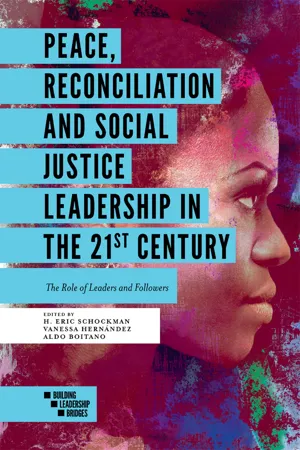
Peace, Reconciliation and Social Justice Leadership in the 21st Century
The Role of Leaders and Followers
- 328 pages
- English
- ePUB (mobile friendly)
- Available on iOS & Android
eBook - ePub
Peace, Reconciliation and Social Justice Leadership in the 21st Century
The Role of Leaders and Followers
About this book
Conflicts and violence,
repression and oppression have always been part of the world, resulting in
situations where no one really wins and leading to stalemates
that cause the degradation of economic order – and of the human condition.
Whether conflicts can be won or not, the human cost must be addressed when
building a lasting peace, and this role falls now to our future leaders
and followers.
In Peace, Reconciliation and Social Justice Leadership in the 21st Century, expert contributors explore the ways in which leaders and followers can bring forth pacifism, peace building, nonviolence, forgiveness and social cooperation. The chapters focus on the role of positive public policies on the national and international order, and the role leadership and followership plays in harmonizing differences and personifying space. They include lessons learned from post-conflict societies in Rwanda, Sri Lanka, Bosnia-Herzegovina, Chile, and others to remind us all that peace is a collective endeavour where no one can take a back seat.
Bringing together leading scholars and practitioners from the worlds of leadership, followership, transitional justice, and international law, this research provides a blueprint of how people-led, bottom-up, grassroots efforts can foster reconciliation and a more peaceful world.
Information
PART I
RECONCILIATION
Reconciliation is often regarded as an elusive and at times controversial concept. Nevertheless, reconciliation does occur in fractured societies arising from conflict, repression, and widespread human rights violations. Reconciliation starts with the acknowledgment of our shared and common humanity and dignity. Forgiving means that we are acknowledging that the other side is also human and that their children and ours deserve to live safely and peacefully. It involves building or rebuilding relationships toward a peaceful coexistence and an ongoing healing process as we will explore in the ensuing chapters, for example in the context of post-legalized slavery, post-apartheid, the trauma of the Balkans War, and the first signs of change in the Catholic Church tackling widespread and systematic clerical abuses. Reconciliation may take the form of a set of complex processes that could take generations, and which depends not only on the state, social organizations, but also on the agency and inclusive leadership and courageous followership of individuals.
Reconciliation may involve the processes based on acknowledgment of past wrongs, political and social customs reforms through economic and educational transformations, dealing with the structural causes of marginalization and discrimination. More so, it will take the preservation of memory spaces, and the eradication of negative stereotypes and attitudes such as the dehumanization of groups of individuals. Reconciliation is a massive undertaking and a long journey, which if successful may result in living a more secure environment, dealing peacefully with differences and reaching compromises based on the common consensus of a community.
To achieve sustainable peace, it is essential to reflect on the conditions of reconciliation. Can conflict be transformed without reconciliation? How should we work with the most traumatized vulnerable groups to ensure a bottom-up, community-led rather than a top-down healing process in creating viable communities?
Reconciliation can take place through the work of many different actors at several levels, and approaches will largely depend on the particular context. At the nation-state level, it may require putting policies in place to address structural issues that led to prior violations and injustice such as weak and corrupt institutions, a long history of impunity, as well as memory initiatives through memorials, monuments, ceremonies, education, the media, and social discourse and agreements aimed at non-repetition of past human right transgressions, among others. Reparations schemes for victims of past atrocities should aim to recognize and address the harms suffered by victims of human rights violations, restoring victims to their position as rightful bearers and members of a community. Another layer in which reconciliation can take place it is at the sociopolitical level, between groups – social, political, ethnic, religious, or others – manifested in social organizations, trade unions, churches, professional associations, and voluntary associations. Whenever possible reconciliation approaches should incorporate trust-building at the grassroots level. At the inter-personal level, reconciliation often focuses on the relationship between victims and perpetrators. When perpetrators face their victims, acknowledge the harm done and ask for forgiveness; when victims face their torturers and forgive, and each of them as individuals reconcile themselves with their past experiences, this may contribute to rebuild their lives and relationships with one another and find ways to live peacefully side by side.
Psychological wounds and trauma arising from conflict and violence can have long-lasting negative effects on victims, when a person is paralyzed by the fear caused by what they experienced, the shame and guilt of not being able to do anything in the face of the loss of relatives and the social stigmatization. Add hatred and rage resulting from the injustices perpetrated on them and sometimes with the impunity of the perpetrators going unaccounted for their crimes. The question is: What we can do?
The ensuing chapters explore several strategies and experiences capable of fostering reconciliation among those once divided in the aftermath of conflict or violence. Can the emotions and feelings victims be left with be transform into forgiveness that allows the violent experience to be reconceptualized and redefined to find a new perspective on life? The journey toward reconciliation and lasting peace is fraught with peril, challenges, and many setbacks; however, we argue that is not a utopian aspiration, and we can all play a meaningful role toward it. We hope these four chapters invite the reader to reflect on the role in leading and nurturing peaceful communities where reconciliation can flourish.
Reconciliation across generations has a very special meaning in Ira Chaleff’s chapter as he takes some concepts from his lifetime work and from his renowned book The Courageous Follower: Standing Up to and for Our Leaders (2009). Chaleff applies it to examine the growing awareness of the impact of the historic institutions of slavery and racial apartheid on current generations of those classified as “white” or “black” and how courageous leadership and followership contribute to the interracial healing process. Through this lens it examines the work required of all members of societies in which there are structurally advantaged and disadvantaged groups. Douglas Cremer’s chapter looks into Pope Francis brave leadership role as a papal leader in highlighting significant global crisis such as climate change, poverty, and the plight of refugees. Cremer also addresses in a revolutionary inclusive way, the internal turmoil at the center of the Catholic Church with a deep analysis of the widespread clerical sexual abuses and how reconciliation and forgiveness can play an existential healing role. Cremer astutely offers that these reforms and global stances cannot occur without the active participation of courageous followership in transparent alignment with new networks of local pastoral laity driven by the core aegis of the church: mercy. Charles David Tauber and Sandra Marić’s chapter addresses the often forgotten and overlooked role of psychological trauma in the healing and reconciliation process, the reintegration into society during and after conflict and working with vulnerable groups in the relapse to violent conflict due to unprocessed trauma. Sarah Chace in her chapter looks through the lenses of a “Holding Environment as Container” into the leadership process that took place in post-apartheid South Africa when the Truth and Reconciliation Commission (TRC) was formed. Chace argues and makes a strong case that a similar commission can bring dialogue and reconciliation in the United States around racial issues.
On this long journey toward lasting and sustainable peace, there are often many setbacks and disappointing events. However, as long as there is a historical memory of how terrible the violence was, people will understand that you cannot go back. We hope these four chapters will reflect for the reader to not stand idly by and motive us all never to forget.
1
LEADING AND FOLLOWING FOR TRANSFORMATION IN A RACIALIZED SOCIETY
ABSTRACT
The roots of racial injustice in the United States precede its formation as a nation and continue to send up shoots that bear toxic fruit. Leadership and followership are intrinsic both to the continuation of this condition and to its resolution. The brutality of 250 years of legalized enslavement resulted in generations of children forcefully fathered by white enslavers and their black “property” and disowned by the masters and their white families and communities. The current popularity of genealogy has ripped off the social masks of denial and documented significant numbers of “white” and “black” families who clearly share the same ancestry. This has presented a new challenge and opportunity for truth-telling, reconciliation, healing, and repairing the social injustice engendered by structural racism. This chapter explores the work of a group committed to this process. Through this lens, it examines the work required of all members of societies in which there are structurally advantaged and disadvantaged groups. The requirement is to step beyond the roles of perpetrator, victim, or passive bystander, into the roles of courageous follower and inclusive leader, in mutual service to personal and societal transformation.
Keywords: Racism; slavery; justice; reconciliation; trauma; followership; healing
In this chapter, I will examine the growing awareness of the impact of the historic institutions of slavery and racial apartheid on current generations of those classified as “white” or “black” and how courageous leadership and followership contribute to the interracial healing process. My focus on this European-American and African-American dynamic does not imply that other historic dynamics such as those between indigenous peoples and European-Americans is less problematic; rather, it is a function of my direct experience with the European-African dynamic, which I will bring into this essay. I will begin with a brief historical outline. It is imperative to keep this history in mind to understand and transform racial tensions and inequities today.
A central point for understanding why history matters comes from the field of chaos or complexity theory. One of the tenets of complexity theory, as introduced to the world of leadership studies by Margaret Wheatley (1999), is that small changes in the early conditions of a system can lead to dramatically different and magnified outcomes over time. In contemporary race relations, the practice, begun by the early sixteenth century, of capturing, enslaving, and selling Africans to work on the plantations of the Caribbean islands and the British colonies in America (Thomas, 1997), set in motion dynamics that continue to reverberate and dismay today.
This slave trade, and the institution of slavery it spawned, is now recognized as a crime against humanity of the first order of magnitude. Millions of people were ripped forcefully from their lives, shackled, and transported in brutal, traumatizing conditions, and sold to “owners” to use as they pleased. Being given the legal status of property, these enslaved people had not even a patina of protection against wanton sexual abuse of women or disfigurement and murder as instruments of terror to keep a potentially rebellious population under control (Feinstein, 2019).
This predatory state was further reinforced when the 13 colonies on the Atlantic coast of North America declared and waged war against Britain for their political independence. When the newly independent Americans worked through their process for organizing a government of free people, they wrote a constitution that did not directly name the inherently contradictory institution of slavery, but preserved it through a compromise that allowed the “importation of such persons as any of the States now existing shall think proper to admit” (US Constitution, Article I, Section 9) for 20 years, and counted enslaved people as three-fifths of a person, for purposes of representation and taxation (US Constitution, Article I, Section 2).
When the Southern states broke away from the larger Union in 1861, Southerners wrote their own short-lived constitution, in which the institution of slavery was explicitly named and protected. Only the wrenching American Civil War brought an end to these sovereign laws that sanctioned treating human beings as property to be used, abused, or disposed of with no regard to the dignity of individuals or the sanctity of family bonds. The ripples of these early conditions continue to roil the waters today. One can hardly characterize the relationship of enslavers as leaders and those enslaved as followers, any more than one can characterize a rapist as a leader and a rape victim as a follower. Nevertheless, if placed in the leader-follower continuum, slaveholders would undoubtedly see themselves as the leaders, whom the enslaved better damn well follow, or else! This is a brutal distortion of what we consider the bounds of legitimate leadership and followership, yet a distortion found all too commonly in history and in contemporary autocratic and dictatorial regimes.
When these power-imbalanced and values-corrupted regimes collapse, a reckoning must occur. In the case of the collapse of the apartheid regime in South Africa in the late twentieth century, many feared that the oppressed black “followers” would exact revenge on the deposed white “leaders.” Instead, the world witnessed an extraordinary act of restraint and an institutionalized process of forgiveness through the Truth and Reconciliation Commission, initiated by the former oppressed “followers” and skillfully guided by Bishop Desmond Tutu (Tutu & Tutu, 2014). Using its hard-won and tenuous power, the first black majority-elected officials, headed by Nelson Mandela (1994), demonstrated a generosity in leadership, based on high moral principles that black South Africans had never been accorded when in the oppressed followership role. Their approach became a model for post-conflict situations around the world.
No such reconciliation occurred in the United States after its fratricidal Civil War, from 1861 to 1865. The sudden emancipation of four million slaves from plantations that had been their only source of livelihood left a mass of destitute “followers.” Their immediate need was to survive in a war-devastated economy. The planned restitution of providing forty acres to freed black families per Union General Sherman’s Special Field Order Number 15, and the Freedman’s Bureau Act, never materialized (Foner, 2014). Efforts by freed black leaders to expand self-sufficient communities were largely thwarted (Blackmon, 2008; LaRoche, 2014), and the oppressive categories of “master” and “slave” were soon re-established in new, equally brutal forms of racial apartheid laws and extra-judicial violence. Per the National Association for the Advancement of Colored People (NAACP), between 1882 and 1968, there were over 3500 documented deaths by mob lynching of black people in the United States. It was only a century after the war’s end, when black “followers” refused any longer to follow oppressive white “leadership,” and birthed their own true leadership and followership in the Civil Rights Movement, that the legal structure of racial apartheid began to crumble (Morris, 1984).
Yet even to this day, echoes of the American apartheid system reverberate in the mass incarceration of African-American men and the overuse of lethal force toward them by law enforcement officers. African-Americans are incarcerated at five times the rate per capita as whites (Alexander, 2010). Police shootings of unarmed black men continue to make national headlines with distre...
Table of contents
- Cover
- Title Page
- Introduction: On Peace, Reconciliation, and Social Justice
- Part I Reconciliation
- Part II Community Building: To Make, Build, and Maintain Peace
- Part III International Law and Social Justice
- Part IV Peacebuilding
- Index
Trusted by 375,005 students
Access to over 1.5 million titles for a fair monthly price.
Study more efficiently using our study tools.
Frequently asked questions
Yes, you can cancel anytime from the Subscription tab in your account settings on the Perlego website. Your subscription will stay active until the end of your current billing period. Learn how to cancel your subscription
No, books cannot be downloaded as external files, such as PDFs, for use outside of Perlego. However, you can download books within the Perlego app for offline reading on mobile or tablet. Learn how to download books offline
Perlego offers two plans: Essential and Complete
- Essential is ideal for learners and professionals who enjoy exploring a wide range of subjects. Access the Essential Library with 800,000+ trusted titles and best-sellers across business, personal growth, and the humanities. Includes unlimited reading time and Standard Read Aloud voice.
- Complete: Perfect for advanced learners and researchers needing full, unrestricted access. Unlock 1.5M+ books across hundreds of subjects, including academic and specialized titles. The Complete Plan also includes advanced features like Premium Read Aloud and Research Assistant.
We are an online textbook subscription service, where you can get access to an entire online library for less than the price of a single book per month. With over 1.5 million books across 990+ topics, we’ve got you covered! Learn about our mission
Look out for the read-aloud symbol on your next book to see if you can listen to it. The read-aloud tool reads text aloud for you, highlighting the text as it is being read. You can pause it, speed it up and slow it down. Learn more about Read Aloud
Yes! You can use the Perlego app on both iOS and Android devices to read anytime, anywhere — even offline. Perfect for commutes or when you’re on the go.
Please note we cannot support devices running on iOS 13 and Android 7 or earlier. Learn more about using the app
Please note we cannot support devices running on iOS 13 and Android 7 or earlier. Learn more about using the app
Yes, you can access Peace, Reconciliation and Social Justice Leadership in the 21st Century by H. Eric Schockman, Vanessa Hernández, Aldo Boitano, H. Eric Schockman,Vanessa Hernández,Aldo Boitano in PDF and/or ePUB format, as well as other popular books in Business & Management. We have over 1.5 million books available in our catalogue for you to explore.