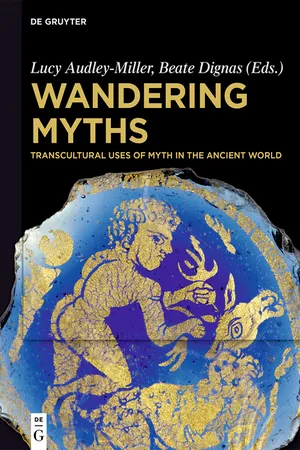
In spite of the growing amount of important new work being carried out on uses of myth in particular ancient contexts, their appeal and reception beyond the framework of one culture have rarely been the primary object of enquiry in contemporary debate. Highlighting the fact that ancient societies were linked by their shared use of mythological narratives, Wandering Myths aims to advance our understanding of the mechanisms by which such tales were disseminated cross-culturally and to investigate how they gained local resonances. In order to assess both wider geographic circulations and to explore specific local features and interpretations, a regional approach is adopted, with a particular focus on Anatolia, the Near East and Italy. Contributions are drawn from a range of disciplines, and cross a wide chronological span, but all are interlinked by their engagement with questions focusing on the factors that guided the processes of reception and steered the facets of local interpretation. The Preface and Epilogue evaluate the material in a synoptic way and frame the challenging questions and views expressed in the Introduction.
eBook - ePub
Wandering Myths
Transcultural Uses of Myth in the Ancient World
- 481 pages
- English
- ePUB (mobile friendly)
- Available on iOS & Android
eBook - ePub
Wandering Myths
Transcultural Uses of Myth in the Ancient World
About this book
Information

Part I:Changing Cultural and Mythical Landscapes in Anatolia
Ian Rutherford
Kingship in Heaven in Anatolia, Syria and Greece
Patterns of Convergence and Divergence
Introduction
Anyone who studies mythology in different ancient cultures will sooner or later be struck by similarities between them, and wish to understand how such similarities come about. There are three general ways of explaining similar story-patterns in different cultures:
- as coincidence;
- as common cultural patterns that go back very early in human pre-history; and
- as diffusion, either long-term over several millennia (3a) or more recently (3b).
A recent proponent of position 2 is the Harvard indologist Michael Witzel who in The Origins of the World’s Mythologies (2012) argues that many of the similarities between the mythologies of different cultures can be traced back to the period before the human migrations of the late Stone Age. He makes a primary distinction between features shared by cultures of Eurasia and the Americas (for which he uses the geological term “Laurasia”), and those of Africa and Australasia on the other (for which the analogous geological term is “Gondwana”) which in his view diverged around 40,000 BC. For Witzel some diffusion may have taken place subsequently, but for the most part parallels are to be explained by movements of people rather than of myths.
Scholars of early Greek literature and myth have for the most part had a more limited focus. In recent decades they have been concerned particularly with two types of diffusion. One is cross-cultural diffusion from the Ancient Near East (ANE), either in the Late Bronze Age (1400–1200 BC) (LBA) or the “Orientalising Period” (eighth century BC).135 The other is linguistic and cultural diffusion associated with speakers of Indo-European languages who are believed to have spread from a common homeland, probably around the Black Sea.136 The problems posed by the two cases are slightly different, but one thing they share is that there exists widespread disagreement about how significant diffusion actually was.
To take the case of the purported diffusion from the ANE, some have argued for widespread and comparatively recent diffusion from East to West, given archaeological evidence for the movement of material culture, and textual evidence for the existence of similar patterns in different cultures.137 For others trying to pinpoint borrowing is futile given the limitations of our knowledge, and the most we can reasonably do is make comparisons.138 Witzel’s work serves as a warning that diffusion is not the only way of explaining shared cultural patterns. If we are to make a convincing case for it, we have to show that it is more likely than the other hypotheses. One way of doing that might be to point to the existence of parallel names in narratives in two different traditions. Another might be to demonstrate a critical mass of parallels between narratives in two different traditions. It is also important to be able to present a persuasive narrative about how it comes about.
The Succession Myth and the Near East
The strongest case for diffusion between the Near East and Greece (and one that convinces Witzel)139 is that of the Divine Succession Myth as we find it in Hesiod’s Theogony. Myths about the origin of the gods and their early battles are found in various cultures of the Near East, including Babylon and Ugarit, but the best parallel for Hesiod’s version, as has long been known, is a Hittite narrative, known now as the “Song of Coming Forth”, the surviving text of which, like those of other Hittite myths, comes from the archives of the Hittite capital at Boghaz-Köy in central Anatolia. Along with at least two other narratives it forms a sequence charting the origins of the Storm god and his early battles with monstrous challengers. These texts seem to have a background in the narrative literature and religion of the Hurrians of North Syria, with whom the Hittites had strong cultural links from the early sixteenth century BC. The Hurrian language (which was neither Indo-European not Semitic) is still imperfectly understood, and we have little independent information about their literature, although we know they had themselves absorbed the elements of the earlier cultures of Syria and Mesopotamia, and at an earlier point, when they lived further to the East, they seem to have been in contact with Indo-Iranians. The Hittite versions of the myths have sometimes been thought to be translations from Hurrian ones, but the more recent thinking is that they should be seen as loose adaptations.140
Hittite religion and poetry were in fact deeply multicultural. They had taken over central Anatolia from an earlier “Hattic” culture (another non Indo-European language) whose religion and mythology they continued to use. They also absorbed elements of another culture or group of cultures, the Luwians (Luwian was another Indo-European language closely related to Hittite), who occupied parts of southern and western Anatolia. The Hittite archives contain texts translated from Hattic and Hurrian (as well as original versions), and in addition ritual texts collected from as far away as Arzawa in the west of Anatolia and Babylon. The Hittites were in diplomatic contact with Ahhiyawa (Mycenaean Greece), and one text from about 1300 BC gives us the startling information that the deities of Ahhiyawa and Lazpa (surely the island of Lesbos) were somehow present in the Hittite capital.141
The Hittite archives preserve about twenty narrative-myths, a fairly small proportion of all Hittite texts of which there are many hundreds.142 Four major classes of narrative texts are:
–narratives about the gods’ conflict with the snake Illuyanka (Hoffner 1); see below §6.
–narratives relating to vanishing gods (Hoffner 2–8); these resemble Greek myths of disappearing gods, such as that of Demeter, but it is impossible to prove influence either way.143 A feature of the vanishing god narratives, as well as of the Illuyanka narratives, is that the texts supply information about the ritual context of their performance, something which tends to be absent from Greek myths and which scholarly ingenuity has long tried to supply.
–narratives relating to the theme of kingship in Heaven, adapted from Hurrian (Hoffner 14–18);
–other translations and adaptations: of the Babylonian epics of Gilgamesh and Atrahasis;144 and of an Ugaritic tale, Elkunirsa and Ashertu (Hoffner 21); an early Hittite tale, the story of the queen of Kanesh and her thirty sons and thirty daughters (Hoffner 19). The most recent addition has been a bilingual Hurrian and Hittite text called “The Song of Release”, which includes narratives involving both gods and humans (Hoffner 18a). Most of these narratives involve cultural translations of one sort or another; even the vanishing god narrative and the Illuyanka narratives may be translated from the “Hattic” sphere.
Remarkable as the Hittite narratives are, they are unlikely to have been unique in this period. A significant corpus of narratives has also been found at Ugarit (see below §5), and it seems likely that similar myths were composed, performed and archived in many parts of the Ancient Near East. For example, it has been recently argued that there was an early Levantine myth narrating the battle of the Storm-god with the Sea-deity, which had a deep influence on the Hurrian-Hittite tradition (see below). Mythical narratives seem to have wandered easily from one culture to another at this time. Their movement is particularly easy to observe within what we might call the zone of cuneiform culture (from Mesopotamia, Syria, Anatolia), but Syrian and Mesopotamian narratives even reach Egypt.145 They might well have reached the Aegean as well, or indeed moved from the Aegean to Anatolia and Syria;146 Hittite influence extended to areas where Greeks may well have encountered it, especially the West of Anatolia (known in the Late Bronze Age as “Arzawa”), but also the South-East (“Kizzuwatna”) and even the Black Sea coast;147 in the case of Syrian and other Near-Eastern myths the contact zone could have been the Levant or Cyprus.
Why might such myths wander? One facilitating factor is probably that different states had shared ideas about the gods, who are thus “translatable” (cf. M. S. Smith 2008). Walter Burkert in the 1980s argued for the importance of wandering ritual practitioners in cultural transfer (and cosmogonies are known to have been recited during rituals).148 Another context for wandering might be festivals, attended by travelling singers,149 and official delegates from different states.150 A further key factor could have been political ideology, which myth supports: a letter from Mari (eighteenth century BC) transmits a message to King Zimri-Lim purporting to come from the god Addu of Aleppo, saying that he had sent him the weapon with which he had battled the Sea (the first evidence for the existence of that myth), a piece of information which would obviously have been useful propaganda for Zimri-Lim.151 Similarly, in neo-Assyrian royal inscriptions the king may be presented as following in the footsteps of the victorious storm god Marduk, smiting his enemies.152
Hurrian-Hittite Myths: The Song of Coming Forth and the Tarpanalli-Narratives
Three Hittite mythical narratives which chart the early history of the gods seem to belong together.153 The first is the “Song of Going Forth” (“SÌR par...
Table of contents
- Cover
- Title Page
- Copyright
- Contents
- Preface
- Introduction
- Part I: Changing Cultural and Mythical Landscapes in Anatolia
- Part II: Reception and Innovation of Mythological Programmes between Greece and Italy
- Part III: Wandering East, Wandering South
- Epilogue
- Index
Trusted by 375,005 students
Access to over 1.5 million titles for a fair monthly price.
Study more efficiently using our study tools.
Frequently asked questions
Yes, you can cancel anytime from the Subscription tab in your account settings on the Perlego website. Your subscription will stay active until the end of your current billing period. Learn how to cancel your subscription
No, books cannot be downloaded as external files, such as PDFs, for use outside of Perlego. However, you can download books within the Perlego app for offline reading on mobile or tablet. Learn how to download books offline
Perlego offers two plans: Essential and Complete
- Essential is ideal for learners and professionals who enjoy exploring a wide range of subjects. Access the Essential Library with 800,000+ trusted titles and best-sellers across business, personal growth, and the humanities. Includes unlimited reading time and Standard Read Aloud voice.
- Complete: Perfect for advanced learners and researchers needing full, unrestricted access. Unlock 1.5M+ books across hundreds of subjects, including academic and specialized titles. The Complete Plan also includes advanced features like Premium Read Aloud and Research Assistant.
We are an online textbook subscription service, where you can get access to an entire online library for less than the price of a single book per month. With over 1.5 million books across 990+ topics, we’ve got you covered! Learn about our mission
Look out for the read-aloud symbol on your next book to see if you can listen to it. The read-aloud tool reads text aloud for you, highlighting the text as it is being read. You can pause it, speed it up and slow it down. Learn more about Read Aloud
Yes! You can use the Perlego app on both iOS and Android devices to read anytime, anywhere — even offline. Perfect for commutes or when you’re on the go.
Please note we cannot support devices running on iOS 13 and Android 7 or earlier. Learn more about using the app
Please note we cannot support devices running on iOS 13 and Android 7 or earlier. Learn more about using the app
Yes, you can access Wandering Myths by Lucy Gaynor Audley-Miller,Beate Dignas in PDF and/or ePUB format, as well as other popular books in History & Ancient History. We have over 1.5 million books available in our catalogue for you to explore.