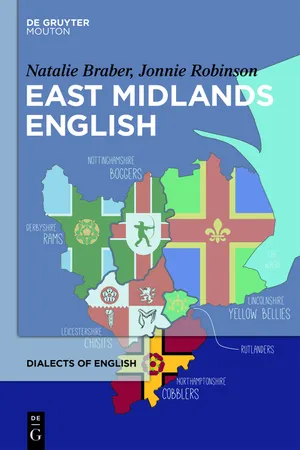
This volume will provide a comprehensive yet accessible description of East Midlands English, an area of neglect in linguistic research. Existing publications, which aggregate the findings of earlier surveys and more recent localised studies presenting an overview of regional speech in the UK, are either lacking up-to-date research data from the East Midlands or simply ignore the region.
A coordinated survey of dialects of the East Midlands was part of the Survey of English Dialects (SED) in the 1950s. This data is now over sixty years old and focuses almost exclusively on broad rural dialect speakers. This book will fill the knowledge and literature gaps by comparing vernacular speech in different urban and rural locations in the East Midlands, and examining whether the East Midlands is a 'transition zone' between the North and South. Recordings held by the British Library will be used, and will be supplemented with recordings made with local speakers.
Language in the East Midlands is distinctive and there is considerable regional variety, for instance, between speech in the major urban centres of Nottingham, Derby and Leicester. Bringing out this regional variation will also improve our wider understanding of language variation in English. The concept of the East Midlands in itself is not a clear one, and this volume aims to address such issues and to examine what makes the East Midlands an area of itself and what this area includes.
The East Midlands includes a variety of types of towns and countryside, ranging from the uplands of north-west Derbyshire to the lower levels of the Lincolnshire fens in the east. It is an area which has received relatively little linguistic study and is frequently overlooked in overviews of language variation in the UK. This chapter provides an outline of the geographical, historical and linguistic background of the region. This region is not an unproblematic one and this chapter aims to discuss these issues and justify our particular focus. The purpose is to examine the features which unite and differentiate the localities within the region as well as surrounding regions and justify why the East Midlands is a variety worthy of investigation.
1.2 Geography of the East Midlands
Geographically, the region poses some ambiguities, for example, what exactly is included within the East Midlands (for full details see Braber 2014). The Nomenclature of Territorial Units for Statistics (NUTS) defines the East Midlands as containing the six counties of Derbyshire, Leicestershire, Lincolnshire, Northamptonshire, Nottinghamshire and Rutland. However, there are problems with such definitions, as they are not universally agreed upon in the literature, with particular problems surrounding Lincolnshire and Northamptonshire (see for example Beckett 1988: 2–3; Horton and Gutteridge 2003: iii). Beckett states that there is no doubt that the ‘East Midlands’ has existed since the 1980s due to the presence of the airport and many organisations and services which use the definition ‘East Midlands’ (Beckett 1988: 2). But this is not an automatically formal or natural region and is therefore used differently by different people and organisations (see also Read 1981: 4). K.C. Edwards, who was founder and first editor of the East Midlands Geographer incorporated the six counties stated above on “the grounds that since this was the 1939 administrative unit for Civil Defence it was functionally coherent” (Edwards 1954, cited by Beckett 1988: 2). Others have included Oxfordshire, Bedfordshire and Huntingdonshire (Holderness 1979: 27 cited by Beckett 1988: 2–3). Others have omitted the Lincolnshire Fenlands or concentrated on Derbyshire, Leicestershire and Nottinghamshire (for all these see Beckett 1988: 2–3). Palmer and Neaverson (1992: xii) comment that “Derbyshire, Nottinghamshire and Leicestershire, including Rutland, are generally accepted as part of the area” and add that Lincolnshire shows a separate and distinctive development. Townsend comments that it was not “renamed the East Midlands until 1965” (Townsend 2006: 4) and that it is a difficult region to define and describe.
The East Midlands (see Figure 1.1) forms England’s fourth largest region making up 12% of England’s land area, spread over 15,600 km2 and consisting of most of the eastern half of the traditional region of the Midlands. It has a population of just over 4.5 million people (7% of the UK total), making it one of the less populated regions of the UK (data taken from www.nomisweb.co.uk and the Office for National Statistics). It is a largely rural area and half of the population live in and around Nottingham, Derby and Leicester. The region has the second lowest population density in England (East Midlands Regional Plan 2009: 5). It has no areas which are classified as ‘Major Urban’, suggesting much of the region is rural. It is an area with many natural resources, including coal, limestone, igneous rock and iron.
Figure 1.1: Map of the East Midlands (map from www.picturesofengland.com).
For this study, only Derbyshire, Leicestershire and Nottinghamshire are included in the linguistic analysis. However, these counties include the three main urban centres of the region, containing the three largest cities, that is, Nottingham, Derby and Leicester, and as such the most easily recognised centres of the East Midlands. They are frequently treated as the base of the East Midlands, both in official contexts and by many inhabitants. For example, the BBC East Midlands Today news programme, despite its title, currently excludes most of Northamptonshire, north Nottinghamshire and north Derbyshire, while most of Lincolnshire is covered by the BBC’s Yorkshire and Lincolnshire region. Northamptonshire is part of the BBC East region, based in Norwich, and can also receive Central News East, with the south of the county receiving Thames Valley. Given the important role of local news media in representing and constructing regional identity, this suggests that the counties of Lincolnshire and Northamptonshire might be regarded as peripheral to the ‘core’ East Midlands region. Northamptonshire has a greater focus towards southern England, while Lincolnshire is on the periphery of the East Midlands, distinctly more rural and due to its large size, certain areas are connected more closely to East Anglia or Humberside. Because of these issues, the ‘three shires’ of Derbyshire, Leicestershire and Nottinghamshire will be chosen to represent the East Midlands in this book.
1.3 History of the region and its language
The 1951 Ordnance Survey Map of Prehistoric Britain shows only 29 locations in the East Midlands before the time of the Romans. However, Stocker (2006: 35) suggests that this does not mean that there were no people in the region before this time, but that it is likely that as one of England’s main arable areas such historic sites may have been eradicated. Molyneux and Dwelly claim that the East Midlands “can claim the site of some of the oldest known homes in Britain” (Molyneux and Dwelly 1992: 13). They discuss that cave dwellings at Creswell Crags (between Chesterfield and Worksop) prove habitation of the region over 100,000 years ago and that these are like to have been occupied until Roman invasion.
The dialects of the East Midlands owe aspects of their lexis and syntactic structure to Nordic influences, as the region was part of the Danelaw resulting from Danish invasion in the late 9th century. This created the partition of Mercia and is roughly the region of the East Midlands today. This is still clearly seen in some place names which retain these influences, for example the ‘thwaite’ (woodland clearing) sometimes converted to ‘wood’ as in Eastwood, ‘thorpe’ as in Woodthorpe (outlying farm or settlement) and ‘by’ as in Derby (homestead or village). This is discussed in more detail in section 4.3.
By 942, Nottingham, Lincoln, Stamford, Derby and Leicester had been named ‘burhs’ which during the Danelaw suggested fortification and urban settlement (Stocker 2006: 198). This domination lasted only a short time and by the early 10th century the East Midland counties had been incorporated into the kingdom of the English (Beckett 1988: 3). Nottinghamshire was a county by 1016 and Derbyshire by 1049, although they may actually have been founded earlier. By 1089 the populations of Nottingham, Leicester, Stamford and Northampton were likely to have been greater than 2,000 and the largest city at the time, Lincoln, may have had a population of around 10,000 (Stocker 2006: 72). Nottingham, Leicester and Derby became important regional agricultural and industrial centres and grew increasingly large. Important industries included coal mining, stone quarrying and the textile industry, but farming has long dominated the region.
By the time of the census in 1801, the distribution of population and settlement in the region bore a close resemblance to the patterns occurring after Anglian and Danish colonisation although the actual numbers were obviously higher than previously (Osborne 1966: 341).
As will be discussed in the following section, there are few contemporary studies on language variation ...
Table of contents
Cover
Title Page
Copyright
Contents
List of Figures
List of Tables
Acknowledgements
Map of the East Midlands
1 Geography, demography, and cultural factors
2 Phonetics and phonology
3 Morphology and syntax
4 Lexis
5 Annotated transcripts
6 Annotated bibliography and references
Index
Trusted by 375,005 students
Access to over 1.5 million titles for a fair monthly price.
Study more efficiently using our study tools.
Frequently asked questions
Yes, you can cancel anytime from the Subscription tab in your account settings on the Perlego website. Your subscription will stay active until the end of your current billing period. Learn how to cancel your subscription
No, books cannot be downloaded as external files, such as PDFs, for use outside of Perlego. However, you can download books within the Perlego app for offline reading on mobile or tablet. Learn how to download books offline
Perlego offers two plans: Essential and Complete
Essential is ideal for learners and professionals who enjoy exploring a wide range of subjects. Access the Essential Library with 800,000+ trusted titles and best-sellers across business, personal growth, and the humanities. Includes unlimited reading time and Standard Read Aloud voice.
Complete: Perfect for advanced learners and researchers needing full, unrestricted access. Unlock 1.5M+ books across hundreds of subjects, including academic and specialized titles. The Complete Plan also includes advanced features like Premium Read Aloud and Research Assistant.
Both plans are available with monthly, semester, or annual billing cycles.
We are an online textbook subscription service, where you can get access to an entire online library for less than the price of a single book per month. With over 1.5 million books across 990+ topics, we’ve got you covered! Learn about our mission
Look out for the read-aloud symbol on your next book to see if you can listen to it. The read-aloud tool reads text aloud for you, highlighting the text as it is being read. You can pause it, speed it up and slow it down. Learn more about Read Aloud
Yes! You can use the Perlego app on both iOS and Android devices to read anytime, anywhere — even offline. Perfect for commutes or when you’re on the go. Please note we cannot support devices running on iOS 13 and Android 7 or earlier. Learn more about using the app
Yes, you can access East Midlands English by Natalie Braber,Jonnie Robinson in PDF and/or ePUB format, as well as other popular books in Languages & Linguistics & Linguistics. We have over 1.5 million books available in our catalogue for you to explore.