eBook - ePub
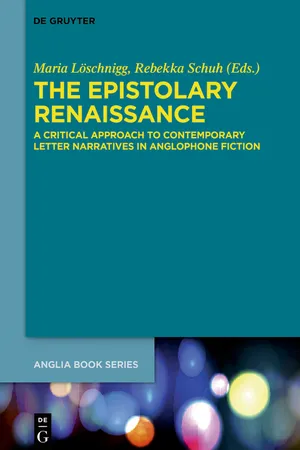
The Epistolary Renaissance
A Critical Approach to Contemporary Letter Narratives in Anglophone Fiction
- 305 pages
- English
- ePUB (mobile friendly)
- Available on iOS & Android
eBook - ePub
The Epistolary Renaissance
A Critical Approach to Contemporary Letter Narratives in Anglophone Fiction
About this book
No detailed description available for "The Epistolary Renaissance".
Information
Part I: Contemporary Epistolary Fiction: New Approaches
Maria Löschnigg, Rebekka Schuh
Epistolarity
Theoretical and Generic Preliminaries
Abstract: Contemporary epistolary fiction calls for new critical approaches which do justice to the specificities of the form as it has emerged in the wake of the epistolary renaissance. This chapter therefore provides an overview of the central narratological issues of epistolarity. These include a generic distinction between the letter and the diary (which cannot be separated from the question of the presence/absence of the figure of the internal reader), the temporal and spatial complexity of epistolary fiction, multiperspectivity, and the fragmentation of linear storylines. The impact of digital forms of communication on the novel/short story as well as variants of partially and occasionally epistolary fiction will be further issues addressed in this chapter. The final part is devoted to the epistolary short story as a distinct literary form.
1 Introduction
While many aspects of epistolarity have already been addressed by Altman, Beebee, Bray and others (see “Introduction”), this chapter focuses on the specificities of contemporary epistolary fiction in novel and short story form. Bearing in mind that “novels written entirely in letters have become comparatively rare” (Bowers 2009: n. pag.) and that the re-emergence of the epistolary form in the late twentieth and the early twenty-first century is linked to a trend towards partially epistolary fiction, it is necessary for narrative theory to do justice to this shift. Following modern definitions of epistolary writing, which include hybrid forms where the epistolary voice is no longer limited to the letter but “unfolds through multiple forms of communication that have descended from the letter” (Bowers 2009: n. pag.) and which is combined with other (non-epistolary) narrative voices, this volume draws attention to the elasticity and adaptability of epistolary fiction, which, among other factors, has contributed to the form’s survival and renaissance. This is also confirmed by Linda Kauffman (1992: xiv), who argues that the “very looseness of its [the epistolary mode’s] conventions has made it resilient, adaptable, and relevant in diverse historical epochs”. The fact that a number of contemporary works of epistolary fiction, and especially epistolary short stories, “use a mixed mode, in which letters carry not all of the narrative” (Beebee 1998: 385) renders it necessary to distinguish between the term ‘epistolary fiction’ on the one hand (i. e. narrative literature which includes epistolary modes that propel the plot and are essential for the structural denotation of meaning), and the various epistolary modes (including letters, postcards, and digital forms of communication) integrated into the narrative on the other. In fact, the integrated elements which are (usually) visually marked as separate texts assume a dual status as they constitute an autonomous meaning-making unit while simultaneously adopting a different semantic status as soon as they are deciphered as parts of the whole narrative. What Altman (1982: 169) says about letters in this context is similarly applicable to the different digital modes staged in a large number of contemporary epistolary novels: “Within the epistolary work the letter has both a dependent and an independent status. Like tesserae, each individual letter enters into the composition of the whole without losing its identity as a separate entity with recognizable borders”. However, no matter whether we encounter an all-epistolary, a partially epistolary or an occasionally epistolary work of fiction (cf. Bowers 2009: n. pag.), in all cases the intrinsic features of epistolarity have to be considered with regard to the assembled or interpolated epistolary units and their aesthetic effects.
This chapter will thus first offer a narratologically based distinction between epistolary and diary modes and discuss it against the backdrop of the letter novel’s long-lasting status as an ideal narrative medium for rendering subjective consciousness. Meta-narrativity as well as the temporal and spatial complexity of the epistolary novel and short story will also be addressed in this theoretical approach. Other genre-specific aspects of epistolary fiction such as multiperspectivity, the breaking up of linear story lines and the frequent use of editor or collector characters will be discussed with regard to their potential to challenge the myth of coherent and unified identities and of notions of subjectivity independent from the impact of social, cultural and political influences. In addition to considering new functions of epistolary fiction that result from contemporary experiments with this form as well as from the specific ideological, social and cultural context of the late twentieth and the early twenty-first century, this chapter will also address the impact of new media on narrative fiction and the definition of epistolarity. A typology of different epistolary functions employed in contemporary epistolary fiction, ranging from I-related to you-related manifestations of epistolarity, as well as a communicative model of contemporary epistolary fiction will offer applicable and adaptable categories for the further study of epistolary literature. While most of the parameters elaborated in the following four sections apply to both the novel and the short story, there are aspects of epistolary short fiction which demand specific consideration. The chapter therefore closes with an approach to epistolary short fiction as a distinct literary form.
2 Epistolarity and the Instance of the Internal Reader
As mentioned before, contemporary epistolary fiction more often than not appears in tandem with other narrative forms (diary, figural third-person narration, retrospective first-person narration, authorial narration). However, it is paramount all the same to identify the epistolary mode used in these novels or short stories as a distinct form of narrative expression defined by clear generic markers. In this context, Janet G. Altman (1982: 200) rightly criticizes tendencies to focus mostly on thematic concerns, pointing out that “all studies of the epistolary genre, whatever their approach, depend most fundamentally on some concept – intuitive or systematic – of the genre’s structural constituents”. Agreeing with Altman (1982: 88) that the most essential genre-determining feature of epistolary discourse is the presence of an intratextual addressee shaping the content, style and purpose of the epistolary text, it follows that clear distinctions must be made between the diary and the letter (or other addressee-related forms of communication). Even though, as Bayer notes, “criticism has found it cumbersome to differentiate between the two narrative modes” (2009: 173), it cannot be ignored that this blurring of boundaries between the diary and the letter (or its electronic equivalents) prevents an appropriate assessment of the different narrative potentials of both modes. Given that the “letter writer simultaneously seeks to affect his [sic!] reader and is affected by him [sic!]” (Altman 1982: 88), epistolary writing can never be the “transcribing [of] uncensored streams of consciousness” or “thinking out loud”, as Ruth Perry (1980: 128) puts it.
Obviously, there are numerous features which diary fiction and letter fiction have in common: both are first-person narratives which are usually characterized by a minimal distance between or even near coalescence of the experiencing and narrating self, both fragment linearity through division into autonomous textual entities, and both are frequently “shown as collected, exchanged, edited and published”, thus “account[ing] for their own origins” (Beebee 1998: 385). However, a number of features remain which decisively distinguish these two modes and testify to the individual letter’s unique discursive status as a specifically crafted hypotext. The most important of these distinctive features is the presence of an intratextual addressee in epistolary texts. One should add here that in the case of confessional letters, especially those which are addressed to a reader who is already dead or who is never meant to receive the letters in the first place, the epistolary mode does indeed lean towards the diary mode without, however, entirely coalescing with it. A novel where this becomes evident is, for example, T. R. Richmond’s What She Left (2015). Here, Jeremy Cooke’s confessional letters to his friend Larry do not only continue when, at one point, Jeremy finds out that his friend is dead, but they also show that the envisioning of a concretized internal reader continues to affect the content as well as the style of these letters. Another example is Charlie from Stephen Chbosky’s coming-of-age novel The Perks of Being a Wallflower (1999), who writes letters to an unknown recipient whom he chooses as a confident because he hears that this person is ‘nice’. The letters serve a therapeutic function for the fifteen-year-old, and he stops his letter writing as soon as he comes to terms with the traumatic experiences of the past.3 Again, it is by no means insignificant to whom the letters are addressed, which is similarly true for letters which are solely composed in the mind, or for ‘dreamed letters’, which appear for example in Alice Munro’s short story “Accident”. Many of these letters, which have a strong therapeutic function – especially those which also constitute an act of revenge or ‘writing back’ – show an interesting tendency to include the ‘you’ in the epistolary discourse, thus coming close to what Brian Richardson has referred to as the “autotelic form of second person narration” (2006: 30 ff.). This epistolary mode can be observed for example in Munro’s story “Before the Change” (1998) and in Diane Schoemperlen’s ‘post-romantic novel’ At a Loss for Words (2008), where the intratextual addressee repeatedly becomes an agent in the narrative. In both texts, the female protagonists grapple with broken relationships and deal with them by offering their former lovers their own stories, uncannily defamiliarized by being filtered through their female and feminist lens. While agency is thus given to the addressee, it is paradoxically the addresser who controls this agency through her appropriative act of ‘writing back’, thereby liberating herself from the oppressive impact of this experience.
In his article “Deceptive Narratives: On Truth and the Epistolary Voice”, Gerd Bayer (2009: 173) shows, using the example of Die Leiden des jungen Werthers, that Goethe clearly differentiated between letter and diary. In a similar manner, Richard B. Wright’s novel Clara Callan (2001) foregrounds the different narrative make-up of diary and letter. In this novel, the main character, Clara, is not only an assiduous writer of letters, but also keeps a diary. As the readers are in the privileged position of having access to both discourses,4 they will find that the protagonist’s accounts of events in her letters to her sister Nora not only radically differ from the narrativizing of the same events in the diary, but also that some events are entirely concealed from Nora. Epistolary discourse, as this novel compellingly shows, is edited and shaped for a specific reader, while diary narratives normally represent the uncensored thoughts of the writer. The presence of an intradiegetic addressee, as Altman and others have pointed out, is thus the most important defining feature of epistolary fiction, distinguishing it from diary fiction but also from other first-person narratives such as fictional autobiography, with its strongly retrospective character and the assumption of an implied reader (normally) situated on a different diegetic level, or from simultaneous first-person narration, where the showing-mode cancels out any conscious narrative purpose on the part of the focalizer.
Joe Bray’s focus on ‘representations of consciousness’ in his 2003 book on the epistolary novel sheds light on the differences between the epistolary novel in the seventeenth and eighteenth centuries (which are the focus of Bray’s study) and new forms that have emerged in the course of the renaissance of epistolary writing from the late twentieth century onwards. Bray starts out from Ruth Perry’s claim that “the characters in such epistolary fictions were transcribing uncensored streams of consciousness” (Perry 1980: 128). At the same time, he clearly distances himself from assumptions that the epistolary novel “render[s] individual psychology” and “present[s] a relatively unsophisticated and transparent version of subjectivity” (2003: 1). Interestingly, however, his exploration of the potential for sophisticated and complex constructions of subjectivity (cf. 2; 137), which he attests to the letter novel, focuses almost exclusively on the intricate relationship between the experiencing and narrating self and the potential this creates for epistolary fiction to render something close to ‘free indirect discourse’. In other words, Bray entirely eclipses the letter’s intrinsic you-focus which – more radically than the distinction between experiencing and narrating self – complicates and defines the representation of consciousness in the epistolary novel and short story. While “the tensions that can be created between the letter writer’s past and present selves, and the uncertainties about identity that arise as a result” (16) are also possible in other first-person forms (including the diary), it is in epistolary fiction alone that the narrative is additionally refracted through the presence of the envisioned addressee as well as the set of functions attributed to the respective letter.
While in eighteenth-century epistolary fiction the letter may indeed have been an important technique for rendering consciousness, this function has been taken over by other more effective techniques from the nineteenth century onwards. Thus, the focus on epistolary fi...
Table of contents
- Cover
- Title Page
- Copyright
- Table of Contents
- Introduction to this Volume
- Part I: Contemporary Epistolary Fiction: New Approaches
- Part II: The Epistolary Short Story
- Part III: The Contemporary Epistolary Novel
- Part IV: Literature and Electronic Correspondence
- Contributors
- Index
Trusted by 375,005 students
Access to over 1.5 million titles for a fair monthly price.
Study more efficiently using our study tools.
Frequently asked questions
Yes, you can cancel anytime from the Subscription tab in your account settings on the Perlego website. Your subscription will stay active until the end of your current billing period. Learn how to cancel your subscription
No, books cannot be downloaded as external files, such as PDFs, for use outside of Perlego. However, you can download books within the Perlego app for offline reading on mobile or tablet. Learn how to download books offline
Perlego offers two plans: Essential and Complete
- Essential is ideal for learners and professionals who enjoy exploring a wide range of subjects. Access the Essential Library with 800,000+ trusted titles and best-sellers across business, personal growth, and the humanities. Includes unlimited reading time and Standard Read Aloud voice.
- Complete: Perfect for advanced learners and researchers needing full, unrestricted access. Unlock 1.5M+ books across hundreds of subjects, including academic and specialized titles. The Complete Plan also includes advanced features like Premium Read Aloud and Research Assistant.
We are an online textbook subscription service, where you can get access to an entire online library for less than the price of a single book per month. With over 1.5 million books across 990+ topics, we’ve got you covered! Learn about our mission
Look out for the read-aloud symbol on your next book to see if you can listen to it. The read-aloud tool reads text aloud for you, highlighting the text as it is being read. You can pause it, speed it up and slow it down. Learn more about Read Aloud
Yes! You can use the Perlego app on both iOS and Android devices to read anytime, anywhere — even offline. Perfect for commutes or when you’re on the go.
Please note we cannot support devices running on iOS 13 and Android 7 or earlier. Learn more about using the app
Please note we cannot support devices running on iOS 13 and Android 7 or earlier. Learn more about using the app
Yes, you can access The Epistolary Renaissance by Maria Löschnigg, Rebekka Schuh, Maria Löschnigg,Rebekka Schuh in PDF and/or ePUB format, as well as other popular books in Literature & English Literary Criticism. We have over 1.5 million books available in our catalogue for you to explore.