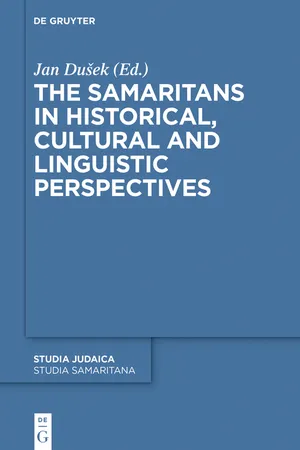
The volume contributes to the knowledge of the Samaritan history, culture and linguistics. Specialists of various fields of research bring a new look on the topics related to the Samaritans and the Hebrew and Arabic written sources, to the Samaritan history in the Roman-Byzantine period as well as to the contemporary issues of the Samaritan community.
Anti-Samaritan Polemics in the Hebrew Bible? The Case of 2 Kings 17:24–41
Does 2 Kings 17:24–41 contain anti-Samaritan polemics? Julius Wellhausen argued that vv. 24–34a spoke of the Samaritan population. Against this analysis, Bernhard Stade suggested that the reference of vv. 24–33 were not the Samaritans, but descendants of the foreign colonists.1 Since then, the discussion has gone on. Seow states that “the heterodoxy of ‘Samaria’ and the ‘Samaritans’ is an indirect result of what both Jeroboam and the people of Israel had done.”2 W. Dietrich: “This is the beginning of the Jewish-Samaritan split.”3 S. Talmon argues that the whole chapter is anti-Ephraimite.4
Discoveries on Mount Gerizim and the Aegean island Delos make the questions relevant again. As the dates of Hebrew Bible texts today often is sought in Persian and Hellenistic times, and the recent finds with Samaritan provenance are dated to the same periods, the research situation is such that we now have material where we earlier lacked data, and it comes from the periods when scholars today think the formation of the Hebrew Bible took place. It is time to posit the question again: with our new knowledge, what is the date and the purpose of 2 Kings 17:24–41? We start with the investigation of the date.5
Conspicuous Usage of Verbs in 2 Kings 17:24–41
Throughout the chapter, wayyiqtol (consecutive imperfect) is used to describe the events. When the action is negated or when a part of speech precedes the verb, qatal (perfect) is used. Further, there are imperatives in vv. 13, 21 and 39, and negated yiqtol (apodictic imperfect) is found in vv. 12, 35, 37 and 38, yiqtol in a command is used in vv. 36, and 37, and for the future in v. 39. The overall usage of verbal forms is standard Classical Biblical Hebrew.6
Inside this system, an interesting feature about the Hebrew of this chapter is the relative frequency of participles used with finite verbs or as predicates with pronouns or with a negation particle. The verbal construction hyh plus a participle we encounter in these instances:
1. The construction wayhi qotel, six instances (with the corresponding NRSV translations):
“([lions] which) killed (some of them),” v. 25.
“(he [= the priest]) taught (them how they should worship the LORD),” v. 28.
“(but every nation) still made (gods of its own),” v. 29; “([priests] who) sacrificed (for them in the shrines of the high places),” v. 32.7
“(they also) worshiped (the LORD),” v. 32; “(so these nations) worshiped (the LORD),” v. 41.
The translation of NRSV uses the past tense in these instances, without attempting to convey, for example, a durative aspect. In v. 29, the translation “still made” is perhaps an attempt to express a durative aspect, but it is also possible that “still” is inserted to mellow the transition from the preceding verse or to express contemporality with the action referred to in the preceding verse: the priest taught them how to worship the Lord (v. 28), but they still made gods of their own (v. 29). In the other five cases, the translation functions as an indicative past, like the wayyiqtol- and qatal-forms in this chapter, and the specific character of the wayhi qotel-constructions is not visible in the translations. The wayyiqtol-element of the phrases (wayhi) may have steered the understanding of NRSV, and the added qotel-element seems not to have influenced the translation.
2. The construction hayah qotel, three instances:
“(so they) worshiped (the LORD),” v. 33.
“(but also) served (their own gods),” v. 33; “(but also) served (their carved images),” v. 41.
It seems that, in these cases, when a part of speech precedes, the hayah qotel-construction is used instead of the wayhi qotel, corresponding to the standard usage of wayyiqtol and qatal. The translation of NRSV is also here indicative past. We therefore have nine instances with the two verbal constructions, constructions of the MT that have not occasioned a rendering with a durative aspect in the NRSV. They both are verbal constructions typical of Late Biblical Hebrew (see below).
3. We may also consider certain nominal constructions as part of the picture. Here, we encounter the construction hinneh/hem qotelim in five instances:
“(they) are killing (them),” v. 26.
“(in the cities in which they) lived,” v. 29.
“(to this day they) continue to practice (their former customs),” v. 34; “(but they) continued to practice (their formed custom),” v. 40; “(to this day their children and their children’s children) continue to do (as their ancestors did),” v. 41.
In vv. 26, 34, 40, and 41 the translation of NRSV indicates a durative aspect at the moment of utterance, comparable to habitual present, and also in v. 29 this durative aspect may be intended in the translation, contemporaneous with the actions in the past referred to in the verse.
One might also include the nominal construction found in v. 31:
“the Sepharvites burned (their children in the fire)”.
The translation of v. 31 may be understood as referring to actions going on over a period. For all these nominal constructions the translation tends to convey a durative aspect.
4. Negated nominal constructions of the type enam qotelim are used in three instances:
“they do not know,” v. 26.
“they do not worship (the LORD),” v. 34.
“they do not follow (the statutes of the ordinances or the law or the commandment),” v. 34.
The translation here is present indicative, and the sense of the verbs (“know,” “worship,” and “follow”) in the context would refer to continuous phenomena. The NRSV can in these instances be understood as conveying a duration of the acts referred to, without using verbal forms that are explicit in this regard; the verbal constructions are not translated with durative aspects.
Positive and negated nominal constructions are found in nine instances altogether. This construction is encountered in Classical Biblical Hebrew, but it receives a more markedly verbal status and can express durative or iterative aspects in Late Biblical Hebrew.8 The instances of
and
v. 26, repeat the meaning of the finite constructions
v. 25, and
v. 26, and continue the series of two perfect and two consecutive imperfect forms in the message to the Assyrian king, v. 26aβb. The two instances might have been perfects or consecutive imperfects as well, but in the former case, there is an emphasis: “behold, they are killing”, and in both instances a durative aspect seems to be intended. The aspect of
v. 29, is evidently durative, “(the cities in which) they were living”. The instance of
v. 31, continues the series of qatal-forms in vv. 30–31 and equals a finite form with durative aspect, a habitual present in English. The three instances of
and
v. 34, all are dependent upon the introducing formula
and therefore have a durative aspect referring to an extended period including the moment of utterance.
These nine instances of nominal constructions with a participle therefore all share in the development towards Late Biblical Hebrew, or are already examples of this stage of the language. The nine verbal instances with hyh plus a participle and these nine nominal instances together constitute a series of 18 instances of linguistic phenomena associated with Late Biblical Hebrew.
The instances are found in vv. 25, 26, 28, 29, 31, 32, 33, 34 ,40, and 41, which makes it difficult to isolate a particular strand or layer in this text, and also to explain them as additions—they are too many and distributed over the entire section vv. 25–34bα, 40–41. The phenomenon seems to be integral to vv. 25–41, minus vv. 34bβ–39.
Cogan and Tadmor remark, when they comment on v. 25, “The periphrastic construction, employing a form of the verb ‘to be’ (Heb. hāyâ) plus a participle, is a feature of Late Hebrew and is widely used throughout the unit vv. 24–33.”9 The grammar of P. Joüon describes the sense of the type hayah qotel as a pure perfect with no durative or frequentative sense in the cases of Neh 2:13,15; 2 Chr 24:12; 30:10; 36:16,...
Table of contents
Cover
Title Page
Copyright
Preface
Contents
Abbreviations
1 Hebrew Bible and Samaritan Pentateuch
2 Roman-Byzantine and Rabbinic Studies
3 Arabic Studies
4 Samaritans in Modern and Contemporary Time
5 Linguistic Studies
Abstracts and Keywords
Index of Authors
Index of Sources
Trusted by 375,005 students
Access to over 1.5 million titles for a fair monthly price.
Study more efficiently using our study tools.
Frequently asked questions
Yes, you can cancel anytime from the Subscription tab in your account settings on the Perlego website. Your subscription will stay active until the end of your current billing period. Learn how to cancel your subscription
No, books cannot be downloaded as external files, such as PDFs, for use outside of Perlego. However, you can download books within the Perlego app for offline reading on mobile or tablet. Learn how to download books offline
Perlego offers two plans: Essential and Complete
Essential is ideal for learners and professionals who enjoy exploring a wide range of subjects. Access the Essential Library with 800,000+ trusted titles and best-sellers across business, personal growth, and the humanities. Includes unlimited reading time and Standard Read Aloud voice.
Complete: Perfect for advanced learners and researchers needing full, unrestricted access. Unlock 1.5M+ books across hundreds of subjects, including academic and specialized titles. The Complete Plan also includes advanced features like Premium Read Aloud and Research Assistant.
Both plans are available with monthly, semester, or annual billing cycles.
We are an online textbook subscription service, where you can get access to an entire online library for less than the price of a single book per month. With over 1.5 million books across 990+ topics, we’ve got you covered! Learn about our mission
Look out for the read-aloud symbol on your next book to see if you can listen to it. The read-aloud tool reads text aloud for you, highlighting the text as it is being read. You can pause it, speed it up and slow it down. Learn more about Read Aloud
Yes! You can use the Perlego app on both iOS and Android devices to read anytime, anywhere — even offline. Perfect for commutes or when you’re on the go. Please note we cannot support devices running on iOS 13 and Android 7 or earlier. Learn more about using the app
Yes, you can access The Samaritans in Historical, Cultural and Linguistic Perspectives by Jan Dusek in PDF and/or ePUB format, as well as other popular books in History & Jewish History. We have over 1.5 million books available in our catalogue for you to explore.