- 160 pages
- English
- ePUB (mobile friendly)
- Available on iOS & Android
eBook - ePub
About this book
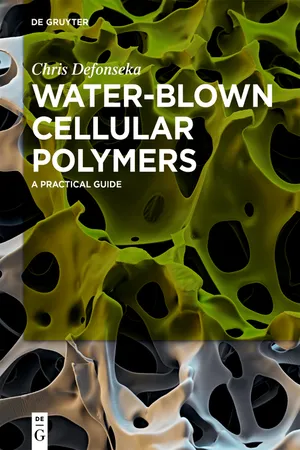
Drawing on over 45 years of hands-on experience, the author provides in-depth knowledge of water-blown cellular polymers, from their chemistry to formulation and process methodology. This book describes the manufacture of standard and specialty foams using new and emerging technologies. The author gives advice on the challenges foam producers commonly face with regard to formulations and makes recommendations for machinery and equipment.
Information
1What are polymers?
A polymer is a large molecule (‘macromolecule’) composed of structural units typically connected by covalent chemical bonds. The basic unit of a polymer is a mer and poly means ‘many’, so the word ‘polymer’ means a substance with many basic units. There are different types of mers and, when they are joined by a process called polymerisation, three basic types of polymer are formed.
If the same type of mers is joined together, they are called ‘homopolymers’. If two different types of mers are joined together, they are called ‘copolymers’. If three different types of mers are joined together, they will form ‘terpolymers’.
These polymers are classified into two main categories: ‘thermoforming’ (they soften upon heating and after moulding can be re-used) and ‘thermosetting’ (they cannot be re-used after moulding). Some simple examples of thermoforming polymers are polyethylenes (PE), polystyrenes (PS) and polypropylenes (PP). Examples of thermosetting polymers are silicones, polyurethanes (PU) and melamines.
Because of the extraordinary range of properties of polymeric materials, they have established themselves as an essential part of everyday life, ranging from the very familiar plastics and elastomers to natural biopolymers such as deoxyribonucleic acid and proteins (which are essential for life). Most plastics are based on ethylene gas derived from crude oil. A simple example of a basic plastic is PE, the repeating units of which are based on ethylene monomer. Polymeric materials from natural sources such as shellac, amber and natural rubber have been known for centuries. Biopolymers such as proteins and nucleic acids have crucial roles in biological processes. Other varieties of natural polymers are available (e.g., cellulose is the main constituent of wood and paper).
1.1Microstructure
The microstructure of a polymer (sometimes called ‘configuration’) relates to the physical arrangement of monomer residues along the backbone of the polymer chain. These are the elements of polymer structure that require the breaking of the covalent bond to change. A structure has a strong influence on the properties of a polymer.
An important microstructural feature determining polymer properties is the ‘architecture’ of the polymer. The simplest polymer architecture is a linear chain: a single backbone with no branches. A related non-branching architecture is a ring polymer. A branched polymer molecule is composed of a main branch point in a polymer chain with one or more chains or branches. Branching of polymer chains affects the ability of chains to ‘slide’ past one another by altering intermolecular forces, which in turn affects the bulk physical properties of a polymer. Long-branch chains may increase polymer strength, toughness and the glass transition temperature (Tg) due to an increase in the number of entanglements per chain. The effect of such long-chain branches on the size of the polymer in solution is characterised by the branching index. Conversely, random lengths and short chains may reduce polymer strength due to disruption of organisation and may likewise reduce the crystallinity of the polymer. A good example of this effect is related to the range of physical attributes of PE. High-density polyethylene (HDPE) has a very low degree of branching, is quite stiff and is used in applications such as containers and milk jugs. Conversely, low-density polyethylene (LDPE) has a significant number of long and short branches, is quite flexible and is used in applications such as plastic films.
The architecture of a polymer is often physically determined by the functionality of the monomers (basic mers) from which it is formed. The property of a monomer is defined as the number of reaction sites at which it may form chemical covalent bonds. The basic functionality required for forming even a linear chain is two bonding sites. Higher functionalities yield branched or even crosslinked or network polymer chains.
An effect related to branching is chemical crosslinking by formation of covalent bonds between chains. Crosslinking tends to increase the Tg and increase strength and toughness. This process is used to strengthen rubber compounds in a process known as ‘vulcanisation’, which is based on crosslinking with sulfur. For example, to a great degree vulcanisation is essential in applications such as car tyres, whereas rubber erasers are not crosslinked to promote flaking when used, thereby protecting the paper. A crosslink may provide branch points from which four or more distinct chains emanate. A polymer molecule with a high degree of crosslinking is referred to as a ‘polymer network’.
1.2Lengths of polymer chains
Physical properties of a polymer are strongly dependent on the size or length of the polymer chain. For example, as chain length is increased, melting points and boiling points increase, as does the impact strength and viscosity (resistance to flow) of the polymer in its melt state. A tenfold increase in the length of a polymer chain results in a viscosity increase of >1,000-fold. Increasing chain length tends to decrease chain mobility, increase strength and toughness, and increase the Tg. A common means of expressing the chain length of a polymer is the ‘degree of polymerisation’, which quantifies the number of monomers incorporated into the chain. As with other molecules, the size of a polymer may also be expressed in terms of molecular weight (MW).
1.3Polymer morphology
Polymer morphology can, in general, be described as the arrangement chains and the order of the many polymer chains. A synthetic polymer may be described as ‘crystalline’ if it contains regions of three-dimensional ordering on scales of atomic (rather than macromolecular) length, usually arising from intramolecular folding and/or stacking of adjacent chains. Synthetic polymers may consist of crystalline and amorphous regions, the degree of crystallinity being expressed in terms of a weight fraction or volume fraction of crystalline material.
The crystallinity of polymers is characterised by their degree of crystallinity, ranging from ‘zero’ for a completely non-crystalline polymer to ‘one’ for a completely crystalline polymer. Polymers with microcrystalline regions are, in general, tougher, can be bent more without breaking and more impact-resistant than totally amorphous polymers. Polymers with a degree of crystallinity approaching zero or one tend to be transparent, whereas polymers with intermediate degrees of crystallinity tend to be opaque due to light scattering by crystalline or glassy regions. Thus, for many polymers, reduced crystallinity may also be associated with increased transparency.
1.4Mechanical properties
The tensile strength of a material quantifies how much stress the material can endure before undergoing permanent deformation. Tensile strength is very important in applications that rely on the physical strength or durability of a polymer. For example, a polymer with high tensile strength will hold a greater weight before snapping than a polymer with low tensile strength. In general, tensile strength increases with the length of the polymer chain and crosslinking of polymer chains. Young’s modulus quantifies the elasticity of a polymer, and is the ratio of rate of change of stress to strain. Like tensile strength, Young’s modulus is very important in polymer applications involving the physical properties of polymers, and is strongly dependent on temperature.
1.5Phase behaviour
In general, the melting point of a material would suggest solid-to-liquid transition. However, if applied to polymers, the melting point of a material is more a transition from a crystalline or semi-crystalline phase to a solid-amorphous phase. This property is more appropriately called the ‘crystalline melting temperature’. Among synthetic polymers, crystalline melting is discussed only with respect to thermoplastics because thermosetting polymers decompose at high temperatures rather than melt. The boiling point of a polymeric material is strongly dependent on chain length. Polymers with a large degree of polymerisation do not exhibit a boiling point because they decompose before reaching theoretical boiling temperatures. For shorter chain lengths, a boiling transition may be observed.
A parameter of particular interest in manufacture of synthetic polymers is the Tg, which describes the temperature at which amorphous polymers undergo a second-order transition from a rubbery, viscous amorphous solid or from a crystalline solid to a brittle, glassy amorphous solid. The Tg may be engineered by altering the degree of branching or crosslinking in the polymer or by the addition of plasticisers.
1.6Mixing behaviour
In general, polymeric mixtures are far less miscible than materials with small molecules. Usually, the driving force for mixing is entropy, not interaction energy. That is, miscible materials usually form a solution not because their interaction with each other is more favourable than their self-interaction, but because of an increase of entropy, and hence free energy associated with increasing the amount of volume available to each component. Polymeric molecules are much larger and have much larger specific volumes than smaller molecules, so the number of molecules involved in a polymeric mixture is far smaller than the number in a small molecule mixture of equal volume. Furthermore, the phase behaviour of polymer solutions and mixtures is more complex than that of small-molecule mixtures. In dilute solution, the properties of the polymer are characterised by the interaction between the solvent and polymer. In good solvents, a polymer will appear swollen and will occupy a large volume.
Inclusion of plasticisers tends to lower the Tg and increase polymer flexibility. In general, plasticisers are small molecules that are chemically similar to polymers and create gaps between polymer chains for greater mobility and reduced inter-chain interaction. A good example of the action of plasticisers is related to polyvinyl chloride (PVC). Unplasticised polyvinyl chloride (uPVC) is used for production of pipes, which have no plasticiser in them, because they need to be strong and heat-resistant. If plasticised PVC is used for pipes, they will lose the plasticiser through evaporation due to heat, and will become brittle and split. Plasticised PVC is used for flexible applications such as coatings, sheeting, and films.
1.7Chemical properties
The attractive forces between polymer chains play a large part in determining the properties of a polymer. Polymer chains are long, so these inter-chain forces are amplified far beyond the attractions between conventional molecules. Different side groups can lead the polymer towards ionic bonding or hydrogen bonding between its own chains. Typically, these stronger forces result in higher tensile strength and higher crystalline melting points.
The intermolecular forces in polymers can be affected by molecules with different charges (‘dipoles’) in the monomer units. Polymers containing covalent double-bond (‘carbonyl’) groups can form hydrogen bonds between adjacent chains. These strong hydrogen bonds, for example, result in the high te...
Table of contents
- Cover
- Title Page
- Copyright
- Preface
- Contents
- 1 What are polymers?
- 2 Cellular polymers
- 3 Water-blown cellular polymers
- 4 Processing methods for water-blown cellular polymers
- 5 Water-blown specialty cellular foams
- 6 Raw materials, storage of materials and basic safety factors
- 7 Principles of foam productions, foam calculations and foam formulations
- 8 Practical processing methods of water-blown cellular polymers
- 9 Recommendations for process efficiency
- 10 Recycling of cellular foam wastes
- Appendix 1 Suppliers of raw materials and foaming machines
- Appendix 2 Conversion table of units commonly used in industry
- Abbreviations
- Index
Trusted by 375,005 students
Access to over 1.5 million titles for a fair monthly price.
Study more efficiently using our study tools.
Frequently asked questions
Yes, you can cancel anytime from the Subscription tab in your account settings on the Perlego website. Your subscription will stay active until the end of your current billing period. Learn how to cancel your subscription
No, books cannot be downloaded as external files, such as PDFs, for use outside of Perlego. However, you can download books within the Perlego app for offline reading on mobile or tablet. Learn how to download books offline
Perlego offers two plans: Essential and Complete
- Essential is ideal for learners and professionals who enjoy exploring a wide range of subjects. Access the Essential Library with 800,000+ trusted titles and best-sellers across business, personal growth, and the humanities. Includes unlimited reading time and Standard Read Aloud voice.
- Complete: Perfect for advanced learners and researchers needing full, unrestricted access. Unlock 1.5M+ books across hundreds of subjects, including academic and specialized titles. The Complete Plan also includes advanced features like Premium Read Aloud and Research Assistant.
We are an online textbook subscription service, where you can get access to an entire online library for less than the price of a single book per month. With over 1.5 million books across 990+ topics, we’ve got you covered! Learn about our mission
Look out for the read-aloud symbol on your next book to see if you can listen to it. The read-aloud tool reads text aloud for you, highlighting the text as it is being read. You can pause it, speed it up and slow it down. Learn more about Read Aloud
Yes! You can use the Perlego app on both iOS and Android devices to read anytime, anywhere — even offline. Perfect for commutes or when you’re on the go.
Please note we cannot support devices running on iOS 13 and Android 7 or earlier. Learn more about using the app
Please note we cannot support devices running on iOS 13 and Android 7 or earlier. Learn more about using the app
Yes, you can access Water-Blown Cellular Polymers by Chris Defonseka in PDF and/or ePUB format, as well as other popular books in Technology & Engineering & Chemistry. We have over 1.5 million books available in our catalogue for you to explore.