The must-read summary of Mikel Harry and Richard Schroeder's book: "Six Sigma: The Breakthrough Management Strategy Revolutionizing the World's Top Corporations".
This complete summary of the ideas from Mikel Harry and Richard Schroeder's book "Six Sigma" presents the simple Six Sigma philosophy that can have powerful ramifications. Companies should focus on improving quality and aiming for perfection in the products it offers. In their book, the authors explain how to apply this philosophy at all levels of your company and how to establish it as a long-term practice. This summary is a must-read for any leader who wants to follow in the footsteps of the world's biggest companies and understand the benefits of the Six Sigma strategy.
Added-value of this summary:
• Save time
• Understand key concepts
• Expand your knowledge
To learn more, read "Six Sigma" and find out how you can achieve great business success on the path to perfection.
eBook - ePub
Summary: Six Sigma
Review and Analysis of Harry and Schroeder's Book
- English
- ePUB (mobile friendly)
- Available on iOS & Android
eBook - ePub
About this book
Information
Subtopic
Business StrategyIndex
BusinessSummary of Six Sigma (Mikel Harry & Richard Schroeder)
Section 1
The Six Sigma Philosophy
Main Idea
Six sigma is a business process which empowers companies to dramatically and immediately increase their profitability by:
- Streamlining operations.
- Improving quality.
- Eliminating defects or mistakes.
In essence, six sigma provides specific methods organizations can use to re-create business processes so that less defects and errors will arise in the future. As such, six sigma is proactive rather than reactive -- it focuses on changing processes so less errors arise rather than fixing errors.
Supporting Ideas
The six sigma program originated at Motorola in 1979 when it was realized there was a direct correlation between higher quality and lower development costs across a wide range of manufactured products. The concept that improving quality would cut costs rather than raise them was fairly radical for that era, especially for a company like Motorola which was built around economies of scale.
When a detailed analysis was carried out, however, Motorola found it was spending between 5- and 20-percent of its revenues on correcting poor quality. And significantly, the $800 - $900 million involved would, if not applied to correcting quality defects, flow directly to the company’s bottom line profitability.
How could quality be improved? Motorola identified two ideas:
- Detect and fix the defects that cropped up.
- Prevent defects by improving manufacturing and design.
Whereas all previous quality improvement programs tried at Motorola had been reactive (responding to defects as they arose), the six sigma program was proactive -- it focused on how products were designed and all the processes involved. In short, six sigma is a focused program to provide customers with higher-quality products at a cheaper cost.
Within four years, the six sigma program had saved Motorola $2.2 billion. That success didn’t go unnoticed, and within a short period of time six sigma programs were underway in a number of companies across a broad range of industries.
The key points of the six sigma philosophy are:
- A focus on processes, not results. Everything an organization does is either:
- An industrial process -- using machinery, or
- A commercial process -- using human activity.
Six sigma seeks to improve both commercial and industrial processes so that errors are lowered. - Six sigma takes its name from applied statistics. It is calculated as 3.4 out of 1 million. When a process is described as being a “six sigma” process, that means the number of defects produced is less than 3.4 for every 1 million opportunities for something to go wrong. Or to put it another way, when something is at six sigma level, the likelihood of it performing as specified is 99.99966-percent.
- Six sigma is a performance target and applies to a single critical-to-quality characteristic, not to the total product. Thus, the more complex a product is, the more opportunities there are for defects to occur, and the greater the likelihood that a defect may occur somewhere with the product even if all the individual components are six sigma.
- Six sigma focuses on the variability of processes. By creating a better process that reduces variations during the creation, manufacture and delivery of products and services, it is possible for any business to achieve six sigma quality in its processes.
- Six sigma organizations find they spend less than 1-percent of their operating revenues on rework costs. By contrast, an organization whose processes are at the four sigma level (6,210 defects per million opportunities, which is about average for many industries) end up spending between 15-and 25-percent of operating errors on rework costs.
- Six sigma is the goal. The means by which that goal is achieved is by the Breakthrough Strategy -- which is a highly focused system for solving problems and reducing defects. In other words, organizations pursue six sigma by means of the Breakthrough Strategy.
- The Breakthrough Strategy is a disciplined method for gathering data, analyzing the results to pinpoint errors and developing ways to eliminate those errors.
- The Breakthrough Strategy has eight steps, called phases. The four core phases are called M-A-I-C:
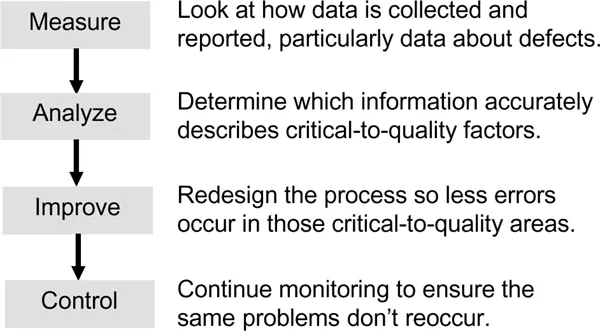
- Applying the Breakthrough Strategy in any organization requires the services of ...
Table of contents
- Book Presentation: Six Sigma by Mikel Harry & Richard Schroeder
Trusted by 375,005 students
Access to over 1.5 million titles for a fair monthly price.
Study more efficiently using our study tools.
Frequently asked questions
Yes, you can cancel anytime from the Subscription tab in your account settings on the Perlego website. Your subscription will stay active until the end of your current billing period. Learn how to cancel your subscription
No, books cannot be downloaded as external files, such as PDFs, for use outside of Perlego. However, you can download books within the Perlego app for offline reading on mobile or tablet. Learn how to download books offline
Perlego offers two plans: Essential and Complete
- Essential is ideal for learners and professionals who enjoy exploring a wide range of subjects. Access the Essential Library with 800,000+ trusted titles and best-sellers across business, personal growth, and the humanities. Includes unlimited reading time and Standard Read Aloud voice.
- Complete: Perfect for advanced learners and researchers needing full, unrestricted access. Unlock 1.5M+ books across hundreds of subjects, including academic and specialized titles. The Complete Plan also includes advanced features like Premium Read Aloud and Research Assistant.
We are an online textbook subscription service, where you can get access to an entire online library for less than the price of a single book per month. With over 1.5 million books across 990+ topics, we’ve got you covered! Learn about our mission
Look out for the read-aloud symbol on your next book to see if you can listen to it. The read-aloud tool reads text aloud for you, highlighting the text as it is being read. You can pause it, speed it up and slow it down. Learn more about Read Aloud
Yes! You can use the Perlego app on both iOS and Android devices to read anytime, anywhere — even offline. Perfect for commutes or when you’re on the go.
Please note we cannot support devices running on iOS 13 and Android 7 or earlier. Learn more about using the app
Please note we cannot support devices running on iOS 13 and Android 7 or earlier. Learn more about using the app
Yes, you can access Summary: Six Sigma by BusinessNews Publishing in PDF and/or ePUB format, as well as other popular books in Business & Business Strategy. We have over 1.5 million books available in our catalogue for you to explore.