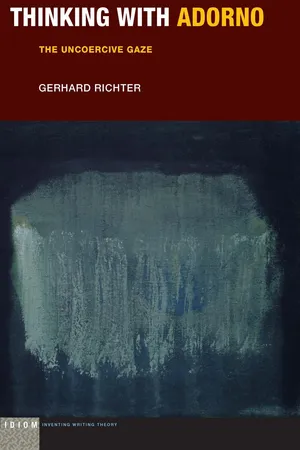
What Theodor W. Adorno says cannot be separated from how he says it. By the same token, what he thinks cannot be isolated from how he thinks it. The central aim of Richter's book is to examine how these basic yet far-reaching assumptions teach us to think with Adorno—both alongside him and in relation to his diverse contexts and constellations. These contexts and constellations range from aesthetic theory to political critique, from the problem of judgment to the difficulty of inheriting a tradition, from the primacy of the object to the question of how to lead a right life within a wrong one.
Richter vividly shows how Adorno's highly suggestive—yet often overlooked—concept of the "uncoercive gaze" designates a specific kind of comportment in relation to an object of critical analysis: It moves close to the object and tarries with it while struggling to decipher the singularities and non-identities that are lodged within it, whether the object is an idea, a thought, a concept, a text, a work of art, an experience, or a problem of political or sociological theory.
Thinking with Adorno's uncoercive gaze not only means following the fascinating paths of his own work; it also means extending hospitality to the ghostly voices of others. As this book shows, Adorno is best understood as a thinker in dialogue, whether with long-deceased predecessors in the German tradition such as Kant and Hegel, with writers such as Kafka, with contemporaries such as Benjamin and Arendt, or with philosophical voices that succeeded him, such as those of Derrida and Agamben.
- 225 pages
- English
- PDF
- Available on iOS & Android
eBook - PDF
About this book
Information
Publisher
Fordham University PressYear
2019Print ISBN
9780823284023
9780823284030
eBook ISBN
9780823284054
Table of contents
- Cover
- Thinking with Adorno
- Title
- Copyright
- CONTENTS
- Introduction: The Art of Reading
- 1. Adorno and the Uncoercive Gaze
- 2. Buried Possibility: Adorno and Arendt on Tradition
- 3. The Inheritance of the Constellation: Adorno and Hegel
- 4. Judging by Refraining from Judgment: Adorno’s Artwork and Its Einordnung
- 5. The Literary Artwork between Word and Concept: Adorno and Agamben Reading Kafka
- 6. The Artwork without Cardinal Direction: Notes on Orientation in Adorno
- 7. False Life, Living On: Adorno with Derrida
- Conclusion: A Kind of Leave-Taking
- Acknowledgments
- Notes
- Index
Trusted by 375,005 students
Access to over 1.5 million titles for a fair monthly price.
Study more efficiently using our study tools.
Frequently asked questions
Yes, you can cancel anytime from the Subscription tab in your account settings on the Perlego website. Your subscription will stay active until the end of your current billing period. Learn how to cancel your subscription
No, books cannot be downloaded as external files, such as PDFs, for use outside of Perlego. However, you can download books within the Perlego app for offline reading on mobile or tablet. Learn how to download books offline
Perlego offers two plans: Essential and Complete
- Essential is ideal for learners and professionals who enjoy exploring a wide range of subjects. Access the Essential Library with 800,000+ trusted titles and best-sellers across business, personal growth, and the humanities. Includes unlimited reading time and Standard Read Aloud voice.
- Complete: Perfect for advanced learners and researchers needing full, unrestricted access. Unlock 1.5M+ books across hundreds of subjects, including academic and specialized titles. The Complete Plan also includes advanced features like Premium Read Aloud and Research Assistant.
We are an online textbook subscription service, where you can get access to an entire online library for less than the price of a single book per month. With over 1.5 million books across 990+ topics, we’ve got you covered! Learn about our mission
Look out for the read-aloud symbol on your next book to see if you can listen to it. The read-aloud tool reads text aloud for you, highlighting the text as it is being read. You can pause it, speed it up and slow it down. Learn more about Read Aloud
Yes! You can use the Perlego app on both iOS and Android devices to read anytime, anywhere — even offline. Perfect for commutes or when you’re on the go.
Please note we cannot support devices running on iOS 13 and Android 7 or earlier. Learn more about using the app
Please note we cannot support devices running on iOS 13 and Android 7 or earlier. Learn more about using the app
Yes, you can access Thinking with Adorno by Gerhard Richter in PDF and/or ePUB format, as well as other popular books in Littérature & Théorie de la critique littéraire. We have over 1.5 million books available in our catalogue for you to explore.