An examination of the popular music culture of the post-Bolshevik Russian emigration and the impact made by this group on American culture and politics.
Performing Tsarist Russia in New York begins with a rich account of the musical evenings that took place in the Russian émigré enclave of Harlem in the 1920s and weaves through the world of Manhattan's Russian restaurants, Tin Pan Alley industry, Broadway productions, 1939 World's Fair, Soviet music distributors, postwar Russian parish musical life, and Cold War radio programming to close with today's Russian ball scene, exploring how the idea of Russia Abroad has taken shape through various spheres of music production in New York over the course of a century. Engaging in an analysis of musical styles, performance practice, sheet music cover art, the discourses surrounding this music, and the sonic, somatic, and social realms of dance, author Natalie K. Zelensky demonstrates the central role played by music in shaping and maintaining the Russian émigré diaspora over multiple generations as well as the fundamental paradox underlying this process: that music's sustaining power in this case rests on its proclivity to foster collective narratives of an idealized prerevolutionary Russia while often evolving stylistically to remain relevant to its makers, listeners, and dancers. By combining archival research with fieldwork and interviews with Russian émigrés of various generations and emigration waves, Zelensky presents a close historical and ethnographic examination of music's potential as an aesthetic, discursive, and social space through which diasporans can engage with an idea of a mythologized homeland, and, in turn, the vital role played by music in the organization, development, and reception of Russia Abroad.
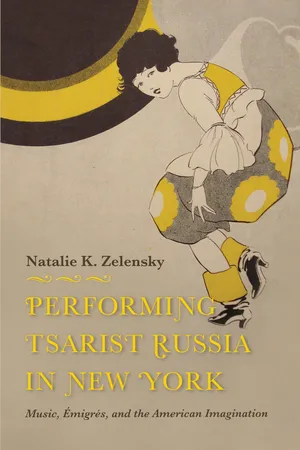
eBook - ePub
Performing Tsarist Russia in New York
Music, Émigrés, and the American Imagination
- 256 pages
- English
- ePUB (mobile friendly)
- Available on iOS & Android
eBook - ePub
Performing Tsarist Russia in New York
Music, Émigrés, and the American Imagination
About this book
1
PERFORMING À LA RUSSE
Music, Migration, and the White Russians in 1920s Harlem
AFTER A LONG DAY’S WORK AT THE SEWING machine, embroidering knockoffs of the Parisian à la Russe tunics and scarves then the rage in New York, Olga Popoff (1894–1990) entered the large parish house attached to Christ the Savior Russian Orthodox Church in Harlem. She, along with numerous other refugees from the Bolshevik Revolution (1917) and Russian Civil War (1918–1922), met—as they did nearly every Wednesday night since arriving in New York City in 1923—for an evening of music, poetry, plays, and dancing. The daughter of a Swedish industrialist and a Russian mother, Popoff had grown up in Siberia and attended the conservatory before marrying a Swedish diplomat and escaping from Russia in 1918. A whirlwind on-ship romance with White Army officer Eupheme Popoff (1873–1972) ended the Swedish marriage, and here they were, in the Russian Club of Harlem, mingling with other former Russian nobles, officers, and intellectuals who attended these gatherings despite long hours painting houses, scrubbing floors, mixing chemicals, and painting dolls on an assembly line.
These so-called “Russian Evenings” gave the Popoffs and the other Russian refugees in New York a chance to escape their quotidian lives—to meet with one another, speak their native tongue, and reminisce about life in the home country. Similar to the gatherings that occurred in other pockets of the postrevolutionary Russian emigration in such locales as Paris, Belgrade, and Harbin, this fellowship allowed émigrés to talk “for hours of politics, of books, of art, and of dreams.”1 Of these dreams, both immediate and enduring, one loomed above all others: to return to Russia following the collapse of the Bolshevik regime. Although a return to Russia free of communist rule would not become possible during the lifespan of Olga or Eupheme Popoff, the Russians in Harlem found ways to maintain a connection to their homeland: they cooked pots of hot borscht and cabbage-stuffed pirozhki, they founded and named their church in honor of Moscow’s monumental Christ the Savior Cathedral (apogee of Tsarist popular support built to commemorate Russia’s victory over Napoleon in 1812 and demolished by the communist regime in 1931), and they designed a memorial chapel in which they hung icon lamps as tribute to those who had died for their homeland.2 Perhaps more than anything else, they listened to their fellow émigrés perform music—strains so compelling that they allowed the dejected exiles to “forget the present and remember our old Russia.”3
What was this “Old Russia” and how was it, as phrased by Richard Taruskin, defined musically?4 Even more germane to this chapter, how did music connect exiles to their lost Russia and inform what it meant to be an émigré, or “emigrant,” the term embraced by members of the diaspora as a reference to the French exiles of nearly a century and half earlier who had similarly fled their homeland after a bloody revolution?5
“Happier days have faded away and the lilac has wilted . . . happiness has vanished, and the heart lives by the past.” These words, sung by émigré Emma Hurok (1897–1974) (wife of the earlier Russian Jewish emigrant and later pivotal impresario Sol Hurok), offer a glimpse of the type of repertoire and affect framing the music culture of the Russian émigré community in 1920s New York, which was then situated in Harlem around Mount Morris Park (now Marcus Garvey Park). Musically, the weekly Russian evenings were dominated by Russian folk and so-called gypsy songs, giving form to the elusive Russian soul and volia (freedom from any and all restrictions) respectively.
As Alaina Lemon points out, however, volia is a particular kind of freedom worlds away from the more pragmatic svoboda (a “more structured liberty from social law”).6 Indeed, volia refers to freedom of one’s very core—one’s free will—an ontological state of liberation. The Russian gypsy song was long considered a potent site harboring volia—an association forged not only through the music’s perceived correlation to the Romani people and the supposedly unfettered lives they led, but, as I will show, through the musical and textual content of this repertoire. The Russian gypsy song offered its listeners temporary liberation from the shackles of exile—a process that worked because of the music’s engagement of an even more mysterious affect: toska. A mood so dependent on cultural context that it has no direct translation into English, toska can roughly be translated as a languid desire for something that is now absent (usually a lover and happier days, more generally). Toska permeated Russian émigré existence—emerging not only in the Russian gypsy repertoire but in the daily lexicon of the exiles. (Natalia Rachmaninoff, for example, wrote to a friend just before her husband’s death, “They say that S[ergei] Vas[ilievich] had a physician who told him that his heart was tired. How true this is, and how so like him. . . . He has become tired from yearning [toska] for Russia. So of course, we understand all of this very well.”)7 Understanding the ways in which toska has been implicated musically presents a critical starting point for better understanding the role of music in shaping the collective outlook of the Russian émigrés.
At first glance, the adoption of Russian gypsy and folk music by members of the predominantly upper-class, largely ethnic-Russian diaspora may appear as an unusual means of self-definition. Yet this music had rolled off the tongue of educated ladies and gentlemen in prerevolutionary Russia and had been ubiquitous on the stages of restaurants and cabarets throughout the Silver Age. Within the halls of the church in Harlem, this music, however, now took on a new dimension, for it was the Russian gypsy and folk music, with their potent evocations of volia, toska, and an idyllic Russia, that helped inform what it meant to be a Russian émigré. This music presented a space for a performative reinterpretation of Russia, with the prerevolutionary marginality of both peasant and gypsy tropes vis-à-vis the Westernized elite now transformed into an appropriate medium through which this elite in exile could express its newly acquired marginalization and perform Otherness in relation to its surrounding cultural milieu.
Perhaps more importantly, the New York émigrés approached Russian folk and gypsy music as discursive sites for developing and circulating collective narratives of the precataclysmic homeland (“Old Russia”) and of being Russian abroad. In line with Victor Turner’s concept of “social drama,” the shared experience, in this case, of revolution, civil war, and migration presented the necessary “conflict” that was processed through the theatrical medium of musical performance.8 These musical acts, in turn, can serve as forums for creating and articulating social metacommentary, or “a story a group tells itself about itself.”9 Such metacommentary not only reflects social life but also allows participants to reflexively reinterpret and subsequently transform everyday life.
Through this dialectic process, a trope of Old Russia thus came into existence by way of musical performance, which helped the émigrés define and maintain their mission of cultural preservation. Indeed, a kind of “active or ‘magic’ mirror” the concerts in Harlem served as sites in which Old Russia could materialize through the reflection, projection, and reinterpretation undertaken by their participants.10 Within a migratory context, this metacommentary often takes on a specific dimension that reifies a perfected (and lost) homeland through musical performance. I call this phenomenon diasporic metacommentary, a concept that fuses anthropological and diasporic theory to help elucidate the processes by which a group of émigrés comes to define itself as a singular, recognizable entity through common discursive tropes enabled through artistic acts.
Examining the music that dominated Russian Harlem, its performance practice, and the ways its performances were publicized and received by the Russian-American press, this chapter explores how Russian émigrés in New York used Russian folk and gypsy music as a space for creating a diasporic metacommentary, the rhetoric of which would become a foundational element in defining the First Wave Russian diaspora. More broadly, an examination of the music culture of Russian Harlem presents a case study of how an exiled community chooses to represent the past through music and to address the pressing question of how to maintain a connection—however imagined or tenuous—to the homeland. Framed as “heightened forms of representation for public perception,”11 musical performance presents a critical forum for the study of how diasporans choose to define themselves around collective symbols of migration, dislocation, and an overriding sense of “not being there.”12
Harlem’s Little Russia
As the anti-Bolshevik White Army suffered defeat after defeat toward the end of the Russian Civil War, growing numbers of people fled their homeland, ultimately reaching a group of approximately one and a half million exiles.13 One of the main evacuation routes from Russia was through Crimea to Constantinople. This departure entailed people desperately making their way onto overcrowded ships in the hopes of escaping the appro...
Table of contents
- Cover
- Title Page
- Copyright
- Contents
- Acknowledgments
- Note on Transliteration
- Introduction
- 1. Performing à la Russe: Music, Migration, and the White Russians in 1920s Harlem
- 2. New York’s Russian Vogue: The Fox-Trotsky and Other Musical Delights
- 3. Emigration at the Boundary: Russian DPs, Second Generation Émigrés, and Soviet Song in the World War II Era
- 4. Radio Liberty, Vernon Duke, and the “Internal” Émigré Voice in Cold War Broadcasting
- 5. Old Russia at the Pierre: Music, Enchantment, and the Dancing Body in Twenty-First Century New York
- Epilogue
- Bibliography
- Index
- About the Author
Trusted by 375,005 students
Access to over 1.5 million titles for a fair monthly price.
Study more efficiently using our study tools.
Information
Frequently asked questions
Yes, you can cancel anytime from the Subscription tab in your account settings on the Perlego website. Your subscription will stay active until the end of your current billing period. Learn how to cancel your subscription
No, books cannot be downloaded as external files, such as PDFs, for use outside of Perlego. However, you can download books within the Perlego app for offline reading on mobile or tablet. Learn how to download books offline
Perlego offers two plans: Essential and Complete
- Essential is ideal for learners and professionals who enjoy exploring a wide range of subjects. Access the Essential Library with 800,000+ trusted titles and best-sellers across business, personal growth, and the humanities. Includes unlimited reading time and Standard Read Aloud voice.
- Complete: Perfect for advanced learners and researchers needing full, unrestricted access. Unlock 1.5M+ books across hundreds of subjects, including academic and specialized titles. The Complete Plan also includes advanced features like Premium Read Aloud and Research Assistant.
We are an online textbook subscription service, where you can get access to an entire online library for less than the price of a single book per month. With over 1.5 million books across 990+ topics, we’ve got you covered! Learn about our mission
Look out for the read-aloud symbol on your next book to see if you can listen to it. The read-aloud tool reads text aloud for you, highlighting the text as it is being read. You can pause it, speed it up and slow it down. Learn more about Read Aloud
Yes! You can use the Perlego app on both iOS and Android devices to read anytime, anywhere — even offline. Perfect for commutes or when you’re on the go.
Please note we cannot support devices running on iOS 13 and Android 7 or earlier. Learn more about using the app
Please note we cannot support devices running on iOS 13 and Android 7 or earlier. Learn more about using the app
Yes, you can access Performing Tsarist Russia in New York by Natalie K. Zelensky in PDF and/or ePUB format, as well as other popular books in Media & Performing Arts & North American History. We have over 1.5 million books available in our catalogue for you to explore.