The history of a radical group of intellectuals who founded the New Era Fellowship, which shaped human rights precedents and social justice policy in South Africa
In 1937 a group of young Capetonians, socialist intellectuals from the Workers' Party of South Africa, embarked on a project they called the New Era Fellowship (NEF). In doing so they sought to disrupt and challenge not only prevailing political narratives but the very premises – class and 'race' – on which they were based. In different forums – public debates, lectures, study circles and cultural events – the seeds of radical thinking were planted, nurtured and brought to full flower. Taking a position of non-collaboration and non-racialism, the NEF played a vital role in challenging society's responses to events ranging from the problem of taking up arms during the Second World War for an empire intent on stripping people of colour of their human rights to the Hertzog Bills, which foreshadowed apartheid in all its ruthless effectiveness. In subsequent narratives of liberation their significance has been overlooked, even disparaged, and has never been fully understood and acknowledged. By shining a contemporary light on the NEF and locating its contribution in current sociological and political discourse, educationist Crain Soudien shows how its members were at the forefront of redefining the debate about social difference in a racially divided society.
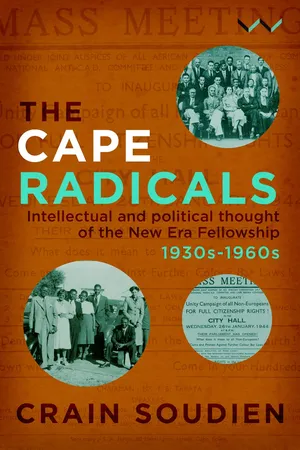
eBook - ePub
Cape Radicals
Intellectual and political thought of the New Era Fellowship, 1930s-1960s
- English
- ePUB (mobile friendly)
- Available on iOS & Android
eBook - ePub
Cape Radicals
Intellectual and political thought of the New Era Fellowship, 1930s-1960s
About this book
Information
Subtopic
African HistoryIndex
History1 ∣ A Battle of Ideas
Just how significant South African colonialism was in the global rise of white supremacy has not been fully acknowledged or understood. It was in South Africa, in circumstances that are very different from those in the United States, that other global laboratory of race-making, that science and politics were yoked together to produce for the world the narratives and strategies it would use to explain and legitimate the great 19th- and 20th-century conceit of white supremacy. Keith Breckenridge, in Biometric State, describes the country as a ‘culture-bed’ for the imperial project.1 The discourses and policies of eugenics and the practices and procedures of oppression and exploitation were a demonstrably powerful combination.
The science was pioneered by Francis Galton, the founder of the eugenicist movement. In the 1850s he had travelled through South West Africa. His observations of the Herero people there allowed him to conclude that he had the proof to show that black people were the cognitive inferiors of white people. The politics came through a battery of laws, policies and practices evolved by the governments of the Cape Colony and the republics of the Transvaal and the Free State to regulate and control black people. The Glen Grey Act of 1894 was an early indicator. Its purpose was to force able-bodied men off their land and it did this through the imposition of a poll tax. Subsistence lifestyles, which was how people in the rural areas survived, did not place in people’s hands the money required to pay the colonial government’s taxes. The only way they could get the money was by submitting themselves to the formality of low-paid employment in the mines. The early 1900s saw techniques of labour control being developed on the Rand as the mining industry grew.
Through these developments, South Africa presented itself to the world as an important focal point for the British Empire’s imagination and realisation of its class and race mission.
At the same time as this mission was taking shape, a number of developments came together to make South Africa also one of the most important global culture-beds for thinking against the imperial project. This thinking, as the country’s oppressed people fought for their dignity, took many forms. Its most dominant was expressed in essentially liberal, assimilationist terms. The struggle for equality was based on European notions of citizenship. Much of the struggle of early nationalism in South Africa – the African National Congress (ANC) provides the clearest example of this – was founded on the principle of the inclusion of African people in the existing social and political architecture of South Africa.
A series of Africanist struggles did emerge, most specifically in what was the Natal area, around the turn of the nineteenth century and several uprisings took place. The most notable of these was the Bambatha rebellion in 1906.
Most pertinent for this book, however, is what was happening within the socialist movement in South Africa. A number of different analytic thrusts began to present themselves in disruptive cadences, vocabularies and frameworks. Political activists began to open up the possibility of the making of what they called ‘the new man’. This thinking, constructed around alternative ways of being human – in opposition to the dominant themes of superiority and inferiority – took dramatic flight towards the end of the 1930s in Cape Town. Dora Taylor, in her 1974 introduction to Isaac Tabata’s book The Awakening of the People, described it as a ‘battle of ideas … amongst the intellectuals’.2
The ideas to which Taylor was referring emerged in inchoate form with the establishment, nationally, of a range of influential political organisations, beginning with the Lenin Club in 1932, the Workers’ Party of South Africa (WPSA) and the All-African Convention (AAC) in 1935 and the National Liberation League (NLL) in 1937. They would come to flower a decade and a half later in the philosophy of non-racialism. The engine room for these ideas in the Cape was the New Era Fellowship (NEF), which was formed in 1937.
Dick Dudley, a former president of the New Unity Movement (NUM), in writing about the destruction of District Six, described the NEF as having been ‘the single most influential training ground for students and workers in those early years … the Stakesby-Lewis Hostel in Canterbury Street was the centre of some of the most fruitful developments in the new ideology that was to sweep South Africa after the second world war.’3
NUM intellectual Hosea Jaffe labelled the NEF as the ‘only Jacobin-Cordelier type “club” of its kind in the country’.4 The reference was to the radical political clubs that were formed during the French Revolution, attracting to their membership like-minded activists who gathered regularly for discussion and debate. In the 1930s the NEF attracted the attention of the major anti-Stalinist theoreticians in the world. C L R James, for example, the influential Caribbean social theorist, was aware of and in communication with his comrades across the Atlantic. Several of the actors around the NEF and its antecedent organisations, the Lenin Club and WPSA, as Baruch Hirson recorded, became ‘leading cadres of the Trotskyist movements in China, India, the USA and Great Britain’. He described where these leaders came to find themselves:
Internationally, in the first decade of the movement’s existence, Frank Glass (LiFu-jen/Furen) moved to China and then the US, Murray Gow to India, Ted Grant, Max Basch (Sid Frost), Charlie van Gelderen, Ralph and Millie Lee, Heaton Lee, Ann Keen and others to Britain. There were also persons who joined, or were associated with Trotskyist groups and received later acclaim for work in their specialities. Among these were Peter Abrahams, the novelist, Frederick Bodmer, whose work in linguistics was widely acclaimed when his Loom of Language was published, Dorothea Krook, an acknowledged expert on the later writings of Henry James, and Joseph Sandler, currently president of the International Association of Psychoanalysis.5
They also, at great personal sacrifice, kept the most significant Marxist journals and broadsheets going in South Africa. One of these, still to be studied properly, was The Spark. Produced weekly between 1937 and the 1940s, it was an extraordinary publication, which contained a steady stream of high-quality popular writing, polemic and social analysis. As a journal it provided a model for critical writing for several of the young socialists who emerged during this period. One of these was Helen Kies who, with her husband Ben Kies, was also responsible for the publication of eight editions of the Educational Journal per year between 1943 and the turn of the century.6 The Educational Journal was not a samizdat publication but it was certainly closely scrutinised by the state and, as a result, frequently banned. That it appeared regularly and reliably for more than 60 years places it among the most important examples of resistance journalism. The leaders of the NEF translated and published the Communist Manifesto in Afrikaans.
The NEF was started in the early moments of the rebirth of the socialist movement in South Africa. Soon after its establishment it began to organise lectures and discussions at the Stakesby-Lewis Hostel as well as other venues (a hall in Primrose Street was one) around District Six and these continued and expanded over many years. In 1939 the Cape Standard described its activities: ‘Among the amenities to make evenings in the hostels agreeable and instructive, the New Era Fellowship [held] frequent meetings, at which subjects of topical interest [were] discussed. The organization has had some of the most outstanding men and women to lecture to it since its inception.’7 In 1940 it summarised: ‘At Canterbury Street, the Coloured boarders spend interesting and instructive evenings, generally on Saturday, when the New Era Fellowship arranges for lectures and discussions on topical subjects and visitors are welcomed.’8
These gatherings quickly became a feature of Cape Town intellectual life. Although the NEF’s regular advertisements presented it as an open debating space, it served as a clearing house for progressive socialist thought, effectively replacing earlier vanguard forums such as the Lenin and Spartacus clubs. (The latter was formed by the WPSA in 1935.) Out of this came two distinct South African contributions to the world: a range of progressive anti-Stalinist organisations, principal among them the Non-European Unity Movement (NEUM), but encompassing, too, almost all the strains of progressive Marxism that came to exist on the South African political landscape. Some of these would identify as Trotskyist. Many, while open to Trotskyism, would refuse that label. They were simply socialists.
The NEF was responsible for generating some of the most seminal thinking on socialism, social thought and social analysis for the 1940s and 1950s to be found anywhere in the world. Its contribution to the discussion on race and class, much of it either unnoticed or ignored, was new and, at the time, so different that it was dismissed.9 One of the country’s foremost historians, Leonard Thompson, expressing himself with undisguised indignation, described its contribution as polemical.10 In his view its members were offensive intellectual poseurs.
Seeing more clearly than Thompson, Christopher Saunders argues that the contribution of the NEF constituted a serious Africanist historiographic innovation. He makes the point that ‘their work together embodied an Africanist intervention more radical than Roux’s’, referring to Eddie Roux, author of the well-known and influential text Time Longer Than Rope.11 The NEF’s contribution also preceded the rebirth of contemporary Marxist analysis, to be called neo-Marxism, which made its appearance in the 1960s, much of it following the mid-1960s uprisings of the anti-Vietnam movement, the Paris student revolts and the American Civil Rights struggle. Jaffe made the comment, with respect to a Cape Flats Educational Fellowship (CAFEF) lecture in 1955 on the French Revolution, that ‘the firmness of the theoretical foundations on which our anti-racist, anti-imperialist and real democracy liberation movement was, and continues to be constructed … was more than a decade before the works of A. Gunder Frank and Amin Samir [sic] made world-system theory fashionable’.12 Critically, in South Africa, it preceded the wave of neo-Marxist South African revisionism writing of the 1970s by more than two decades.
Reflecting on the contribution of the anti-Stalinist socialist movement, historian Christopher Joon-Hai Lee suggests that this work constituted an organic, counter-hegemonic body of thought that revealed new ways of thinking about the interplay between politics, culture and consciousness among subaltern subjects and communities.13
The NEF’s contribution, however, remains largely hidden. It is hidden in two senses. The first comes through the diffusion of the work and influence of the NEF into the structures of the radical movement. After the 1950s, when it became a support structure to the NEUM, the NEF was active but not easily distinguished from the multiple organisations and forums with which its members were associated. It is hidden, secondly, because of the dominant historiographic presence of the Congress tradition. The history of resistance in South Africa has morphed into a history of the ANC.14 The effect of this has been to displace alternative narratives. As a result of this marginalisation the NEF, regrettably, has little historical visibility.
The NEF was propelled by the dream of a better life for all South Africa’s people, but the conditions surrounding its beginnings and the journey it had to travel were never propitious. The enormity of what it was chasing after was almost too demanding. At every step of the way it had to deal with the weight of ruling-class thinking – ruling-class thinking from the ruling class itself and ruling-class thinking reproduced from within the subordinate community as well. But by the time this intervention had reached its climax in the 1950s it had opened a window to an alternative for how to be human in a capitalist and racist world.
Sitting outside the academy as the NEF did, and without either the acknowledgement or even the curiosity of the academy, it came to depend on a small handful of intellectual-activists to spread its message. These breakers of new ground, wherever they found themselves, and they were largely in the teaching profession, were admired and respected, but also regularly ridiculed and derided. They were called, among other things, out-of-touch, armchair politicians.
They understood the implications of swimming against the tide and this made their commitment even stronger. As a result, their responses were (and still are, it needs to be said) burdened with the complexity of holding fast to the belief in the possibility of another way. Another way was one that did not depend on the hegemonic thinking of race and its complex conceits of white superiority. The NEF provided the country with its first deep organic intellectuals. Theorists had, of course, arisen from the oppressed before but none had worked with the question of consciousness and modernity with the comprehension demonstrated by the members of the NEF intellectual community. They attempted to understand South Africa in its productive and reproductive socialities in a way no one else was doing.
How these socialities were put in place, instantiated in the everyday and rendered ordinary was the political focus of the NEF’s work. Suffusing people with a certain view of themselves, one that permeates all areas of their lives, is what shapes their consciousness. Intense socialisation experiences, such as those developed by a ruling class for a subordinate class, are so totalising that they are internalised and reproduced over and over again. This results in particular orientations and outlooks among the oppressed.
The leaders of the NEF understood this. They understood that what was needed was a counter-force to this totalisation. They fixed their focus on providing one and on breaking the cycle. This they saw as their most important practical objective. To achieve it, they realised, the nation had to be taken to school. In that great task they saw teachers as the vanguard force. Teachers were the ‘awakeners’. Their job was the production of good education, an education that would place in the hands of young people the capacity to discern the difference between a defensible right and an indefensible wrong.
Reason and its cultivation were the leitmotifs that guided and shaped their sense of who they were and could be. Out of this, Isaac Tabata, a leading NEUM theoretician, argued, would come a new human being: ‘In all this a new man [sic] will be emerging, capable of tackling the problems of society. And a new cultural renaissance will accompany this development. Man must increasingly unravel the secrets of nature, conquer its forces and harness them to his needs.’15 The significance of this new line of thinking, as Ben Kies would say in 1945, was the making of a ‘whole outlook, a new outlook, for the majority [of the people]’.16
At the core of this thinking was a complete rejection of race as any sort of signifier. These radical thinkers believed that a fundamental recuperation of the dignity of people who had been positioned by global whiteness was possible. It could be attained, they claimed, through the simple correction of history and how history had been put to use ideologically for racial supremacy. It went beyond recuperation, however, beyond appeals to ontologies of race that depended on the inversion of white supremacy with black supremacy, or indeed any other form of...
Table of contents
- Cover
- Title
- Contents
- Acknowledgements
- Acronyms and Abbreviations
- Timeline
- Introduction
- 1 A Battle of Ideas
- 2 Planters of the Seed
- 3 ‘Anything under the Sun’: The Formation of the New Era Fellowship
- 4 ‘Honest, Sincere and Fearless’, 1937–1940
- 5 The Road to Emancipation, 1940–1953
- 6 A Cauldron of Conflict
- 7 Legacy
- Notes
- List of Illustrations
- Bibliography
- Index
Trusted by 375,005 students
Access to over 1.5 million titles for a fair monthly price.
Study more efficiently using our study tools.
Frequently asked questions
Yes, you can cancel anytime from the Subscription tab in your account settings on the Perlego website. Your subscription will stay active until the end of your current billing period. Learn how to cancel your subscription
No, books cannot be downloaded as external files, such as PDFs, for use outside of Perlego. However, you can download books within the Perlego app for offline reading on mobile or tablet. Learn how to download books offline
Perlego offers two plans: Essential and Complete
- Essential is ideal for learners and professionals who enjoy exploring a wide range of subjects. Access the Essential Library with 800,000+ trusted titles and best-sellers across business, personal growth, and the humanities. Includes unlimited reading time and Standard Read Aloud voice.
- Complete: Perfect for advanced learners and researchers needing full, unrestricted access. Unlock 1.5M+ books across hundreds of subjects, including academic and specialized titles. The Complete Plan also includes advanced features like Premium Read Aloud and Research Assistant.
We are an online textbook subscription service, where you can get access to an entire online library for less than the price of a single book per month. With over 1.5 million books across 990+ topics, we’ve got you covered! Learn about our mission
Look out for the read-aloud symbol on your next book to see if you can listen to it. The read-aloud tool reads text aloud for you, highlighting the text as it is being read. You can pause it, speed it up and slow it down. Learn more about Read Aloud
Yes! You can use the Perlego app on both iOS and Android devices to read anytime, anywhere — even offline. Perfect for commutes or when you’re on the go.
Please note we cannot support devices running on iOS 13 and Android 7 or earlier. Learn more about using the app
Please note we cannot support devices running on iOS 13 and Android 7 or earlier. Learn more about using the app
Yes, you can access Cape Radicals by Crain Soudien in PDF and/or ePUB format, as well as other popular books in History & African History. We have over 1.5 million books available in our catalogue for you to explore.