Essays on the political, legal, and philosophical dimensions of political legitimacy
Scholars, journalists, and politicians today worry that the world's democracies are facing a crisis of legitimacy. Although there are key challenges facing democracy—including concerns about electoral interference, adherence to the rule of law, and the freedom of the press—it is not clear that these difficulties threaten political legitimacy. Such ambiguity derives in part from the contested nature of the concept of legitimacy, and from disagreements over how to measure it.
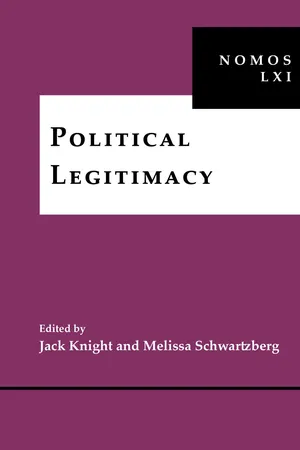
This volume reflects the cutting edge of responses to these perennial questions, drawing, in the distinctive NOMOS fashion, from political science, philosophy, and law. Contributors address fundamental philosophical questions such as the nature of public reasons of authority, as well as urgent concerns about contemporary democracy, including whether "animus" matters for the legitimacy of President Trump's travel ban, barring entry for nationals from six Muslim-majority nations, and the effect of fundamental transitions within the moral economy, such as the decline of labor unions. Featuring twelve essays from leading scholars, Political Legitimacy is an important and timely addition to the NOMOS series.
eBook - ePub
Political Legitimacy
NOMOS LXI
- English
- ePUB (mobile friendly)
- Available on iOS & Android
eBook - ePub
About this book
Information
Part I
Foundations of Legitimacy: Autonomy, Assent, and Obligation
1
Legitimacy and Self-Determination
Anna Stilz
How does a state acquire legitimate jurisdiction over a particular territory and its population? One story, to which I am sympathetic, holds that when people come into conflict about rights and resources, they are obliged to set up a state that can fairly resolve their disputes, since a state is necessary to the legitimate interpretation and enforcement of rights. Immanuel Kant, on whose writings I draw in this chapter, holds that we have an unconditional duty to enter the state, since a state is the condition of possibility of “conclusive” property rights (6:245).1 He also suggests that a person claiming property is permitted to coerce his neighbors to enter a civil condition along with him (6:255). This duty is binding on us independently of any special relationships we have, or any voluntary transactions we have engaged in.
Yet this Kantian view is subject to an important objection, which holds that it is unable to provide any determinate account of the state’s proper boundaries. Critics argue that while the Kantian view may show that states are in general necessary to establish justice, the view cannot address which particular people or places should be included within any state’s jurisdiction, or indeed, why we should prefer a plurality of states to a single world state.2 Those who press this objection typically interpret Kant as offering a purely functionalist account of state legitimacy, which holds that a state has a right to rule a population and territory insofar as it performs morally mandated governance functions in a reasonably just manner.3 Functionalism comes in both maximizing and threshold variants. The maximizing variant holds that a particular state has a right to rule a territory if—compared to its rivals—it can do best at delivering justice. The threshold variant holds that the state has a right to rule a territory if it achieves a decent level of success in that task.4 An important worry about functionalism, however, is that it may license colonialism or involuntary annexation.5 This chapter argues that the Kantian account of state legitimacy should not be assimilated to functionalism (on either variant), but should instead be understood as incorporating a (limited) claim to political self-determination.
Functionalism and Colonialism
The charge is not that functionalists will endorse colonial annexation in all cases. Colonialism and annexation frequently involve unjust violence and rights violations and may be ruled out on these grounds. Allowing just states to annex territory promotes war, which has predictably bad consequences for international peace and security. A functionalist may therefore endorse a general rule requiring respect for other states’ territorial integrity, except in cases of national self-defense or humanitarian intervention. Finally, functionalists would condemn most historical instances of colonialism. Colonial rulers dispossessed indigenous populations of their lands, they engaged in forced labor and economic exploitation, and they institutionalized systems of racial and cultural discrimination. Functionalist commitments to human rights and basic justice explain why these acts were wrong.
Still, the functionalist does not rule out a benign colonial regime if it does a reasonable job of providing good governance. Indeed, functionalism might even be invoked to support “civilizing” colonialism: Particularly in the later colonial period, European colonizers often invoked arguments grounded in liberal principles to justify their practices.6 Colonial rule was defended on the basis that it would help abolish the slave trade in Africa, or that it would further the moral and material well-being of native populations, or advance commerce and development. The US occupation of the Philippines, for example, supposedly aimed to improve “the well-being, prosperity, and the happiness of the Philippine people” and to establish “an enlightened system of government.”7
Suppose a colonial regime were successful in living up to its “civilizing” ideology: It protected its subjects’ rights and delivered enlightened governance to them. In that case, on either variant of functionalism, no claim to self-determination could be pressed against it. Ex hypothesi, the colonial regime meets the minimal justice threshold, and it may do better at securing justice than its rivals (also satisfying the maximizing criterion). Still, it seems that a population subjected to benign colonial administration would have a morally significant complaint: While not subject to grave injustice, they are denied self-rule. This violation of self-rule, I believe, is in itself a wrong, even when not accompanied by further violence or rights violations. The aim of this chapter is to understand the nature of the pro tanto wrong involved in the denial of political self-determination.
Violations of self-determination can occur in other cases. Consider:
- Military Occupation. In 1945, the Allies occupied Germany through a just use of force. Suppose that instead of restoring the territory to the German people, the United States had annexed their zone of occupation, turning it into an additional state of the union. After annexation, the United States governed reasonably justly, protecting the Germans’ human rights and granting them rights of democratic participation in the now-unified polity. Would the Germans have had a claim to political independence?
- Humanitarian Intervention. Proponents of humanitarian intervention argue that it is permissible to intervene militarily in another state in cases of genocide, mass expulsions, or gross violations of basic human rights. They believe temporary foreign rule can be acceptable in the aftermath of a justified humanitarian intervention. Yet most people think occupiers are obliged to restore the country to independence once a decent domestic government can be established. Why do they have this responsibility?
The best way to characterize our intuitions about these cases, I believe, is to hold that annexed, colonized, or occupied populations have a claim to govern themselves and their territory independently, and to order their political institutions as they choose. This claim to self-determination is defeasible and may sometimes be outweighed by competing concerns, as in a justified humanitarian intervention. But where weighty countervailing considerations are not at stake, it ought to be respected. Functionalism, however, seems unable to account for self-determination. On its maximizing variant, no political group can ever claim a right—against a more just colonizing power—to govern itself independently. And while its threshold variant allows a political group that achieves decent rule to govern itself, its right to independence holds only pro tem and may be lost if in the future it becomes subject to reasonably just foreign rule.
Two Dimensions of Legitimacy
If we accept the claim to self-determination, we must view state legitimacy as having two distinct dimensions.8 Let me define “legitimacy” as the state’s possession of an exclusive moral right to make law and policy on behalf of a particular group and to use coercion or force to implement those laws and policies. While a theory of justice addresses the question: “What scheme of rules about rights ought a political community (ideally) to adopt and enforce?,” a theory of legitimacy addresses a different question, namely: “Who has the right to decide what scheme of rules a political community will adopt and enforce?” The concept of legitimacy is contested: Some see legitimacy as correlative to subjects’ obligations to obey the state’s directives, while others define legitimacy as a mere liberty to enforce, which imposes no obligations on subjects, not even the obligation to refrain from vigilante justice. The definition I adopt here is agnostic about whether a legitimate state imposes duties to obey the law, but it does hold that legitimacy correlates to some obligations on subjects, namely, the obligation not to interfere with or resist a legitimate state’s efforts to issue and enforce directives. While citizens of a legitimate state may not have a duty to obey an unjust law rather than engaging in civil disobedience or conscientious refusal, they do have an obligation not to compete with a legitimate state through revolutionary violence or vigilante enforcement, and not to obstruct it in carrying out its functions, including accepting punishment for disobedience.
In theorizing state legitimacy, functionalism focuses on a (reasonably just) state’s role in providing justice-related benefits to its members.9 As institutional “takers,” individuals have interests in protection of their rights, a fair scheme of distributive justice, or public goods that only a state can provide. This “taker” dimension of evaluation focuses on familiar aspects of the basic structure, e.g., “the way in which the major social institutions distribute fundamental rights and duties and determine the division of advantages from social cooperation.”10 It is concerned with the quality of state institutions, independent of anyone’s acceptance or endorsement of them.
But on a self-determination theory, legitimacy also has a second, “maker” dimension: People have an interest in seeing themselves as the authors of their political institutions. It may be as important that their institutions reflect their priorities and values (in their role as “makers”) as that these institutions be good ones (from their perspective as “takers”). This second dimension of evaluation focuses not on the internal structure of the state itself (its qualities or characteristics), but rather on the relation between that state and those it rules.
On one account of self-determination, the nationalist theory, cultural nations are bearers of self-determination rights. A nation is a group marked out by shared characteristics that expressly suit them for self-rule, particularly a common culture.11 On the nationalist view, a state has a right to rule a particular population and territory if (a) the majority of that territory’s population forms a nation, (b) the state is properly authorized by that nation, and (c) the state acts to reproduce the nation’s culture over time, granting it privileged status in state symbols, ceremonies, the public education system, and so on.
A second account, the voluntarist theory, holds that collectives’ rights of self-determination are constructed on the basis of free consent of the governed. Voluntarists argue that subjecting people to political coercion without their consent objectionably infringes on their “natural freedom,” their ability to determine their lives by their own actions and decisions. A particular state has a right to rule a particular population only where individual subjects have actually historically consented to that state’s exercise of political power.12
Here I develop a third account of self-determination, which I call the political autonomy theory. This account draws in important ways on Kant’s political philosophy, especially his argument that the rules governing our collective political life ought not to be enforced unilaterally. Kant instead holds that to have the right to make and enforce law and policy for a population, the state must represent its subjects’ omnilateral will: “Only the concurring and united will of all, insofar as each decides the same thing for all, and all for each, and so only the general united will of the people, can be legislative” (6:314).
A key question is: What exactly makes for an omnilateral will? I suggest that an omnilateral will is an actual popular will. To be in a position to legitimately enforce law and policy, a state needs to reflect its people’s shared intention to cooperate together through particular institutions. In offering this reading, I hope to complicate our understanding of Kant’s political theory. Our most basic natural duties to others, for Kant, require us not only to set up a legitimate state, but also to impose that state’s political order in a manner that is sufficiently respectful of others’ capacity for rational judgment, including their capacity to make judgments about how they should be ruled. Once the conditions of an omnilateral will are unpacked, we will see that it is permissible to impose a political order on unwilling participants only in a narrow range of cases, and that the Kantian view does not sanction colonial annexation. Understanding the problem of unilateralism, in my view, also allows us to explain w...
Table of contents
- Cover
- Title Page
- Contents
- Preface
- Contributors
- Introduction
- Part I. Foundations of Legitimacy: Autonomy, Assent, and Obligation
- Part II. The Justification of Institutional Authority
- Part III. Beliefs About Legitimacy and Compliance
- Index
Trusted by 375,005 students
Access to over 1.5 million titles for a fair monthly price.
Study more efficiently using our study tools.
Frequently asked questions
Yes, you can cancel anytime from the Subscription tab in your account settings on the Perlego website. Your subscription will stay active until the end of your current billing period. Learn how to cancel your subscription
No, books cannot be downloaded as external files, such as PDFs, for use outside of Perlego. However, you can download books within the Perlego app for offline reading on mobile or tablet. Learn how to download books offline
Perlego offers two plans: Essential and Complete
- Essential is ideal for learners and professionals who enjoy exploring a wide range of subjects. Access the Essential Library with 800,000+ trusted titles and best-sellers across business, personal growth, and the humanities. Includes unlimited reading time and Standard Read Aloud voice.
- Complete: Perfect for advanced learners and researchers needing full, unrestricted access. Unlock 1.5M+ books across hundreds of subjects, including academic and specialized titles. The Complete Plan also includes advanced features like Premium Read Aloud and Research Assistant.
We are an online textbook subscription service, where you can get access to an entire online library for less than the price of a single book per month. With over 1.5 million books across 990+ topics, we’ve got you covered! Learn about our mission
Look out for the read-aloud symbol on your next book to see if you can listen to it. The read-aloud tool reads text aloud for you, highlighting the text as it is being read. You can pause it, speed it up and slow it down. Learn more about Read Aloud
Yes! You can use the Perlego app on both iOS and Android devices to read anytime, anywhere — even offline. Perfect for commutes or when you’re on the go.
Please note we cannot support devices running on iOS 13 and Android 7 or earlier. Learn more about using the app
Please note we cannot support devices running on iOS 13 and Android 7 or earlier. Learn more about using the app
Yes, you can access Political Legitimacy by Jack Knight,Melissa Schwartzberg, Jack Knight, Melissa Schwartzberg in PDF and/or ePUB format, as well as other popular books in Politics & International Relations & Political Philosophy. We have over 1.5 million books available in our catalogue for you to explore.