Myanmar's housing sector is struggling to cope with rapid urbanization, internal migration, and new demand from recent economic growth. These challenges are most apparent in the Yangon Region, where estimates suggest there will be a housing shortage of 1.3 million units by 2030. This publication assesses the current housing market situation in Yangon. It identifies reform options and offers practical recommendations to support the Yangon Region Government's implementation of its affordable housing agenda and related policies.
- 88 pages
- English
- ePUB (mobile friendly)
- Available on iOS & Android
eBook - ePub
About this book
Information
I. Assessment of the Housing Market, Housing Stock, and Affordability Gaps
Myanmar is in the midst of an historic transition from a closed and isolated economy to an increasingly open market economy. As Myanmar progresses toward industrialization, the country faces several development challenges such as widespread poverty, poor and inadequate infrastructure, low levels of entrepreneurship and industrialization, a suppressed private sector, and underdeveloped markets. Among these challenges, Myanmar’s housing sector is struggling to cope with rapid urbanization, internal migration, and new demand arising from recent economic growth, particularly in the larger metropolitan districts of Yangon and Mandalay.
The Yangon Regional Government (YRG) has been proactive in recognizing the imminent crisis-like situation likely to develop over the next decade, and has initiated several steps to achieve inclusive urban development and provide access to affordable housing for all residents. The smaller towns and rural areas of the Yangon Region as well as the slum and squatter settlements in Yangon are characterized by poor living conditions and unsafe and inadequate housing, which get compounded with the increasing vulnerability of the population to health hazards and disaster and climate risks. This continues to undermine economic growth and poverty-reduction efforts of the government. Further, the unavailability of long-term housing finance constrains the development and viability of market-led solutions to affordable housing. The existing housing finance system caters only to the high income earners and almost entirely excludes the underserved segments comprising poor and low-income households.
This diagnostic study aims to formulate various reform options, taking into account the importance of disaster risk management components; offer sequenced recommendations to address market failures; and advise YRG on the implementation of its affordable housing agenda and development of related policies. These objectives are in line with the country context and the national priority to position the Yangon Region as an engine of economic growth and development.
A. Current Housing Stock, Housing Structure, and Housing Shortage Estimates
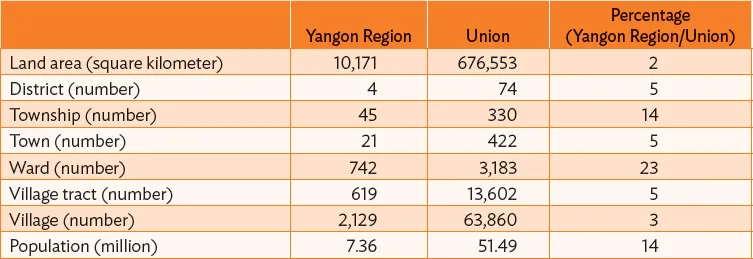
Yangon is the commercial and industrial center as well as the trade hub, with several industrial zones located at its outskirts. It is the largest city in Myanmar and the largest contributor to the national gross domestic product. Table 1 shows the details of the extent of land area and administrative units in the Yangon Region in relation to the Republic of the Union of Myanmar.
Table 1: Land and Administrative Units in the Yangon Region
Source: Government of Myanmar. 2017. Myanmar Statistical Yearbook. Nay Pyi Taw.
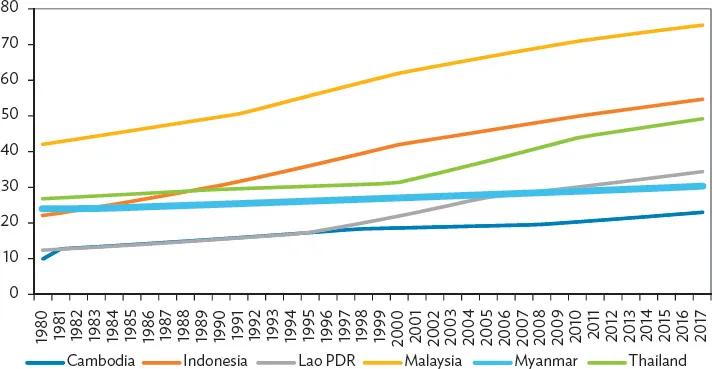
Compared with other countries in the region, the percentage of population residing in urban areas in Myanmar remains low. With less than 31% of the population classified as urban (Figure 1),1 the country remains predominantly rural and the majority of its labor force is involved in agriculture. However, sustained economic growth with accompanying development is expected to bring about increasing levels of urbanization and rapid urban growth.
Figure 1: Urban Population
(% of total)
(% of total)
Lao PDR = Lao People’s Democratic Republic.
Note: Urban population refers to people living in urban areas as defined by national statistical offices. The data are collected and smoothed by United Nations Population Division.
Source: United Nations Population Division. World Urbanization Prospects: 2018 Revision.
Myanmar’s urban population has increased gradually over the past 4 decades from 24% in 1980 to 30% in 2017. The country has witnessed rapid urbanization although the Yangon Region (Table 2) only exhibited a slight increase in the percentage of the population residing in urban areas (70.1% as per the 2014 Census). It must be noted that the composition of the labor force in some parts of the Yangon Region and its towns, which are classified as rural, actually resembles those of urban areas.
Table 2: Population by Urban and Rural across the Four Districts of the Yangon Region

… = data not available.
Source: Government of Myanmar. The 2014 Myanmar Population and Housing Census (Yangon Region). 2014. Nay Pyi Taw.
Beyond general population growth, the growth of urban areas typically involves a mix of socioeconomic push-and-pull factors that drive rural–urban migration. The components of population growth in Yangon in the 5-year period from 2010 to 2014 demonstrate that internal migration accounted for 81%, while natural increase was responsible for 31.46%.2 The labor force movement to fulfill the demands of the manufacturing sector is a significant driver of Yangon’s urbanization. Yangon, which contains more than 20 industrial zones, is among the most popular destinations for internal migration.
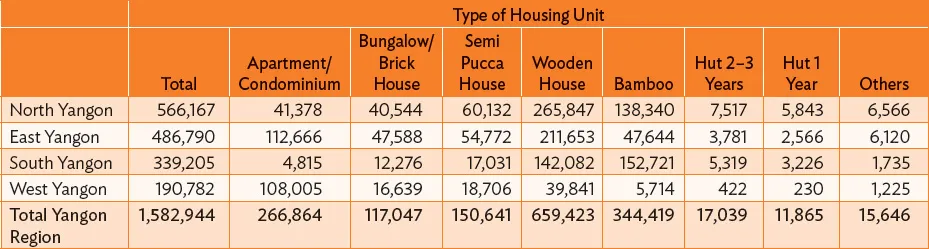
The current housing stock in the four districts of the Yangon Region can be segregated into different types of housing units reflecting the type of construction and its durability as shown in Table 3.
Table 3: Conventional Households by Types of Housing Units
(number)
(number)
Source: Government of Myanmar. The 2014 Myanmar Population and Housing Census (Yangon Region). 2014. Nay Pyi Taw.
It can be observed that, although Yangon has an urban population constituting 70%, barely 25% of the households are residing in formal housing units such as condominiums, apartments, and brick houses, which can be categorized as permanent. The dwelling units for 75% of the households are semipermanent or temporary structures, which would require frequent upgrades and retrofitting.
The quality of the housing stock can also be determined from the types of building materials used for the construction of roof, walls, and floors. Certain building materials such as thatch, bamboo, wood, mud plaster (earth), and corrugated she...
Table of contents
- Front Cover
- Title Page
- Copyright Page
- Contents
- Tables and Figures
- Foreword
- Executive Summary
- Abbreviations
- I. Assessment of the Housing Market, Housing Stock, and Affordability Gaps
- II. Analysis of the Housing Finance Market
- III. Existing Legal Frameworks and Market Practices on Housing, Land, and Property in the Yangon Region
- IV. Vulnerabilities of Myanmar to Climate Change and Disaster Risks
- V. Policy Recommendations for the Development of the Housing Finance Market
- VI. Road Map for the Development of a Rights-Based and Climate-Resilient Housing Sector
- Conclusion
- References
- Footnotes
- Back Cover
Trusted by 375,005 students
Access to over 1.5 million titles for a fair monthly price.
Study more efficiently using our study tools.
Frequently asked questions
Yes, you can cancel anytime from the Subscription tab in your account settings on the Perlego website. Your subscription will stay active until the end of your current billing period. Learn how to cancel your subscription
No, books cannot be downloaded as external files, such as PDFs, for use outside of Perlego. However, you can download books within the Perlego app for offline reading on mobile or tablet. Learn how to download books offline
Perlego offers two plans: Essential and Complete
- Essential is ideal for learners and professionals who enjoy exploring a wide range of subjects. Access the Essential Library with 800,000+ trusted titles and best-sellers across business, personal growth, and the humanities. Includes unlimited reading time and Standard Read Aloud voice.
- Complete: Perfect for advanced learners and researchers needing full, unrestricted access. Unlock 1.5M+ books across hundreds of subjects, including academic and specialized titles. The Complete Plan also includes advanced features like Premium Read Aloud and Research Assistant.
We are an online textbook subscription service, where you can get access to an entire online library for less than the price of a single book per month. With over 1.5 million books across 990+ topics, we’ve got you covered! Learn about our mission
Look out for the read-aloud symbol on your next book to see if you can listen to it. The read-aloud tool reads text aloud for you, highlighting the text as it is being read. You can pause it, speed it up and slow it down. Learn more about Read Aloud
Yes! You can use the Perlego app on both iOS and Android devices to read anytime, anywhere — even offline. Perfect for commutes or when you’re on the go.
Please note we cannot support devices running on iOS 13 and Android 7 or earlier. Learn more about using the app
Please note we cannot support devices running on iOS 13 and Android 7 or earlier. Learn more about using the app
Yes, you can access Financing Affordable Housing in Yangon by in PDF and/or ePUB format, as well as other popular books in Law & Housing & Urban Development Law. We have over 1.5 million books available in our catalogue for you to explore.