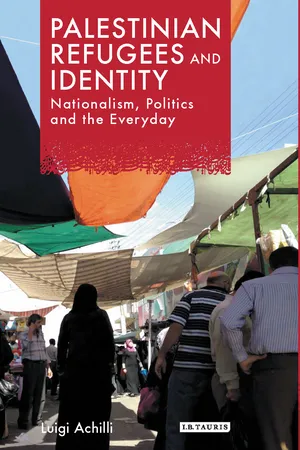
After the creation of the State of Israel in 1948, Palestinian refugees fled over the border into Jordan, which in 1950 formally annexed the West Bank. In the wake of the 1967 War, another wave of Palestinians sought refuge in the Hashemite kingdom. Today, 42 per cent of registered Palestinian refugees live in Jordan. As a result of this historical context, one might expect Palestinian refugee camps to be highly politicised spaces. Yet Luigi Achilli argues in this book that there is in fact a relative absence of political activity. Instead, what is prevalent is a desire to live an 'ordinary life'. It is within the framework of the performing and creating everyday life – working, praying, relaxing, watching football matches, surfing the internet, or idling in barber shops – that Achilli examines nationalism and identity.
Palestinian refugees have been traditionally depicted by the Western media as inherently political beings, ready to fight and resist all attempts to quash their nationalist struggle. But except for occasional political demonstrations and events, neither the political turmoil in Gaza and the West Bank, nor the uprisings throughout the Middle East of 2011, have roused refugees out of what they described as the ordinary course of daily life in the camp. Achilli argues instead that refugee daily life in many ways revolves around the practice of suspending the political.
The performative and reiterative dimensions of ordinary activities have not, however, precluded refugees from feeling an affinity for many of the meanings, ideals, and values of Palestinian nationalism. Achilli holds that it is through the desire for an 'ordinary life' that these Palestinian refugees are able to assert their own meanings and understandings of national identity against the more inflexible interpretations provided by the political systems in Gaza and the West Bank. Examining the concepts of 'everyday' Islam as well as the construction of masculine identity in the camps, Achilli offers vital analysis of the complexities and ambiguities of camp-dwellers' experience of the political in ordinary times.
- 272 pages
- English
- ePUB (mobile friendly)
- Available on iOS & Android
eBook - ePub
About this book
Information
CHAPTER 1
IT FEELS LIKE HOME
I climb into a taxi cab in Jabal Amman. Al-Wihdat is near this wealthy neighbourhood of Amman. Embedded in a tight cluster of dwellings, its densely populated space stretches out without any physical interruption toward the urban areas of Jabal Ashrafiyya (hill of Ashrafiyya). From the town centre, there is a road that leads uphill towards the camp; once separated from Amman, al-Wihdat is today completely incorporated into the city through urban expansion. As the driver steers onto the busy thoroughfares of Amman, the landscape changes visibly. The nice villas and buildings in white stones of this well-off neighbourhood swiftly give way to poorer constructions, dilapidated houses and shabby buildings. The ubiquitous pollution of Amman is thicker here than in the residential area of West Amman, most likely due to the heavier car emissions and traffic jams that engulf one of the main streets that borders the western side of the camp, Madaba Street. The taxi stops here, at the camp's outskirts, and does not enter through the large road that, departing from the main Madaba Street, penetrates into the camp.
A multitude of stands and people jam the road, Al-Nadi Street, slowing down the access to the economic and physical core of the camp: the suq al-wihdat (Wihdat market). An occasional visitor would never guess what actually constitutes ‘the camp’ or where it is. No fences, walls, or barbed wire separates al-Wihdat from the rest of the city. This is quite at odds with popular stereotypes circulating about refugee camps, imagined as big Palestinian enclaves, distinct from the rest of the city, and still not fully assimilated in Jordan: a space of Palestinian national belonging and strong social cohesion, a place inhabited by a distinct type of people. Also many camp dwellers speak of this space in this manner, suggesting that they have internalised such an image. They refer to themselves with the general term ‘awlad al-mukhayyam/mukhayyamjiyye – a word that can be roughly translated as ‘being from the camp’. A term that, however, means much more than just living in the camp: it entails affinity, emotional attachment and personal relationship with this space.
Any feeling of being an intruder in a dangerous and unruly zone of urban life rapidly vanishes once the first steps are taken toward the centre of the camp. Women and men crowd its main streets as well as the small alleys that branch in every direction – smoking shisha (water-pipe), sipping coffee, going shopping or trading. The public space appears to be an extension of the private space. Al-Wihdat does not present itself as an impenetrable community; it is rather an open space and a thriving economic area.
The market is expansive and its food sector bigger than the equivalent market in the downtown area of the city. In some parts of the market, the asphalt of the streets is covered with a thick stratum of dirt that over the years has piled up and taken on the semblance of soil. The sonic jumble of the voices of the passers-by redoubles the shouts and rattles of street vendors with their handcarts and stands. The smell of cattle mingles with the aroma of hot falafel that shopkeepers fry in thick black oil. Occasional whiffs of fresh fruits and the resilient hints of rotten food fill the nose. A multitude of peddlers, stands and small shops sell their merchandise alongside one another. Together, these stores form a huge market that extends from the centre of the camp almost to its outskirts. Although there is a supermarket and a few other medium or large-scale business activities, the souk is made up mostly of stands and shops managed by single individuals or, less frequently, a handful of paid employees. Almost all of these businesses are family based. There are carpenters, butchers, barber shops, tailors, peddlers, coffee sellers and falafel makers with their stands.
The centrality of market life to the camp's daily rhythms and dynamics is apparent particularly in the northern section of the camp. The market serves the needs not only of the camp's inhabitants but also of a much wider spectrum of people. Men in the camp take pride in saying how it is not only ‘us’ (folks from the camp) but also people from the surrounding areas and even from the richer zones of Amman who frequent their souk, attracted by abundant goods and competitive prices.
As a whole, al-Wihdat is an integral part of Amman. There are distinguishing features, though. The main road where the taxi driver dropped me – Madaba Street – is a large one, with two lanes in each direction, divided by a traffic island; the street separates the western border of the camp from the surrounding neighbourhoods. Another big yet slightly narrower road delimits the northern border of al-Wihdat. At the entrance of the large street – al-Nadi Street – that I had crossed to get to the market, a police station towers: a three-storey fortress with a large poster of the King hanging on its facade. If the two roads encircle a part of the camp, separating it from the rest of the city, the police station draws the attention of a visitor to a slightly different visual pattern – a set of non-distinctive features that, taken together, bestows a specific and peculiar dimension to the camp. Aside from a few large roads, al-Wihdat is a maze of narrow passageways and twisting alleys that gives the camp the feeling of a labyrinth. The shabbiness of the shelters (ma'wa/malja') – often protected only with zinc roofs anchored by pieces of debris and heavy stones – and their height (rarely exceeding a second or third floor) set al-Wihdat apart from other comparable areas of the city. Seasoned visitors can also quite easily spot other markers of aesthetic difference in the camp – such as the UN flags on the offices, schools and other facilities of the UNRWA. According to the words of a Palestinian refugee previously employed in the UN compound in the camp, al-Wihdat possesses a familiar air:
for those who have never stepped a foot into it, it is difficult to distinguish the camp from any other poor neighbourhood. But for us who have lived and worked in the camp, it is simple. You can distinguish the camp for its vegetable market [suq al-khudra], for the women who dress traditionally, for the accent of the people and the way they shout when they sell their products.
In Jordan there are few other camps like al-Wihdat whose name reverberates with so much intensity the echo of a distinct national identity. Yet, the borders of the camp have not only served to separate but also to connect.1 Over the years, newcomers and the demographic growth have radically altered its visual profile, which has increasingly melted into the surrounding neighbourhoods. If the refugees' taking over of the spaces and infrastructure of the camp has certainly favoured a process of integration of al-Wihdat into the urban fabric of Amman, it has also evoked ambivalent feelings towards the camp (as it now feels like home) and fears of resettlement among camp residents. In this chapter, I explore the seemingly paradoxical status of al-Wihdat: an arena for fashioning nationalist ideals and subjectivity, and a site for the progressive integration of refugees into the broader Jordanian society. Refugees devote a great deal of their energy to trying to challenge the socio-economic marginality that seems to plague refugee camps. This capacity is a central dimension of their ability to accommodate the need to live an ordinary life as Jordanian citizens with the burden of an extraordinary existence as Palestinian refugees. To illustrate this, the chapter starts with a preliminary examination of the relationship between the Jordanian state and Palestinian refugees. This will show how state and UN policies in the camp have contributed to problematising refugees' feelings of national self-identification – a dilemma further aggravated by the evolution of the UNRWA and the Jordanian state's management of camps' physical infrastructure and housing. I will then document how refugees, through their daily spatial practices, have sought to navigate the quandary pertaining to their status in Jordan by making themselves at home in al-Wihdat. If camp dwellers once sought to maintain the camp's spaces as liminal places, today they welcome its spatial and economic integration inside the territory as a form of agency and creativity that demonstrates their allegiance to Palestinian nationalism. An inside view will also dissipate stereotypical depictions of the camp as an homogenous place and reveal the existence of several sub-neighbourhoods (harat), some of which differ from others in terms of the Palestinian origins of their inhabitants, their reputations and, sometimes, in terms of the forms of wealth and power they are thought to have amassed.
From expansion to contraction: Palestinians in Jordan
When Palestinian refugees arrived in 1948, Jordan had only recently been recognised as a distinct territorial unity. Before Britain and France became the dominant imperialist powers in the area, the country was part of the ‘Province of Damascus’ (wilayat dimashq) under Ottoman jurisdiction. The end of World War I signalled the victory of the Allied Forces. Ruling what was formerly the Ottoman Empire, Great Britain and France introduced two regional systems into the eastern Mediterranean Arab region. The first was the nation-state system; the second was a new international regime that gave the Allies a mandate permitting them to administer the former Ottoman territories until they became fully fledged nation-states.2 In the eastern parts of the region, Arab and Kurdish populations were combined into the new Mesopotamian country called Iraq, which was supposedly independent, but a de facto British protectorate. Meanwhile, Syria and a greatly enlarged Lebanon were governed by France. In April 1921, Hejazi Emir Abdullah I bin al-Hussein, born in Mecca during the Ottoman Empire, was appointed Governor of the newly formed Emirate of Transjordan by the British government. In September 1922, the Council of the League of Nations recognised part of the territories east of the Jordan River as a state under the British Mandate.
The first decade of rule was marked by the joint attempt of the British and the Emir (Emir Abdullah I bin al-Hussein) to establish a governmental structure and consolidate their authority over the territory and local population.3 The creation of Jordan defined the features of new political and ethnic identities. However, with the introduction of the new nation-state system in the region, traditional loyalties to a tribe, a region, a village, a town or a district did not disappear but rather merged into a new complex political system.4 To legitimise the new order, the regime implemented a number of strategies. From 1927 a series of laws were enacted, culminating in Transjordan's Organic Law and the Nationality Law in 1928 that defined the temporal, spatial and corporeal borders of the nation. Territorial integrity and territorial sovereignty provided the basis for grounding the utopian idea that ethnic identity and national territory should correspond. Alongside the judicial and legislative bodies,5 several institutions have had a relevant role in the foundation of Jordan as a distinct national entity: the law and military, the Emir, the educational system, the census and the museum have all served the interests of the ruling powers in the production of a national identity.6 In 1946, the Emir declared himself King of Transjordan and the Emirate became the Hashemite Kingdom of Jordan.7 The following years brought even more radical transformations.
The first Palestinian refugee camps were set up in the Hashemite Kingdom in the late 1940s following the establishment of Israel.8 When the Jewish Agency in Tel-Aviv announced the institution of the Provisional Government of Israel on 14 May 1948, the war that followed resulted in the destruction and mass evacuation of most Palestinian villages. The end of the war saw the territory of Mandatory Palestine divided between the Zionist colonies and the Arab forces that intervened on the ‘behalf’ of the Palestinian side. Whereas the former took control of a large part of the territory designated as the British Mandate of Palestine, Egypt and Jordan respectively administered Gaza and annexed the West Bank. Those who left their land and abandoned their houses to flee the mass persecution and atrocities perpetrated by the Haganah and other Jewish forces were therefore prevented by the newly born state of Israel from returning to their homes and lands.9 Three-quarters of a million people, many injured during the violent Jewish–Arab conflict, were suddenly transformed into a humanitarian problem: the Palestinian issue. Palestinians from southern parts of Mandatory Palestine fled to the Gaza Strip; those from the centre dispersed to the West Bank; and refugees from the north spread out into southern Lebanon and Syria.10 According to the Red Cross, about 320,000 Palestinian refugees stayed in the West Bank; 210,000 went to the Gaza Strip and 180,000 to other Arab countries. Around 100,000 Palestinians found refuge in the East Bank (today's Jordan).11
The establishment of Israel in 1948 provided an opportunity for the ambitious King Abdullah to fulfil his expansionist goals. In the aftermath of the Arab–Israeli war, the monarch's military annexed what remained of central Palestine, including the cities of Jerusalem (the East part), Ramallah, Nablus, Jenin, Hebron and the surrounding areas. In 1950, the government formally announced that
on the occasion of the lifting of barriers between the East and the West Banks of the Hashemite Jordanian Kingdom, there is no longer a reason to consider the country [al-balad] located in the West Bank a foreign country […] the two countries located in said two Banks are considered one unity [wihdah wahidah].12
The territory formerly known as Palestine became the ‘West Bank of Jordan’.
The military expansion was hence legitimised by the signing of an addendum to the 1928 Law of Nationality, which stated that
all those who are habitual residents, at the time of the application of this law, of Transjordan or the Western Territory administered by the Hashemite Kingdom of Jordan, and who hold Palestinian nationality, are considered as having already acquired Jordanian nationality and to enjoy all the rights and obligations that Jordanians have.13
Along with a set of laws containing regulations relating to nationality, the addendum of 1928 – then amended in 1954 by the Law of Jordanian Nationality – granted...
Table of contents
- Front Cover
- Title Page
- Copyright
- Dedication
- Contents
- List of Illustrations
- Acknowledgements
- Introduction
- 1. It Feels Like Home
- 2. Imperatives of Work
- 3. Politics and Islam
- 4. Ordinary Masculinities
- 5. Time Off! ‘Loitering’ in the Camp
- Conclusion
- Glossary
- Notes
- Bibliography
- Back cover
Trusted by 375,005 students
Access to over 1.5 million titles for a fair monthly price.
Study more efficiently using our study tools.
Frequently asked questions
Yes, you can cancel anytime from the Subscription tab in your account settings on the Perlego website. Your subscription will stay active until the end of your current billing period. Learn how to cancel your subscription
No, books cannot be downloaded as external files, such as PDFs, for use outside of Perlego. However, you can download books within the Perlego app for offline reading on mobile or tablet. Learn how to download books offline
Perlego offers two plans: Essential and Complete
- Essential is ideal for learners and professionals who enjoy exploring a wide range of subjects. Access the Essential Library with 800,000+ trusted titles and best-sellers across business, personal growth, and the humanities. Includes unlimited reading time and Standard Read Aloud voice.
- Complete: Perfect for advanced learners and researchers needing full, unrestricted access. Unlock 1.5M+ books across hundreds of subjects, including academic and specialized titles. The Complete Plan also includes advanced features like Premium Read Aloud and Research Assistant.
We are an online textbook subscription service, where you can get access to an entire online library for less than the price of a single book per month. With over 1.5 million books across 990+ topics, we’ve got you covered! Learn about our mission
Look out for the read-aloud symbol on your next book to see if you can listen to it. The read-aloud tool reads text aloud for you, highlighting the text as it is being read. You can pause it, speed it up and slow it down. Learn more about Read Aloud
Yes! You can use the Perlego app on both iOS and Android devices to read anytime, anywhere — even offline. Perfect for commutes or when you’re on the go.
Please note we cannot support devices running on iOS 13 and Android 7 or earlier. Learn more about using the app
Please note we cannot support devices running on iOS 13 and Android 7 or earlier. Learn more about using the app
Yes, you can access Palestinian Refugees and Identity by Luigi Achilli in PDF and/or ePUB format, as well as other popular books in Politics & International Relations & Middle Eastern History. We have over 1.5 million books available in our catalogue for you to explore.