- 288 pages
- English
- ePUB (mobile friendly)
- Available on iOS & Android
eBook - ePub
About this book
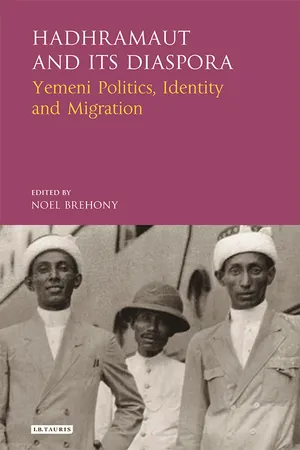
The Hadhramis of Yemen have migrated for centuries in large numbers, establishing a diaspora that extends around the Indian Ocean, Saudi Arabia and the other Gulf States. This migration has deeply affected the host countries as well as Hadhramaut itself. Yet the region has not been able to use its population size, capabilities or resources to wield significant political influence in successive Yemeni regimes. This book examines the people of the Hadhrami diaspora, who travelled as religious scholars, traders, labourers and soldiers, to understand their enduring influence and identity. In doing so, the book explores key aspects of their history, including the impact of Yemeni nationalist movements, the significance of land reforms, the importance of social and tribal origins and how the Hadhrami resisted European domination as a Muslim community. Although a distinctive part of geographical Yemen, Hadhramaut was not regarded as a Yemeni political entity until the twentieth century.This research asks if the recent turmoil in Yemen following the Arab Spring, the growth of Al-Qa'ida and ISIS, and war involving a coalition led by Saudi Arabia, will produce even greater instability in the region or perhaps lead to a united Yemen, a restored South Yemen or even to Hadhramaut as an independent state.
Information
Part I
Hadhramis in Yemen
1
Hadhramaut in Yemeni Politics since the 1960s
Saadaldeen Talib and Noel Brehony
One impact of the tumultuous events in Yemen since 2011 is that Hadhramis now demand a greater say in how Yemen and their region are governed. Since the late nineteenth century, Hadhramaut has been a part, successively, of the Aden Protectorate and then of the Eastern Aden Protectorate in British South Arabia, the People’s Democratic Republic of Yemen (PDRY, 1967–90), and, from May 1990, the Republic of Yemen, but has not achieved the influence that might have been expected from the numbers and attainments of its population and its economic resources. Political and economic developments in Hadhramaut have been determined by regimes in Aden (one-fifth of the PDRY’s population was Hadhrami), Sana‘a (one-twentieth) and by forces in other parts of Yemen – and since March 2016 by civil war and the intervention of a Saudi-led coalition. Even when Hadhramis have held top political positions in Yemeni regimes, they have been less effective than politicians from some other Yemeni regions in fostering the interests of their homeland. To understand why, we examine the place of Hadhramaut in Yemen in the last few decades, and assess how recent political developments might affect Hadhramis in their homeland and diaspora.
Hadhramaut in South Arabia
Under the British system, Hadhramaut was separate from the rest of South Arabia. The sultans of Qu’ayti and Kathiri resisted pressure to join the South Arabian Federation, and may even have contemplated making Hadhramaut independent or possibly linking it to Saudi Arabia. They clearly saw Hadhramaut as distinct from the rest of Yemen, reflecting the fact that, for much of its history, it was made up of independent entities. On the other hand, the Arab nationalist forces competing to take over from the British saw Hadhramaut as an integral part of a future South Yemen, though some were cautious in the mid 1960s about advocating Yemeni unity.1 These parties were covertly active in Mukalla and Say‘un, drawing on the nationalist ferment inspired by Nasserism and by the nationalism and revolutionary ideas sweeping the countries of the diaspora. The Movement of Arab Nationalists (MAN) recruited its first cells in Hadhramaut in 1960. At a meeting in Sana‘a in 1963, MAN leaders launched the National Liberation Front (NLF) to spearhead the liberation of South Arabia.
From its bases in Yemen, and drawing on support provided by Egyptian forces, the NLF gave priority in the early 1960s to fighting the British and the sultans in Lahij, Fadhli and Lower and Upper Yafa, close to the border, and then in Aden. The focus in Hadhramaut was to use the MAN network as a basis for penetrating key institutions, including the Hadhrami Bedouin Legion (HBL) and the sultans’ security forces. The NLF achieved this without the British or the sultans fully appreciating the scope and depth of its organisation.2 Ali Salim al-Beidh, a sayyid from Raidat Abd al-Wadood and a leading figure in the central NLF leadership, had a supervising role, and even visited East Africa to seek financial support for the NLF from the large Hadhrami community.3
The armed struggle in Hadhramaut was launched only in April 1967, assisted by four experienced NLF fighters sent from Aden. Had the sultans been present in the critical month of August 1967, they might have been strong enough to rally support against the NLF, but were in Geneva attending meetings held by the United Nations Committee for Independence of South Arabia. When they returned to Mukalla by boat on 17 September, they were met by a delegation from the HBL and the NLF, which refused them entry.4 In early October, the NLF formally took power in Hadhramaut, with little resistance.
The NLF leaders in Hadhramaut came from the extreme left, and even before the People’s Republic of South Yemen (PRSY) was set up on 30 November 1967, there were ‘soviets’ in parts of Hadhramaut.5 With some encouragement from al-Beidh, the new governor of Hadhramaut Faysal al-Attas pursued radical policies (see Chapter 2) that alienated the more pragmatic figures around Qahtan al-Sha‘abi, the new president of the PRSY, who were appalled at what they saw as chaos. When, in May 1968, the Hadhrami NLF announced the formation of the People’s Democratic Republic of Hadhramaut, Qahtan sent the armed forces to remove al-Attas, purge the Hadhrami NLF and bring the region under the control of Aden. Any prospect that Hadhramaut might have become independent of Aden, or seceded from the PDRY, came to an end.
Hadhramaut in the PDRY
The PDRY went through a turbulent and violent period in its early years, driving tens of thousands of people, many Hadhrami, into exile. However, from the mid 1970s, especially after the NLF had become the Yemeni Socialist Party (YSP), in 1978, Aden – benefiting, unlike Sana‘a in the YAR, from the administrative system inherited from the British – provided its citizens with a fairly effective and largely incorrupt administration able to deliver government services to most parts of the country. Hadhramaut, like other regions, was affected by Aden’s drive to abolish tribalism and its determination to make the PDRY a civil state in which religion was a private concern. Violence against Sufi shrines in the Wadi in the late 1960s was gradually replaced by an effort to win the acquiescence, if not endorsement, of the PDRY by religious scholars and clerics in the 1980s. Earlier socialist economic policies, which had had profound and often adverse consequences in Hadhramaut, gradually became more pragmatic. Aden’s alliance with the Soviet Union enabled it to build a modern military, but had the effect of isolating it from GCC states (apart from Kuwait) for much of the 1970s, and of making the GCC cautious in the backing it provided in the 1980s. Moscow and its allies never gave enough to the PDRY to lift it from poverty, while the rest of the Arabian Peninsula benefited from the oil booms of the 1970s and 1980s. The economic problems of the state were mitigated to some extent in Hadhramaut by the inflow of remittances, especially in the early 1980s, from the traditional diaspora and the expanding Yemeni communities in the Gulf states.6
The late arrival of the NLF, and the peripheral nature of the region to the main struggle in the West, partly explain why Hadhramaut had less influence throughout the life of the PDRY than Aden, (where many of the main leaders were of North Yemeni origin), Lahij and Abyan. Thus, at the first NLF conference in March 1968, there were only 13 delegates from Hadhramaut, which had a population of 492,000 (in 1973) compared with 45 for Abyan (311,000) and 34 for Lahij (291,000). On the other hand, individual Hadhramis often had a strong influence because of their role in the independence fight (for example, Ali Salim al-Beidh) or their high level of education. A few from the diaspora went to the PDRY to offer their services to the government.
Hadhrami politicians, who were often assiduous in building support in their home region, proved adroit at either staying out of or picking the winning side in the power struggles within the PDRY after 1975, which in effect became a battle between political and military leaders from Abyan (led by Ali Nasser Muhammad) and their rivals from Lahij. In January 1986, a virtual civil war broke between these two factions, leading to the death of at least 5,000 people and great damage to the reputation of the PDRY and its economy, as well as much physical destruction in Aden. Hadhramaut was not affected directly. With many of the top PDRY leaders dead, in exile with Ali Nasser Muhammad, or in gaol, two Hadhramis were left in nominal command of the state. Al-Beidh, a survivor of this and later crises, became secretary-general of the YSP, and Haydar al-Attas the new president. Though other Hadhramis were in key positions (Salih al-Siyayli as minister of state security, for example), real power lay with military figures from Lahij – Ali Nasser’s supporters from Abyan were in the north, and were used by Sana‘a to put pressure on Aden.
The Hadhrami-led regime struggled to maintain its legitimacy and the economy, and it soon became clear that the PDRY had been mortally wounded by the 1986 civil war. It was finished off in 1989, when the collapse of the Soviet Union exposed Aden’s strategic error of cutting itself off from the West and the GCC.
As we shall see, the impact of the PDRY on Hadhramaut was to create in some an attachment to the idea of an independent southern state, or at least a distinctive southern region in a federal Yemen. Such sentiments are shared by other parts of the former PDRY, where people have a nostalgic memory of a PDRY, based on the good days of the early 1980s, that provided a degree of equality and reasonably good government services. Others recall the brutality of the PDRY’s early years, and the conflict and instability of its last few years.
Hadhramaut, the YAR and Yemeni Unity
After the demise of the PDRY, the regime of President Ali Abdullah Saleh took control of Hadhramaut; the ability of Hadhramis to influence the regime’s policies further diminished. To understand the situation, it is essential to look at the nature and functioning of the Saleh regime.
The Saleh Regime
The Yemen Arab Republic, set up in 1962 following the overthrow of the last Imam, had experienced eight years of civil war and, after a brief period of stability in the early 1970s, saw two of its presidents assassinated within the 18 months before Ali Abdullah Saleh came to power in 1978. After a difficult start, he developed a system that enabled him to stay in power for the next 33 years, and still survives. He built up strong defence and security forces commanded by relatives and close allies drawn from his Sanhan tribe, a member of the Hashid Tribal Confederation. Around this core he constructed networks of patronage embracing tribal, local and commercial elites who provided loyalty in return for jobs for their followers, contracts for associates and positions for themselves and their allies. This was given political expression in the General People’s Congress (GPC), which delivered Saleh majorities in presidential and parliamentary elections. According to Peter Salisbury, ‘It was made up of a wide array of voices: Islamists, tribesmen, businessmen, Arab nationalists, Nasserists and civil society actors. Broadly nationalist and developmental in its outlook, the party served as much as a mechanism for distributing patronage and rewarding regime loyalists as it fulfilled any ideological function’.7 Saleh was a master at divide and rule, keeping opponents at each other’s throats and his allies suspicious of each other.
In 1990, Abdullah al-Ahmar, the head of the Hashid confederation, helped found a new political party, the Yemeni Congregation for Reform, known as Islah. Though this was in opposition to the GPC, al-Ahmar operated his own networks of influence, including in the security forces. He shared with Saleh an interest in preserving the system from which both could benefit. From its foundation Islah, whose core membership is not dissimilar to that of the GPC, took in members of the Muslim Brotherhood and Salafis. It was a convenient tool for Saleh at a time when he had to contend with the influence of the well-organised and Hadhrami-led YSP. General Ali Mohsen, who was a long-term ally of Saleh – they were from the same tribe and village – was a leading military figure commanding the First Armoured Division, the largest and most effective part of the Yemeni armed forces at the time, and close to Islah.
Hadhramaut and Yemeni Unity
Both Yemeni regimes had seen their respective states as being two parts (shatrayn) of a single Yemen, and spoke endlessly of their goal of unification; but each concentrated on building their respective systems. They were deeply involved in each other’s affairs, signing unity agreements in 1972 and 1979 after fighting brief border wars. Until the early 1980s, the two states were of roughly equal strength; the population of the YAR was four times larger, but the PDRY was better organised politically and militarily, and the YSP had a secret branch in the YAR from its foundation in 1978.
By late 1989, the Hadhrami Ali Salim al-Beidh and his colleagues concluded that their salvation lay in a confederation with the YAR – spurred by the potential economic gains of being able to exploit oilfields that lay across their borders in Marib and Shabwah. The YAR leaders were also ready for unity in the form of a federation. Instead of the expected confederation or federation, Saleh and al-Beidh agreed, in private talks in December 1989, to the implementation of full uni...
Table of contents
- Cover
- Author Bio
- Endorsement
- Title Page
- Copyright Page
- Contents
- List of Figures
- List of Maps
- Foreword
- Acknowledgements
- Notes on Contributors
- Introduction
- Part I Hadhramis in Yemen
- Part II Hadhramis in the Diaspora
- Part III Research Issues
- Bibliography
Trusted by 375,005 students
Access to over 1.5 million titles for a fair monthly price.
Study more efficiently using our study tools.
Frequently asked questions
Yes, you can cancel anytime from the Subscription tab in your account settings on the Perlego website. Your subscription will stay active until the end of your current billing period. Learn how to cancel your subscription
No, books cannot be downloaded as external files, such as PDFs, for use outside of Perlego. However, you can download books within the Perlego app for offline reading on mobile or tablet. Learn how to download books offline
Perlego offers two plans: Essential and Complete
- Essential is ideal for learners and professionals who enjoy exploring a wide range of subjects. Access the Essential Library with 800,000+ trusted titles and best-sellers across business, personal growth, and the humanities. Includes unlimited reading time and Standard Read Aloud voice.
- Complete: Perfect for advanced learners and researchers needing full, unrestricted access. Unlock 1.5M+ books across hundreds of subjects, including academic and specialized titles. The Complete Plan also includes advanced features like Premium Read Aloud and Research Assistant.
We are an online textbook subscription service, where you can get access to an entire online library for less than the price of a single book per month. With over 1.5 million books across 990+ topics, we’ve got you covered! Learn about our mission
Look out for the read-aloud symbol on your next book to see if you can listen to it. The read-aloud tool reads text aloud for you, highlighting the text as it is being read. You can pause it, speed it up and slow it down. Learn more about Read Aloud
Yes! You can use the Perlego app on both iOS and Android devices to read anytime, anywhere — even offline. Perfect for commutes or when you’re on the go.
Please note we cannot support devices running on iOS 13 and Android 7 or earlier. Learn more about using the app
Please note we cannot support devices running on iOS 13 and Android 7 or earlier. Learn more about using the app
Yes, you can access Hadhramaut and its Diaspora by Noel Brehony in PDF and/or ePUB format, as well as other popular books in History & Middle Eastern History. We have over 1.5 million books available in our catalogue for you to explore.