All Religion Is Inter-Religion analyses the ways inter-religious relations have contributed both historically and philosophically to the constructions of the category of "religion" as a distinct subject of study.
Regarded as contemporary classics, Steven M. Wasserstrom's Religion after Religion (1999) and Between Muslim and Jew (1995) provided a theoretical reorientation for the study of religion away from hierophanies and ultimacy, and toward lived history and deep pluralism. This book distills and systematizes this reorientation into nine theses on the study of religion.
Drawing on these theses--and Wasserstrom's opus more generally--a distinguished group of his colleagues and former students demonstrate that religions can, and must, be understood through encounters in real time and space, through the complex relations they create and maintain between people, and between people and their pasts. The book also features an afterword by Wasserstrom himself, which poses nine riddles to students of religion based on his personal experiences working on religion at the turn of the twenty-first century.
eBook - ePub
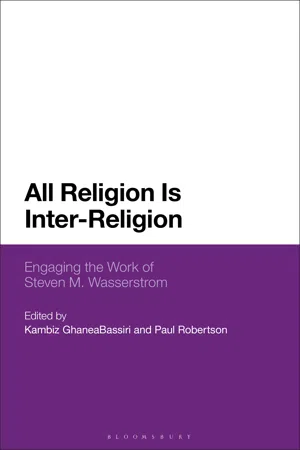
All Religion Is Inter-Religion
Engaging the Work of Steven M. Wasserstrom
- 320 pages
- English
- ePUB (mobile friendly)
- Available on iOS & Android
eBook - ePub
All Religion Is Inter-Religion
Engaging the Work of Steven M. Wasserstrom
About this book
Information
1
Introducing Wasserstrom’s Work on Religion
Steven M. Wasserstrom argues that religion is “a vocation worth the work.”1 So, it is only fitting that an introduction to his influence on the study of religion begins with placing him at work. Wasserstrom is a world-class historian of religions who teaches at a liberal arts college. Liberal arts college professors pride themselves in being teacher-scholars—in that order. The precedence teaching takes in their careers means that they rarely have the opportunity to pursue specialized research interests with their students who, unlike doctoral students of their counterparts at research universities, possess neither the necessary background knowledge nor the requisite research languages. They also do not have ready access to research libraries, and while, in recent years, more and more archives and specialized journals are becoming available online, they still have not replaced the need for visits to research libraries. Wasserstrom, in fact, has made these research trips a regular part of his scholarly regime. Once, when I was a graduate student and had invited him to give a talk at Harvard, he tacked on a few extra days to his trip on his own dime so that he could spend time reading at Widener library.
For all these reasons, fewer liberal arts college professors write field-changing works like Wasserstrom’s Between Muslim and Jew and Religion after Religion. If they do produce such scholarship, their careers usually take a sharp turn toward research universities, where they are called on to help train a new generation of specialists. Of the very few who write field-changing books and opt to remain at liberal arts colleges, fewer still have the influence Wasserstrom has had on their field through training undergraduate students. This is not to suggest that Wasserstrom regards undergraduate teaching a burden. On the contrary, he dedicated Religion after Religion to “Reedies everywhere.”2 Inquisitive and thoughtful undergraduates provided him an audience with whom he has worked for more than three decades to close the gap between “the manifest power of religion in the ‘real world’” and Religious Studies’ ability to communicate its findings to a wider audience.3 This is all by way of saying, you hold a rare volume in your hands that is a product of an exceptional career in Religious Studies. In it, thirteen of Wasserstrom’s students at Reed College who went on to pursue careers in the academy and two colleagues of his generation whose professional life and scholarship have fruitfully intersected with Wasserstrom’s come together not just to celebrate Wasserstrom’s contributions to the study of religion but also to think with him about the vocation of Religious Studies.
The idea of this book originated at the annual conferences of the American Academy of Religion in the 2010s when I (and Kristin Scheible, after she joined the department in 2014) gathered informally with graduates of Reed’s Religion Department to talk about research, to track careers, and to reminisce. In these gatherings, Steve’s (for we are all on a first-name basis at Reed) pedagogy and scholarship loomed large. It did not take long before these graduates began to float the idea that they should mark his impact on their own intellectual lives and the study of religion more generally. As Steve’s thirty-year anniversary at Reed approached, I offered to help organize a conference in his honor, and Paul Robertson volunteered to help with editing the Festschrift. We received financial support from Reed’s Religion Department and Reed’s Greenberg Distinguished Scholar Program to gather about two dozen of Steve’s students and colleagues at Reed College in October 2017 for a three-day academic conference centered around Steve’s pithy provocation that “all religion is inter-religion.” This provocation encapsulates the collective thesis of the essays gathered here. The principal argument of the present book is that religion is always relational and plural. There is no religion in the singular, nor is there any religion outside of human society, economy, politics, psychology, or ethics. The study of religion is thus tasked with making philosophical sense of the complex relations and differences that humans have managed in history without compartmentalizing them or essentializing them and thus erasing the relations and differences that constitute religion as a subject of study.
Steve had penned the notion that all religion is inter-religion in an essay titled “Nine Theses on the Study of Religion,” which is published in this volume for the first time. He had submitted the essay for an edited volume that never reached the printing presses. The large number of these unpublished manuscripts on Steve’s shelves and hard drive is mind-boggling. Were it not for Steve sharing this piece with me when we co-taught “Theories and Methods in the Study of Religion,” it is very likely that it would not have seen the light of day. Wasserstrom has a long and illustrious curriculum vitae (CV), but Steve does not write to add a publication line to his CV. He researches because he hungers for answers to big humanistic questions, and he writes to think through his research findings. Not many can keep up with the speed with which he thinks and devours books, and while he willingly works to bring inquisitive students along with him in the classroom, he does not slow down for the publishing industry.
We were fortunate that Bruce Lincoln and Elliot Wolfson—two scholars who travel in the fast lane with Steve—readily agreed to give the two keynote lectures for the conference, which have been reproduced with some minor edits in this volume. Lincoln’s lecture, “Before Religion? The Zoroastrian Concept of Daēnā and Two Myths about It,” inaugurated the conference. In it, Lincoln paid homage to the argument of Religion after Religion that the concept of religion used by such founding figures of Religious Studies as Mircea Eliade, Henry Corbin, and Gershom Scholem does not reflect the historical realities of the subjects they studied. Lincoln asked whether or not the concept of religion as it is used in the academy today has a pre-history that is reflected in the Avestan word daēnā, which scholars often render as “religion.” He demonstrated that daēnā has multiple meanings in ancient Zoroastrian texts, some of which affirm contemporary presuppositions about religion as primordial and interior and others that problematize such an understanding by historicizing daēnā. Lincoln’s essay shows that defining daēnā as “religion,” in the singular, obfuscates the multifarious uses of the term in our historical sources and thus, like the founding figures Wasserstrom studied, imposes contemporary ideologies of religion on the term.
Wolfson’s keynote lecture closed out the public portion of the conference and paid homage to Wasserstrom, less through agreement and more by showing how Wasserstrom’s conclusions have challenged Wolfson to think and articulate his own ideas about Jewish mysticism. As such, Wolfson’s chapter is more programmatic and longer than the other chapters in the book. Wolfson examines Martin Heidegger’s “philosophical ruminations” on language as a way of moderating the strong link that Wasserstrom sees between fascism and the mythic/symbolic language through which fascist ideas were buttressed and popularized in the twentieth century. By comparing Heidegger, a well-known supporter of Hitler, with kabbalists, Wolfson seeks to demonstrate that, in careful philosophical work, truths reveal themselves despite the moral shortcomings of the philosopher. Wolfson does not rehabilitate Heidegger for Jewish Studies, but he tries to make sense of similarities he finds between Heidegger’s philosophy and the kabbalah in light of Wasserstrom’s admonishment that Heideggerian discourses on phenomenology of religion have been “contaminated” by fascism.4 “What is dark,” Wolfson writes, “is not dissolved brightness; it remains concealed and comes to appearance in the light … By illuminating the dark light and uncovering the shadow as shadow, one is emancipated.”5
The longstanding conversations between Wolfson and Wasserstrom reverberate in Jeremy Brown’s essay. Brown studied with Wasserstrom before completing his PhD in Jewish Studies with Wolfson at New York University. He examines the polemical work of the Argentinian nationalist cleric Julio Meinvielle, bringing a concrete example to bear on his two teachers’ different approaches to mysticism. More specifically, he examines Meinvielle’s use of Scholem to advance a polemic against kabbalah informed by the anti-gnostic framework of ancient Christian heresiology. On the one hand, he demonstrates that Scholem’s “mystocentric”6 scholarship, regardless of the scholar’s own Jewishness and anti-fascist intentions, has had a direct effect on the development of fascist and anti-Jewish ideology in Argentina; on the other hand, he interrogates discursive similarities between Meinvielle’s heresy hunting and the anti-gnostic pitch of Wasserstrom’s critique of mystagoguery in the academic study of religion.
Lincoln’s historicizing approach to the study of religion could not be more different than Wolfson’s philosophical approach. The fact that they both admire and think with Wasserstrom, just as Wasserstrom admires and thinks with them,7 not only speaks to how widely Steve reads but also bears witness to how his work seeks to “negotiate … the transdisciplinary space between history and philosophy.”8 Indeed, during one of the evening events of the conference, a trialogue on the “Past, Present, and Future of the Study of Religion,”9 Wasserstrom sat between Lincoln and Wolfson, physically performing “the dialectic of the Historian of Religion … be[ing] at once historical and philosophical.”10
We had hoped that Peter Gordon would also offer a keynote lecture that would reflect on his experiences with Wasserstrom as someone who was Steve’s first thesis student and now could look back on his oeuvre as a full professor and a prominent intellectual historian of modern Europe. Gordon, however, was unable to make the conference, but graciously contributed a chapter to the volume that “take[s] comfort” in Wasserstrom’s assertion that “all religion is inter-religion,” because it suggests that the secular, liberal-democratic “promise of interreligious coexistence today has its historical origin in the phenomenon of interreligion itself.”11
For Steve’s students, friends, and colleagues, the conference culminated in a private lecture that Steve delivered titled “Nine Riddles.” A word about this lecture for it reveals much about Wasserstrom’s pedagogical and scholarly temperament! When I asked Steve if he would be willing to give a lecture at the end of the conference just to his former and current students as well as his colleagues and close friends, he magnanimously agreed. He titled his lecture “The Vocation of Religion.” However, three weeks before the conference, he decided to completely scrap this talk, which had already been written. He worked fastidiously during these three weeks to write a completely new lecture titled “Nine Riddles.” Following his lecture, which received a standing ovation, someone asked him why he changed his lecture. He explained that when he read the drafts of his former students’ papers that were circulated a few weeks before the conference, he was struck by how sophisticated and erudite they were. He wondered what he could possibly say about the study of religion that they have not yet figured out for themselves. So, he decided to write a completely different talk at the last minute, one that was more personal and expressed his gratitude to his students for all that he had learned from them.
The present volume is thus bookended with nine theses about how religion ought to be studied, and nine riddles that question whether anyone could ever know how religion ought to be studied. As Anne Albert explains in her essay, the number nine in kabbalistic schemes of divine emanation anticipates the tenth emanation that interconnects the whole through the “messianic restoration” of the world.12 Form and content have always been inseparable in Wasserstrom’s pedagogy and scholarship. This is likely why he has trepidations about the freedom Wolfson suggests could be uncovered in the “dark light” of a Nazi-sympathizer’s writings. Wasserstrom finds freedom in the labor over the mundane. He asserts, “Reoccupation is significance itself” in “Nine Riddles.” In the lecture version at the conference, he gestured from behind the lectern, as though he were picking up a book from a shelf and quoted from Theodore Reik’s Pagan Rites in Judaism: “I get up from the chair and am aware of making the same slow motions” that Reik made when he picked up a book of Sigmund Freud’s that talked about Freud picking up a book of Goethe’s that talked about Goethe picking up King Lear to read.13 By describing his work on religion as the “reoccupation” of earlier scholars’ writings on religion, Wasserstrom differentiates his own approach to the study of religion from those scholars who believe they could overcome their mortality through grandiose, all-encompassing theories of religion. Wasserstrom’s work on religion has been a form of resistance to such apotheoses in Religious Studies. To claim to have prevailed over death is to deny the shared humanity that death represents. Wasserstrom’s “Nine Theses” orients one in studying religion as a vocation preoccupied with human relations, human responsibility, and human memories that are datable, nameable, and the result of a variety of types of contact.
If the theses communicate how Wasserstrom grapples with the ways religion is defined and evoked in human history, the riddles reveal the personal relations and stakes of his work. The political, ethical, and epistemological implications of definitions of religion are personal for this “little Jewish professor”14 coming of age during the “cultural wars” and civil rights struggles of the 1970s and thinking about Judaism, Islam, and Religious Studies in the aftermath of the Holocaust and the formation of the state of Israel. In the introduction to his contribution to this volume, Wolfson quotes from a 1994 letter Steve wrote him: “Our forays into gender-sensitive revisions of scholarship demand that we be alert to the ideologies built into scholarship.” I read this sentence as evidence of the influence feminist critiques have had on Steve’s thought. “The personal is political.” Although in the “Nine Riddles” Steve does not speak about his relation to Israel in the same detail as he does about his familial connections to the Holocaust, his scholarship on Judaism and Jewish–Muslim relations is telling insofar as it uses the study of Jews and Judaism under Muslim rule as a way of asking questions that are of universal import for the humanities as well as counter trends toward insularity and self-referentiality in Jewish Studies in America. One of the conference attendees mentioned that when he studied Judaism with Steve, his studies always opened outward, but when he went on to study Judaism in graduate school, he found the field too inwardly oriented to stick with it.
********
Were I ever able to make any claims to fame, one of them would have to be that my office shares a wall with Steve Wasserstrom’s. When I came to Reed in 2002, any religionist who heard about my job immediately retorted: “That’s where Wasserstrom teaches, isn’t it?” I myself was excited about teaching at Reed because “Wasserstrom teaches there.” One of the unexpected perks of sharing an office wall with Steve is that I get to see the cool postings on his door. For a period of time a few years ago, he had posted a small cartoon of an old man with spectacles hunched over a desk poring over a big book with a magnifying glass. Its caption read something like, “For a second, it all made sense!” Reading Steve’s “Nine Riddles” alongside his “Nine Theses,” one sees the futility and perils of a scholar one day thinking “it” all makes sense. The general provocations put forth at the beginning of this book are particularized and historicized in the riddles that end it. “The final veil to lift,” Wolfson writes, “is the veil that there is a final veil to lift.”15 Whatever truths Steve managed to unveil about the study of religion through his theses, he veiled them at the end with his riddles. The book begins with the axioms around which Steve has learned to orient his scholarship and pedagogy in Religious Studies, and it ends with prioritizing learning and labor over making truth-claims. It is precisely because of the complexity and vastness of religion and the fact that Religious Studies asks big questions about meaning, eternality, and ultimacy that its study must be grounded in verifiable data and in careful study of texts and practices with methodologies that are teachable and reproducible. When Wasserstrom’s former students gathered to honor him, they did so by critically engaging his ideas rather than idolizing him or remarking on his charisma.
It is because the study of religion demands the scholar understand and explain people whose core beliefs and ways differ from one’s own that we need to mind our critical distance from our subject of study and be vigilant of the ethics and politics of our vocation. Steve, throughout his career and in his writings, has astutely and empathetically tended to these differences. As Gordon notes, his methodology and pedagogy center on “dialectical understanding.”16 To understand religion dialectically is to see it not only as work on negotiations between different folks or between folks and their old ways but also as work on negotiations between disciplines, between history and philosophy/theology, between science and politics. If Gordon is right, and I think he is, when he suggests that “strong” disciplines no longer occupy a space in the academy, the longstanding transdisciplinarity of Religious Studies rooted in “dialectical understanding” may have something to teach other faculties at the university. We do not just have “something to say … that needs to be said,”17 but rather what we have to say needs to be heard.
All religion is inter-religion! The brevity of this thesis belies the enormity of the task it assigns to scholars of r...
Table of contents
- Cover
- Halftitle Page
- Title Page
- Contents
- Notes on Contributors
- Acknowledgments
- 1. Introducing Wasserstrom’s Work on Religion
- 2. Nine Theses on the Study of Religion
- Part One: Conversing
- Part Two: Mediating
- Part Three: Rethinking
- Epilogue: Nine Riddles
- Notes
- Publications of Steven M. Wasserstrom
- Bibliography
- Index
- Imprint
Trusted by 375,005 students
Access to over 1.5 million titles for a fair monthly price.
Study more efficiently using our study tools.
Frequently asked questions
Yes, you can cancel anytime from the Subscription tab in your account settings on the Perlego website. Your subscription will stay active until the end of your current billing period. Learn how to cancel your subscription
No, books cannot be downloaded as external files, such as PDFs, for use outside of Perlego. However, you can download books within the Perlego app for offline reading on mobile or tablet. Learn how to download books offline
Perlego offers two plans: Essential and Complete
- Essential is ideal for learners and professionals who enjoy exploring a wide range of subjects. Access the Essential Library with 800,000+ trusted titles and best-sellers across business, personal growth, and the humanities. Includes unlimited reading time and Standard Read Aloud voice.
- Complete: Perfect for advanced learners and researchers needing full, unrestricted access. Unlock 1.5M+ books across hundreds of subjects, including academic and specialized titles. The Complete Plan also includes advanced features like Premium Read Aloud and Research Assistant.
We are an online textbook subscription service, where you can get access to an entire online library for less than the price of a single book per month. With over 1.5 million books across 990+ topics, we’ve got you covered! Learn about our mission
Look out for the read-aloud symbol on your next book to see if you can listen to it. The read-aloud tool reads text aloud for you, highlighting the text as it is being read. You can pause it, speed it up and slow it down. Learn more about Read Aloud
Yes! You can use the Perlego app on both iOS and Android devices to read anytime, anywhere — even offline. Perfect for commutes or when you’re on the go.
Please note we cannot support devices running on iOS 13 and Android 7 or earlier. Learn more about using the app
Please note we cannot support devices running on iOS 13 and Android 7 or earlier. Learn more about using the app
Yes, you can access All Religion Is Inter-Religion by Kambiz GhaneaBassiri, Paul Robertson, Kambiz GhaneaBassiri,Paul Robertson in PDF and/or ePUB format, as well as other popular books in Theologie & Religion & Jüdische Theologie. We have over 1.5 million books available in our catalogue for you to explore.