- 208 pages
- English
- ePUB (mobile friendly)
- Available on iOS & Android
eBook - ePub
About this book
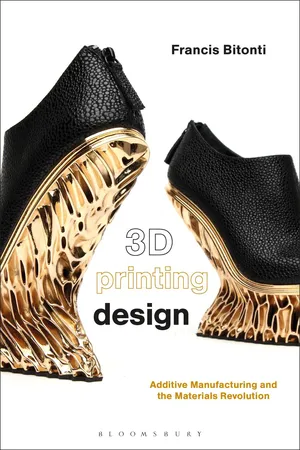
To work with the materials of tomorrow, design students across visual arts disciplines need to understand the cutting edge of today. Whether you're modelling in interiors, designing in fashion or constructing for interiors, in your work or as part of a final project, 3D Printing design is an encouraging guide to additive manufacturing within design disciplines. Francis Bitonti gives an insider's view from his design studio on how 3D printing is already shaking up the industry, and where it's likely to go next. Complete with interviews from designers, business owners and 3D-print experts throughout, Bitonti considers whether 3D body scans mean couture for all, how rapid prototyping can change your design method and if 3D printing materials can enhance medical design, amongst other areas of this emerging method of manufacture. This is inspirational reading for the designers of tomorrow.
Information
1
The materials revolution of 3D printing
Also called “additive manufacturing,” 3D printing refers to any fabrication technology that builds up a construction by an additive process rather than by subtraction. Subtraction, in this sense, refers to the cutting and carving of standard blocks of material, subtracting from the block. Crafting and designing something has heretofore been a matter of subtraction. Additive manufacturing, on the other hand, builds up materials layer by layer, even particle by particle. It is a process of building up rather than subtracting.
Materials and tools have long been subject to a linear progression building on top of the other. We have experienced through the ages a successive linear evolution of our capacities since the first wood tools were made. With primitive tools, we made other wood tools and with those tools we made stone tools. And this progression goes on and on through the ages, from the Stone Age to the Steel Age to the Information Age. The tools of the Information Age will no longer be formed by handheld tools and human intuition, which since the dawn of civilization has been the case. Our tools expand our capacity to form and manipulate present materials. These tools define our creative capacities as human beings. Tools define our culture at any particular point in history, as well as the materials those tools enable us to manipulate. For example, the work of architect Ludwig Mies van der Rohe could never have existed in the Bronze Age, it would have been impossible to form such lightweight structures. We had to wait until we mastered steel, aluminum, and glass for such structures to exist in the world. Even if Rohe were to have lived at that time, the available tools and resources could never have enabled such a vision for our current built environment. For the first time ever, our tools for manipulating matter are linguistic and driven by the cultivation and replication of information. Language is now our hammer and saw, data our medium. This means product design, architecture, and fashion design are now all linguistic activities, capable of benefiting from the distributed models we have seen in the Information Age. Materials are now flexible, malleable things that start as data capable of being formed, shared, and edited in a digital environment. We can presently remix objects; materials are like a video or a song. Everything discussed in this book stems from a radical way of thinking about how we design with materials.
Additive manufacturing also presents us with an entirely unique material condition to design for: we are now in a position to build up objects, micron by micron, with an ever increasing amount of control over the geometry on both the micro- and macro-scales. This new capacity is, for now, largely hindered by (at the time of writing this book) not yet having adequate design software that enables us to manipulate technologies in this way, although that day is rapidly approaching. This chapter will argue that the greatest advancements in materials for 3D printing will largely be software driven. First, let us examine in more detail this material revolution.
3D printers and computational modeling processes have unlocked a completely new understanding of materials for us. Computational modeling and imaging technologies have expanded our capacity to represent the world around us by producing evermore robust drawings and visualizations. We are now able to draw the most complex geometries, both real and imagined. Initially, there was a gap between these software-driven advancements and the tools for manifesting these visions into tangible material. 3D printers close the gap between representation and fabrication. To draw is to make, and the separation between the two continues to close.
UNDERSTANDING FORMULAS IN COMPUTATION
Computational Design often utilizes rules and relationships inherent in mathematical equations to generate iterations. A mathematical expression in this book consists of three different parts: variables, constants, and an output. “Variables” are numbers that can vary based on circumstance. “Constants” are numbers that remain constant in the equation no matter the circumstance, and the output is the result of the calculation.
It could be argued that materials are now digital constructs. Materials are no longer analog things, but digital assets whose construction and organization are largely subject to the capacities of our current software. We are living through a technological revolution that is bringing about significant cultural, social, and economic transformation. 3D printing, more specifically “additive manufacturing,” is reinventing our capacities for engaging with physical matter. Products are now digital assets. To “make” is now to produce temporal, transformable, editable, and self-replicating entities, capable of having an equally rich life in the digital environment as they have enjoyed in the physical environment. Matter is now media.
KEY TERMS
Slicer, Tool Path, and G-Code are the three terms that describe the moment of translation to form geometric representation instructions for a tool. Passing through the slicer and exporting a geometry as G-Code represents a moment of translation from physical to digital.
Slicer
A Slicer is computer program that converts a three-dimensional CAD (Computer-Aided Design) model into instructions that the 3D printer will follow so that it deposits material in the correct way and achieves the desired form and material effects.
Tool Path
A Tool Path is a term used to describe a set of vectors that indicate the motion of a tool through space.
G-Code
The G-Code is the programming language used to tell the 3D printer what to do. The slicer converts your CAD file into strings of commands written in G-Code that describes tool paths. G-Code contains more than vectors, also including information like temptation of the tool, speed of travel, and a variety of other commands that control the motors and tools in a particular machine.
A complex kind of media
If our material world is influenced by formation of the digital or software environment, then we can start to think about physical material as a kind of digital media. And, if matter is media, that means it is compressible, shareable, hackable, downloadable, can be open-sourced, light, and highly disposable and capable of self-replication. In a world such as this, we need to reinvent the way we think about material construction from a digital perspective. We need to rethink how we understand the design of new materials. How we design new material constructions, but, more importantly, what are the kinds of systems of representation we need in order to access and manipulate that data which will lead us to new forms and new material compositions?
A good starting point of reference is medical imaging. Medical imaging has had to address this problem, except those creating medical imaging software had to do the reverse. They had to take lots of really complex organic material organizations and find ways of indexing and representing all these different materials. Imaging biological systems within the medical community meant having to take various and differentiated physical components and digitally rendering them into high resolution. We are enabled to create these images in the inverse method through 3D printing and additive manufacturing.
EARLY WORKS
When I first began working, I was an architect. Due to the nature of the materials and the technologies that I was working with, I gradually became interested in product design and eventually in fashion. My first project when I set out on my own was a proposal for a bike rack for the New York City Department of Transportation (Figure 1.1). I was selected as a finalist for a competition and was commissioned to produce two prototypes of my idea. I submitted a set of drawings that was, in all honesty, designed more as a provocation than as something I expected to have built and installed in the city. The geometries could not be fabricated by traditional means and was rapidly going way out of budget on research and development (R&D) trying to find a way to produce a set of geometries that were not traditionally machineable—until I discovered 3D printing. It was clear to me that there could be no other medium to suit my design methodology. My design methodology had evolved before manufacturing had discovered ways to interface with the means of representation that I was working with in my design process. I was able to draw more and calculate more than...
Table of contents
- Cover
- Half-Title Page
- Dedication
- Title Page
- Contents
- Acknowledgments
- Introduction
- 1 The materials revolution of 3D printing
- 2 The future of materials
- 3 Disruptive distribution
- 4 Case studies
- Conclusion
- Index
- Copyright
Trusted by 375,005 students
Access to over 1.5 million titles for a fair monthly price.
Study more efficiently using our study tools.
Frequently asked questions
Yes, you can cancel anytime from the Subscription tab in your account settings on the Perlego website. Your subscription will stay active until the end of your current billing period. Learn how to cancel your subscription
No, books cannot be downloaded as external files, such as PDFs, for use outside of Perlego. However, you can download books within the Perlego app for offline reading on mobile or tablet. Learn how to download books offline
We are an online textbook subscription service, where you can get access to an entire online library for less than the price of a single book per month. With over 1.5 million books across 990+ topics, we’ve got you covered! Learn about our mission
Look out for the read-aloud symbol on your next book to see if you can listen to it. The read-aloud tool reads text aloud for you, highlighting the text as it is being read. You can pause it, speed it up and slow it down. Learn more about Read Aloud
Yes! You can use the Perlego app on both iOS and Android devices to read anytime, anywhere — even offline. Perfect for commutes or when you’re on the go.
Please note we cannot support devices running on iOS 13 and Android 7 or earlier. Learn more about using the app
Please note we cannot support devices running on iOS 13 and Android 7 or earlier. Learn more about using the app
Yes, you can access 3D Printing Design by Francis Bitonti in PDF and/or ePUB format, as well as other popular books in Business & Fashion Design. We have over 1.5 million books available in our catalogue for you to explore.