This introduction brings to life the main themes in Indian philosophy of language by using an accessible translation of an Indian classical text to provide an entry into the world of Indian linguistic theories.
Malcolm Keating draws on Mukula's Fundamentals of the Communicative Function to show the ability of language to convey a wide range of meanings and introduce ideas about testimony, pragmatics, and religious implications. Along with a complete translation of this foundational text, Keating also provides:
- Clear explanations of themes such as reference, figuration and sentence meaning
- Commentary illuminating connections between Mukula and contemporary philosophy
- Romanized text of the Sanskrit
- A glossary of terms and annotated bibliography
- A chronology of important figures and dates
By complementing a historically-informed introduction with a focused study of an influential primary text, Keating responds to the need for a reliable guide to better understand theories of language and related issues in Indian philosophy.
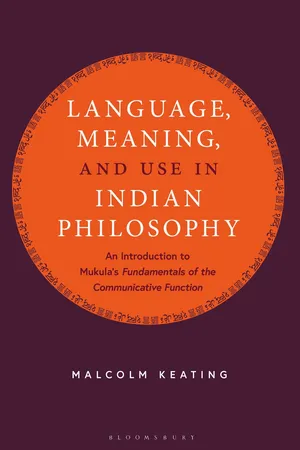
eBook - ePub
Language, Meaning, and Use in Indian Philosophy
An Introduction to Mukula's “Fundamentals of the Communicative Function”
- 320 pages
- English
- ePUB (mobile friendly)
- Available on iOS & Android
eBook - ePub
Language, Meaning, and Use in Indian Philosophy
An Introduction to Mukula's “Fundamentals of the Communicative Function”
About this book
Information
Part I
Introduction
Why did Mukula Bhat.t.a Write the Fundamentals?
Indication and Resolving Incongruity: Mukula’s Response
Understanding Mukula’s Context
Further Reading by Topic
Suppose your friend is telling you about a coworker who constantly talks over people at the office. Your friend complains, “Ajay is a bulldozer.” Chances are, you immediately understand what your friend means—Ajay is like a bulldozer in pushing through people to get to his goal. Or, take the expression “Two heads are better than one.” It doesn’t refer to inert heads bereft of bodies, but to a pair of people who have heads and use them, together, for thinking. Likewise, we often talk about governments by using names of buildings: “The White House held a press conference,” or “Downing Street called for a referendum,” but no one thinks that these buildings are alive. This way of using language, going beyond the ordinary meaning of words to communicate something else, is pervasive, no matter which language people are speaking. Now consider poetry. When William Shakespeare writes in Sonnet 19 “Devouring Time, blunt thou the lion’s paws and make the earth devour her own sweet brood” what does he mean?1 This meaning is less easy to understand. There are study guides written on Shakespeare’s poetry and literary critics have written (and continue to write) volumes analyzing it. Still, people do understand something from this and other poems like it. We might wonder, though, is the way that we understand Shakespeare the same way that we understand the others, about Ajay and the White House? If it is the same process, then what explains why poetry seems different from everyday speech? And if it is a different process, what is it?
In the late ninth or early tenth century CE, Mukula Bhaṭṭa, a thinker writing in Sanskrit and located in Kashmir, wrote a treatise explaining how communication works, and answering these questions. Mukula’s treatise, the Fundamentals of the Communicative Function (Abhidhā-vṛtta-mātṛkā), sets out a framework for how communication happens, from what words mean to how sentences are constructed to how people use language beyond its ordinary meanings. We know little about him except that his father is Bhaṭṭa Kallaṭa, the author of the Commentary on the Verses on Vibration (Spanda-kārika-vṛtti), and that he had two students, Pratīhāra Indurāja and Sahadeva. The Fundamentals is an important work for the study of poetry and aesthetics in India (known as alaṅkāra-śāstra, or henceforth, Alaṅkāra). The tremendously influential twelfth-century writer Mammaṭa adopts large sections of it verbatim, even while criticizing other aspects of Mukula’s view. However, although Mukula’s text can be understood as a positive theory of communication, he writes it with a polemical aim: to argue against a new theory of language put forward by Ānandavardhana, another Kashmiri thinker living a little earlier than Mukula, in the mid to late ninth century CE. Mukula’s thesis, that understanding ordinary and poetic language involves the same fundamental processes, sets the stage for a debate which will continue for hundreds of years. Contemporary philosophers, though typically unaware of the Indian tradition (they usually draw on ancient Greek philosophy if appealing to historical sources), are still discussing the questions Mukula raises, a thousand years later.2 For this reason, the book’s cover includes the word for “speech” in multiple languages, to reflect the universality of the topic.
In what follows, I will explain the basics of Ānanda’s new theory with the aim of showing how Mukula responds to him.3 In the second half of the introduction, we will take a step back to understand the broader context for Mukula’s reply. Around ninth century CE, Ānanda, who was a poet, Kashmiri literary theorist, and philosopher, writes a treatise in which he argues that there is a previously undiscovered process of understanding meanings, known as suggestion (dhvani). This process accounts for poetry like Shakespeare’s sonnets—although Ānanda of course focuses on the Rāmāyaṇa, Mahābhārata, and other poems written in Sanskrit and Prakrit.4 Mukula responds by arguing that we can explain this putative process of “suggestion” through a fairly ordinary process which thinkers had already discussed, a process known as indication (lakṣaṇā). Indication accounts for our ability to understand the sentences about Ajay the bulldozer and Downing Street, thus making our understanding of poetic meaning simply an extension of our natural linguistic abilities, even if one that requires advanced skill and knowledge about the world. Further, Mukula thinks that part of what happens in indication is that hearers “solve” a linguistic puzzle or incongruity, and what is indicated is the solution to that puzzle. Poetry for Mukula is just like any other case of linguistic communication in the way we understand it. Essentially, if our theory cannot account for poetry as a human use of language, then something is wrong with it.
Why did Mukula Bhat.t.a
Write the Fundamentals?
Write the Fundamentals?
Ānandavardhana’s A Light on Suggestion (Dhvanyâloka) lays out a number of arguments for his claim that we need to postulate a new process of understanding, suggestion, to account for poetry.1 In order to understand the main lines of reasoning, we need to understand how he thinks ordinary language works. First, it’s important to recognize that while Ānanda is concerned with how people come to know what words and sentences mean, he does not focus on the distinction between what a person means and what someone mistakenly takes them to mean. In other words, he is working on the assumption that there is a certain meaning (artha) communicated by an expression (be it a word, a sentence, or an entire poem) and that the hearer can come to understand these meanings, which are the same as the meanings intended by the speaker. When he’s focusing on the process of understanding, he’s assuming this is correct understanding. Put more specifically, he’s concerned with the function of speech (śabda-vyāpāra) which is to cause hearers to understand certain meanings. Thus a hearer’s comprehension of linguistic meaning is also characterized in terms of a capacity of words. We are setting aside problems of misinterpretation, failed communication, and so on, and are only concerned with a competent hearer.
Second, Ānanda, along with many thinkers before him, distinguishes between two main functions of speech: the primary function and the secondary function. The Sanskrit terms for these functions vary, but the basic idea is the same. The primary function is what a word expresses directly, whereas the secondary function works indirectly, based on the first, primary meaning. Ānanda argues that we need a third function, suggestion, for two main reasons:
a. Suggested meanings vary in contexts, so they are not the result of the primary function, which results in the same meaning in each context.
b. Suggested meanings can occur without figures of speech, so they are not the result of secondary meaning.
Let’s take a modern example to explain these ideas. Someone says
1 I had to go two streets over to find a parking meter.
The phrase “parking meter” communicates through its primary function the meaning device that charges fees for parking cars nearby. This is what someone would understand directly from “parking meter.” It is consistent across contexts—if it were not, we wouldn’t be able to understand new sentences. But assuming that words have primary meanings which remain fixed allows us to explain this ability. However, in this example, our speaker isn’t just looking for a parking meter. She wants to find a place to park which has a meter. Thus from the primary meaning of “parking meter” we understand a further meaning.
2 I had to go two streets over to find a spot next to a parking meter.
This meaning, in italics, is understood through the secondary function of words. This function does not happen all of the time. The phrase “parking meter” doesn’t always mean “spot next to a parking meter,” but only in certain contexts. In fact, according to Indian thinkers, there are three necessary conditions which must be met for the secondary function to work:
a Incongruity. There must be an incongruity in the primary meaning.
bRelationship. There must be some relationship between the secondary and primary meanings.
c Motive. There must be some motive to understand the secondary meaning.
These conditions are present in our example case above. To take our speaker as looking for just a meter doesn’t make sense with the facts we know—it is an incongruity. There is a relationship between a meter and a parking spot, that of spatial contiguity, since they are found next to each other all regularly. Finally, in this case, it’s a matter of convention to refer to a parking spot with the term “meter,” but sometimes there are unusual, unconventional motives. For instance, in our first example
3 Ajay is a bulldozer
the incongruity is that people are not bulldozers. However, there is a relationship of similarity between Ajay and bulldozers: both move through obstacles, both keep going regardless of what’s in front of them, etc. And finally, regarding motive, our speaker might choose this term to dehumanize Ajay, or perhaps for plausible deniability if someone overhears her (oh, I meant to say that he keeps going at all costs!).2 Both of these examples, what are today typically called “metonymy” and “metaphor,” respectively, are examples of the secondary function at work. Ānanda distinguishes the function of suggestion from both primary and secondary functions. Let’s look at one of his examples:
4. While the heavenly visitor was speaking, Pārvatī,
standing with lowered face beside her father,
counted the petals of the lotus in her hand.3
In this example, taken from 6.84 of Kālidāsa’s The Origin of the Young God (Kumāra-saṃbhava), Pārvatī is standing next to her father and a sage while the two discuss her betrothal to the god Śiva. From the primary function we understand the ordinary meaning of the sentence, just that Pārvatī is counting the petals of a lotus flower which she holds in her hand. There is no obstacle in understanding this, and so there is no figure of speech. But, still, Ānandavardhana argues that this verse suggests that Pārvatī is shy (and from this it suggests that she is in love). This is what the function of suggestion does—it conveys something beyond the primary meaning which does not require an incongruity.
Further, suggestio n is the whole point of poetry. That Pārvatī is in love is the point of the poem. But no poet worth their salt conveys love by stating “Pārvatī is in love.” Rather, they convey this fact implicitly, by their choice of words and by the figures of speech they use. Ānanda argues that, in good poetry, conveying suggested meanings is the purpose of every aspect of the poem. While poets can be clever—they can use double entendré, metaphors, alliteration, and so on—if these figures of speech are the focal point of a poem, it has failed. Poetry should suggest what Ānandavardhana and thinkers before him call rasa, a word literally meaning “flavor” or “sap,” and which, for Ānanda, leads to aesthetic beauty. However, we must pause here. Ānanda calls rasa a meaning, alongside of the meanings communicated by the primary and secondary functions. It is a meaning that is understood differently, yes, but he is not talking about emotions that hearers experience. It is found in the text, in the characters of a poem, for instance. For him, rasa is a meaning communicated by words, through what he calls “suggestion.”
Finally, although the main point of poetry is to suggest rasa, suggestion can yield two other kinds of meanings. Suggestion can convey facts or narrative matter (vastu) and it can convey figures of speech. An example of a suggested fact is this verse:
5. Mother-in-law sleeps here, I there:
look traveler, while it is light.
For at night when you cannot see
you must not fall into my bed. 4
As with the case of Pārvatī, Ānanda would say that there is no obstacle to taking this in its primary meaning. However, a reader familiar with the relevant poetic motifs would immediately know that the speaker (who is a married woman) is coyly inviting a (male) traveler into her bed. This invitation is suggested. It is not explicitly stated, nor is it a metaphor or double meaning. Rather, it is implicit in the woman’s manner of speaking. Figures of speech can also be suggested, as in this verse which Ānandavardhana himself wrote:
6 Truly insensate is the ocean
that it is not now stirred by this your smiling face,
tremulous-eyed beauty,
which fills the horizon with the splendor of its loveliness. 5
This verse suggests a metaphor: your face is the moon. The tides of the ocean are implicitly compared to how someone’s heart is moved by a beautiful woman. Nowhere in the verse is this comparison stated, and even if there is some secondary meaning i...
Table of contents
- Cover
- Half-Title
- Series
- Title
- Epigraph
- Contents
- List of Illustrations
- Foreword
- Acknowledgements
- Note on Text/Translation
- How to Use this Book
- Part I Introduction
- Part II English Translation of “The Fundamentals of the Communicative Function”
- Part III Commentary on “The Fundamentals of the Communicative Function”
- Part IV Sanskrit Text of the Abhidhāvr.ttamātr.kaā
- Part V Mukula and Contemporary Linguistic Philosophy
- Part VI Study Resources
- Notes
- Bibliography
- Index of Names, Works, and Terms
- Copyright
Trusted by 375,005 students
Access to over 1.5 million titles for a fair monthly price.
Study more efficiently using our study tools.
Frequently asked questions
Yes, you can cancel anytime from the Subscription tab in your account settings on the Perlego website. Your subscription will stay active until the end of your current billing period. Learn how to cancel your subscription
No, books cannot be downloaded as external files, such as PDFs, for use outside of Perlego. However, you can download books within the Perlego app for offline reading on mobile or tablet. Learn how to download books offline
Perlego offers two plans: Essential and Complete
- Essential is ideal for learners and professionals who enjoy exploring a wide range of subjects. Access the Essential Library with 800,000+ trusted titles and best-sellers across business, personal growth, and the humanities. Includes unlimited reading time and Standard Read Aloud voice.
- Complete: Perfect for advanced learners and researchers needing full, unrestricted access. Unlock 1.5M+ books across hundreds of subjects, including academic and specialized titles. The Complete Plan also includes advanced features like Premium Read Aloud and Research Assistant.
We are an online textbook subscription service, where you can get access to an entire online library for less than the price of a single book per month. With over 1.5 million books across 990+ topics, we’ve got you covered! Learn about our mission
Look out for the read-aloud symbol on your next book to see if you can listen to it. The read-aloud tool reads text aloud for you, highlighting the text as it is being read. You can pause it, speed it up and slow it down. Learn more about Read Aloud
Yes! You can use the Perlego app on both iOS and Android devices to read anytime, anywhere — even offline. Perfect for commutes or when you’re on the go.
Please note we cannot support devices running on iOS 13 and Android 7 or earlier. Learn more about using the app
Please note we cannot support devices running on iOS 13 and Android 7 or earlier. Learn more about using the app
Yes, you can access Language, Meaning, and Use in Indian Philosophy by Malcolm Keating in PDF and/or ePUB format, as well as other popular books in Philosophy & Eastern Philosophy. We have over 1.5 million books available in our catalogue for you to explore.