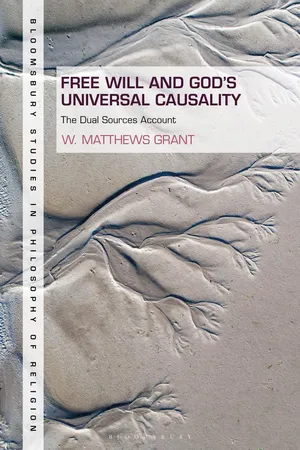
The traditional doctrine of God's universal causality holds that God directly causes all entities distinct from himself, including all creaturely actions. But can our actions be free in the strong, libertarian sense if they are directly caused by God?
W. Matthews Grant argues that free creaturely acts have dual sources, God and the free creaturely agent, and are ultimately up to both in a way that leaves all the standard conditions for libertarian freedom satisfied. Offering a comprehensive alternative to existing approaches for combining theism and libertarian freedom, he proposes new solutions for reconciling libertarian freedom with robust accounts of God's providence, grace, and predestination. He also addresses the problem of moral evil without the commonly employed Free Will Defense. Written for analytic philosophers and theologians, Grant's approach can be characterized as "neo-scholastic" as well as "analytic," since many of the positions defended are inspired by, consonant with, and develop resources drawn from the scholastic tradition, especially Aquinas.
- 256 pages
- English
- ePUB (mobile friendly)
- Available on iOS & Android
eBook - ePub
About this book
Information
1
Introduction
According to traditional theism, God is the universal cause, who causes all being distinct from himself. An implication of this doctrine is that creaturely acts are caused by God. With few exceptions, contemporary philosophers assume that a creaturely act caused by God cannot be free in the libertarian sense. The present volume challenges this assumption, showing that libertarian theists need not reject a central tenet of the classic theological tradition. In the course of this challenge, a comprehensive alternative to the currently most popular approaches for combining theism with libertarian freedom will emerge.
In this introductory chapter, I first set out the doctrine of divine universal causality (DUC), displaying its deep roots within theistic tradition, giving the doctrine a precise definition, and drawing out its implications for God’s relationship to creaturely action. Then, after presenting the libertarian conception of freedom and explaining why it has proven attractive to many theists, I give evidence of, and suggest reasons for, the widespread assumption that a creaturely act being caused by God precludes the act being free in the libertarian sense. Finally, I introduce my approach to resolving the conflict—what I call “Dual Sources”—offering a brief preview of how the approach will be developed in the chapters that follow and explaining the approach’s roots in the scholastic philosophical-theological tradition.
1.1 Divine Universal Causality (DUC) and Creaturely Action
Theists have traditionally held that God is the universal cause, who causes all being distinct from himself. Augustine, for example, teaches that God’s “hidden power … causes all that exists in any way to have whatever degree of being it has; for without Him, it would not exist in this way or that, nor would it have any being at all.”1 Anselm maintains that “with the exception of the supreme essence itself [God], nothing exists that is not made by the supreme essence.”2 Maimonides writes that “the basic principle of all principles and the pillar of all sciences is to realize that there is a First Being who brought every existing thing into being.”3 Aquinas holds that “everything other than God … must be referred to Him as the cause of its being.”4 Such belief in God’s universal causality is rooted in scripture, which declares God maker of all things (Isa. 44:24) and the one from whom and through whom all things are (Rom. 11:36).5 The Church Fathers strongly affirm God’s universal causality.6 The Nicene Creed expresses such belief by confessing God “maker of heaven and earth, of all things visible and invisible.”7
With such impressive support from the tradition, it is not surprising that contemporary philosophers of religion often include God’s universal causality in accounts of what theists have traditionally believed. Thus, Alvin Plantinga notes that most Christians affirm God’s “control over all things and the dependence of all else on his creative and sustaining activity.”8 According to Brian Leftow, “theists believe that necessarily, for any x, if x is God, x creates and maintains in existence whatever is not identical to x.”9 And Thomas Morris remarks that “arguably the central idea of the theistic tradition” is “the idea of God as absolute creator of everything which exists distinct from him.”10
Statements of this sort are easily multiplied. Michael Bergmann and Jeffrey Brower consider “traditional theism” to hold that “everything distinct from God depends on God’s creative activity for its existing.”11 Hugh McCann explains that “the concept of a creator as it has been usually construed in the Western theological tradition” involves “the idea that the world and all that pertains to it—indeed, anything that exists in any way—owes its being and sustenance to the act of an all-powerful being whose existence requires no explanation.”12 William Alston concurs that “God is the ultimate source of being for everything other than himself.”13 And Katherin Rogers characterizes “traditional, classical theism” as holding that “whatever has any positive ontological status at all is God or comes from God.”14
What, then, is numbered among the effects God causes? Some of the foregoing statements are more explicit than others, but the natural reading of most of them would suggest that God causes every entity whatsoever that is not identical to God. Whether this reading is the one intended by all the authors quoted, it is certainly the traditional view. It is not, therefore, only creaturely objects or substances that God has traditionally been thought to cause. As Anselm insists, “every quality, every action, everything that has existence owes its being at all to God.”15 As Aquinas makes clear, “whatever is the cause of things considered as beings [namely, God], must be the cause of things, not only according as they are such by accidental forms, nor according as they are these by substantial forms, but also according to all that belongs to their being at all in any way.”16
As some of the passages quoted above suggest, the traditional view understands the being of all that is distinct from God to be caused by God, not just at the first moment such things come into existence but rather for the entire duration of their existence. Aquinas is representative:
Since God is very being by His own essence, created being must be His proper effect; … Now God causes this effect in things not only when they first begin to be, but as long as they are preserved in being; as light is caused in the air by the sun as long as the air remains illuminated.17
The belief that God keeps things in being is usually expressed by saying that God “preserves,” “sustains,” or “conserves” them; but it would be a mistake to read the tradition as claiming that a thing’s being “conserved” by God denotes an essentially different sort of dependence on God than its being caused to exist at its first moment. Jonathan Kvanvig and Hugh McCann helpfully explain the traditional view as one
according to which each instant of the existence of any of God’s creatures is as radically contingent as any other, and equally in need of activity on His part to account for it. Furthermore, God’s activity as Creator is held to be essentially the same no matter what instant of the being of the thing created is at stake.18
God’s causality, then, has traditionally been thought to extend to his effects in the same way, at any time they exist.
Moreover, the traditional view maintains not just that everything distinct from God is, in fact, caused by God but that it is not possible that anything else exist without being caused by him. Thus, Anselm, having concluded that the supreme essence makes everything other than itself, goes on to argue that “something else is only able to exist where and when the supreme essence exists … without it absolutely nothing exists.”19 Maimonides likewise holds that “if it could be supposed that He [God] did not exist, it would follow that nothing else could possibly exist.”20 Aquinas teaches that “there can be nothing besides [God] that is not caused by Him.”21 And Plantinga remarks that “it is not possible, at least if traditional theism is correct, that we should exist and God not create and sustain us.”22
Finally, the traditional view understands God’s causing of things distinct from himself to be immediate and direct, rather than mediate, indirect, or remote. So, Aquinas, in arguing for God’s omnipresence, states that “God is in all things … as an agent is present to that upon which it works. For an agent must be joined to that wherein it acts immediately.”23 Here, Aquinas is offering God’s immediate causal action in all things distinct from himself as a premise in an argument for God’s omnipresence. To the objection that God’s power is such that his action even extends to things distant from him, Aquinas responds:
No action of an agent, however powerful it may be, acts at a distance, except through a medium. But it belongs to the great power of God that He acts immediately in all things.24
Like Aquinas, Suarez maintains that God causes his effects directly and immediately,25 describing divine conservation, for instance, as involving God’s “direct and immediate continuous inpouring of the esse itself within one and the same singular entity.”26 Among contemporary philosophers, Morris is especially clear on the direct nature of the dependence that all things other than God have on God:
All things distinct from God stand in a dependence relation to God, a relation that is both direct and absolute. It is never the case that some created object x depends on God only in the sense of depending for its existence upon some other created objects y and z, which in turn directly depend on God. … Metaphysical or ontological dependence upon God, dependence for being, is, rather, in every case direct.27
To say that God causes his effects directly or immediately, I take it, is to deny that he causes any entity a by means of causing some other entity b, which is a more proximate cause of a or which is that by means of which, or in virtue of which, God causes a. On the traditional view, then, every divine causing of an effect is a “basic” causal action, a causal act God performs, but not by means of causing anything else.28
Incorporating the various elements of the traditional view, we can now define the doctrine of divine universal causality (DUC) as follows:
Necessarily, for any entity distinct from God, God directly causes that entity to exist at any time it exists.29
Notice, DUC does not claim that God is the only genuine cause, as in occasionalism.30 It does imply, however, that if there are other causes, it is not possible that those causes bring about their effects without God’s also directly bringing those effects about. Moreover, it implies that God directly causes all creaturely actions, whether free or unfree, since whatever they consist in, creaturely actions are entities distinct from God.31 Thus, Brian Davies notes:
Traditionally speaking, all things apart from God are there because God makes them to be there, not just in the sense that he lays down the conditions in which they can arise, but also in the sense that he makes them to be for as long as they are there. And on this account, all that is real in creatures is caused by God, including their activity.32
This implication for God’s relationship to creaturely action was unhesitatingly acknowledged by classical proponents of DUC. Anselm’s “student” no doubt expresses Anselm’s own conclusion on the matter: “I cannot in fact deny that every action is a reality nor that whatever is has its being from God.”33 Aquinas holds that God “acts in every agent immediately”;34 that “we must admit without any qualification that God operates in the operations of nature and will”;35 and that “the very act of free will is traced to God as to a cause.”36 Suarez affirms that “God acts per se and immediately in every action of a creature, and that this influence of his is absolutely necessary in order for the creature to effect anything.”37 Consistency requires, of course, that the proponent of DUC admit that even evil or sinful acts are caused by God, an implication not lost on the doctrine’s traditional proponents. Thus, according to Aquinas, “the act of sin is both a being and an act; and in both respects it is from God. Because every being, whatever the mode of its being, must be derived from the First Being, as Dionysius declares.”38 Similarly, Suarez holds that “one should deny that any action (be it natural or free, good or evil), insofar as it is a real action, exists without the First Cause’s immediate concurrence.”39
As illustrated in this last passage from Suarez, the term “concurrence” came to be used by scholastics to refer to God’s causal activity in co-operating to bring about the effects and actions of creaturely agents when they act. Scholastics generally affirm that, in addition to God the universal cause, there are creaturely or secondary causes that exercise genuine causal powers in bringing about effects in the world. Given DUC, however, it is not possible for any creaturely agent to act or to bring about an effect without God’s concurrently causing both the creaturely agent’s effect and its act. Thus, Suarez insists that “whatever is real must come immediately from God’s efficient causality; therefore, the causal activities and effects of all the [genera of] causes must come immediately from God’s efficient causality.”40 Moreover, given DUC, the whole of a creaturely effect and act must be caused by God, since no aspect of its being could exist without God’s immediately causing it. Yet, concurrentists typically hold that the entirety of a creature’s act and effect is brought about by its creaturely agent, as well. Thus, while any creaturely act involves the dual operation of God and the creature in bringing about the creaturely act and effect, this co-operation is not that of two partial contributors, each of which contributes only a portion of the effect jointly produced; it is rather the co-operation of two causes each of which produces the whole of the effect. As Aquinas instructs, “the same effect is not attributed to a natural cause and to divine power in such a way that it is partly done by God, and partly by the natural agent; rather it is wholly done by both.”41 And Suarez agrees that “it is not the case that part of the effect comes from the one cause and part from the other; rather, as St. Thomas notes … the whole effect comes from each.”42
Scholastic philosophers in the late Middle Ages and Renaissance worked out detailed accounts of how God concurs with creaturely operations. I will not pause to examine those details here.43 For present purposes, it is enough that we appreciate what DUC implies for God’s relationship...
Table of contents
- Cover
- Halftitle Page
- Title Page
- Contents
- Acknowledgments
- 1. Introduction
- 2. God: Universal Cause and Cause of Human Actions
- 3. Divine Universal Causality and the Threat of Occasionalism
- 4. Free Creatures of the Universal Cause
- 5. The Extrinsic Model Defended
- 6. Does God Cause Sin?
- 7. The Problem of Moral Evil
- 8. Providence, Grace, and Predestination
- Notes
- Bibliography
- Index
- Imprint
Trusted by 375,005 students
Access to over 1.5 million titles for a fair monthly price.
Study more efficiently using our study tools.
Frequently asked questions
Yes, you can cancel anytime from the Subscription tab in your account settings on the Perlego website. Your subscription will stay active until the end of your current billing period. Learn how to cancel your subscription
No, books cannot be downloaded as external files, such as PDFs, for use outside of Perlego. However, you can download books within the Perlego app for offline reading on mobile or tablet. Learn how to download books offline
Perlego offers two plans: Essential and Complete
- Essential is ideal for learners and professionals who enjoy exploring a wide range of subjects. Access the Essential Library with 800,000+ trusted titles and best-sellers across business, personal growth, and the humanities. Includes unlimited reading time and Standard Read Aloud voice.
- Complete: Perfect for advanced learners and researchers needing full, unrestricted access. Unlock 1.5M+ books across hundreds of subjects, including academic and specialized titles. The Complete Plan also includes advanced features like Premium Read Aloud and Research Assistant.
We are an online textbook subscription service, where you can get access to an entire online library for less than the price of a single book per month. With over 1.5 million books across 990+ topics, we’ve got you covered! Learn about our mission
Look out for the read-aloud symbol on your next book to see if you can listen to it. The read-aloud tool reads text aloud for you, highlighting the text as it is being read. You can pause it, speed it up and slow it down. Learn more about Read Aloud
Yes! You can use the Perlego app on both iOS and Android devices to read anytime, anywhere — even offline. Perfect for commutes or when you’re on the go.
Please note we cannot support devices running on iOS 13 and Android 7 or earlier. Learn more about using the app
Please note we cannot support devices running on iOS 13 and Android 7 or earlier. Learn more about using the app
Yes, you can access Free Will and God's Universal Causality by W. Matthews Grant in PDF and/or ePUB format, as well as other popular books in Philosophy & Free Will & Determinism in Philosophy. We have over 1.5 million books available in our catalogue for you to explore.