Bringing together leading international scholars, John Banville and His Precursors explores Booker and Franz Kafka prize-winning Irish author John Banville's most significant intellectual influences. The book explores how Banville's novels engage deeply with a wide range of sources, from literary figures such as Samuel Beckett, Heinrich von Kleist, Wallace Stevens, Rainer Maria Rilke, and Henry James, to thinkers such as Freud, Heidegger, and Blanchot.
Reading the full range of Banville's writings - from his Booker Prize-winning novel The Sea to his latest book, Mrs Osmond – John Banville and His Precursors reveals the richness of the author's work. In this way, the book also raises questions about the contemporary moment's relationship to a variety of intellectual and cultural traditions - Romanticism, Modernism, existentialism – and how the significance of these can be appreciated in new and often surprising ways.
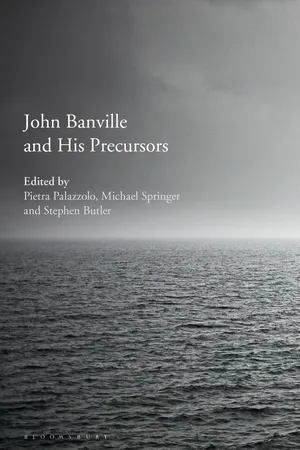
eBook - ePub
John Banville and His Precursors
- 256 pages
- English
- ePUB (mobile friendly)
- Available on iOS & Android
eBook - ePub
John Banville and His Precursors
About this book
Information
Part one
National and transnational currents
1
John Banville and the idea of the precursor: Some meditations
Derek Hand
We carry the dead with us only until we die too, and then it is we who are borne along for a little while, and then our bearers in their turn drop, and so on into the unimaginable generations.
(Banville 2005: 119)
John Banville’s The Sea comes to an end with this observation from the narrator:
The sky was hazed over and not a breeze stirred the surface of the sea, at the margin of which the small waves were breaking in a listless line, over and over, like a hem being turned endlessly by a sleepy seamstress. There were few people on the beach, and those few were at a distance from me, and something in the dense, unmoving air made the sound of their voices seem to come from a greater distance still. I was standing up to my waist in water that was perfectly transparent, so that I could plainly see below me the ribbed sand of the seabed, and the tiny shells and bits of crab’s broken claw, and my own feet, pallid and alien, like specimens displayed under glass. As I stood there, suddenly, no, not suddenly, but in a sort of driving heave, the whole sea surged, it was not a wave, but a smooth rolling swell that seemed to come up from the deeps, as if something vast down there had stirred itself, and I was lifted briefly and carried a little way toward the shore and then was set down on my feet as before, as if nothing had happened. And indeed nothing had happened, a momentous nothing, just another of the great world’s shrugs of indifference. (Banville 2005: 263–4)
It is an image, it might be suggested, that is repeated again and again, with variation, throughout Banville’s long writing career. The reader is offered in these moments an image of a character at once alone and isolated in the midst of throbbing life and nature. His high cold heroes, Copernicus and Kepler, so caught up in their mathematical and astronomical pursuits seem destined to move towards such intense reflective moments:
What had possessed it to climb so high, what impossible blue vision of flight reflected in the glass? … Pressed in a lavish embrace upon the pane, the creature gave up its frilled grey-green underparts to this gaze, while the head strained away from the glass, moving blindly from side to side, the horns weaving as if feeling out enormous forms of air. But what had held Johannes was its method of crawling. He would have expected some sort of awful convulsions, but instead there was a series of uniform smooth waves flowing endlessly upward along its length, like a visible heartbeat. The economy, the heedless beauty of it, baffled him. (Banville 1990: 99)
Then there is Gabriel Godkin in Birchwood, one of Banville’s earliest renditions of the self-conscious narrator who creates his world and himself, not through scientific formulae, but through an act of writing:
Such scenes as this I see, or imagine I see, no difference, through a glass sharply. The light is lucid, steady, and does not glance in spikes or starts from bright things, but shines in cool cubes, planes and violet lines and lines within planes, as light trapped in polished crystal will shine. Indeed, now that I think of it, I feel it is not a glass through which I see, but rather a gathering of perfect prisms. ... Outside my memories, this silence and harmony, this brilliance I find again in that second silent world which exists, independent, ordered by unknown laws, in the depths of mirrors. This is how I remember such scenes. If I provide something otherwise, be assured I am inventing. (Banville 1984: 21)
The unnamed historian in The Newton Letter, Alexander Cleave the actor and Freddie Montgomery the murderer are all presented to us with these privileged epiphanic moments of revelation. Coupled with this encapsulating image of simultaneous isolation and enclosure, being both a part of and apart from, is the attendant and consequent exposé: a recognition of something essential about the individual life being lived and life generally, at once simple, straightforward, communicable and yet strange, on the verge of comprehension and language, vaguely profound but deeply and immeasurably weighty. That fluctuation between poles, between extremes, between definites, is the feature of Banville’s writing.
They are also disruptive moments when thought of, not in and of themselves in terms of character and plot within the boundaries of the novel itself but in terms of the narrative flow of the novel generally. In other words, moments such as these – littered as they are throughout Banville’s fiction – stop and halt the flow of narrative, arrest and seize the reader’s attention, as they do to the perceiving character, that might want to gallop ahead and find out what happens next. They slow the world and the reader’s attention down, funnelling our perspective towards a single spot of time. Increasingly in his fiction a central part of the dilemma for his narrators is to try and link these moments of luminous significance into something like a coherent narrative, something that might read like a complete life story.
As Freddie Montgomery declares in Athena: ‘Ah, this plethora of metaphors! I am like everything except myself’ (Banville 1995: 90). There is a need, therefore, to attend closely to the images Banville employs and how he employs them. In relation to the notion of ‘precursors’, and particularly literary precursors, scenes such as these – which emphasize both isolation and a yearning for connection – can become a way into beginning to think about and articulate Banville's relationship, if any, to his literary forebears. These moments accentuate, as has been suggested, being both a part of and being apart from. In other words, for Banville perhaps it might be argued that this notion also underpins his relationship and attitude to a literary tradition: his novels are both a part of tradition and apart from it. This certainly can be said in relation to an Irish literary tradition. These scenes are also illuminating on a micro level when we consider the type of characters being afforded these revelations. No matter what the context has been – from medieval Europe on the cusp of modernity, to the rarefied air of espionage in mid-twentieth-century Britain or the Anglo-Irish Big House – all of Banville’s protagonists endure the dilemma of existing too much in the mind: their lives are spent in opposition to the world outside their imagination. Science and pictorial art and the craft of acting and spying, like acts of writing, have been used as a means of making this struggle – for it is a struggle – manifest in the novels. All of his characters discover that the truths they hoped to attain, the order they hoped to impose upon the world, was always just beyond them, maddeningly outside their grasp. The divergence between the perfection of the life or of the work is like a yawning wound: a wound that none of Banville’s characters have been able to finally heal, and yet the desire to bridge that gap is what energizes each of Banville’s characters and each of his novels.
The approach I want to take, then, with these images of rupture and concurrent ache for wholeness as an overarching guide, is consider the idea of the ‘precursor’ in Banville’s writing at the macro and micro levels, both within the novels and outside the novels. In doing so it will be possible to engage with the numerous writers that are ‘precursors’ to Banville’s work, those writers who have influenced him in terms of style and theme and literary fixation. The issue of the nature of Irish writing’s uneasy relationship to literary traditions can also be considered and how this relates to Banville’s work. This contextual discussion will inform the subsequent textual analysis focusing on Banville’s stories which are all about the anxiety of inheritance and influence at some basic level and how his work might be best understood within the Irish modernist configuration that critiques the very notion of ‘precursors’, the need for them at all and the need to break away from them and certainly deny them.
John Banville himself looks to many precursors for the solace and comfort that a literary tradition can provide. Any such list of names would include James Joyce, Samuel Beckett, Henry James, Heinrich von Kleist, Vladimir Nabokov, Rainer Maria Rilke and Franz Kafka. A cursory trawl through the ever-growing critical scholarship surrounding Banville demonstrates not just literary forebears but philosophical and psychological influences too: such as Sigmund Freud, Jacques Lacan, Jacques Derrida and Jean Baudrillard. It is not just the ‘plethora of metaphors’ (Banville 1995: 90) consequently which haunt his writing, but it is these philosophers and their ideas as well as literary, theoretical and cultural movements which appear to get in the way of characters’ self-realization. The constant employment of intertextuality throughout the oeuvre is one obvious manifestation of this. John Banville, not unlike his literary creations can echo everything and everyone rather than express himself as himself.
From an Irish perspective two of the more prominent names to conjure with are James Joyce and Samuel Beckett, and Banville himself has said that he chooses Beckett as a literary antecedent (Schwall 1997: 17). And one can obviously see why. Beckett’s withdrawal or retreat from the magnificent bric-a-brac world of Joyce’s Ulysses into the singular consciousness perceiving the world would seem to chime with Banville’s own concern with mapping that postmodern interiority. In other words, if Joyce can be thought of, as I would argue, as struggling towards interiority in his writing, a thing that had not been done overly successfully in the Irish novel to that point, then Banville shares with Beckett in having that interiority as the starting point of their fictional universe. They inhabit the fictional world hollowed out by Joyce and therefore the dilemmas faced by both writers and their characters are markedly different. Their world is a fallen one in which there is nothing left to do other than endlessly tell one’s own story again and again and again. The reorientation is towards a single voice talking and telling. The consequences of this are, in their own peculiar way, nightmarish. Think of the historian in The Newton Letter. All his exertions, in both the literary and the historical spheres, come to nought: he is, finally, a nobody, denied a name because he has found no place in the world to be. Ottilie, at one point, says to him:
You know … sometimes I think you don’t exist at all, that you’re just a voice, name – no, not even that, just the voice, going on. Oh God. Oh no. (Banville 1983: 67)
In the midst of the numerous fictions he has created, the historian lacks any tangible connection to the real world, his entire being condensed to a voice.
Banville’s heroes share with Beckett’s characters an overwhelming acceptance of failure as the very starting point of all (post)modern endeavour and desire. Others have explored these Beckettian influences in more detail (D’hoker 2006: 68–80) but what is important is to acknowledge the Beckettian sense of ‘disinheritance’ that pervades Banville’s writing: characters are isolated, powerless, alone with a fading memory of some former time of glory and well-being, a memory which in itself may be but a construction, a fiction.
The other obvious precursor in this line is Elizabeth Bowen. Her work possesses an atmosphere somewhat similar to that of Beckett but with infinitely more detail and plot. Banville himself has celebrated her literary style above all other aspects of her art (Banville 2015), talking of her ‘allusive’ and ‘subtle’ prose. Its attractiveness for Banville might be the way in which her writing not only talks of things but embodies a self-reflexive anxiousness about language itself and what it hopes to achieve. He wrote the screenplay for a 1999 movie adaptation of her 1929 Anglo-Irish Big House novel The Last September, managing to pay homage to his precursor but failing to truly capture precisely that admired allusiveness of the original within the demands of a medium that must make everything visible and plain to see (Parezanović 2017: 141–59). As an artist Bowen straddles both British and Irish writing traditions, with much of her work focusing on adolescence thereby registering a mood of brittle being in the modern world as the focus is oriented towards characters and plots on the cusp of profound change. Her work charts the borderlines of an old world of aristocratic privilege and position facing into a newer world of bourgeois desire. Bowen herself came from a world of privilege, the Anglo-Irish Big House, and lived through its demise in the political realm while helping it continue in the sphere of culture and literature. Hers is not a Yeatsian vision with the emphasis on threnody; rather she is willing to critique her own class and caste.
John Banville’s version of the Big House in novels such as Birchwood and The Newton Letter owes much to Bowen’s delineation of the structures and ceremonies of life lived there...
Table of contents
- Cover
- Half-Title
- Title
- Contents
- Contributors
- Foreword
- Acknowledgements
- Introduction
- Part one National and transnational currents
- Part two Literary engagements
- Part three Philosophical, theoretical and artistic forebears
- Index
- Copyright
Trusted by 375,005 students
Access to over 1.5 million titles for a fair monthly price.
Study more efficiently using our study tools.
Frequently asked questions
Yes, you can cancel anytime from the Subscription tab in your account settings on the Perlego website. Your subscription will stay active until the end of your current billing period. Learn how to cancel your subscription
No, books cannot be downloaded as external files, such as PDFs, for use outside of Perlego. However, you can download books within the Perlego app for offline reading on mobile or tablet. Learn how to download books offline
Perlego offers two plans: Essential and Complete
- Essential is ideal for learners and professionals who enjoy exploring a wide range of subjects. Access the Essential Library with 800,000+ trusted titles and best-sellers across business, personal growth, and the humanities. Includes unlimited reading time and Standard Read Aloud voice.
- Complete: Perfect for advanced learners and researchers needing full, unrestricted access. Unlock 1.5M+ books across hundreds of subjects, including academic and specialized titles. The Complete Plan also includes advanced features like Premium Read Aloud and Research Assistant.
We are an online textbook subscription service, where you can get access to an entire online library for less than the price of a single book per month. With over 1.5 million books across 990+ topics, we’ve got you covered! Learn about our mission
Look out for the read-aloud symbol on your next book to see if you can listen to it. The read-aloud tool reads text aloud for you, highlighting the text as it is being read. You can pause it, speed it up and slow it down. Learn more about Read Aloud
Yes! You can use the Perlego app on both iOS and Android devices to read anytime, anywhere — even offline. Perfect for commutes or when you’re on the go.
Please note we cannot support devices running on iOS 13 and Android 7 or earlier. Learn more about using the app
Please note we cannot support devices running on iOS 13 and Android 7 or earlier. Learn more about using the app
Yes, you can access John Banville and His Precursors by Pietra Palazzolo, Michael Springer, Stephen Butler, Pietra Palazzolo,Michael Springer,Stephen Butler in PDF and/or ePUB format, as well as other popular books in Literature & English Literary Criticism. We have over 1.5 million books available in our catalogue for you to explore.