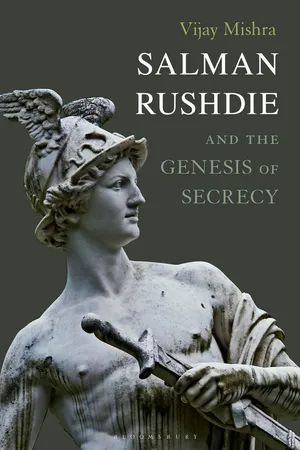
Salman Rushdie and the Genesis of Secrecy is the first book to draw extensively from material in the Salman Rushdie archive at Emory University to uncover the makings of the British-Indian writer's modernist poetics. Simultaneously connecting Rushdie with radical non-Western humanism and an essentially English-European sensibility, and therefore questions about world literature, this book argues that a true understanding of the writer lies in uncovering his 'genesis of secrecy' through a close reading of his archive. Topics and materials explored include unpublished novels, plays and screenplays; the earlier versions and drafts of Midnight's Children and its adaptations; understanding Islam and The Satanic Verses; the influence of cinema; and Rushdie's turn to earlier archives as the secret codes of modernism.
Through careful examination of Rushdie's archive, Vijay Mishra demonstrates how Rushdie combines a radically new form of English with a familiarity with the generic registers of Indian, Arabic and Persian literary forms. Together, these present a contradictory orientalism that defines Rushdie's own humanism within the parameters of world literature.
- 264 pages
- English
- ePUB (mobile friendly)
- Available on iOS & Android
eBook - ePub
Salman Rushdie and the Genesis of Secrecy
About this book
Information
Chapter 1
Archive Fever: The ‘Biografiend’ and the Genesis of Secrecy
Life, he himself said once, (his biografiend, in fact, kills him verysoon, if yet not, after) is a wake, livit or krikit, and on the bunk of our breadwinning lies the cropse of our seedfather, a phrase which the establisher of the world by law might pretinately write across the chestfront of all manorwombanborn.
— James Joyce, Finnegans Wake (55)
‘Life’, wrote the great novelist, ‘is a wake’ and no matter what you do, it is the wake written on the ‘chestfront of all manorwombanborn’ that defines our lives. A ‘biografiend’ kills his subject for the wake because the wake is the moment from which one can look back. Salman Rushdie is not dead, but a reader of the Archive – for the Archive is a wake – kills him ‘verysoon’ in his search for a revisionist historiography. The ‘biografiend’ therefore enters the archive, and enter he does with the aim of critically reading it, knowing full well that any scholarly engagement with the archive must keep the two sides of the Greek arkhē or arkheion firmly in the foreground. Archives being what they are, an understanding of the power by which an archive is authorized and the principles which govern its implementation, its classification and the like is a precondition. These protocols are always in place whenever an analyst turns to ‘anamnesis’, the art of recollection, of constructing a case study. Derrida had subtitled his monograph Archive Fever (1996a) ‘A Freudian Impression’ (referred to elsewhere in the book as a ‘Freudian signature’) because an archive as a repository of unpublished works, autographs, marginalia and other paraphernalia will always carry marks of concealed offence, repression or, to stretch it a bit, its dark side.
In his essay ‘The Aetiology of Hysteria’, Freud suggests a method of anamnestic inquiry that would lead beyond the visible, beyond the manifest, to uncover ‘what is buried’. He gives the analogy of the archaeologist who with picks, shovels and spades clears away the rubbish and ‘starting from the visible remains … bring(s) to light what is buried’ (Freud 1971: 185). If the method is successful, the ‘discoveries explain themselves’, the symptoms tell the tale of the subject, provided they, the symptoms, have both what Freud called ‘determining quality’ and ‘traumatic power’ (186). The methodology captures something of the latent force of a writer and enables the writing of a biography different from what the author himself would have and has created. But this is not to say that like some of Freud’s own unstable texts, Delusions and Dreams in Jensen’s ‘Gradiva’, Moses and Monotheism, The ‘Uncanny’, to name a few, Rushdie’s texts are simply tissues of repressed spectres which may be uncovered or which haunt the Archive. What I seek to do, even as I acknowledge the nomological imperative which governs an archive (the laws of classification, the place of consignation, the rules of reading and so on), is to flesh out diverging narratives that throw light on the other archive, the already edited and therefore already censored archive which constitutes the writer’s published corpus.
An Anamnestic Enquiry: The Genesis of Secrecy
Archives are held under an interdiction because they hold secrets. These secrets may be many, some inconsequential, a number of them significant to a textual critic. Among the latter a few must remain under an embargo and are therefore in a sense under ‘erasure’, awaiting a more propitious time for their release. The Rushdie Archive is no exception as it too holds secrets which are closed to researchers other than the author himself. One secret, surprisingly, which is not under a total embargo, is the writer’s engagement with a genesis of secrecy in Islam at the heart of the novel that changed the author’s life. The novel, quite obviously, is The Satanic Verses (Rushdie 1988). What does the Archive say about this work and its religious intertext? As we have noted Rushdie himself has written a memoir dealing with the fatwa years. The memoir was published in September 2012 with the benefit of the complete Archive at his disposal, something not available to researchers. I therefore turn to the partially available Archive on the subject to examine, fiendishly, the genesis of the decisive text of the fatwa. When did Rushdie’s interest in ‘the genesis of secrecy’ in Islam begin? Was there a conscious plan to deconstruct the Qur’ān itself? And was he aware of the consequences of such an undertaking? There is much in the Rushdie Archive at Emory University that shows Rushdie’s fascination with blasphemy,1 religion, God and the Qur’ān as the unedited word of God: nothing out of place, the words as recited by Muhammad upon the instigation of Angel Gabriel. It is like the śruti texts of the Vedas, unauthored, unmediated, in need of no amanuensis, although no Muslim would condone this connection with the texts of a polytheistic religion.
What is there in the Archive which Rushdie, like every ‘careful concealer’, meant to keep secret? Should we, like Norbert Hanold, the archaeologist (or the annotator) in Wilhelm Jensen’s Gradiva, bring back to life these traces which may or may not be concealed? The literary biographer (the ‘biografiend’ as Joyce called him) tries to uncover the repressed, concealed texts and nothing delights him or her more than the discovery of a fragment which completes a literary jigsaw puzzle. Fascinating as the enterprise is, my task in this chapter is limited, as my aim is, to explore Rushdie’s interest in a Qur’ānic genesis of secrecy and its relationship to The Satanic Verses.2 Like Stephen in the Acts of the Apostles was he inviting blasphemy? And like Stephen, again, who in his defence retraced God’s gift of a covenant from Abraham to Jesus, did he mean to offer another, synoptic, narrative of a holy book? Did he blaspheme? After all, Stephen’s speech, whose subtext is the failure of the Jews to uphold the austere monotheistic covenant between God and Abraham, reads very much like a synopsis of the Qur’ān with the difference that in Islam the covenant gets qualified via Muhammad or Ishmael and not Christ or Isaac. The archive fever that Derrida (after Freud) had spoken about – a fever linked to the ‘desire and the disorder of the archive’ (1996a: 81), a fever quintessentially of the death drive which makes us run after the archive ‘even if there’s too much of it, right where something in it anarchives itself’ (91) – compulsively drags us into the darkening heart of the archive. We are moving too fast; we need to pause; theoretical self-consciousness is g etting in the way; an interlude or an excursus is necessary here.
Chapters six and seven of Acts (the entire book is addressed to one Theophilus) are devoted to Stephen. Chapter five had already introduced us to the Council of Jewish elders who, concerned with the proselytizing methods of the apostles, wanted them killed. They are saved by a Pharisee named Gamaliel who basically argued that the apostles should be left alone. If what they preached came from men, their ideas would disappear; if indeed they came from God, then we have no choice but to listen to them, ‘lest haply ye be found even to fight against God’ (5.39). These are the early years of the Christian Church (we may want to recall even now that the intertext of The Satanic Verses too are the early years of the Islamic Church) and we get, along with theology, a schematic sociology of the foundational moments of the Christian Church. Stephen comes into the picture literally out of nowhere because the apostles require someone to look after their finances and the material well-being of their members. There is some strife between converts especially in respect of the treatment of widows and it is the latter’s material needs which require special redressing. Clearly Stephen is a brilliant accountant, a great debater as well as a miracle worker. Such a combination in a man can be dangerous, and often it is those who have recently acquired freedom who find such a person threatening. So, recently freed Jewish slaves (by the Romans) foment strife. They bribe their own kind, who now declare, ‘We have heard him speak blasphemous words against Moses, and against God’ (6.11). Stephen is caught in a bind: witnesses have declared that he has blasphemed. How does he get out of it? His case is doomed even as he mounts a theological defence in which he retraces God’s covenant from Abraham down to Jesus. And yet he makes no critical reappraisal of the Mosaic ‘law’ of blasphemy under which he has been condemned. The synopsis has considerable rhetorical power and is even novelistic in its design but its very ingenuity triggers memory of the Old Testament God’s own treatment of blasphemy. In Lev. 24.10-16 we get the incident of the Egyptian-Israelite man who during a quarrel with an Israelite ‘blasphemed the name of the Lord, and cursed’ (24.11). He is taken to Moses for judgement and Moses in turn waits for God to tell him what punishment should be meted out to him. And God replies,
Bring forth him that hath cursed … and let all that heard him lay their hands upon his head [to testify that he is guilty], and let all the congregation stone him. And thou shalt speak unto the children of Israel, saying, Whosoever curseth his God shall bear his sin. And he that blasphemeth the name of the LORD, he shall surely be put to death, and all the congregation shall certainly stone him: as well the stranger, as he that is born in the land [the foreigner as well as the Israelite], when he blasphemeth the name of the LORD, shall be put to death. (24.14-16)
This is the law as we find it when we turn to the full text of Stephen’s defence that follows the accusation. The witnesses (including jurists) testify, one presumes falsely, before the Council of Jewish elders that ‘we have heard him say, that this Jesus of Nazareth shall destroy this place, and shall change the customs which Moses delivered us’ (6.14). Witnesses declare that he has blasphemed; God had earlier declared that this is acceptable testimony. The defendant’s penalty is death by stoning.
As Acts presents it, the charge is of course trumped up. The constructed crime, quite conveniently, is: he had spoken against God and his prophet Moses. And it seems that under the Mosaic code this is as blasphemous as you can get. Stephen’s speech, which takes up all but two or three verses of chapter seven, rehearses Jewish resistance to the ‘Holy Spirit’, their failure to observe God’s law and acknowledge the coming of the ‘Just One’, the promised Saviour, who was in fact murdered by them. The speech, in terms of the failure of the Jews to uphold the austere monotheistic covenant between God and Abraham, reads very much like a synopsis of the Qur’ān. Stephen’s defence, however, is too much for the jury and witnesses stone him to death as Saul is seen ‘consenting unto his death’ (8.1). Acts begins to read like a novel as we know that this Saul, as Paul, will soon become the ethical voice of Christianity through the letters he will write to the foundational Christian churches and their key players.
In the case of Stephen, blasphemy is a useful excuse for punishment. We do not know what was the other crime of the part-Israelite in Leviticus but we may suspect that witnesses there too found blasphemy a very convenient excuse for killing off troublesome people. This is not to say that blasphemy has no historical power or that it has a purely ideological function; rather it co-exists with religion, belief, God and society, which is why laws against blasphemy exist in so many countries. Whereas the Biblical definition of the word is precise and clear-cut – it is a crime punishable by death – its semantic trajectory in English is anything but straightforward. The Oxford English Dictionary (OED) informs the reader that the word comes from the Greek ‘βλασφημία’ via Latin ‘blasphēmia’, meaning slander, blasphemy. The first meaning is given as ‘Profane speaking of God or sacred things; impious irreverence’ and supported by an early Middle English (1225) citation: ‘Þe seoueđe hweolp is Blasphemie’ (‘that seventh offspring is Blasphemy’). Caxton (1488) defines blasphemy as speaking ‘unhonestly of god’ and Milton (1659) refers to blasphemy as ‘evil speaking against God maliciously’. The word also has a more common figurative and general meaning. In figurative use, we find Bacon (1605) writing about blasphemy ‘against learning’ for which one is punished. The general meaning – slander, evil speaking, defamation, now obsolete – is captured in the 1656 citation: ‘To speak evil of any man is blasphemy.’ It is only by 1768 (Blackstone) that we get a meaning which touches more directly on our subject matter: ‘Blasphemy against the almighty, by denying his being or providence.’ Except for the 1768 quote most of the other meanings are not particularly helpful in laying down the parameters of blasphemy. How does one define ‘unhonestly’ (Caxton), or ‘maliciously’ (Milton)? Only Blackstone is clear: blasphemy involves denying God’s being and his role as the guardian of his creation. The OED does not help us when it comes to telling us the consequences of blasphemy. There is no citation from Leviticus or from Acts. When does one cross the line? To what extent can one rewrite or challenge religiously sanctioned and culturally endorsed representations of God? The questions posed here become a matter not of epistemology but of law and of legal interpretation which is governed by the social mores of the time. Given our subject matter, we need to turn to blasphemy in Islam.
In Islam, blasphemy, although more marked, is far less doctrinal, and textual support from the Qur’ān is not readily forthcoming. ‘Blasphemy’ in Arabic has two words: ‘tajdīf’, a more religiously specific term, and ‘sabb’, a more general word for irreverent attitudes. The first does not occur in the Qur’ān, while the second does but without a religious meaning. ‘Sabb’, meaning ‘revile’, occurs in an ambiguous passage in the Qur’ān where God seems to be condoning heresy (ilhād) and unbelief (kufr) which, along with polytheism (shirk), are unpardonable sins in Islam.
Do not revile the idols which they invoke besides God, lest in their ignorance they revile God with rancour. (6.108)3
Arabic scholars, however, have pointed out that even if the two common words for blasphemy do not make their way into the Qur’ān in any strict sense, it does not follow that the ‘intent’ of that word (as we understand it in Judaeo-Christianity) is non-existent. They point to sura 7.180 where the verb ‘alhada’ carries this meaning of the word (Netton 1996: 3):
God has the Most Excellent Names. Call on Him by His Names and keep away from those that pervert them. They shall receive their due for their misdeeds.
Here ‘pervert’ is a clear injunction against profanity. However, it is not a matter of a single word being offensive (as is the case with blasphemy in the Bible) but rather the totality of relations across a number of words found in the Qur’ān which becomes important. Thus blasphemy is not simply reviling God through language but is a Muslim’s total attitude towards kufr (unbelief), ilhād (heresy) and shirk (polytheism) that must be kept in mind. But above and beyond all this is the figure of Islam’s prophet Muhammad. Indeed, such is his extraordinary reverence among believers that, in many ways, it is a lesser crime to ‘blaspheme’ against God than to doubt Muhammad’s role as the ultimate and final prophet before the Day of Judgement. Although he never claimed to be anything other than mortal, Islam stands and falls on the inviolability of his personage. There is a telling Persian adage which makes this clear: ‘bā khudā diwānā basad, bā Muhammad hoshiyār’ (‘You may take as many liberties as you like with Allah, but beware of transgressing Muhammad’). This is echoed in Rushdie’s interview with Valerie Grove (The Sunday Times, Sunday, 22 January 1989) some three weeks before the fatwa:
Objective information about him [Muhammad] is forbidden to fundamentalists. Muhammad himself always insisted that he was no more than a human being. But there’s a saying: ‘You say what you like about God, but be careful with Muhammad.’ It is the Islamic world’s new assertiveness that makes this book [The Satanic Verses] an act of reckless courage. (45/11)
As we have already noted, Rushdie has declared on a number of occasions his passion, indeed his love, of Islamic culture. Coming from an anglicized (and even anglophilic) liberal Bombay Muslim family, the implicit distinction between Islamic culture and Islamic religion is important to him. Muslim rituals were observed in his Bombay home, but these were limited to the forty-day fast and the feasts and new clothes that followed. There were occasional Friday prayers in the mosque where recitations were more likely to have been made in Urdu than in Arabic. How then...
Table of contents
- Cover
- Half-Title
- Series
- Dedication
- Title
- Contents
- Preface
- Acknowledgements
- PROLOGUE: ‘AND WHAT SO TEDIOUS AS A TWICE-TOLD TALE’
- Chapter 1 ARCHIVE FEVER: THE ‘BIOGRAFIEND’ AND THE GENESIS OF SECRECY
- Chapter 2 MANUSCRIPTS IN THE ARCHIVE
- Chapter 3 THE RIDDLE OF MIDNIGHT’S CHILDREN: UNRAVELLING A TEXT
- Chapter 4 THE AFFECTIVE TURN AND SALMAN RUSHDIE
- Chapter 5 SALMAN RUSHDIE CINEMA AND BOLLYWOOD
- Chapter 6 ARCHIVAL MODERNISM
- EPILOGUE: SALMAN RUSHDIE HUMANISM AND WORLD LITERATURE
- Notes
- Bibliography
- Index
- Copyright
Trusted by 375,005 students
Access to over 1.5 million titles for a fair monthly price.
Study more efficiently using our study tools.
Frequently asked questions
Yes, you can cancel anytime from the Subscription tab in your account settings on the Perlego website. Your subscription will stay active until the end of your current billing period. Learn how to cancel your subscription
No, books cannot be downloaded as external files, such as PDFs, for use outside of Perlego. However, you can download books within the Perlego app for offline reading on mobile or tablet. Learn how to download books offline
Perlego offers two plans: Essential and Complete
- Essential is ideal for learners and professionals who enjoy exploring a wide range of subjects. Access the Essential Library with 800,000+ trusted titles and best-sellers across business, personal growth, and the humanities. Includes unlimited reading time and Standard Read Aloud voice.
- Complete: Perfect for advanced learners and researchers needing full, unrestricted access. Unlock 1.5M+ books across hundreds of subjects, including academic and specialized titles. The Complete Plan also includes advanced features like Premium Read Aloud and Research Assistant.
We are an online textbook subscription service, where you can get access to an entire online library for less than the price of a single book per month. With over 1.5 million books across 990+ topics, we’ve got you covered! Learn about our mission
Look out for the read-aloud symbol on your next book to see if you can listen to it. The read-aloud tool reads text aloud for you, highlighting the text as it is being read. You can pause it, speed it up and slow it down. Learn more about Read Aloud
Yes! You can use the Perlego app on both iOS and Android devices to read anytime, anywhere — even offline. Perfect for commutes or when you’re on the go.
Please note we cannot support devices running on iOS 13 and Android 7 or earlier. Learn more about using the app
Please note we cannot support devices running on iOS 13 and Android 7 or earlier. Learn more about using the app
Yes, you can access Salman Rushdie and the Genesis of Secrecy by Vijay Mishra in PDF and/or ePUB format, as well as other popular books in Literature & English Literary Criticism. We have over 1.5 million books available in our catalogue for you to explore.