Daniel W. McManigal provides a fresh analysis of the meaning of the baptism in the Holy Spirit and fire, and John's baptism as a prophetic sign-act. Expanding upon the sources, grammar and meaning of the Logion, analysing Old Testament and Second Temple texts, and discussing the prevalent theme of judgment in baptism, McManigal offers the first extended treatment of the baptism in the Holy Spirit in Matthew's gospel.
As a backdrop for the prevalence of judgment in baptism, McManigal locates Matthew's eschatological judgment within the broader Old Testament and apocalyptic literature of the Second Temple, drawing upon texts such as Isaiah 11 and the Isaiah Targum, Malachi 3, Daniel 7, 1 Enoch and 4 Ezra. This volume's analysis aids deeper understanding of how the themes of the Old Testament are woven throughout Matthew's narrative, capitalizing on John's role as the last of the prophets sent to Israel; McManigal focuses in particular on Matthew's foretelling the coming of the Messiah, and his call for repentance in order to prepare people for the arrival of the kingdom of God. Drawing out the unique Matthean meaning of the baptism of the "coming one," McManigal's study offers readers a new insight into the nature of repenting and prophetic baptism, whether through water, fire or Spirit.
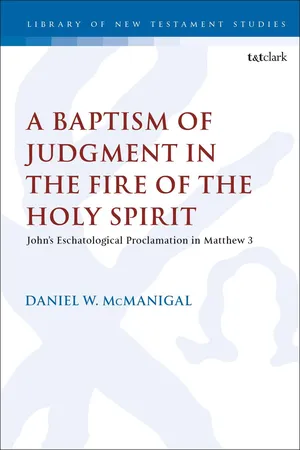
eBook - ePub
A Baptism of Judgment in the Fire of the Holy Spirit
John’s Eschatological Proclamation in Matthew 3
- 224 pages
- English
- ePUB (mobile friendly)
- Available on iOS & Android
eBook - ePub
A Baptism of Judgment in the Fire of the Holy Spirit
John’s Eschatological Proclamation in Matthew 3
About this book
Information
Chapter 1
INTRODUCTION
The Backlighting of Matthew 3:11
When readers of Matthew’s Gospel step into his narrative world, they encounter a dutiful scribe who has undertaken to tell Jesus’s story through the lens of Israel’s past. Through the use of OT citations, allusions, and typology Jesus is presented as the promised offspring of Abraham, David’s royal son and prophet. In Jesus, Israel comes face to face with the fulfillment of the nation’s prophetic past. Matthew repeatedly reminds his readers that Jesus has come, “In order that it might be fulfilled,” but will that mean blessing or curse for Israel? The hope of blessing (1:1) and the possibility of curse (1:11) hinge upon how Israel will respond to Jesus, and Matthew will not allow his readers to linger long over Israel’s decision and its outcome. Jesus will be rejected according to the scriptures, but this also fulfills a plan that was announced in the OT and will be the decisive event whereby the nations will be gathered to the people of God (Matt 8:11; 28:19–20).
In ch. 2, Matthew sets up the expectation of a future crisis. Under the specter of death God once more calls his son out of Egypt (Hos 11:1; Matt 2:15). The subsequent slaughter of the innocents (2:16–18) and the quotation from Jeremiah preview the coming judgment upon Israel. And yet the dark foreboding is balanced by an implicit message of hope that runs through the events of ch. 2. As the true king of the Jews (2:2), Jesus has come to experience the exodus on behalf of his people. Chapter 2 also hints that Jesus will escape death and lead his people out of Israel.
In ch. 3 some thirty years of narrative silence are passed over as Jesus goes from infancy to adulthood. In the wilderness, the silence is broken. When John the Baptist arrives he announces that Israel must submit to the assessment of heaven (Matt 3:2). Those who refuse and hold to their status as the biological children of Abraham (3:9) will undergo the judgment. John condemns the leaders of Israel by announcing that the one who is coming after him is coming to destroy them. They will experience the Spirit’s fire and there will be no escape. The messianic judgment will chop down the unfruitful trees and cast out the chaff into the unquenchable fire. Both of these symbolic pictures are placed on either side of the baptism in the Holy Spirit and fire and help to elaborate its meaning. This study will argue that the baptism of the Holy Spirit and fire is the eschatological judgment that will come upon the unrepentant nation in Jesus’s generation, upon Jesus himself as he hangs upon the cross for the sins of his people, and upon the wicked on the last day, when the judge returns in glory.
The Reason for This Book
Our aim is to advance a fresh Matthean reading of John’s words, “He will baptize you in the Holy Spirit and fire” (Matt 3:11). We will argue that the future baptism, as conceived by Matthew, is not the gift of Pentecost. It is not two baptisms: one for the good and the other for the evil. It is not a baptism of fire through which all must pass. The Gospel of Matthew presents the baptism of the Holy Spirit and fire as the judgment of God upon the nation of Israel, and the regathering of a people around Jesus. In the second place we will argue that the meaning of John’s water baptism mirrors the future messianic baptism of judgment upon Israel. Because the two baptisms have been brought together in Matt 3:11, they are best understood in light of one another and in light of Matthew’s larger narrative concerns with regard to Israel’s national failure and future. The outcome of this nuanced narrative reading is that the baptism with water and the baptism in the Holy Spirit and fire are mutually explanatory and distinctively one-sided in meaning.
The Plan of This Book
The present work explores and explains the meaning of the logion of Matt 3:11, ἐν πνεύματι ἁγίῳ καὶ πυρί, in its Matthean form. Grammatical details effecting the interpretation are also explored, followed by a survey of the main interpretations proposed by scholars. We then go on to offer an explanation of the baptism in the Spirit and fire as eschatological judgment upon Israel, taking note of the structural and contextual aspects that confirm such a reading.
We next turn to several OT passages to explore the underpinnings of John’s eschatological announcement. Isa 11, Mal 3–4, and Dan 7 provide announcements of the arrival of the day of the Lord and of a coming figure(s), the root of Jesse and Son of Man. The characteristics both of the day of the Lord and the ruler to come are the soil from which Matthew’s eschatological material grows.
The narrative context of Matt 3:1–12 will establish the reason for the arrival of John the Baptist and the reason for his eschatological message and sign. John’s message and baptism are closely related even though not easily understood. As we will argue, John’s preaching and baptism are auditory and visual pronouncements of judgment. Consideration must therefore be given to John baptizing Jesus. What are the implications of John’s prophetic sign for Jesus’s messianic work? Is the judgment carried out during Jesus’s ministry (Matt 11–12)? Should the cross be considered a baptism in the Holy Spirit and fire? To this we fill out the last of our textual treatment of the messianic baptism of Spirit and fire with the Olivet Discourse (Matt 24–25).
Because John’s preaching and baptism are future-oriented and are best understood as a prophet with an apocalyptic message, we conclude by defining the descriptive terms used throughout the pages that follow.
Messianic
When it comes to the word(s) messiah/messianic the multiplicity of definitions is hardly surprising. For Collins, “What matters is the expectation of a Davidic king, of an ideal priest, of an eschatological prophet. Besides, there was no Jewish orthodoxy in the matter of messianic expectation, and so we should expect some variation.”1
John the Baptist does not describe the one to come as the messiah, but such a requirement is not necessary.2
Matthew’s narrative presents Jesus as (1) John’s “one to come,” and (2) Israel’s messiah. The activities of the one to come (3:11) and his identity as “Χριστός” (1:1) tell us that Matthew has conceived of John’s expected figure as Jesus the messiah. John’s self-professed unworthiness to carry the sandal straps of the “Coming One” (3:11) and his question as to whether or not Jesus was ὁ ἐρχόμενος (11:3) indicate that John was looking for some sort of powerful figure to set things right. Matthew presents Jesus in the role of an agent of deliverance and judgment. In sum, Jesus is the Christ, the fulfillment of the OT eschatological proclamation of the prophets and the agent of salvation and judgment.
Eschatology
Traditional definitions of eschatology narrowly define it as, “The end of this world’s time—that is to say, when it refers to a consummation of the historical process in events which lie beyond the scope of the world’s history.”3
Our usage of eschatology is broader in scope than the “last things.” With regard to the prophets in particular, there is not always a distinction “to be drawn between Jahweh’s action within history and his action at the end of it, and there is consequently no need to confine the term ‘eschatological’ to the latter.”4
Future, temporal events in history that involve the activity of God in salvation and judgment and are described with end-time language (darkness, shaking of the heavens, heavenly armies, the overthrow of God’s enemies) will be designated as “eschatological.” This use of the term is not intended to imply the end of history in every given situation, though it could convey such depending upon the event.5
Apocalyptic
Matthew’s Gospel in general and John’s preaching in particular contain traits of apocalypticism.6
Hagner states that “from beginning to end, and throughout, the Gospel makes such frequent use of apocalyptic motifs and the apocalyptic viewpoint that it deserves to be called the apocalyptic Gospel. Nearly every major section of the Gospel bears the stamp of apocalyptic in one way or another.”7
David Sim articulates eight characteristics of apocalyptic eschatology: a dualistic world view, a deterministic understanding of history, the belief in a series of eschatological woes preceding the end, the arrival of a savior figure, the judgment, descriptions of the fate of the wicked, the fate of the righteous, and an expectation of the end as imminent.8
The literary genre of the Gospel of Matthew is not that of an apocalypse proper (e.g., Daniel, 1 Enoch, 4 Ezra, Apocalypse of Abraham, or the book of Revelation), but it does contain the themes enumerated by Sim. John proclaimed that the end was near, that there were only two types of people: the wheat and the chaff, fruitful and unfruitful trees; he proclaimed the imminent arrival of the kingdom of heaven and announced the coming separation which would be either to the eternal fire or to the barn of the one wielding the winnowing fork (3:12). Such descriptive activities in Matthew’s Gospel will be designated “apocalyptic.”
Conclusion
Matthew 3:11 is an important part of John the Baptist’s apocalyptic eschatological proclamation. Matthew’s narrative framework identifies Jesus as the messianic agent who will bring to pass the eschatological utterances and action of John. The combination of broader judgment themes found in Matthew and the prophets along with a close reading of Matt 3:11 in its narrative context will break new ground on the baptism in the Holy Spirit and fire and the baptism of John as the symbolic pointer to the reality he proclaimed.
Notes
1 John J. Collins, The Scepter and the Star: Messianism in Light of the Dead Sea Scrolls (Grand Rapids/Cambridge: Eerdmans, 2010), 18.
2 Andrew Chester, Messiah and Exaltation, WUNT 207 (Tübingen: Mohr Siebeck, 2007), 193–201, esp. 193–96.
3 Geerhard von Rad, Old Testament Theology, 2 vols., trans. D. M. G. Stalker (New York: Harper & Row, 1965), 2.114.
4 Von Rad, Old Testament Theology, 115.
5 Cf. E. P. Sanders, The Historical Figure of Jesus (London: The Penguin Press, 1993), 93.
6 Leopold Sabourin, “Apocalyptic Traits in Matthew’s Gospel,” RSB 3.1 (1983): 19–36; Donald Hagner, “Apocalyptic Motifs in the Gospel of Matthew: Continuity and Discontinuity,” HBT 7.2 (1985): 53–82; Daniel M. Gurtner, “Interpreting Apocalyptic Symbolism in the Gospel of Matthew,” BBR 22.4 (2012): 525–45.
7 Hagner, “Apocalyptic Motifs,” 60.
8 David C. Sim, Apocalyptic Eschatology in the Gospel of Matthew, SNTSMS 88 (Cambridge: Cambridge University Press, 1996), 31–52.
Chapter 2
THE GRAMMAR OF THE LOGION
Introduction
In this chapter we will present arguments for interpreting βαπτίσει ἐν πνεύματι ἁγίῳ καὶ πυρί as a single, future outpouring of the Holy Spirit in judgment. The textual indicators for a single baptism are the following: the solitary preposition governing the two datives, the close connection of water and spirit, and the parallelism of βαπτίζω to the same gr...
Table of contents
- Cover
- Half-Title
- Title
- Contents
- Acknowledgements
- General Abbreviations
- Chapter 1 INTRODUCTION
- Chapter 2 THE GRAMMAR OF THE LOGION
- Chapter 3 THE MEANING OF THE LOGION
- Chapter 4 ISAIAH 11, THE ROOT OF JESSE—THE DAVIDIC KING
- Chapter 5 MALACHI 3–4, ELIJAH, AND THE DAY OF THE LORD
- Chapter 6 DANIEL 7, THE ONE TO COME: JUDGMENT aND SALVATION
- Chapter 7 MATTHEW’S TYPOLOGICAL STORY
- Chapter 8 THE TIME, LOCATION, AND IDENTITY OF THE PROPHET
- Chapter 9 THE PREACHING OF JUDGMENT
- Chapter 10 BAPTISM AS THE SIGN-ACT OF JUDGMENT
- Chapter 11 THE MEANING OF THE JUDGMENT iN THE BAPTISM OF JESUS
- Chapter 12 THE JUDGMENT(S) TO COME IN MATTHEW’S GOSPEL
- Chapter 13 CONCLUSION
- Bibliography
- Index
- Copyright
Trusted by 375,005 students
Access to over 1.5 million titles for a fair monthly price.
Study more efficiently using our study tools.
Frequently asked questions
Yes, you can cancel anytime from the Subscription tab in your account settings on the Perlego website. Your subscription will stay active until the end of your current billing period. Learn how to cancel your subscription
No, books cannot be downloaded as external files, such as PDFs, for use outside of Perlego. However, you can download books within the Perlego app for offline reading on mobile or tablet. Learn how to download books offline
Perlego offers two plans: Essential and Complete
- Essential is ideal for learners and professionals who enjoy exploring a wide range of subjects. Access the Essential Library with 800,000+ trusted titles and best-sellers across business, personal growth, and the humanities. Includes unlimited reading time and Standard Read Aloud voice.
- Complete: Perfect for advanced learners and researchers needing full, unrestricted access. Unlock 1.5M+ books across hundreds of subjects, including academic and specialized titles. The Complete Plan also includes advanced features like Premium Read Aloud and Research Assistant.
We are an online textbook subscription service, where you can get access to an entire online library for less than the price of a single book per month. With over 1.5 million books across 990+ topics, we’ve got you covered! Learn about our mission
Look out for the read-aloud symbol on your next book to see if you can listen to it. The read-aloud tool reads text aloud for you, highlighting the text as it is being read. You can pause it, speed it up and slow it down. Learn more about Read Aloud
Yes! You can use the Perlego app on both iOS and Android devices to read anytime, anywhere — even offline. Perfect for commutes or when you’re on the go.
Please note we cannot support devices running on iOS 13 and Android 7 or earlier. Learn more about using the app
Please note we cannot support devices running on iOS 13 and Android 7 or earlier. Learn more about using the app
Yes, you can access A Baptism of Judgment in the Fire of the Holy Spirit by Daniel W. McManigal in PDF and/or ePUB format, as well as other popular books in Theology & Religion & Biblical Studies. We have over 1.5 million books available in our catalogue for you to explore.