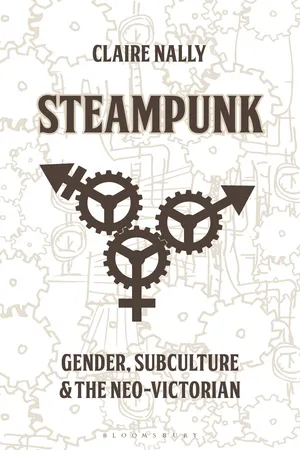
What is steampunk? Fashion craze, literary genre, lifestyle - or all of the above? Playing with the scientific innovations and aesthetics of the Victorian era, steampunk creatively warps history and presents an alternative future, imagined from a nineteenth-century perspective.
In her interdisciplinary book, Claire Nally delves into this contemporary subculture, explaining how the fashion, music, visual culture, literature and politics of steampunk intersect with theories of gender and sexuality. Exploring and occasionally critiquing the ways in which gender functions in the movement, she addresses a range of different issues, including the controversial trope of the Victorian asylum; gender and the graphic novel; the legacies of colonialism; science and the role of Ada Lovelace as a feminist steampunk icon. Drawing upon interviews, theoretical readings and textual analysis, Nally asks: why are steampunks fascinated by our Victorian heritage, and what strategies do they use to reinvent history in the present?
- 304 pages
- English
- ePUB (mobile friendly)
- Available on iOS & Android
eBook - ePub
About this book
Information
1
Steampunk: The Politics of Subversion?
Introduction
Steampunk is an equivocal discourse. Many practitioners maintain that the movement espouses an aesthetic radicalism which is inherently resistant to mainstream values and which expresses itself in a subculture through material objects, fashion, art, film, literature and other instantiations of popular culture.1 In ‘A Steampunk Manifesto’, Jake von Slatt suggests that steampunk practice is a contestation of contemporary mainstream culture. He explains:
The only future we are promised is the one in development in the corporate R&D labs of the world. We are shown glimpses of the next generation of cell phones, laptops, or MP3 players. Magazines that used to attempt to show us how we would be living in fifty or one hundred years, now only speculate over the new surround-sound standard for your home theater, or whether next year’s luxury sedan will have Bluetooth as standard equipment.2
This focus on aesthetic resistance acknowledges the rejection of consumerism, alongside, as the manifesto explains later, ‘the politically and environmentally aware Steampunk’.3 However, whilst the declared resistance to commodity culture is self-evident here, it is difficult to discern how von Slatt’s utopian vision of ‘choosing to own a very few fine things rather than closets of mass-produced goods’ isn’t also a party to privileged ideas of wealth, leisure time and indeed, a partial vision of the Victorian period.4 Von Slatt references how steampunk’s focus on ‘disruptive technologies’ can offer us lessons in the climate of the oil crisis and the evolution of labouring economies of China and India. What is less apparent, in this comparison, is how far the Victorian period was in itself foundational to mass-market production, but more importantly, how the Industrial Revolution and its associated technologies, valorized here as a solution to contemporary threats of apocalypse, were also responsible for grand-scale inequalities in terms of social class, gender and the rights of the worker. This steampunk fantasy of a-past-that-never-was seems curiously partial in its appraisal of the history upon which it draws.5 It is also important to note that steampunk politics discussed in this section, whilst broadly left of centre, are not reflective of an organized political policy as such, and this is part of the indeterminacy of steampunk which this book seeks to explore. The steampunk semiotics of refusal, insofar as aesthetics are concerned, is less about the policymaking of government and more about what Hebdige refers to as a ‘symbolic violation of the social order’.6
However, other steampunk manifestos seem quite emphatically embedded in challenging the romanticism of this vision, presenting a steampunk which maps an awareness of the inequalities of the past onto the present and contests both of these social problems. The Steampunk Magazine is a foundational publication in this respect. The opening article of the first issue, ‘What, then, is steampunk?’, articulates this most forcefully:
Ours is not the culture of Neo-Victorianism and stupefying etiquette, not remotely an escape to gentlemen’s clubs and classist rhetoric. It is the green fairy of delusion and passion unleashed from her bottle, stretched across the glimmering gears of rage.
We seek inspiration in the smog-choked alleys of Victoria’s duskless Empire. We find solidarity and inspiration in the mad bombers with ink-stained cuffs, in whip-wielding women that yield to none, in coughing chimney sweeps who have escaped the rooftops and joined the circus, and in mutineers who have gone native and have handed the tools of their masters to those most ready to use them.7
This argument puts the injustices of Victoria’s reign – women’s rights, Empire, class distinctions, working children and poverty – at the forefront of steampunk practice and aligns steampunk with the outsider in the nineteenth century. The ‘whip wielding women’ (whilst being suggestively sexual) possibly refers to suffragette figures like Emily Wilding Davison, who famously attacked a vicar with a dog whip in 1913, mistaking him for the Prime Minister, Lloyd George.8 Sympathy with ‘mad bombers’ is likely a gesture towards anarchist agitation in the period and perhaps specifically references the Greenwich Observatory bombing of 1894 (immortalized in Joseph Conrad’s 1907 novel, The Secret Agent). The magazine presents itself as an activist publication, and this version of steampunk is aided by its publication context, its status as an online zine and its political content. Similarly, The Men That Will Not Be Blamed for Nothing (hereafter abbreviated to TMTWNBBFN) align themselves with the underdog of Victorian culture. This steampunk band not only addresses the histories of inventors, scientists and visionaries (Brunel, Stephenson, Darwin, Curie) but explores the steaming underbelly of Victorian society: the poverty stricken but morally bankrupt ‘baby farmers’: aberrant women who reject their traditional gendered role and who are in many ways monsters fostered by the insatiable greed of capitalism. Exploring this underground Victorian culture suggests a corrective to some of the more polite versions of steampunk which focus on aesthetic revolution to the detriment of activism.
‘We stand with the traitors of the past as we hatch impossible treasons against our present.’ The Steampunk Magazine (2007–2013)
One of the most compelling facts about steampunk is that despite its emphasis on material, tactile culture, its visibility online (through maker websites like Etsy, community forums such as ‘Brass Goggles’, online publications such as The Steampunk Journal and designated groups on Facebook, among many other sites and forums) mean that steampunk’s digital footprint is extensive, as is now common to many subcultures. Indeed, in many ways, The Steampunk Magazine participates in constructing and maintaining the imagined subcultural community of steampunk. In his definitive statement on nationalism, Benedict Anderson maintains that ‘[the nation] is an imagined political community … because the members of even the smallest nation will never know most of their fellow-members, meet them, or ever hear of them, yet in the minds of each lives the image of their communion’.9 These subcultural communities function in a similar way. Relatedly, Paul Hodkinson has discussed the role of online participation in relation to goth, stating that the web functions to
reinforce the boundaries of the grouping. The key general point here is that regardless of the number of individuals online, the internet does not, in practice, function as a singular mass medium but rather as a facilitating network which connects together a diverse plurality of different media forms … resources and forums on the internet functioned to facilitate the subculture as a whole through providing specialist knowledge, constructing values, offering practical information and generating friendships.10
The tension between material, tactile culture and virtual community is foregrounded in how The Steampunk Magazine navigates virtual and material cultures. It is a broadly anarchist publication which is available for free online or to purchase as a physical publication.
The Steampunk Magazine was initially published in 2007 and remains one of the best examples of politically resistant steampunk practice. It is closely aligned to anarchist politics, and more specifically, anarcho-feminism (as witnessed in material by Miriam Roček – otherwise known as Steampunk Emma Goldman). If The Steampunk Magazine explores an alternative future influenced by a fictional nineteenth-century past, then it also aligns itself with iconoclastic politics. This is foregrounded in the first issue of The Steampunk Magazine, in the article by The Catastrophone Orchestra and Arts Collective (discussed above). As a manifesto to steampunk practice, this article situates itself against an uncritical nostalgia which replicates the Victorian age without any political critique. The collective suggests that ‘steampunk rejects the myopic, nostalgia-drenched politics so common among “alternative” cultures … Too much of what passes as steampunk denies the punk, in all its guises’.11 This also summarizes the ethos of magazine very effectively. The Steampunk Magazine lasted for nine issues and delivered interviews with writers, such as Michael Moorcock and Alan Moore, as well as musicians and bands like Ghostfire, The Men That Will Not Be Blamed for Nothing, Dr Steel and Unwoman (some of whom will be discussed below). The magazine also published original fiction and poetry on steampunk themes, but a large part of the publication was comprised of non-fiction articles, including descriptions of the subculture, lifestyle advice, and hints and tips for makers and DIY practitioners (for instance, ‘It Can’t All Be Brass, Dear: Paper Maché in the Modern Home’, ‘Sew an Aviator’s Cap’, ‘Sew Yourself a Lady’s Artisan Apron’). At the heart of many articles is an incendiary plan to revolutionize society (‘The Courage to Kill a King: Anarchists in a Time of Regicide’, ‘Nevermind the Morlocks: Here’s Occupy Wall Street’, ‘On Race and Steampunk: A Quick Primer’, ‘Riot Grrls, 19th Century Style’). Notably, many of these articles give a feminist perspective which is diametrically opposed to conventional ideas of gender and sexuality. In ‘The Steampunk’s Guide to Body Hair’, the reader is enjoined that ‘in regards of the growing or shaving of body hair, people of all genders ought to feel free to do either’, whilst one article by Miriam Roček (aka Steampunk Emma Goldman) contests ‘the fascism in fashion’.12 Part of this also reflects the ethos of the publication more generally. Spearheaded by Margaret Killjoy (a trans woman with anarchist sympathies), the magazine’s DIY and alternative credentials put it squarely in the zine tradition. As Michelle Liptrot has argued in her discussion of British DIY punk, ‘[in] the Do-It-Yourself (DIY) self-production ethic of 1970s punk … participants followed in the DIY tradition of jazz, skiffle and the sixties counter-culture to produce their own music, visual style and media (in the form of fanzines)’.13 DIY functions in punk, and in steampunk, as a locus of autonomy, egalitarianism and self-definition from within the community. Before moving on to the content of the magazine, this chapter will explore the ways in which it shares many characteristics with zines and the online equivalent, e-zines (electronic fanzines).
In his definitive guide to zine culture, Notes from Underground, Stephen Duncombe describes the zine as follows: ‘[it] might start with a highly personalized editorial, then move into a couple of opinionated essays or rants criticizing, describing, or extolling something or other, and then conclude with reviews of other zines, bands, books, and so forth.’14 At first glance, this doesn’t seem to represent The Steampunk Magazine. What distinguishes a zine from other publications, Duncombe continues, is the pirating of material and ‘unruly cut-and-paste layout, barely legible type, and uneven reproduction’.15 Given its expert visual presentation and page layout, The Steampunk Magazine seems, at least initially, to be quite far removed from this description. However, zines are also ‘independent and localized, coming out of cities, suburbs and small towns across the US, assembled on kitchen tables...
Table of contents
- Cover
- Halftitle Page
- Title Page
- Contents
- List of Figures
- Acknowledgements
- Series Editors’ Introduction
- Introduction
- 1. Steampunk: The Politics of Subversion?
- 2. Doctor Geof and Nick Simpson: Sex, War and Masculinity
- 3. Freak Show Femininities: Emilie Autumn
- 4. Steampunk and the Graphic Novel
- 5. Steampunk Romance: Gail Carriger and Kate McAlister
- Conclusion
- Bibliography
- Index
- Imprint
Trusted by 375,005 students
Access to over 1.5 million titles for a fair monthly price.
Study more efficiently using our study tools.
Frequently asked questions
Yes, you can cancel anytime from the Subscription tab in your account settings on the Perlego website. Your subscription will stay active until the end of your current billing period. Learn how to cancel your subscription
No, books cannot be downloaded as external files, such as PDFs, for use outside of Perlego. However, you can download books within the Perlego app for offline reading on mobile or tablet. Learn how to download books offline
Perlego offers two plans: Essential and Complete
- Essential is ideal for learners and professionals who enjoy exploring a wide range of subjects. Access the Essential Library with 800,000+ trusted titles and best-sellers across business, personal growth, and the humanities. Includes unlimited reading time and Standard Read Aloud voice.
- Complete: Perfect for advanced learners and researchers needing full, unrestricted access. Unlock 1.5M+ books across hundreds of subjects, including academic and specialized titles. The Complete Plan also includes advanced features like Premium Read Aloud and Research Assistant.
We are an online textbook subscription service, where you can get access to an entire online library for less than the price of a single book per month. With over 1.5 million books across 990+ topics, we’ve got you covered! Learn about our mission
Look out for the read-aloud symbol on your next book to see if you can listen to it. The read-aloud tool reads text aloud for you, highlighting the text as it is being read. You can pause it, speed it up and slow it down. Learn more about Read Aloud
Yes! You can use the Perlego app on both iOS and Android devices to read anytime, anywhere — even offline. Perfect for commutes or when you’re on the go.
Please note we cannot support devices running on iOS 13 and Android 7 or earlier. Learn more about using the app
Please note we cannot support devices running on iOS 13 and Android 7 or earlier. Learn more about using the app
Yes, you can access Steampunk by Claire Nally in PDF and/or ePUB format, as well as other popular books in Social Sciences & Film & Video. We have over 1.5 million books available in our catalogue for you to explore.