- 304 pages
- English
- ePUB (mobile friendly)
- Available on iOS & Android
eBook - ePub
About this book
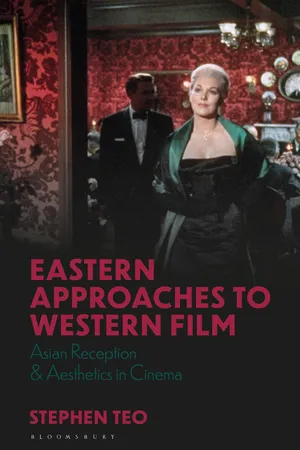
Eastern Approaches to Western Film: Asian Aesthetics and Reception in Cinema offers a renewed critical outlook on Western classic film directly from the pantheon of European and American masters, including Alfred Hitchcock, George Lucas, Robert Bresson, Carl Dreyer, Jean-Pierre Melville, John Ford, Leo McCarey, Sam Peckinpah, and Orson Welles. The book contributes an "Eastern Approach" into the critical studies of Western films by reappraising selected films of these masters, matching and comparing their visions, themes, and ideas with the philosophical and paradigmatic principles of the East. It traces Eastern inscriptions and signs embedded within these films as well as their social lifestyle values and other concepts that are also inherently Eastern. As such, the book represents an effort to reformulate established discourses on Western cinema that are overwhelmingly Eurocentric. Although it seeks to inject an alternative perspective, the ultimate aim is to reach a balance of East and West. By focusing on Eastern aesthetic and philosophical influences in Western films, the book suggests that there is a much more thorough integration of East and West than previously thought or imagined.
Information
1
Star Wars Eastern Saga
The force is the Dao
This chapter focuses on the Star Wars Saga as the best known template of the incorporation of Eastern elements in the cinemas of the West. It sets the tone of this book in identifying and analyzing the Eastern concepts that are present but not usually perceived or studied in Western films as a matter of course. The basic theme is that the East has been an embedded part of the films of the West but that current film theory and criticism, Eurocentric and narcissistic, has obscured this material. The book intends to bring this material to light through analysis of a series of films by canonical Western directors ultimately to demonstrate an Easternized West in the films of the West. While Eastern motifs, designs, characters, and concepts appear in some films of the West in a transparent fashion, they are not as obvious in others. The Star Wars Saga is the most transparent example of the “Oriental West” in the contemporary Western cinema. The Saga refers to a franchise produced in Hollywood that is the most popular and financially successful of Western cinematic narratives told and constructed in a serial fashion over the past forty years. At the time of writing, it consists of the official eight films thus far released, including the original trilogy, a prequel trilogy, and the first and second episodes of a sequel trilogy (another film, a spin-off from the Saga, has also been released).1
The Star Wars Saga is representative of the fundamental integration of Eastern elements and archetypes in Western narratives. This is not a new discovery, and the current literature on Star Wars both online and in print reveals that this basic truth is widely recognized. Many writers and scholars have attested to the Saga’s evocation and use of Eastern philosophy, elements, and characteristics, and some have decried them as Orientalist. I will address this Orientalist tendency in greater length below while acknowledging a serious attempt by Hollywood filmmakers at an East-West synthesis of character, story, and concepts. The Orientalism, after all, is in time-honored Hollywood tradition. One of the most predictable influences on the Saga was the serial Flash Gordon, popular in the 1930s, which featured the Oriental Emperor Ming as the space villain who seeks to destroy Earth, saved invariably by the Occidental hero.2 Mainly, however, I will consider the significance of the “Eastern” in three ways. First, as a notion distinctive from “Orientalism,” which is, to take a cue from John Hobson, a concept that is interchangeable with Eurocentrism;3 second, as an inherent quality in the West—what Hobson calls the “Oriental West”—and I will cover this in more detail in the next section; and third, the didactic dimension of the Eastern. There is a lot of moral teaching in the Saga, as its primary creator George Lucas has confessed: “I wanted it to be a traditional moral study, to have some sort of palpable precepts in it that children could understand.”4 Many of the precepts are reminiscent of the pithy teachings found in ancient Chinese texts, such as those attributed to Confucius, Lao Zi, and Zhuang Zi. The Force is one such precept, now regarded as generic to the whole mythical-religious structure of the Star Wars Saga, and it has become the single most identifiable concept of the whole franchise. Its “high concept” definition is “a cosmic energy source that incorporates and consumes all living things.”5 Sounding abstract and accessible at the same time, one could regard it as prototypical of 1970s’ American New Age esotericism arising out of the imagination of George Lucas. However, I will make clear that it springs from Eastern sources of thought that have influenced Lucas.
The Force is suggestive of the Dao, the Eastern philosophy that seems closest to its substance. Kevin J. Wetmore Jr. had earlier stated as much in his article “The Tao of Star Wars, or, Cultural Appropriation in a Galaxy Far, Far, Away,” published in 2000. He remarked that “the language the various characters use to describe the Force suggests Taoism.”6 In the recent offshoot of the franchise, Rogue One (2016), whenever we hear the refrain “The Force is with me, I am one with the Force,” exchanged by two Chinese Jedi knights (played by Donnie Yen and Jiang Wen), it is immediately reminiscent of the Daoist idea of being one with the Dao and that all things come from the Dao. (The fact that it is also uttered by two Chinese knights also heightens the association between the Force and the Dao.) The description of the Force as a “cosmic energy force” is, more specifically, a description of the vital energy contained in the Dao, which is qi (literally, breath).7 Walter Robinson sees the Force largely in terms of its application to the martial arts philosophy of the Jedi knights in which qi is a vital energy that sustains one’s power as a martial arts warrior. However, Robinson also notes that the Force is “central to the Star Wars mythology.”8 It is a complete system of thought which has inspired a new religion, Jediism, described by Markus Altena Davidsen as the “Force religion of the Jedi knights,” acquiring a universal “theology, ethics, and spiritual practice.”9 Davidsen questions whether the Force “is monistic or dualistic in nature” even if it is “usually presented as dualistic, with both a light side (Ashla) and a dark side (Bogan).”10 The dualism of the dark and light sides suggests the Daoist origins of the Force with its yin (or dark side) and yang (or light side) conjoined into a circle.11 Davidsen recognizes influences from “Christianity and Westernized Buddhism and Taoism.”12 From our perspective, the Force is much more akin to the Dao. Both are ethereal in nature, but the Force is only a kind of Dao, of course, transmuted by the space-frontier environment and narrative contexts of the whole Saga.
Lucas has admitted to the influence of Carlos Castaneda’s stories in the “Don Juan” books, The Teachings of Don Juan: A Yaqui Way of Knowledge, published in 1968, followed by two sequels, and a further book, Tales of Power, published in 1975.13 In Tales of Power, the narrator experiences a “life force” summoned into him through the knowledge of the Indian shaman, Don Juan, who also speaks of “the warrior’s freedom.” Castaneda’s Don Juan is reminiscent of the Daoist warrior. The tales of the book are like Zhuang Zi’s instructions for his disciples to follow the natural force of the Dao (the Way), as written in the Zhuang Zi (partly attributed to the master himself but mostly written by his followers). Through Castaneda, the Dao has seeped into the Star Wars Saga. The Indian sorcerer, Don Juan (the Zhuang Zi-like figure), is the main influence on the character of Obi-Wan Kenobi and his relationship with Luke Skywalker. Obi-Wan Kenobi is the Daoist warrior cognizant of the arcane ways of the Dao (Force) and stresses that what matters to a warrior “is arriving at the totality of oneself,” achieving this by immersing oneself with the Dao/Force.14 We may say that the Force is Lucas’s Western methodology of “knowing” the Dao, concretizing the Dao as an “energy field created by all living things that binds the universe together,” and when the Jedi knights tap into this field of energy it gives them “the status of magician/warriors.”15
It is generally acknowledged that the Star Wars Saga draws on ancient Eastern traditions of moral, spiritual, and lifestyle teaching. This is not to suggest that the Saga is interested in proselytizing any particular Eastern religion, although it might have inadvertently promoted its own religion of Jediism out of its syncretization of Eastern religions. As Dale Pollock tells us, Star Wars is “a metaphor for the tenets of Christianity, Buddhism, Judaism, and Islam.”16 We can now add Daoism to the mix, as many writers have already denoted a greater influence of the teachings of the Dao on the Saga.17 That all these religions stem from the East is justification enough for our identification of the whole series as an Eastern Saga although some may argue that its Eastern ideology is nothing more than shallow Orientalism. The Saga is also a modern myth and fairy tale based in outer space which is expressive of an advanced Western technological society. Its surface features and many of its characters are “Western.” As the architect and scholar David Beynon explains, “The surface of a thing contributes to, if not helps to determine, its content.”18 The surface of the Saga is innately Western, and its mythical trappings suggest a completely Western tradition of classical myth and epic poetry. In an essay entitled “The Return of the Jedi: Epic Graffiti,” published in 1987, Todd H. Sammons analyses the application of the European epic poetic mode to Episode VI of the Saga, The Return of the Jedi, and we may extrapolate from this the essentialist relevance of European epics to the entire legend as it now stands. Sammons tells us that “every single scene in Jedi has an analogue in the European epic tradition,” and he gives an impressive list of epics that have influenced the film, including Homer’s Odyssey, Virgil’s Aeneid, Beowulf, Dante’s Divine Comedy, Ariosto’s Orlando Furioso, Tasso’s Gerusalemme liberata, Spenser’s The Færie Queene, and Milton’s Paradise Lost.19
Sammons goes on to demonstrate how the characters and events in the film relate analogously to these epics, but there is a deceptive layer to the allusions of all these seemingly Western poetic myths. Sammons also demonstrates how Lucas has transformed them. Lucas was making a science fiction adventure series wherein the scientific and futuristic conceits would demand a New Age if not postmodern approach to the material (the European epics would otherwise be just too medieval to be accessible). Sammons describes Lucas’s approach as “epic graffiti” in that he utilizes “epic analogues in Jedi the same way he uses songs in American Graffiti.”20 This is Lucas’s own cinematic form of transformational grammar, which gives rise to a surface structure of the medieval European epics. It has resulted in a film that Sammons dubs “epic manqué,” “the ‘epic’ tone guaranteed by the pastiche of epic motifs.”21 In a sense, the European tradition remains largely suppressed by this approach. Undoubtedly, the approach is highly eclectic and leads not just to the Saga’s incorporation of European epics but also Eastern elements, which give it a more prominent Eastern visage. In fact, the Saga looks so very much like Orientalist art in its costumes, in its settings, and in many of the characterizations (including the use of nonhuman characters) that the Western surface is effectively effaced. This is ironic if we put ourselves into Sammons’s perspective, which is a Eurocentric view of the Star Wars films, but the point to make here is that Orientalist motifs already infuse the European epic tradition that Sammons cites, perhaps notoriously exemplified by Dant...
Table of contents
- Cover
- Half-Title
- Series
- Dedication
- Title
- Contents
- List of Figures
- Acknowledgements
- Introduction
- 1 Star Wars Eastern Saga
- 2 Vertigo, Hitchcock’s Chinese Riddle
- 3 Orson Welles’s The Lady from Shanghai
- 4 Le Samouraï, Eastern Action in the Milieu
- 5 Robert Bresson, French or Daoist?
- 6 Dreyer’s Vampyr: Wandering in the West
- 7 Eastern Principles in Sam Peckinpah’s Westerns
- 8 Make Way for Tomorrow, America’s Confucian Classic
- 9 John Ford and Asian Family Values
- Conclusion
- Glossary
- Bibliography
- Index
- Copyright
Trusted by 375,005 students
Access to over 1.5 million titles for a fair monthly price.
Study more efficiently using our study tools.
Frequently asked questions
Yes, you can cancel anytime from the Subscription tab in your account settings on the Perlego website. Your subscription will stay active until the end of your current billing period. Learn how to cancel your subscription
No, books cannot be downloaded as external files, such as PDFs, for use outside of Perlego. However, you can download books within the Perlego app for offline reading on mobile or tablet. Learn how to download books offline
Perlego offers two plans: Essential and Complete
- Essential is ideal for learners and professionals who enjoy exploring a wide range of subjects. Access the Essential Library with 800,000+ trusted titles and best-sellers across business, personal growth, and the humanities. Includes unlimited reading time and Standard Read Aloud voice.
- Complete: Perfect for advanced learners and researchers needing full, unrestricted access. Unlock 1.5M+ books across hundreds of subjects, including academic and specialized titles. The Complete Plan also includes advanced features like Premium Read Aloud and Research Assistant.
We are an online textbook subscription service, where you can get access to an entire online library for less than the price of a single book per month. With over 1.5 million books across 990+ topics, we’ve got you covered! Learn about our mission
Look out for the read-aloud symbol on your next book to see if you can listen to it. The read-aloud tool reads text aloud for you, highlighting the text as it is being read. You can pause it, speed it up and slow it down. Learn more about Read Aloud
Yes! You can use the Perlego app on both iOS and Android devices to read anytime, anywhere — even offline. Perfect for commutes or when you’re on the go.
Please note we cannot support devices running on iOS 13 and Android 7 or earlier. Learn more about using the app
Please note we cannot support devices running on iOS 13 and Android 7 or earlier. Learn more about using the app
Yes, you can access Eastern Approaches to Western Film by Stephen Teo in PDF and/or ePUB format, as well as other popular books in Media & Performing Arts & Film History & Criticism. We have over 1.5 million books available in our catalogue for you to explore.