- 360 pages
- English
- ePUB (mobile friendly)
- Available on iOS & Android
eBook - ePub
About this book
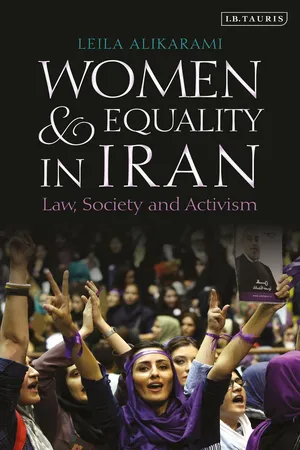
Iran's continued retention of discriminatory laws stands in stark contrast to the advances Iranian women have made in other spheres since the Revolution in 1979. Leila Alikarami here aims to determine the extent to which the actions of women's rights activists have led to a significant change in their legal status. She argues that while Iranian women have not yet obtained legal equality, the gender bias of the Iranian legal system has been successfully challenged and has lost its legitimacy. More pertinently, the social context has become more prepared to accommodate legal rights for women. Highlighting the key challenges that proponents of gender equality face in the Muslim context, Alikarami attempts to ascertain the causes of Iran's failure to ratify the CEDAW and questions whether and to what extent interpretations of Islamic principles prevent Iran from doing so. Applying feminist legal theory to contemporary Iran, Alikarami's approach re-evaluates the underlying principles that have shaped the struggle for equal rights between the sexes.
Information
CHAPTER 1
THE DEVELOPMENT OF UNIVERSAL STANDARDS ON GENDER EQUALITY: THE CONVENTION ON THE ELIMINATION OF ALL FORMS OF DISCRIMINATION AGAINST WOMEN
Introduction
In several instances, Iranian women's rights activists have demonstrated on the streets of Tehran and demanded that the government take action end to discrimination against women. The fact that every protest has been brought to an end through suppression by the security forces underscores the extent to which human rights in general – and women's rights in particular – are seen as a challenge to be faced down by the Iranian Government. Traditionally, in some Islamic countries like Iran, human rights are considered a Western invention with limited or no connection to the fabric of Muslim societies.1 The reason for this view may be the fact that no educational or awareness-raising measures can be effective in a community that regards the values reflected in human rights instruments as alien and imposed on them from the outside.2
The principal argument advanced in this chapter is that, despite the traditional view of some Islamic governments that human rights discourse is a Western phenomenon, international standards of human rights extend beyond national borders. This chapter examines the development of international standards on women's human rights to highlight the presence and participation of Muslim women in this process. The aim is to demonstrate that gender equality standards are not alien to Muslim women.3
Equality and non-discrimination are fundamental principles of human rights. With respect to the human rights of women, the Convention on the Elimination of All Forms of Discrimination Against Women (CEDAW), which was adopted by the UN General Assembly in 1979, stands out as the most influential instrument yet devised by the international community. Although the CEDAW is designed to eradicate discrimination against women and improve the individual, family, social, political, economic and cultural aspects of women's lives in the ratifying country, the contradictions between the CEDAW and the Shari‘a remain a primary concern in many Muslim states.
The CEDAW urges States Parties to amend laws, practices and customs that discriminate against women.4 Whilst the CEDAW's objectives appear capable of universal acceptance, they have nevertheless been controversial in the Muslim world. The central basis of the convention is the demand for gender equality as expressed in Articles 2 and 16 of the CEDAW.
This chapter briefly analyses the CEDAW to assess the extent to which this comprehensive and well-targeted international convention focusing on non-discrimination against women can be effective in improving the status of women worldwide. It argues that the convention provides effective legal language and a framework which can be used as a legal tool by advocates for gender equality for addressing the issue of discrimination against women. It also provides minimum common standards on gender equality to persuade the States Parties to the convention to ensure and guarantee the protection of women's rights. In the words of Indira Jaising, ‘the implementation of human rights norms for women can only be effective if it is in furtherance of preserving and according to women a life of dignity. The role of laws in such matters has to rise above the level of a tool of adjudication to a tool to ensure the provision of justice’.5
The global movements for women's rights: Muslim women's experience
While gender equality carries a certain modern quality, the fact is women began the struggle for equality long before the adoption of the UN Charter. Consider the International Alliance of Women (1904) and the Women's International League for Peace and Freedom (1915), both organised by women, including Muslim women.6 Of course, solidarity, as they say, begins at home, and women were involved in social and political movements seeking equality within national borders dating back to the turn of the twentieth century. Iranian women, for example, played essential roles in the political events that occurred in the country during and after the Constitutional Revolution of 1906.7
The preamble of the United Nations Charter affirms ‘faith in fundamental human rights, in the dignity and worth of the human person, in the equal rights of men and women of nations large and small.’8 The purpose of the United Nations, according to Article 1 of the charter, is ‘to achieve international cooperation […] in promoting and encouraging respect for human rights and for fundamental freedoms for all without distinction as to race, sex, language or religion.’9 To promote the implementation of the principle that men and women have equal rights and to develop proposals to give effect to such recommendations, the Commission on the Status of Women (CSW) was set up by United Nations Economic and Social Council (ECOSOC) in accordance with Article 68 of the UN Charter, in 1946.10 During its first session in February 1947, the CSW declared as one of its guiding principles:
[To] raise the status of women, irrespective of nationality, race, language or religion, to equality with men in all fields of human enterprise, and to eliminate all discrimination against women in the provisions of statutory law, in legal maxims or rules, or in interpretation of customary law.11
The CSW has played a significant role in setting new international standards on women's human rights during 1946–62. A number of international conventions were held with sponsorship from the commission, namely the 1952 Convention on the Political Rights of Women,12 the 1957 Convention on the Nationality of Married Women13 and the 1962 Convention on Consent to Marriage, Minimum Age for Marriage, and Registration of Marriage.14 The commission, therefore, was successful in elaborating and adopting specific conventions on the rights of women before the UN Commission on Human Rights, founded in 1946, succeeded in drafting the Covenant on Economic, Social and Cultural Rights and the Covenant on Civil and Political Rights, both of which contain non-discriminatory provisions.15
The commission had observer status in the Human Rights Committee (HRC) of the UN during the drafting process of the Universal Declaration of Human Rights (UDHR). Although the CSW did not have an independent vote in the HRC, its presence and lobbying encouraged the incorporation of the equality of rights discourse into the UDHR.16
Women's rights were discussed significantly during the drafting process of the UDHR, in one of the most essential debates of the drafting process. Reference to gender equality in the UN Charter's opening affirmation of faith was left out and replaced with the gender-neutral term ‘everyone’ in the fourth draft submitted to the HRC by the drafting committee.17 This provoked objections from the delegations of some countries during the discussion in the Third Committee of the General Assembly. Lakshimi Menon, the delegate from India, objected to the omission of gender equality, arguing that its absence invited discrimination against women. Minerva Bernardino from the Dominican Republic, supporting Lakshmi's position, insisted that:
[In] certain countries the term ‘everyone’ did not necessarily mean every individual, regardless of sex. Certain countries claimed to recognise the rights of ‘everyone’ but experience has shown that women did not enjoy those rights in the same capacity as men – as, for instance, voting rights.18
The explicit term ‘gender equality’ was re-inserted into the text by a vote of thirty-two to two, and three abstentions that came from the United Kingdom, Canada and Ethiopia. The United States and China cast the two opposing votes.19 It is interesting to note that no representative from Muslim countries voted against the text on gender equality. The representatives from the Muslim world, however, did not have a unified position on the issue of gender equality. According to Waltz, while most representatives from Muslim countries hoped to limit the strong language of gender equality inserted in the UDHR, some Muslim delegations, including those of Iraq and Pakistan, strongly advocated for women's rights.20
Article 16 of the UDHR guarantees both sexes equal rights in marriage, including the right to choose whom to wed, and the right to dissolve a marriage contract. This was one of the debated issues that attracted significant attention during the drafting process of the UDHR. The CSW, in its report submitted to the HRC in mid-1947, suggested including a clause to the UDHR in relation to family issues. The commission suggested that the clause mention freedom of choice, the dignity of the wife, the right to keep one's nationality, the right to make contracts and equal rights to divorce, guardianship of children and the ownership of property.21 The draft of Article 16 discussed at the Third Committee contained three paragraphs: 1) ‘Men and women of full age have the right to marry and to found a family and are entitled to equal rights as to marriage’; 2) ‘Marriage shall be entered into only with the full consent of both intending spouses’; and 3) ‘The family is the natural and fundamental group unit of society and is entitled to protection.’22
Equal rights to divorce constituted the most controversial issue for the delegates to the Third Committee. It is interesting to note that ‘much of the opposition to the explicit mention of divorce came from delegates from Christian countries and organisations’.23 M. Amado, the Panamanian representative, argued, for instance, ‘some States were bound by laws based on Concordats with the church and had, in respect of religious marriage and divorce, obligations which would not permit them to accept the proposal text.’24
Some Muslim delegations were also active in these discussions. Saudi Arabia and Egypt, for example, proposed amendments to the text of Article 16.25 The Saudi Arabian delegation strongly criticised the article, stating that Western standards on the family were given priority over ‘more ancient civilisations that had passed the experimental age, and the institution of which, for example, had proven their wisdom through the centuries’.26 Lebanon and Syria were the only Muslim countries supporting Saudi Arabia's position. Interestingly, no other Muslim states backed it. Yet, Shaista Irkamullah of Pakistan raised the point with other Muslim representatives that the term ‘equal rights’ was not equivalent to ‘identical rights.’ She stated that Article 16 was drafted ‘to prevent child marriage and marriages without the consent of both parties, and also to ensure the protection of women after divorce.’27
When the text of UDHR Article 16 was forwarded to the General Assembly in December 1948, the phrases ‘without any limitation due to race, nationality or religion’ and ‘during marriage and its dissolution’ were added to the first paragraph. The word ‘free’28 was added to the second paragraph to make the consent full and free. In the third paragraph, the terms ‘by society and the state’ were added to the idea of protection.29 Therefore, the final text of Article 16 in the UDHR included provisions for equal rights to marriage, during marriage and its dissolution, the free and full consent of both parties and prohibited limitations based on race, nationality and religion. It is important to note that Muslim states, with the sole exception of Saudi Arabia, voted for Article 16. The latter was approved through the positive vote of, amongst others, Egypt, Iran, Iraq, Pakistan, Turkey, Lebanon and Syria. Therefore, one may agree with Morsink when he states:
The question of human rights cannot be settled on religious grounds. The human rights enunciated in the UDHR are not linked to religion. The drafters did not think that to accept the existence of any one of the rights one had to be an adherent of a certain faith.30
The CSW ‘aimed at improving the status of women in all fields of human rights irrespective of their nationality, language or religion and therefore in its view democracy is the only way in which women can enjoy their full rights as human beings.’31
Muslim states also advocated for gender equality during the adoption of the International Covenant on Civil and Political Rights (ICCPR) and the International Covenant on Economic, Social, and Cultural Rights (ICESCR). The Human Rights Commission did not initially provide for a separate article on gender equality in an earlier draft of covenants. Rather, the provisions guaranteeing gender equality were attached to other articles of the covenants.32 The Iraqi delegation, headed by Bedia Afnan, insisted on the incorporation of a separate article on gender equality within the covenant drafts.33 Although the delegations of both Western and Muslim states argued against the Iraqi delegation's position, Afnan's idea attracted more positive support and resulted in adoption of a common Article 3 in both covenants that urges...
Table of contents
- Cover
- Title Page
- Copyright
- Dedication
- Contents
- Note on Transliteration
- Glossary of the most commonly used Persian and Arabic Terms and Abbreviations
- Acknowledgements
- Preface
- Introduction and Theoretical Framework
- 1. The Development of Universal Standards on Gender Equality: The Convention on the Elimination of All forms of Discrimination Against Women
- 2. The Political and Legal System of the Islamic Republic of Iran
- 3. Deliberation Over the Adoption of CEDAW by the Islamic Republic of Iran
- 4. Iranian Women's Struggle for Gender Equality: The Case of Iran's Civil Code
- 5. Iranian Women Demanding Equal Rights: The Case of Iran's Criminal Code
- 6. The One Million Signatures Campaign: Domestic Discourse on Gender Equality
- Conclusion
- Notes
- Bibliography
Trusted by 375,005 students
Access to over 1.5 million titles for a fair monthly price.
Study more efficiently using our study tools.
Frequently asked questions
Yes, you can cancel anytime from the Subscription tab in your account settings on the Perlego website. Your subscription will stay active until the end of your current billing period. Learn how to cancel your subscription
No, books cannot be downloaded as external files, such as PDFs, for use outside of Perlego. However, you can download books within the Perlego app for offline reading on mobile or tablet. Learn how to download books offline
Perlego offers two plans: Essential and Complete
- Essential is ideal for learners and professionals who enjoy exploring a wide range of subjects. Access the Essential Library with 800,000+ trusted titles and best-sellers across business, personal growth, and the humanities. Includes unlimited reading time and Standard Read Aloud voice.
- Complete: Perfect for advanced learners and researchers needing full, unrestricted access. Unlock 1.5M+ books across hundreds of subjects, including academic and specialized titles. The Complete Plan also includes advanced features like Premium Read Aloud and Research Assistant.
We are an online textbook subscription service, where you can get access to an entire online library for less than the price of a single book per month. With over 1.5 million books across 990+ topics, we’ve got you covered! Learn about our mission
Look out for the read-aloud symbol on your next book to see if you can listen to it. The read-aloud tool reads text aloud for you, highlighting the text as it is being read. You can pause it, speed it up and slow it down. Learn more about Read Aloud
Yes! You can use the Perlego app on both iOS and Android devices to read anytime, anywhere — even offline. Perfect for commutes or when you’re on the go.
Please note we cannot support devices running on iOS 13 and Android 7 or earlier. Learn more about using the app
Please note we cannot support devices running on iOS 13 and Android 7 or earlier. Learn more about using the app
Yes, you can access Women and Equality in Iran by Leila Alikarami in PDF and/or ePUB format, as well as other popular books in Social Sciences & Middle Eastern History. We have over 1.5 million books available in our catalogue for you to explore.