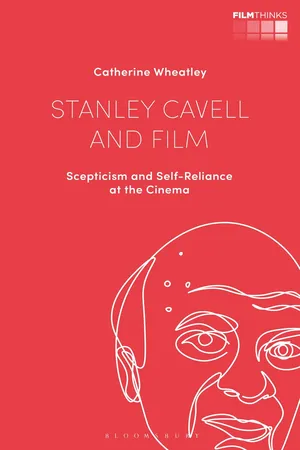
"Film is made for philosophy," asserted Stanley Cavell. In addition to his work on scepticism, morality, and the intentions and meanings of ordinary language, the American philosopher wrote fascinatingly about cinema, arguing that film can reveal new ground for thinking through old philosophical problems.
In this book, Catherine Wheatley draws upon Cavell's explicitly film-inspired works, key philosophical concepts and autobiographical writings, examining his analyses of films from Hollywood's Golden Age, the French New Wave, contemporary action cinema, silent film heroes Chaplin and Keaton, directors Cocteau and Hitchcock, and performers Greta Garbo and Ginger Rogers. Revealing the ways in which Cavell's thinking was shaped by the movies, Wheatly poses the question: what was it about film that taught the philosopher how best to live in the world?
- 320 pages
- English
- ePUB (mobile friendly)
- Available on iOS & Android
eBook - ePub
About this book
Information
1
A Life in Movies
By my way of thinking the creation of film was as if meant for philosophy – meant to reorient everything philosophy has said about reality and its representation, about art and imitation, about greatness and conventionality, about judgement and pleasure, about scepticism and transcendence, about language and expression.
– Stanley Cavell, Contesting Tears
Stanley Cavell was born Stanley Goldstein in Atlanta, Georgia, in 1926, the only son of two immigrants. His mother, a professional pianist of local repute, played on the radio, at the vaudeville and during intermissions at the Fox Movie Theatre. His father was a shopkeeper-cum-pawnbroker and – importantly – a consummate raconteur (but also, in the words of Cavell’s mother, ‘a serious man’). The young Cavell seems to have been quite fascinated by his mother, who often worked late and who he suspected had sacrificed a career as a concert pianist to raise him. She recurs as a touchpoint throughout much of his work (as, too, does his father, but in a rather different, less poetic manner) and is, perhaps, the prototype of the Unknown Woman who Cavell writes about in relation to Hollywood melodramas of the 1940s and 1950s, a subject considered in detail in Chapter 5 of this book.
But back to young Stanley, growing up during the Great Depression, following his parents as they moved, several times, between Atlanta and Sacramento, California. According to Cavell, his family would go to the films ‘quite religiously’. In fact they attended twice a week, an activity that must have afforded a small amount of consistency amidst a rather peripatetic childhood.1 Cavell was by his own admission a precocious child and was skipped two grades at school during first grade, a custom that he describes as ‘absolutely destructive’ to his social and psychological life. School was particularly painful: the young Stanley’s clothes were never quite right; he failed to understand the jokes being made at his expense. Tellingly, perhaps, one of the few positive experiences he recounts comes courtesy of a young English teacher who gave the class as a writing assignment the reviewing of a film: Hold Back the Dawn starring Charles Boyer and Olivia de Havilland (Mitchell Leisen, 1941). The teacher’s praise for Cavell’s work seems to have had a lasting effect, informing his imagination ‘of the permanent effects an act of acknowledgement may have’.2
His adolescence was thus isolating, ‘helplessly lonely’ in his own words, the only respite coming from cinema and – via his involvement in a band – music, and sometimes the two together, as when he would visit the cinema with his bandmate Bob Thompson: ‘looking forward as much to the conversation afterward as to the film’.3 He was only sixteen when he headed off to Berkeley in 1943 to take his BA in Music, shortly after taking the decision to change his name to Cavell, an anglicization of his family’s original Russian name, Kavelieruskii (changed at Ellis Island).4 Cavell graduated in 1947. But when he moved to New York to study composition at Juilliard the following year, he felt too old to begin a career as a composer. Unmoved by his classes and sensing that music was not lost to him but would no longer be his career, he started ‘playing hooky’ by going to at least two films a day, a practice that would prove formative.
In 1948, he returned to California to enrol as a student at UCLA, first in psychology, then in philosophy. Here he met a visitor from Harvard, Morton White, who suggested that Cavell apply to Harvard. At Harvard, he attended a series of lectures given by the Oxford-based philosopher J.L. Austin. He describes the encounter with Austin – who came to Harvard to deliver a series of lectures in 1955 – as the decisive encounter of his life, describing the moment as one where ‘I found the beginning of my own intellectual voice’.5 Cavell put this voice to the test in dialogue with colleagues and fellow philosophers such as White, Thomas Kuhn and Bernard Williams. Friendship was, and continued to be, important to Cavell as a means of developing his ideas about what philosophy should be and how one should live a philosophical life. Important, too, was the meeting of minds constituted by the best marriages. Cavell met Marcia Schmid, who was to be his first wife and the mother of Cavell’s daughter Rachel, around the same time as he embarked upon his path towards becoming a professional philosopher. Their short-lived marriage ended in divorce in 1961 for reasons that Cavell, in his 2010 memoir, fails to fully fathom but which had to do, he senses, with the fact that although ‘we seemed to share everything, friendship, philosophy, music … Our minds were not freely given’.6 Such a failure to give freely of oneself to another, to meet as equals on some common ground, is a failure that Cavell understands as both personally and philosophically devastating. The question of what makes for a successful marriage is one that lies at the heart of his work on screwball comedy, to which we will turn in Chapter 4. Happily for Cavell, in 1964, shortly after accepting a tenured position at Harvard, he met Cathleen Cohen, a student reporter for the Harvard Crimson, and the pair were married in 1967. They were still married at the time of Cavell’s death in 2018 and have two sons, Benjamin (born 1976) and David (born 1984).
It was while struggling to write his PhD thesis (finally submitted in 1961) that Cavell, at the end of his tether one night, saw Bergman’s Smiles of a Summer Night and hurried home to dash off an essay describing its effect upon him. Around this time he began, once more, to visit the cinema, watching films regularly again: now some Godard, Fellini, Resnais, Antonioni.7 Upon his appointment at Harvard, Cavell was assigned a general philosophy course to teach, ‘Ideas of Man and the World in Western Thought’. The reading list he inherited features all the canonical classics: Machiavelli’s The Prince, Luther’s Preface to the Letter of St. Paul to the Romans, Descartes’s Meditations and Locke’s Second Treatise of Government; Hume’s Dialogues on Natural Religion, Kant’s Groundwork of the Metaphysics of Morals, Mill’s On Liberty and Nietzsche’s The Birth of Tragedy (many of which will pop up, in various manners, throughout Cavell’s later work). But Cavell, determined to drag the course into the twentieth century, and determined not to let the twentieth century be represented by works of philosophy that lacked ‘influence’ or ‘value’, opted to end with a film, which in his words worked ‘pedagogical wonders’. So when he was asked to also deliver a course in philosophical aesthetics, he opted to focus on film here, too. Cavell explains his motivation for this – at the time – rather unorthodox decision in his autobiography, Little Did I Know:
I found little charm in analytical aesthetics. I had never been convinced by the ways I had managed to bring that strain of contemporary English-speaking philosophy and the individual arts into the classroom together, let alone my writing. Individual works in the arts never seemed for my taste to talk back sufficiently to philosophy … to make philosophy look at its own limitations, its own dependence on literary conditions. What the best or most influential literary critics in English (T.S. Eliot, William Empson, I.A. Richards, Kenneth Burke, R.P. Blackmur, Robert Penn Warren, Paul Goodman) had been saying about works of literature remained to my mind incomparably more interesting, and indeed intellectually more accurate, than the competing provisions of analytical philosophy […] Art historians (for example, Panofsky, Wölflinn) supplied their own philosophy that philosophers whom I knew did not improve upon. The analysis of music was, in my experience … done best by composers, and in any case assumed a basic knowledge of harmony and classical forms that would have left nonmusicians out of the picture. It was from this sense of pedagogical impasse that I came to the idea of experimenting with what could be said about film, a field in which new work, by directors and writers in France and Italy and Sweden and Japan, had brought new consciousness and interest to the international art of cinema, at a time when American film seemed to shrink before the competition of television.8
Historical context
Cavell’s work on film arises, then, from a very specific context. Firstly, it comes out of a philosophy department. It is the work of a philosopher who is interested in film (rather than, say, a film scholar who is interested in philosophy). His approach to the subject is indeed rather ironic given Cavell’s own insistence in the above passage that it is the experts in literature, art and music who write best about their subjects, rather than interlopers from his own discipline. This irony has not been lost on Cavell’s critics, a point to which I will return when I come to consider the reception of Cavell’s work. Secondly, it emerges from a North American, academic, context at a time when comparatively little intellectual work on film had been written in or translated into English. In both his autobiography and his writing on film Cavell himself acknowledges that figures such as Sergei Eisenstein, Walter Benjamin, Erwin Panofksy and André Bazin had already written ‘fresh and free’ treatments of film, but they were hardly well known amongst US scholars (Bazin’s What Is Cinema? was not translated into English by Hugh Gray until 1967). In fact the only other American writer on film Cavell refers to in his first essays on film is the critic James Agee, although there were others working in the field – Andrew Sarris’s ‘Notes on the Auteur Theory’ was published in 1961, for example. Thirdly, Cavell begins writing on film at a point when, as he notes, the American cinema, or at least Hollywood cinema, was in the doldrums, while the European cinemas, including the French New Wave and Italian Neorealism, were enjoying a golden age. Finally, if the seed that was to grow into Cavell’s extensive writing on film was born with his late-night scribblings on Smiles of a Summer Night, it was nurtured and took root in a classroom at Harvard, where Cavell was facing ‘fellow citizens of mine’ to whom ‘anything could be said that I found it worth saying and felt that aspirants to democracy should gladly hear, on the condition that I took pains sufficient to say it, as talent allowed, lucidly and provocatively’.9
Each of these factors would have an impact on Cavell’s approach to film as well as to his selection of particular movies. But it is perhaps just as important that Cavell’s first thorough-going engagement with film, inspired in part by a restiveness with philosophy’s avoidance of human experience, coincided with the festiveness that marked the move to a new, permanent job and the start of his academic career in earnest (as well as, of course, the beginning of a new love affair). Cavell’s first engagement with film is marked by a sense of giddiness, of possibility – a brave new world opening up. It certainly presaged a glut of productivity. Cavell published his first book, Must We Mean What We Say?, in 1968, and two years later The World Viewed: Reflections on the Ontology of Film was released. One year after that came yet another book: on the philosopher Henry David Thoreau, The Senses of Walden. Thoreau, though widely read at the time, had yet to receive any extended attention, so Cavell was breaking ground on two fronts: by writing the first serious book produced within the context of North American academia, and the first serious book on Thoreau. The two interests would eventually collide, as I will examine in greater detail by and by, in Cavell’s subsequent books on film: Pursuits of Happiness: The Hollywood Comedy of Remarriage (1981) and Contesting Tears: The Hollywood Melodrama of the Unknown Woman (1996), as well as in Cities of Words: Pedagogical Letters on a Register of the Moral Life (2005), a book that weaves philosophy and philosophical accounts of literature with studies of films to provide a moral articulation of a democratic society. Cavell has also written essays on television and video and on specific films, many of which are gathered together in a collection edited by his former student William Rothman, called Cavell on Film (2005). While these works do not form a strict and unified system, there are deep connections between them.10 There are also connections between them and Cavell’s philosophical work broadly, and it will be one aim of this book to sketch out some of these connections.
The avoidance of Cavell
At the time of its release, The World Viewed was not particularly well received. Responses ranged from polite bafflement to Leo Braudy’s damning review of it as a ‘little book designed to make anyone interested in good film criticism very unhappy’.11 Today, it has become something of a truism that Cavell is overlooked and under-appreciated by the scholarly community, and in particular the Film Studies community. Several articles and at least one entire book12 exist devoted to examining the question of why it is that Cavell’s work has been, to borrow a term from Garrett Stewart, ‘avoided’ for so long.13 Or, as Russell B. Goodman puts it, why it is that while Cavell is a major figure within several disciplines, people ‘don’t quite know how to use’ his work.14 Michael Fischer’s 1989 book Stanley Cavell and Literary Skepticism investigates the grounds of neglect in the specifically literary reception of Cavell, which he believes stems from the neoscepticism at its base.15 Stephen Melville, writing in 1993, locates the disregard for Cavell on four fronts, by which he is positioned as ‘a maverick figure within the American philosophic academy, an obscure register of mainstream contemporary film theory, an odd man out with respect to the current literary theoretical orthodoxy, and, I imagine, a figure of retrograde enthusiasms to a community of Americanists largely in flight from New Critical canonization’.16 Timothy Gould’s 1998 book Hearing Things perhaps gets to the crux of the problem, however, suggesting that perhaps the biggest obstacle facing readers of Cavell is not methodological, but stylistic.17
Cavell is considered notoriously difficult to read, and with good reason. On the one hand, he is committed to the ordinary, and to communicating his ideas as clearly and lucidly as possible, always with an eye to encouraging his reader to better understand how he sees the world. To write – to write for someone – is in short to attempt to overcome the problem of scepticism, an issue that goes to the heart of Cavell’s philosophy. For Cavell, then, much is at stake in the act of writing. But there is a sense in which his writing constantly struggles under this effort. In Garrett Stewart’s words, ‘Cavell’s diction is straightforward enough, no technical argot, and the syntax much of the time cadenced not unlike speech, but it all comes at us with a heft and velocity that transfigures the ordinary’.18 Numerous critics point to the opening paragraph of The Claim of Reason, which consists of just two sentences, one of which is two hundred words long, as an example of such laboriousness.19 One adjective used time and again is ‘dense’; another is ‘weighty’. Every word seems so carefully chosen, every subclause (and there are many!) so laboured, so deliberate. The burden transfers itself to the reader, who in turn finds herself struggling under its load.
Hand in hand with Cavell’s idiosyncratic prose style goes a deliberate lack of distinct or rigorous argument, a lack that springs from Cavell’s commitment to finding words adequate to convey an experience (of philosophy, of theatre, of art, of film), rather than to per...
Table of contents
- Cover
- Halftitle Page
- Title Page
- Contents
- List of Figures
- Acknowledgements
- Introduction
- 1. A Life in Movies
- 2. Everything Matters
- 3. Screening Scepticism
- 4. Acknowledgement, Other Minds
- 5. Self-Reliance
- 6. Perfectionism, Friendship, Education
- 7. Love’s Work
- Postscript: The End. The Beginning
- Notes
- Bibliography
- Index
- Imprint
Trusted by 375,005 students
Access to over 1.5 million titles for a fair monthly price.
Study more efficiently using our study tools.
Frequently asked questions
Yes, you can cancel anytime from the Subscription tab in your account settings on the Perlego website. Your subscription will stay active until the end of your current billing period. Learn how to cancel your subscription
No, books cannot be downloaded as external files, such as PDFs, for use outside of Perlego. However, you can download books within the Perlego app for offline reading on mobile or tablet. Learn how to download books offline
Perlego offers two plans: Essential and Complete
- Essential is ideal for learners and professionals who enjoy exploring a wide range of subjects. Access the Essential Library with 800,000+ trusted titles and best-sellers across business, personal growth, and the humanities. Includes unlimited reading time and Standard Read Aloud voice.
- Complete: Perfect for advanced learners and researchers needing full, unrestricted access. Unlock 1.5M+ books across hundreds of subjects, including academic and specialized titles. The Complete Plan also includes advanced features like Premium Read Aloud and Research Assistant.
We are an online textbook subscription service, where you can get access to an entire online library for less than the price of a single book per month. With over 1.5 million books across 990+ topics, we’ve got you covered! Learn about our mission
Look out for the read-aloud symbol on your next book to see if you can listen to it. The read-aloud tool reads text aloud for you, highlighting the text as it is being read. You can pause it, speed it up and slow it down. Learn more about Read Aloud
Yes! You can use the Perlego app on both iOS and Android devices to read anytime, anywhere — even offline. Perfect for commutes or when you’re on the go.
Please note we cannot support devices running on iOS 13 and Android 7 or earlier. Learn more about using the app
Please note we cannot support devices running on iOS 13 and Android 7 or earlier. Learn more about using the app
Yes, you can access Stanley Cavell and Film by Catherine Wheatley in PDF and/or ePUB format, as well as other popular books in Media & Performing Arts & Film History & Criticism. We have over 1.5 million books available in our catalogue for you to explore.