eBook - ePub
Music, Memory and Memoir
- 264 pages
- English
- ePUB (mobile friendly)
- Available on iOS & Android
eBook - ePub
Music, Memory and Memoir
About this book
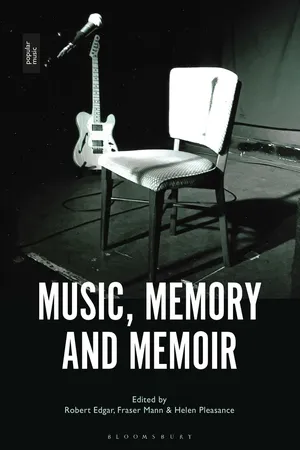
Music, Memory and Memoir provides a unique look at the contemporary cultural phenomenon of the music memoir and, leading from this, the way that music is used to construct memory. Via analyses of memoirs that consider punk and pop, indie and dance, this text examines the nature of memory for musicians and the function of music in creating personal and cultural narratives. This book includes innovative and multidisciplinary approaches from a range of contributors consisting of academics, critics and musicians, evaluating this phenomenon from multiple academic and creative practices, and examines the contemporary music memoir in its cultural and literary contexts.
Information
Part One
Readings
1
Hiatus: Music, memory and liminal authenticity
Let’s open our Melody Maker and scan the list of the Top Twenty: of the recordings which have had the highest sales to our fellow-countrymen and women. What will it tell us of their tastes and dreams? In the week I write this, plenty … modern troubadours are teenagers, and the reason’s not too far to seek: the buyers are teenagers, too. (MacInnes 1961: 49)
Colin MacInnes, writing for Twentieth Century in 1958, documented the birth of the teenager in the UK and with this the emergence of recorded popular music as a mass commodity. Much has been written about the emergence of ‘the teenager’ as a concept and teenagers as an identifiable grouping and their relationship to popular music and the subsequent variety of related subcultures. This is significant in a number of fundamental ways that have an impact on the relationship between individual (what might be crudely identified as personal) and shared/cultural memory. This is furthered by the birth of pop music still being, just, within living memory. MacInnes identifies that, from the advent of rock and roll, there has been an alignment of producer and consumer. This raises questions about the formation of our identity in adolescence and whether there is an initial alignment. The presupposition is that we follow the bands and performers we grew up liking due to a nostalgic drive, or perhaps because we never really become adult. However, recent research has identified that there is the potential for neurological as well as cultural resonances of the music (and associated artefacts) we consume in our youth. When I was growing up it was still common to see middle-aged men traversing the streets dressed as Teddy Boys. They seemed so old, so lost in time and we seemed cutting edge in our post-punk/indie attire, not recognizing it, at the time, for the uniform it was. But it provided localized identity forged in youth. The suggestion that this is not simply a function of nostalgia is important. The drive to continually buy Adidas trainers, plaid shirts and Harringtons, while listening to The Pastels and BMX Bandits on a loop, is more than a clinging to an ever more quickly disappearing youth. The 1960s revival gang shows that tour the seaside towns of Britain have been joined by indie-focused 1990s Shiiine On and Indie Daze one-day events, mini-cruises and festivals at Butlins holiday camp in Minehead. These events reunite and in doing so provide a continuum.
The term hiatus has crept in to common parlance as a way of describing a band reforming or a performer coming out of retirement. What was, perhaps, seen as a final act – the break up – is now arguably seen as a pause, a gap in time but one where a continuum is implied and potential to continue exists. In these terms there is currency in the adherence to something that is present and this problematizes what might otherwise be seen as an act of nostalgia. The reformation is inevitable. That there will be a ready audience for bands/performers is a given, and it is easy to suggest that this is due to financial gain and/or a ready nostalgia market. Whilst this might be true for some performers or might be a by-product of their desire to continue performing, there are many other artists/groups who perform without lucrative financial rewards. In his early discussion of the origins of rock and roll, MacInnes uses the term troubadour. The etymology of this phrase suggests that this is where the writer and performer is often the same person. This classical allusion also implies satire in terms of social commentary and, therefore, substance in confirming a sense of identity. From its origins this form of popular music is one that documents society and comments on itself through form and content. This is perhaps why Simon Reynolds (somewhat playfully) identifies 1963 as the starting point: ‘Rock ‘n’ roll in the fifties sense was both rawer and more showbizzy; 1963, the year of The Beatles, Dylan, The Stones, is when the idea of Rock as Art, Rock as Revolution, Rock as Bohemia, Rock as a Self-Consciously Innovative Form really began’ (2011: 403). This suggests an early distinction between that which is thoughtful, reflective, aware or transformative and that which is simply commercial, disposable and transitory. This last definition of transformative focuses on reception as much as it does on production. It is the well-considered argument that meaning, and with it socio-cultural function, is generated between the text (artefact) and the person consuming that artefact. In these terms it is as possible for a stadium behemoth such as Fleetwood Mac, with their origins in the 1960s British blues boom, to have been as transformative as the Dead Kennedys or Take That to have been as formative in creating a sense of youthful connection as, for instance, the Senseless Things. The substance lies in their reception and other associations made by an audience. The implication is that this is linear; association with a band or artist forms as memory at the intersection between a band’s emergence in popular culture and where you encounter them at the same historical moment. This is certainly the case for some individuals, but this simply connected timeline does not capture the broad function of the relationship with popular music and memory. Some of this comes from the reach of the form beyond music simply as a sonic experience. The playful part of Reynolds’s discussion of 1963 as the year of his birth; linear time then seems to always function not as a measure but rather as a structuring device.
Perhaps inevitably there has been a tendency to treat popular music as a purely commodified form, with respectful analysis focused on the subcultures that in some ways tend to rally against what might be seen as the dominant: music as simply an industrial form. The trend has led to sociological analysis of the origin of the teenager in the 1950s and the development of the subculture reaching its zenith with punk in the 1970s. The predominance of the texts available from Dick Hebdidge (1979) onwards and the development of a variety of subsequent research networks confirm this. These approaches tend towards an analysis of the collective and, therefore, the individual’s inclusion within that collective. More recent analysis has shifted this focus; texts such as Punk Rock, an Oral History (Robb 2006) start to capture the testimony of those that were ‘there at the time’. Those who were involved, complicit, part of the scene and those who started to define it. This marks a shift or perhaps, in reference to MacInnes, a return. The processes of sociological and journalistic comment conflate in providing a reference point for a range of bands/performers including those that were at the height of commercial success. The emergence of the popular music memoir starts to close the gap. It starts to see the artist as ‘real’. The authors are humans discussing aspects of their life away from their music. Often they discuss their life as a fan placing them on a level with those reading the book, making them part of the scene that they also in many ways define. This is the case with books such as Tracey Thorn’s Bedsit Disco Queen (2014), Viv Albertine’s Clothes, Clothes, Clothes. Music, Music, Music. Boys, Boys, Boys (2015) or Tim Burgess’s homage to vinyl and iconic performers, Tim Book Two: Vinyl Adventures from Istanbul to San Francisco (2016). Potential for shared memories is something that is furthered through texts which are formed from diary extracts, such as Miles Hunt’s The Wonder Stuff Diaries 86–89 (2016) or The Wedding Present: Sometimes These Words Just Don’t Have to Be Said (Houghton and Gedge 2017). Hunt’s work references youth scenes we may have experienced and gigs we may have been at: a portrait of the artist as a Grebo. The Wedding Present text draws on memories from fans and fellow performers, drawing on our memories and re-presenting them back to us and to a wider audience. The advertising notes on The Wedding Present’s website identifies that: ‘The book gives a real insight in to what it’s like to attract – or become one of – a coterie of passionate fans who have followed the group since the beginning. Many have fallen in love with – and to – the band’s music. As one fan describes it, “They have been the soundtrack to my life”’ (Scopitones.co.uk, n.d.).
This triage of approaches – sociological, historical and personal – creates an intersection where experience is at once personal and collective and where popular music treads the liminal space between the two.
The nature of our memories, as defined by popular music, might easily be seen as trivial; the alignment with a popular cultural or commodified form could easily drive this perception. Discussion of transitory moments in rundown venues seeing obscure bands or queuing outside record shops waiting for the new release might be seen as youthful folly or a moment of experience without fundamental value. How value is ascribed to moments such as this requires consideration regarding what value systems are being applied and, the question remains, value in relation to what? Denis Dutton differentiates between expressive and nominal authenticity as systems of classification, recognition and, from this, of ascribing forms of value (2003). This meta-classification considers perceptions of originality and fake (in Dutton’s terms) as the basis for this process of classification. The sense of the original having a time frame is, in these terms, fundamental in legitimizing not an experience but the memory of that experience and with it the holder of the memory. The artefacts of popular music serve as cultural signifiers and with them the nature of time can be specific – a record release or a performance happened at a given time and place and this confers a level of providence. Music provides a structure to experience in that it emerges in a particular time and has particular connotations. This confers authority on the text due to it being genuinely of a moment in time. With this comes (in Dutton’s terms) a sense of expressive authenticity; the music was there at that moment and so the individual intersects with a cultural phenomenon. However, the cultural ‘event’ is a status that is invoked in hindsight. The small crowd that attended the Sex Pistols at the Manchester Free Trade Hall was going to see a small gig, probably because local heroes Buzzcocks organized it. The status of the gig is built in the subsequent canonization of the Sex Pistols as a group and their function in representing punk as a movement. For the individual this moves from nominal authenticity in the moment of engaging with the musical artefact to expressive authenticity in recounting the act. This becomes expressive authenticity when it intersects with the discourse of popular music as expressed through popular memory (newspaper reports, popular journalism, documentary, etc.). For example, seeing The Hoverchairs in 1990 in the Doncaster Toby Jug remains nominally expressive in being representative of a scene and a venue, particularly in respect of the rituals that are associated with it. Dutton cites ritual as a validating part of the process of identifying authenticity. In viewing an obscure band in a dilapidated (and sadly long gone) music venue in a northern British town this might include wearing Doctor Martens, a Smiths t-shirt, an army Parka, Levi 501s, drinking snakebites and dancing in dim light in a strange shuffling motion. (These indie music rituals are considered in Empire of Dirt (Fonarow 2006).) This is where there is an additional level of complexity. The eclectic mixing of the artefacts of individual memory compounds the authentic function of the event. However, these levels of authentic expression are problematized when shared and the artefacts of memory which, in popular musical terms, are generally shared. In these terms there has always been a play between the commodified and the personal.
The True Faith exhibition in Manchester in 2017 presented artefacts relating to Joy Division and New Order. The range of objects and images used testify to the complex relationship we have with the various aspects of popular music. This sharing takes on different forms, including the sharing of items within a particular sub-group of friends (which we might define as personal), the sharing of items within a subculture (which extends the reach of the artefact) and the sharing of the artefact at a national or international level, for instance with a record or a video. The presentation of Peter Saville’s album cover art alongside Rob Gretton’s notebooks, alongside a Parka with a New Order album cover hand-painted on the back exemplifies these complex relationships. There is a related and inevitable authentic battle for the individual where these artefacts exist in the same space and yet are of a different order. Their functions as signifiers of cultural memory are varied. Arguably, the albums are universal and their reproduction over time spreads their impact. Ian Curtis’s handwritten lyrics for ‘Love Will Tear Us Apart’ appear to have a different status and the exhibition played with the concept of art in reifying the art object and the artist in the deification of Curtis. The lyrics were the last exhibit presented and were displayed behind glass. The tiny piece of paper took on the aura of the Mona Lisa; or perhaps had much more significance than that. Prior to this, the exhibition engaged us as audience, we had seen objects that we likely own and more than likely have shared with others before being allowed to see (but not photograph) the holy relic. The experience was of seeing the originating point, an object which is expressively authentic, an object which has providence conferred not by its location in the gallery or even as an aesthetic object in its own right but by its cultural significance as a piece of recorded and replicated music. Despite this, the other objects within the space give way in the presence of this ‘original’ to liminality where they function within and without private space. Deborah Curtis’s Touching From a Distance: Ian Curtis and Joy Division (2005), Bernard Sumner’s Chapter and Verse: New Order, Joy Division and Me (2015) and Peter Hook’s Unknown Pleasures (2016) all provide context and expose a perceived reality of Joy Division and Ian Curtis which collapse in respect of that which is expressively authentic. The power of this form of authenticity is palpable, in seeing New Order perform at Liverpool Olympia on 22 November 2015 the encore was preceded by an iconic image of Curtis above the stage. The black and white image of him smoking a cigarette drew a reverent hush from an otherwise excited and boisterous crowd who were reeling from a Hi-NRG performance of a range of tracks. The quiet remained as the crowd watched, still, as Anton Corbijn’s video was projected while the band played ‘Ceremony’. This is where, outside the safety of the gallery, the experience exists as liminal authenticity – it exists in reference to that which has providence, but only (to borrow a title) touching at a distance.
Conway and Loveday discuss this phenomenon in relation to neurological functioning and identify a similar conflation of the personal and the collective. In these terms the process of inhabiting what might be determined a collective and individual past is biological in function:
Autobiographical memory contains autobiographical knowledge, e.g. personal factual knowledge and cultural knowledge, such as the history of our times. It also contains episodic memories, e.g. fragmentary knowledge derived from experience … As such it forms a major part of the self … episodic memories are part of general events which in turn are part of lifetime periods which may themselves be part of broader themes such as work or relationship themes and the life story. (2015: 574–5)
Meaning is then generated for the individual who holds that memory – the memory serves a function for the individual who both generates and receives that memory. Conway and Loveday extend their argument to discuss the idea of the memory cue where indirect associations in effect trigger memories. In music terms this can, for i...
Table of contents
- Cover
- Halftitle Page
- Title Page
- Dedication Page
- Contents
- List of illustrations
- Notes on contributors
- Introduction
- Part 1: Readings
- Part 2: Recollections
- Index
- Imprint
Trusted by 375,005 students
Access to over 1.5 million titles for a fair monthly price.
Study more efficiently using our study tools.
Frequently asked questions
Yes, you can cancel anytime from the Subscription tab in your account settings on the Perlego website. Your subscription will stay active until the end of your current billing period. Learn how to cancel your subscription
No, books cannot be downloaded as external files, such as PDFs, for use outside of Perlego. However, you can download books within the Perlego app for offline reading on mobile or tablet. Learn how to download books offline
Perlego offers two plans: Essential and Complete
- Essential is ideal for learners and professionals who enjoy exploring a wide range of subjects. Access the Essential Library with 800,000+ trusted titles and best-sellers across business, personal growth, and the humanities. Includes unlimited reading time and Standard Read Aloud voice.
- Complete: Perfect for advanced learners and researchers needing full, unrestricted access. Unlock 1.5M+ books across hundreds of subjects, including academic and specialized titles. The Complete Plan also includes advanced features like Premium Read Aloud and Research Assistant.
We are an online textbook subscription service, where you can get access to an entire online library for less than the price of a single book per month. With over 1.5 million books across 990+ topics, we’ve got you covered! Learn about our mission
Look out for the read-aloud symbol on your next book to see if you can listen to it. The read-aloud tool reads text aloud for you, highlighting the text as it is being read. You can pause it, speed it up and slow it down. Learn more about Read Aloud
Yes! You can use the Perlego app on both iOS and Android devices to read anytime, anywhere — even offline. Perfect for commutes or when you’re on the go.
Please note we cannot support devices running on iOS 13 and Android 7 or earlier. Learn more about using the app
Please note we cannot support devices running on iOS 13 and Android 7 or earlier. Learn more about using the app
Yes, you can access Music, Memory and Memoir by Robert Edgar, Fraser Mann, Helen Pleasance, Robert Edgar,Fraser Mann,Helen Pleasance in PDF and/or ePUB format, as well as other popular books in Social Sciences & Music Biographies. We have over 1.5 million books available in our catalogue for you to explore.