Through a wide-ranging selection of essays representing a variety of different media, national contexts and critical approaches, this volume provides a broad overview of the idea of work in modernism, considered in its aesthetic, theoretical, historical and political dimensions.
Several individual chapters discuss canonical figures, including Richard Strauss, Joseph Conrad, Virginia Woolf, Franz Kafka and Gertrude Stein, but Modernist Work also addresses contexts that are chronologically and geographically foreign to the main stream of modernist studies, such as Swedish proletarian writing, Haitian nationalism and South African inheritors of Dada. Prominent historical themes include the ideas of class, revolution and the changing nature of women's work, while more conceptual chapters explore topics including autonomy, inheritance, intention, failure and intimacy.
Modernist Work investigates an important but relatively neglected topic in modernist studies, demonstrating the central relevance of the concept of "work" to a diverse selection of writers and artists and opening up pathways for future research.
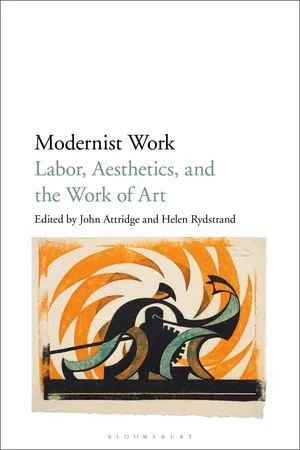
eBook - ePub
Modernist Work
Labor, Aesthetics, and the Work of Art
- 232 pages
- English
- ePUB (mobile friendly)
- Available on iOS & Android
eBook - ePub
Modernist Work
Labor, Aesthetics, and the Work of Art
About this book
Information
Part I
THE WORK OF ART
Chapter 1
THE ABSOLUTE AND THE IMPOSSIBLE WORK: FRANZ KAFKA’S “THE BURROW”
Robert Buch
One of the preferred targets of the avant-garde’s cheerful and occasionally triumphalist iconoclasm was undoubtedly the category of “work,” both in the sense of the artwork and in that of the activity aimed at producing it. What came under attack as the category of work was dismantled were, on the one hand, the putative ideals underlying it, notions of coherence, closure, unity, and self-sufficiency, in short, the artwork’s lofty detachment and self-contained character. On the other hand, the iconoclastic critique, according to the well-known thesis of Peter Bürger’s classic Theory of the Avant-Garde, aimed at the special status accorded to the work of art, the bourgeois sacralization of art, its removal and isolation from the spheres of everyday life and everyday practice.1 Against the institutional seal, both in the sense of consecration—the stamp of approval conferred by cultural authorities and the institutions of art—and in the sense of sealing art off by placing it in a circumscribed domain, the protagonists of the avant-garde advocated more permeable boundaries between work and beholder, art and audience, unsettling the latter’s expectations and presumed complacency. In Bürger’s account this effort amounted to nothing less than revoking the autonomy of the artwork and collapsing the boundary between art and life. The ideal of disinterested contemplation was to be replaced with a sense of exposure and disquiet on the part of the spectators; passive receptivity would yield to more unsettling and possibly transformative experiences.
Equally under attack was the work of the artist, her creative labor and the related notions craftsmanship, discipline, practice, and virtuosity. These characteristics had to give way to less elevated, less controlled, and more spontaneous modes of creation: opening the door to chance, contingency, and violence as important elements in the creative process. Ironically, the modernist clearing operation also swept up the opposite of the traditional values of craftsmanship and skill, namely the ideas of genius and inspiration, replacing them at times with a more sober and cerebral approach, at times with more exalted and visceral conceptions.
The avant-garde’s iconoclastic impulse was not pervasive, however. As a matter of fact, some paradigmatic modernist artists and writers stuck to the notion of work in a rather emphatic manner. Once more, I think, in the double sense of the term, work as in the single and singular artwork (less in the sense of an entire oeuvre) and “work” in the sense of the creative activity, the effort required to bring the artwork into being, to make it appear. It is an activity that is typically experienced as difficult, the hard work that is necessitated by the fact of resistance, whether it be the resilience of the material or the elusiveness of form.
There are many examples of the search for the work and the effort and despair spent on it. Often it is a search for nothing less than the perfect, the ultimate work, the absolute painting, for instance, “the one picture that will annihilate all the other ones,” as Francis Bacon put it in conversation with David Sylvester, but also “the one that sums up all the others.”2 It is a search, though, that is haunted by failure, dogged by a sobering sense of shortcoming, and perpetual self-repudiation. Among the most dramatic accounts of this process are Francis Bacon’s own depictions of his effort to wrest new configurations from the canvas in a peculiar mix of marshaling models from the great tradition of easel painting and of a late-modernist investment in chance and the material properties of oil paint, spurted randomly on the canvas. It is as though Bacon sought to continually thwart his own virtuosity in oil painting by hurling paint on the figures and faces he had just finished and then smudging the paint so as to see what possibilities this technique produces. It comes as no surprise that abandoning and even destroying works would come to be an inevitable part of this procedure. So is an unmistakable repetitiveness and seriality in Bacon’s production, returning to the same motifs over and over, as though to something constitutively unfinishable.
A similar dialectics of achieving the perfect and indisputable work through a process of creation and destruction can be found in James Lord’s fascinating account of sitting for a portrait by the Swiss sculptor and painter Alberto Giacometti or in W. G. Sebald’s story in The Emigrants about the British painter Frank Auerbach.3 Both Giacometti and Auerbach proceeded by painting or drawing over the previous day’s work, adding and erasing at the same time, in an unending effort to capture the appearance that condenses all appearances in one. Whether in Bacon, Giacometti, or Auerbach, it seems as though the ostensibly old-fashioned search for perfection, if still in place, tends to unfold via its opposite: negation, reduction, elimination. The gesture of erasure which appears to be such a typical feature of this effort is at once a deletion that makes room for starting from scratch, as though the perfect work had to be achieved ex nihilo, in a few decisive strokes, and a verdict on the efforts thus far, forcing a new departure. Perfection has its counterpart in repeated failure, the dream of completion and closure never comes to an end but prompts ever-renewed beginnings. And yet, this failure and the seemingly compulsive self-denial accompanying it constitute an approximation of the absolute work flickering through in its ephemeral appearances. It is something like an infinite, an unending approximation because the absolute by definition does not manifest itself in the world of relations and particulars, or if it does, it does so only by repudiation, through denial and withdrawal.
The dynamic sketched here is not limited to the visual arts. In literature too, it is not difficult to think of a number of modernist authors who clung to an emphatic notion of work and an emphatic notion, if not of perfection, then at least of supreme achievement. The two such perfectionists that come to mind immediately are Flaubert and Proust, whose novels, while not necessarily seeking to “annihilate” all precursors and contenders, were nevertheless thought to constitute a kind of summa, a summation of the possibilities of their art: from the former’s livre sur rien to the latter’s œuvre cathédrale. In the first case, it is a work whose accomplishment is supposed to be entirely independent of its apparent subject matter and one that refuses to conform to any worldview or impart any kind of message. Flaubert’s ideal is one of an absolute work in that it has absolved itself from the tutelage of ideas or, in his words, conclusions. In the case of Proust, rather than a book built on, and ostensibly about, nothing, patently oblivious to meaning and content, the ideal work at once encompasses and transcends the world. It is, in short, a book about everything. The novel outlined in the last volume of the Recherche is claimed to subsume, absorb, and sublimate the narrator’s life of trials and tribulations into a vast structure. Like a cathedral, it would synthesize and integrate not only different arts but also organize and connect the different themes and motifs into a coherent unified whole, joining different discourses, genres, and media into a new form of Gesamtkunstwerk.4 But the summative and totalizing gesture at the conclusion of Proust’s novel is misleading. As many critics have pointed out, the closing prospectus of alignment and convergence is strangely at odds with the actual work the reader is about to end and which, they argue, ought not to be mistaken for the one so emphatically invoked on the last pages.5 As is well known, Proust was working on the proofs of the penultimate volume, Albertine disparue, until his last breath. Rather than the relief and redemption adumbrated in the surprising revelation of the work’s climactic finale, written at about the same time as he wrote the first part, Du côté de chez Swann, the penultimate volume seemed to expand uncontrollably, hypertrophically, a searching but also sprawling exploration of the circumstances and ramifications of a separation, the narrator’s lover’s abrupt departure, indeed escape, a loss that clearly defied any closure and integration, eclipsing the triumphant vision of denouement and fulfillment. Here too then we find a curious dialectic between the notion of a definitive and indeed summative achievement and a creative process that turns out to be interminable and all-consuming, undercutting the very idea of the absolute work.
The notion of the absolute, with its unmistakable theological overtones, has a long lineage.6 It encompasses the aspiration of a work, as in Proust’s Recherche, of ultimate breadth and comprehensiveness, an echo of the encyclopedic dream to create works that would be as wide in scope and as abundant in content as the world itself. We have also seen the quasi-Platonic dream of matching the elusive ideal, of painting, in Giacometti, Bacon, and Auerbach, the perfect head, the perfect scream, the perfect portrait, indeed the perfect, that is, the absolute and final painting itself. Then there is the notion of the work that is absolute in terms of its detachment, its radical independence and self-sufficiency, as in Flaubert’s livre sur rien. And there is also, finally, the notion of the artist’s unconditional commitment, the single-minded pursuit of a calling irreconcilable with any other vocation.
In the following, I want to pursue the categories of work and work, of work as consummate achievement and of work as painstaking labor, as an arduous process that requires discipline, dedication, and skill, with regard to the case of another high modernist, Franz Kafka, who seems to fit seamlessly in the paradoxical logic of creation and destruction, the definitive confirmation of creative power and its perpetual revocation. A pattern that gives the distinct impression that self-realization, self-effacement, success and failure are not antithetical but coincide, effecting one another in a peculiar form of reciprocity. The aim is to develop a better understanding of the curious crossing, or concurrence, between the notion of an ultimate accomplishment and its opposite, an almost inescapable sense of defeat. Perhaps this is merely an understandable psychological dynamic of the overly ambitious, part of the myth and self...
Table of contents
- Cover
- Half-Title Page
- Title Page
- Contents
- List of Figures
- Notes on Contributors
- Acknowledgments
- An Introduction to Modernist Work
- Part I: The Work of Art
- Chapter 1: The Absolute and the Impossible Work: Franz Kafka’s “The Burrow”
- Chapter 2: Autonomy, Difficulty, and the Work of Literature in Wyndham Lewis’s Tarr and André Gide’s the Counterfeiters
- Chapter 3: Mimesis and the Task of the Writer for Lawrence and Woolf
- Part II: Artistic Labor
- Chapter 4: Richard Strauss at Work in His Works
- Chapter 5: Stein’s Immaterial Labors
- Chapter 6: Trace and Facture: Legacies of the “Ready-Made” in Contemporary South African Art
- Part III: Representing Work and Workers
- Chapter 7: Joseph Conrad’s Nostromo: Work, Inheritance, and Desert in the Modernist Novel
- Chapter 8: Magic, Modernity, and Women at Work
- Chapter 9: The Disclosure of Work in the Poetry of Ron Silliman
- Part IV: Class Identity and Class Conflict
- Chapter 10: Swedish Social Modernism: The Inward and Outward Turn in Eyvind Johnson’s Stad I LJUS
- Chapter 11: Percussion and Repercussion: The Haitian Revolution as Worker Uprising in Guy Endore’s Babouk (1934) and C. L. R. James’s Black Jacobins (1938)
- Chapter 12: Domestic Holocaust: Michael Haneke’s Intractable Class War
- Afterword: Work, Modernism, and Thinking Through the Aesthetic
- Index
- Copyright
Trusted by 375,005 students
Access to over 1.5 million titles for a fair monthly price.
Study more efficiently using our study tools.
Frequently asked questions
Yes, you can cancel anytime from the Subscription tab in your account settings on the Perlego website. Your subscription will stay active until the end of your current billing period. Learn how to cancel your subscription
No, books cannot be downloaded as external files, such as PDFs, for use outside of Perlego. However, you can download books within the Perlego app for offline reading on mobile or tablet. Learn how to download books offline
We are an online textbook subscription service, where you can get access to an entire online library for less than the price of a single book per month. With over 1.5 million books across 990+ topics, we’ve got you covered! Learn about our mission
Look out for the read-aloud symbol on your next book to see if you can listen to it. The read-aloud tool reads text aloud for you, highlighting the text as it is being read. You can pause it, speed it up and slow it down. Learn more about Read Aloud
Yes! You can use the Perlego app on both iOS and Android devices to read anytime, anywhere — even offline. Perfect for commutes or when you’re on the go.
Please note we cannot support devices running on iOS 13 and Android 7 or earlier. Learn more about using the app
Please note we cannot support devices running on iOS 13 and Android 7 or earlier. Learn more about using the app
Yes, you can access Modernist Work by John Attridge, Helen Rydstrand, John Attridge,Helen Rydstrand in PDF and/or ePUB format, as well as other popular books in Literature & Literary Criticism for Comparative Literature. We have over 1.5 million books available in our catalogue for you to explore.