"The Jeep is as iconic a military vehicle as the Chieftain tank, and this terrific book celebrates it in brilliant style . . . inspiring." —Books Monthly
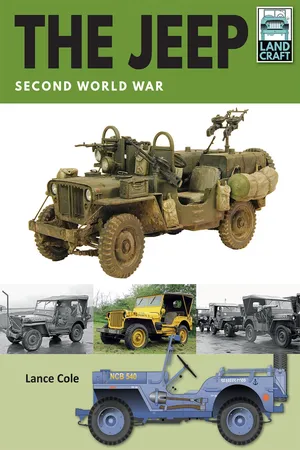
The Second World War Jeep was one of the most famous and influential military vehicles of all time, and over 600,000 were produced. It served with all the Allied forces during the war on every front and it has been the inspiration behind the design of light, versatile, rugged military and civilian vehicles ever since. In this, the first volume in Pen & Sword's LandCraft series, Lance Cole traces the design, development and manufacturing history of the Jeep and describes its operational role within the Allied armies.
A selection of archive photographs showing the Jeep in service in European and Pacific campaigns gives a graphic impression of how adaptable the Jeep was and records the variety of equipment it could carry. The book is an excellent source for the modeler, providing details of available kits, together with specially commissioned color profiles recording how the Jeeps used by different units and armies appeared.
Lance Cole's introduction to the Jeep is necessary reading and reference for enthusiasts and modelers.
"If you are a modeler looking for guidance and inspiration then this book is a must have. Its pages are packed full of jeep goodness, giving tips and ideas for your build. It is also a great read, or coffee-time browser, if you are a vehicle enthusiast or simply love Willys/Ford jeeps and merely want to stimulate your brain and satisfy your eyes." —The OCAD Collection
- 64 pages
- English
- ePUB (mobile friendly)
- Available on iOS & Android
eBook - ePub
About this book
Information
The Jeep in Detail
So evolved the design language and engineering integrity of the Jeep. The core of the new light car-cum-truck was a basic, twin-rail box-section, cross-braced chassis that was strong yet could absorb suspension loads and torsional twist. The chassis was clad in thin, lightweight steel bodywork that offered a fold-flat windscreen that was also quickly detachable. A single layer of paint became the military specification; after all long-life and rust-proofing were hardly wartime design requirements. Under that paint layer, several variations of primer were used. This included ‘Red’ ferrous-oxide-based primer. It is now known that some MB Jeeps dated January and February 1942 have been found with original, zinc-chromate primer on the tub and front wings – so production differences and supplier variations were real despite the standardized design.
The ladder-type chassis was manufactured by the Midland Steel Company, under the simple, steel (not aluminium) body panels would soon be found more power in that derivative of a Willys-designed 2.2-litre (2,199cc), 55bhp (then 60bhp) four-cylinder side-valve engine (with aluminium pistons) which replaced the original Continental-sourced engine of approximately 35bhp that was to be found in the first 2,675 American Bantam Company-built ‘pilot’-specification cars prior to 1941.
The dashboard or fascia saw traditional vital gauges for fuel contents, volts/ ammeter charge, water temperature and of course the largely irrelevant speedometer. The two transfer case/gear levers were to be standardized on the central tunnel beside the gear lever. A three-speed transmission driving all four wheels (or just the rear wheels as the front drive could be locked out by choice for higher-speed cruising), which would reduce mechanical stress and fuel consumption, was offered. A two-speed transfer mechanism and a free-wheeling front axle offered great adaptability. Although probably delivering just less than 65bhp in service, the Willys side-valve engine did offer superb torque of 105lb/ft (142Nm) and delivered it at a very usable 2,000 rpm, offering real mudplugging (and towing) traction abilities ideal for combat terrain the world over. A torque figure of nearly double the horsepower figure indicated a tight, square, strong engine that had great internal efficiency and an excellent drivetrain or transmission to deliver it.
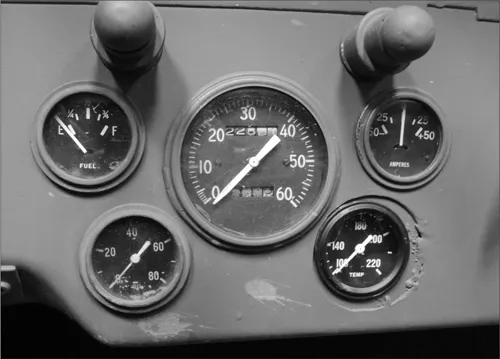
Basic instruments were all that was needed.
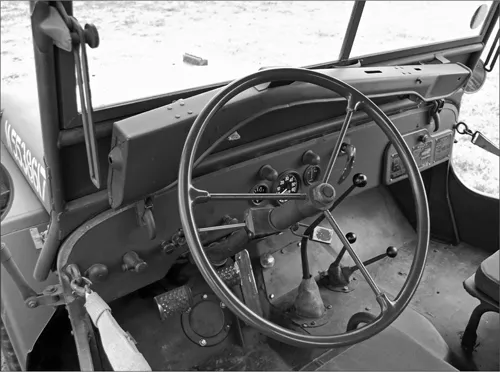
Willys cabin. Note the rifle rack, original lighting switch and location of the gear lever and transfer levers.
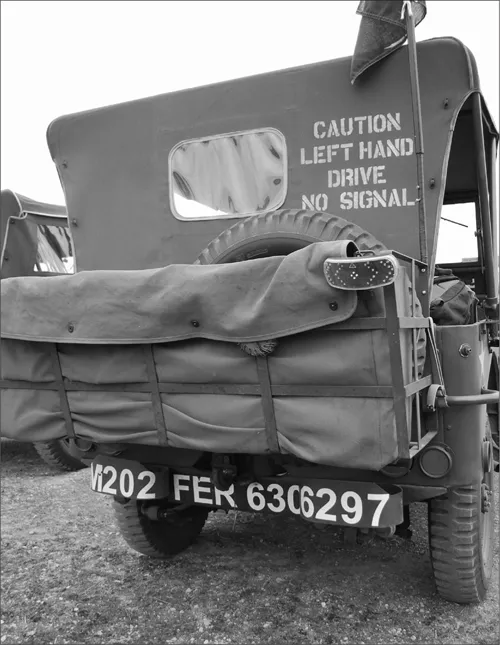
The very useful rear ‘bustle’ cage could carry fuel cans, spares, kit, bicycles, or booze!
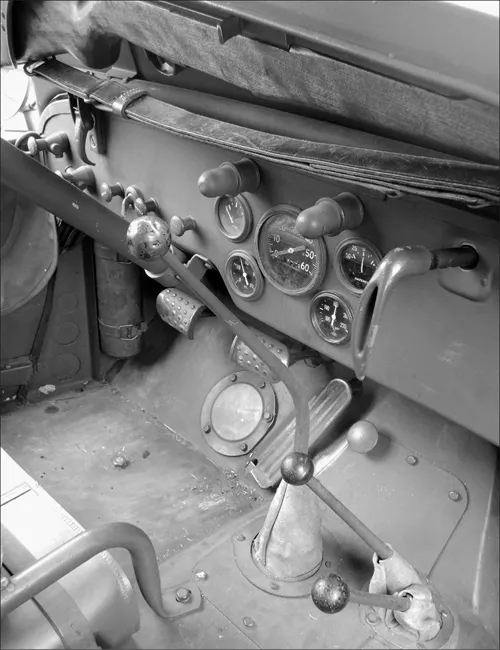
Detail of floor pan and gear levers. Note the left-hand location of the fire extinguisher.
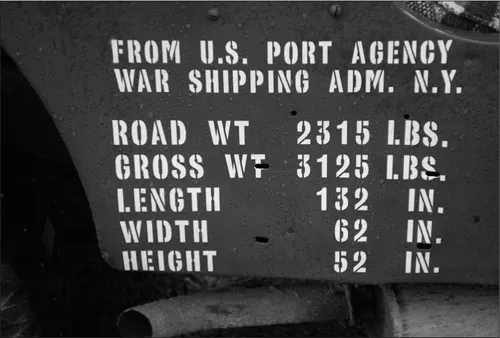
This kind of chassis information was often quickly stencilled onto Jeeps as they were shipped from New York in the war years: it rarely lasted long due to wear and weathering.
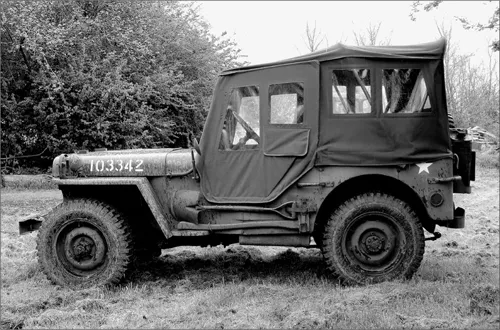
The full, all-weather canvas top with plastic glazed side windows was efficient and kept the winter weather out – vital for troop health and morale.
Interestingly, the Ford-built version of the Willys engine used head-to-block studs instead of bolts. Ford favoured studs and had been building up experience on use of studs in their 21-stud flat-head V8 – eventually using 24 studs.
The three-speed transmission was originally of Borg and Beck type 11123 dry-clutch. Synchromesh was on the first and second gears only. A separate lever engaged/disengaged the front-transmission into the drive-line. Low-range gear ratios were also vital – and another lever.
The suspension was simple and like the rest of the vehicle easy to maintain and repair: leaf springs and dampers suspended the rear axle, and up front a leaf spring/rod set-up offered vital articulation. Telescopic shock absorbers aided rebound and ride control. The suspension reflected 1930s developments and engineering knowledge taken from numerous sources – not least hill-climbing, agriculture, and the ‘Specials’ movement, therefore the handling was firm, with reasonable roll angles, a low centre of gravity, and ‘sporty’ character. The suspension was therefore ‘sporting’ and not with excessive roll angles or wallow despite the large wheel travel and articulation. Oversteer was obvious in the rear-wheel drive-only selection mode, whereas with the full four-wheel-drive engaged, the handling was more neutral and had truer traction.
Of note: the Ford variant used a differing front shock-absorber mounting to the Willys type.
Being hydraulic, the brakes were of saloon-car quality. The hard-compound, all-terrain tyres offered little high-speed grip on a wet road.
The Jeep was only 52 inches (1.32m) high. The fold-flat windscreen would become a well-used feature, not least as it reduced reflection from the upright glass, a giveaway to enemy spotters. Some Jeep units even had specially tailored canvas windscreen covers to mount over the windscreen and its frame to eliminate the chance of reflection from the glass.
The tilt, or hood was made of fabric dyed as close to olive drab as possible, although some beige hoods have been cited. The canvas hood could easily be folded and its steel hoops collapsed. A hood storage locker was supplied in the cabin. The hood’s material was chemically impregnated with a waterproofing compound and with an antimildew substance. Fire-resistance came from chemical treatment, but this had a short life when exposed to the elements.
A strong, welded-steel mounting pintle was placed between the seats to provide a mount for guns or even a rocket launcher/ bazooka. Perhaps by accident, it allowed a large degree of elevation for such weapons.
Of note: after ...
Table of contents
- Cover
- Title
- Copyright
- Contents
- Introduction
- Development & Design
- The Jeep in Detail
- In Service and In Action
- Second World War Jeep Variants
Trusted by 375,005 students
Access to over 1.5 million titles for a fair monthly price.
Study more efficiently using our study tools.
Frequently asked questions
Yes, you can cancel anytime from the Subscription tab in your account settings on the Perlego website. Your subscription will stay active until the end of your current billing period. Learn how to cancel your subscription
No, books cannot be downloaded as external files, such as PDFs, for use outside of Perlego. However, you can download books within the Perlego app for offline reading on mobile or tablet. Learn how to download books offline
Perlego offers two plans: Essential and Complete
- Essential is ideal for learners and professionals who enjoy exploring a wide range of subjects. Access the Essential Library with 800,000+ trusted titles and best-sellers across business, personal growth, and the humanities. Includes unlimited reading time and Standard Read Aloud voice.
- Complete: Perfect for advanced learners and researchers needing full, unrestricted access. Unlock 1.5M+ books across hundreds of subjects, including academic and specialized titles. The Complete Plan also includes advanced features like Premium Read Aloud and Research Assistant.
We are an online textbook subscription service, where you can get access to an entire online library for less than the price of a single book per month. With over 1.5 million books across 990+ topics, we’ve got you covered! Learn about our mission
Look out for the read-aloud symbol on your next book to see if you can listen to it. The read-aloud tool reads text aloud for you, highlighting the text as it is being read. You can pause it, speed it up and slow it down. Learn more about Read Aloud
Yes! You can use the Perlego app on both iOS and Android devices to read anytime, anywhere — even offline. Perfect for commutes or when you’re on the go.
Please note we cannot support devices running on iOS 13 and Android 7 or earlier. Learn more about using the app
Please note we cannot support devices running on iOS 13 and Android 7 or earlier. Learn more about using the app
Yes, you can access The Jeep by Lance Cole in PDF and/or ePUB format, as well as other popular books in History & Military & Maritime History. We have over 1.5 million books available in our catalogue for you to explore.