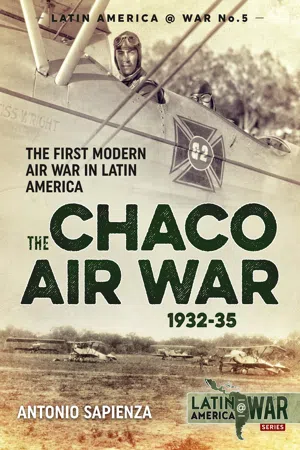
The Chaco War was probably the first "modern" conflict in Latin America where military aviation was widely used in all roles. Bolivia, as the reader will find out, had a very powerful military air force, but unfortunately for them and luckily for Paraguay, its high army command did not take advantage of it. On the other hand, the Paraguayan Commander-in-Chief, General José Félix Estigarribia used military aviation to help him defeat the enemy on the ground, and the result was clear: the Bolivians were expelled from the Chaco after three years of war. Previous publications have focused on the Chaco Air War with the aircraft technical details and almost no information on aerial operations, which is this book's centerpiece. All dogfights and bombing missions mentioned are detailed including crews, aircraft, serials, places and outcomes. The book also describes how both military air forces were organized, how pilots and aviation mechanics were trained, how and where aircraft were purchased and many other unpublished before details. The maps included in the book will help the reader have an idea of where aerial operations took place, both combatants air bases, Bolivia's plan to conquer the whole region and how the Paraguayan Army finally expelled the enemy out of the Chaco. The text is supported by a large number of photographs, and specially commissioned color profile artworks from modelers.
- 80 pages
- English
- ePUB (mobile friendly)
- Available on iOS & Android
eBook - ePub
About this book
Trusted by 375,005 students
Access to over 1.5 million titles for a fair monthly price.
Study more efficiently using our study tools.
Information
Subtopic
20th Century HistoryIndex
HistoryCHAPTER 1
THE THEATRE OF WAR
The Chaco has a length of approximately 1,500 kilometres from north to south and a width of 700 kilometres, making a total area of 1,000,000 square kilometres. This region is divided into three sub-regions: the South Chaco, between the Salado and the Bermejo rivers; the Central Chaco, between the Bermejo and the Pilcomayo rivers, both regions in Argentina; and the North Chaco, between the Pilcomayo, the Otuquis, the Parapití and the Paraguay rivers, the Aguaragué mountain range and the Izozog wetlands, 90 percent in Paraguay and the rest in Bolivia. It was in the North Chaco that the war took place between 1932 and 1935.
The North Chaco is a vast plain without navigable rivers of about 260,000 square kilometres and it is divided into two different regions: the High Chaco, with thick forests and low rainfall, and the Low Chaco, an immense arid prairie with palm trees, grasslands and some estuaries, also with low rainfall. Temperatures in summer normally reach 40–45°C in the shade, and more than 50° in the sun, with hot north winds. In winter, the temperature can easily drop to -3°C at night, with strong south winds. The vegetation is typical of arid zones, with a lot of cacti, which saved many lives during the war because soldiers drank its sap when they did not have access to fresh water.
The diverse wildlife in the zone includes the jaguar, puma, wild boar, crocodile (in the estuaries), many species of snakes, some of them extremely poisonous, and an ample variety of insects and birds. In the deep Chaco, the only inhabitants were the aborigines of different ethnicities, military personnel, and Mennonite settlers, who colonised the central region in the mid-1920s. On the west bank of the Paraguay River, there were many ports where international companies, mainly Argentinean and American, built factories after purchasing millions of hectares of virgin forest to extract the tannin; one of them even built a 145 km railroad that became invaluable for the Paraguayan Army and aviation later. Many have identified the Chaco as the ‘Green Hell’ and almost all agreed that thirst, lack of food and several diseases killed more soldiers than the bullets.

Life at Isla Poí AFB. Clockwise: Captain PAM Carmelo Peralta and Second Lieutenant Obs. Aer. Gonzalo Palau having lunch. A platoon honouring the flag in front of the commander's office and other buildings. Lieutenant PAM Ruffinelli and Urbieta Rojas (centre) studying a map for the next sortie, with three soldiers and Captain Obs. Aer. Job Von Zastrow on the right. A tent used as a pilots' dormitory. (Instituto de Historia y Museo Militar del MDN)

Three Potez 25A.2 bombers at Isla Poí air strip with the personnel assigned to that AFB. (Instituto de Historia y Museo Militar del MDN)
Air navigation in the Chaco was also difficult. From the air, it was like flying over an immense green ocean, with few points of reference. Both military Air Arms had to elaborate maps and pilots had to rely on their instruments because of the lack of radiotelephony equipment on their aircraft. In the case of Paraguay, such equipment was acquired to be used in the Potez bombers, but they were never installed and were used instead as army land equipment. At the beginning of the conflict, logistics was more difficult for Bolivia since its aircraft had to travel at least 1,200 kilometres and cross the Andes to reach its main bases in the Chaco. The Paraguayan Air Arm needed to cover only approximately 300–400 km from Asunción or Concepcion AFB.
Aircraft maintenance was a nightmare for both countries. The dusty environment caused a lot of engine problems, which had to be overhauled more frequently. Most Bolivian planes had air-cooled radial engines, which was an advantage in the Chaco, but the main Paraguayan types had water-cooled ones. During the very low temperatures in winter, water had to be removed from the radiators at night, otherwise it froze. Early in the morning, the radiator water had to be warmed. Minor repairs were carried out in the main air bases in the Chaco, but when major repairs or overhauls were needed, the Paraguayan aircraft were sent to Asunción, and the Bolivian aircraft were sent to Villamontes or Santa Cruz de la Sierra. The rough conditions of the air strips caused many accidents, together with the marginal weather conditions. More airplanes were lost because of those reasons than in air combat or anti-aircraft fire.
Air strips were normally prepared by removing trunks, stones and low vegetation on a flat piece of land and were around 1,200 metres long by 100 metres wide, in north-south orientation, because of predominant winds. A few rudimentary constructions with adobe walls and straw roofs or large tents were available for personnel, including dormitories, a kitchen, pilot and NCOs’ mess, and administrative offices. Hangars were not constructed, except in Santa Cruz, Villamontes and Tarija in Bolivia, and Concepción and Asunción in Paraguay, and aircraft were normally kept under tall trees whose lower branches were cut. Some of the main bases also had a hospital with medical personnel.
The Bolivians organised a series of logistics air routes from La Paz, the capital, with stops in Cochabamba, Sucre or Oruro, then Villamontes or Santa Cruz, and finally Ballivián and Muñoz. For Paraguay, the air routes departed from Asunción, the capital, to Concepción. From there, to Puerto Casado, Isla Taguató or Isla Poí. From Puerto Casado, the Naval Aviation flew northwards to Bahía Negra. Because of the victorious offensive campaign of the Paraguayan Army, more air bases were either conquered, such as Camacho or Picuiba, or just established, such as Cabezón, Yrendagué and Ybamirante.
CHAPTER 2
THE CONFLICT BACKGROUND
It was in 1852 when Paraguay and Argentina signed a treaty that stipulated the Paraguay River belonged to Paraguay “from coast to coast and all its length”. Bolivia did not accept that treaty and submitted a complaint. Then, after the Triple Alliance War (1864-70 when Paraguay simultaneously took on Argentina, Brazil and Uruguay in an unequal and unwinnable conflict), Paraguay lost the Central Chaco region, which was taken by one of the victors, Argentina. As for the North Chaco, the zone between the Pilcomayo and the Verde rivers was subjected to international arbitration, which was done by US President Rutherford B. Hayes, who finally ceded that area to Paraguay as its legitimate owner. Bolivia never accepted that verdict.
Although there was never a definitive border treaty between Paraguay and Bolivia, the former had always defended its legal right to possess the whole North Chaco region because of many maps and documents from the Spanish Colonisation times. The Paraguayans had claimed the whole North Chaco region, from the Otuquis and Parapití rivers in the northwest to the Pilcomayo and Paraguay rivers in the southeast, as part of its territory. Between 1879 and 1907, a series of treaties was signed between both countries to regularise the border issue, but none of them were appropriately ratified by both nations’ congresses. Meanwhile, since the beginning of the 20th century, Bolivia had slowly initiated the occupancy of the Chaco region, establishing military forts and settlements, and building air strips in Saavedra, Platanillos, Madrejón, Ingavi, Cañada Oruro, Capiirendá, Carandayty, Macharetí, Charagua, Camacho, Muñoz, Ballivián and Villamontes. Paraguay did the same on a smaller scale but the first air strips were built just in the first months of the war in Isla Taguató, Isla Poí, Port Casado and Nanawa.

A Bolivian Fokker CVB used in the retaliation raid on Bahía Negra in 1928. (Ramiro Molina Alanes)
At the end of the civil war of 1922 in Paraguay, the authorities understood that the border issue with Bolivia would not have a diplomatic outcome and so the governments of Eligio Ayala (1924–28) and José P. Guggiari (1928–32) began secret military preparations for a future war. The Paraguayan Army was completely reorganised and some foreign military missions were hired to professionalise the armed forces. All sorts of modern weapons were purchased for the army, navy and air force in Europe. The Paraguayan government was fully aware of the Bolivian penetration in the Chaco, but in the 1920s Paraguay was not yet prepared to face a total war against its neighbour.
In December 1928, however, the first skirmishes between Paraguayan and Bolivian troops took place in the Chaco. By that time, Bolivia had occupied half the region and consequently, Paraguayan troops invaded the Bolivian fort of Vanguardia in the north. That led to the rupture of diplomatic relations. It was then that the first air raid took place in the Chaco. In retaliation, the Bolivian government planned a bombing mission on three Paraguayan forts: Bahía Negra, Patria and Galpón. On 15 December, Breguet XIX “Potosi”, crewed by two members of the French military mission in Bolivia, Major Henri Lamaitre as the pilot and Sergeant Ernest Foucher as the mechanic and gunner, and a Fokker CVB, crewed by Sub-Lieutenant Faustino Rico Toro as the pilot and Major Alfredo Santalla as the observer, took off for such mission. The Breguet had technical problems and aborted the mission, but the Fokker reached the targets and dropped some bombs, which did not explode since the fuses were not armed. Sabotage was suspected but the Bolivians proved that they could attack any target in the Chaco. That air raid was followed by the attack on the Paraguayan forts of Boquerón and Mariscal López. Following those actions, the Paraguayan government carried out a general mobilisation of troops but international mediation postponed the conflict for four years.

The Bolivian Breguet XIX “Potosi”. (Ramiro Molina Alanes)
The famous Vickers contract signed by Bolivia with the UK included aircraft, artillery ordnance, rifles, carbines, machine guns, tanks and ammunition, for 2,190,000 pounds. Both nations continued buying weapons, Bolivia mainly from England and Germany, and also signed a contract with Curtiss-Wright in the US for trainers, fighter-bombers and fighters for its military aviation, and Paraguay from France and Italy. Paraguay spent 4,730,733 dollars between 1923 and 1932 to buy aircraft, rifles, machine guns, ammunition, artillery ordnance for the army and air force, and two river gunboats for the navy.
By mid-1932, war was inevitable. Two very different military conceptions would face each other: the German General Hans Kundt, a First World War veteran, hired by the Bolivian government, with typical Prussian tactics of front attacks regardless of the loss of lives, to take and possess as much territory as possible without annihilating the enemy, and the then Lieutenant Colonel José Félix Estigarribia (later promoted to Colonel and then General during the war), who also had combat experience in the Revolution of 1922, and took some specialisation courses in Chile and France, who would use trenches and flank attacks to destroy the enemy, which happened to be the most effective tactics. One advantage that the Paraguayan armed forces had was the takeover of a huge quantity of Bolivian weapons and ammunition during the victorious battles throughout the war.
CHAPTER 3
PARAGUAYAN MILITARY AVIATION

Paraguayan Air Arm badge.

Major HC Vicente Almandos Almonacid (left) was the Military Aviation School director in 1932, later replaced by Lieutenant Commander PAN José Bozzano (right). (Instituto de Historia y Museo Militar del Ministerio de Defensa Nacional)
It was called “Aviación en Campaña (Aviation in Campaign) or “Arma Aérea Paraguaya” (Paraguayan Air Arm). During a short period of six years, from 1927 to 1933, the Paraguayan government acquired a total of 58 aircraft: 16 fighters, 14 bombers, 12 transport and liaison planes, 12 trainers, and 4 flying boats for the Naval Aviation.
Combat planes
At the end of the Revolution of 1922, two surviving biplanes, an Ansaldo SVA-5 and a SVA-10, were the first combat planes for the new Military Aviation School. They were both used as trainers extensively until new aircraft were bought in the late 1920s. Both Ansaldo biplanes had already been withdrawn from service when the war broke out.
The Potez 25 bombers were the only type of aircraft that was used throughout the war. A total of 14 of these sturdy bombers were bough...
Table of contents
- Cover
- Title
- Copyright
- Contents
- Forword
- Introduction
- 1 The theatre of war
- 2 The conflict background
- 3 Paraguayan Military Aviation
- 4 Paraguayan Navy and Naval Aviation
- 5 Bolivian Military Aviation
- 6 Chaco air war chronology
- 7 Conclusion
- I Recce flights carried out by the Paraguayan Air Arm during the Chaco War
- II Chaco War Aircraft Fleets
- Sources
- Acknowledgments
- About the author
- Plate section
Frequently asked questions
Yes, you can cancel anytime from the Subscription tab in your account settings on the Perlego website. Your subscription will stay active until the end of your current billing period. Learn how to cancel your subscription
No, books cannot be downloaded as external files, such as PDFs, for use outside of Perlego. However, you can download books within the Perlego app for offline reading on mobile or tablet. Learn how to download books offline
Perlego offers two plans: Essential and Complete
- Essential is ideal for learners and professionals who enjoy exploring a wide range of subjects. Access the Essential Library with 800,000+ trusted titles and best-sellers across business, personal growth, and the humanities. Includes unlimited reading time and Standard Read Aloud voice.
- Complete: Perfect for advanced learners and researchers needing full, unrestricted access. Unlock 1.5M+ books across hundreds of subjects, including academic and specialized titles. The Complete Plan also includes advanced features like Premium Read Aloud and Research Assistant.
We are an online textbook subscription service, where you can get access to an entire online library for less than the price of a single book per month. With over 1.5 million books across 990+ topics, we’ve got you covered! Learn about our mission
Look out for the read-aloud symbol on your next book to see if you can listen to it. The read-aloud tool reads text aloud for you, highlighting the text as it is being read. You can pause it, speed it up and slow it down. Learn more about Read Aloud
Yes! You can use the Perlego app on both iOS and Android devices to read anytime, anywhere — even offline. Perfect for commutes or when you’re on the go.
Please note we cannot support devices running on iOS 13 and Android 7 or earlier. Learn more about using the app
Please note we cannot support devices running on iOS 13 and Android 7 or earlier. Learn more about using the app
Yes, you can access The Chaco Air War 1932-35 by Antonio Sapienza in PDF and/or ePUB format, as well as other popular books in History & 20th Century History. We have over 1.5 million books available in our catalogue for you to explore.