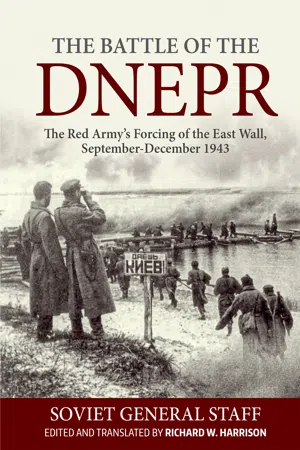
Details a critical period in the Red Army's advance along the southwest strategic direction during the general offensive that followed the fighting in the area of the Kursk salient in July-August 1943. The Battle of the Dnepr: The Red Army's Forcing of the East Wall, September-December 1943, details a critical period in the Red Army's advance along the southwest strategic direction during the general offensive that followed the fighting in the area of the Kursk salient in July-August 1943. The Germans, who were now on the strategic defensive in the East, sought to fall back and consolidate their front along the line of the Dnepr River. The Red Army's success in overturning these expectations along this particularly important sector is the subject of this study. This is a composite work based upon three studies carried out by the Red Army General Staff's military-historical directorate, which was charged with collecting and analyzing the war's experience. The first is a lengthy internal document, dating from 1946, which was eventually published in Russia in 2007, although heavily supplemented by commentary and other information not contained in the original. The present work omits these additions, while supplying its own commentary in places deemed necessary. Two short articles from another publication round out the collection. The book is divided into two parts. The first deals with the efforts by General N.F. Vatutin's Voronezh (later renamed First Ukrainian) Front to exploit the Soviet victory during the battle of Kursk and to carry the war to the Dnepr River and beyond. This involved pursuing the retreating Germans and attempting to seize crossings over the Dnepr in the Kiev area before the Germans could get across and consolidate their position. Although they were able to seize several small footholds, the Soviets were unable at first to expand them to bridgeheads of operational significance. By shifting their efforts to the bridgehead north of Kiev, the Soviets were eventually able to break out and capture Kiev, although a German counterattack from the Zhitomir area threw them back somewhat. Nevertheless, by the end of the year the Red Army in this area was ready to resume the offensive to retake the Ukrainian right bank. The two articles, which comprise the second part, cover the combat operations of General I.S. Konev's Steppe (later renamed Second Ukrainian) Front through Poltava and Kremenchug and to cross the Dnepr and seize bridgeheads south of Kiev. This is a more narrowly focused tactical-operational study, dealing with the efforts of the front's 37th and 52nd armies to expand their positions on the Ukrainian right bank into operational bridgeheads capable of supporting a larger offensive to the west in 1944.
eBook - ePub
The Battle of the Dnepr
The Red Army's Forcing of the East Wall, September-December 1943
- 344 pages
- English
- ePUB (mobile friendly)
- Available on iOS & Android
eBook - ePub
The Battle of the Dnepr
The Red Army's Forcing of the East Wall, September-December 1943
About this book
Information
Topic
HistoriaSubtopic
Historia rusaPart I
The First Ukrainian Front’s Offensive along the Kiev Axis in 1943
Introduction
The offensive by the forces of the First Ukrainian (Voronezh)1 Front along the Kiev axis in September –October 1943, which was conducted under the command of General N.F. Vatutin, 2 occupies an important place in the Soviet army’s historic battle for the Dnepr.
The chief military event of the 1943 summer campaign was the grandiose battle of Kursk. This battle, which lasted from 5 July through 23 August, concluded with the defeat of the Hitlerite army’s main shock group of forces. Following the rout of the enemy around Kursk the German-Fascist command could no longer consider resuming the offensive against the Soviet army. The counteroffensive by Soviet forces around Kursk in August 1943 grew into a general offensive along an enormous front from Velikie Luki to the Black Sea.
In September-October the Soviet Supreme High Command set about carrying out major offensive operations for the purpose of inflicting a defeat on the German-Fascist forces operating along the western and southwestern strategic directions. The depth of the tasks facing the Soviet forces in this grandiose offensive reached 250-300 kilometers against an overall front of combat operations stretching 1,000-1,200 kilometers.
The Hitlerite command attempted to halt the further offensive by the Soviet army along the line Velizh—Dorogobuzh—Bryansk—Sumy—the rivers Severskii Donets and Mius through a stubborn defense. Simultaneously, he was carrying out defensive works along the western banks of the Desna, Sozh, Dnepr, and Molochnaya rivers, calculating that he could employ them for defense in the event of a breakthrough by Soviet forces. These lines had major operational significance, because they intercepted the lines of the Soviet army’s offensive to the west. The fascist command attached particular importance to the line of the Dnepr. The broad and deep Dnepr is difficult for crossing, and its high right bank, with steep and precipitous banks commands the left bank and enables one to organize a powerful defense. The left bank is gently sloping and, for the most part, open and unfavorable for the approach and concentration of troops attacking from the east.
Following the unsuccessful outcome of the battles around Orel, Belgorod and Khar’kov for the Hitlerites, the fascist propagandists loudly proclaimed the fortifications along the Dnepr to be an impregnable line. Despite the harsh lessons received along the Soviet-German front in the campaigns of 1941, 1942 and 1943, the Hitlerites believed that the Soviet army would not be able to carry out a large offensive in summer conditions. The fascist command’s plans for 1943 proved to be adventuristic. They, as before, were based upon an overestimation of their own forces and an underestimation of the enemy’s forces.
The battle for the Dnepr consisted of a series of front and multi-front operations, unified by the overall design of the High Command. In accordance with the course of unfolding events and the sequence of carrying out the tasks, the battle for the Dnepr can be divided into three stages.
The first stage (August-September 1943) is characterized by the rout of the German-Fascist armies along the left bank of the Dnepr and in the Donbass, 3 the arrival of our forces at the Dnepr, the forcing of the Dnepr and the seizure of the first bridgeheads along its right bank. Simultaneously, Soviet forces along the western strategic direction inflicted a defeat on the central group of German-Fascist forces and captured Smolensk and Roslavl’.
The second stage embraces October-December 1943. During this time there was bitter fighting along the right bank of the Dnepr southeast of Kremenchug and in the areas of Dnepropetrovsk, Kiev and Rechitsa. It concluded with the formation of major bridgeheads, which had important strategic significance for the unfolding of the Soviet forces’ subsequent offensive operations. The enemy’s defense was also routed in the area of Zaporozh’ye and along the Molochnaya River, the German and Romanian Crimean group of forces was isolated from the land, and the entire southern part of the Ukrainian left bank was liberated as far as the mouth of the Dnepr, with the exception of the sector in the Nikopol’ area, where the Germans held a small bridgehead. At the same time the Soviet army was concentrating its reserves along the Dnepr’s right-bank bridgeheads and was preparing for a decisive offensive from these bridgeheads. Along the western strategic direction, Soviet forces were fighting along the approaches to Vitebsk and Orsha.
The third stage (the end of 1943-March 1944) is characterized by the Soviet forces’ successful operations along the Ukrainian right bank. The Germans, having suffered a cruel defeat, were thrown back from the Dnepr along an enormous front from the mouth of the Berezina River to Kherson. Soviet forces continued to successfully develop the offensive toward the Soviet Union’s state border. The Korsun’-Shevchenkovskii operation was conducted during this stage, during which the second largest enemy group of forces after Stalingrad was routed. Throughout the course of the entire battle for the Dnepr and the Ukrainian right bank, the forces of the Voronezh (First Ukrainian) Front operated along the main axis.
Further on, the entire course of the front’s battle in the Kiev area is divided into the following stages:
1.The forcing of the Dnepr and the seizure of bridgeheads along the river’s right bank in the second half of September 1943. The front’s offensive operation in October 1943.
2.The front’s November offensive operation and the liberation of Kiev (the first half of November 1943).
3.The front’s defensive operation in the second half of November 1943 in the areas of Zhitomir and Brusilov. The development of the offensive by the front’s right flank along the Ovruch and Korosten’ axes.
From the end of August 1943 (that is, from the moment the battle of Kursk ended) the Voronezh Front’s forces, in close coordination with the Central Front’s left wing (attacking along the Chernigov axis) and the Steppe Front’s forces (attacking along the Kremenchug axis) conducted an uninterrupted offensive. By 22-24 September 1943 they had reached the Dnepr south of the town of Pereyaslav-Khmelnitskii and north of Kiev, forced the river from the march and seized bridgeheads in these two areas.
With their arrival at the Dnepr, the forces of the Voronezh Front faced an extremely grand and responsible task. It was necessary to broaden the captured bridgeheads and through a decisive attack rout the enemy’s Kiev group of forces and liberate Kiev—the capital of Soviet Ukraine. The formation of a major bridgehead in the Kiev area would place the Soviet forces in a favorable situation facing the enemy and would create the prerequisites for the successful development of the fighting along the Ukrainian right bank. The Kiev bridgehead hung from the north over the entire southern wing of the German armies and enabled us to carry out an offensive along three important axes: to Rovno and L’vov to the west and leading to the southern areas of Volhynia4 and to the lower course of the Vistula River, to the southwest toward Mogilev-Podol’skii, and to the south along the right bank of the Dnepr. These axes would put the Soviet forces on the enemy’s communications and would place the German-Fascist armies in a position of semi-encirclement. Besides this, the first two axes would secure our forces’ arrival at the Carpathians and would enable us to split the German front into two parts and complicate the cooperation of two major enemy groups of forces—central and southern.
The Stavka5 of the Supreme High Command attached great significance to the Kiev area for its forthcoming operations. Comrade Stalin6 indicated twice during the course of the Voronezh (First Ukrainian) Front’s offensive that the Kiev bridgehead is the most important and most favorable bridgehead along the right bank of the Dnepr.
Despite several failures by the front’s forces in October, during the fighting on the Bukrin bridgehead, the Kiev operation was completed brilliantly.
Following the liberation of Kiev by Soviet forces the German command concentrated significant forces along this sector and undertook a counteroffensive in the second half of November 1943 for the purpose of halting the Soviet army’s advance and then to destroy our Kiev group of forces and to eliminate the bridgehead along the right bank of the Dnepr in the Kiev area. For this purpose the enemy removed forces from various sectors of the Soviet-German front and dispatched them to the Kiev area, and also shifted reserves here from the occupied countries of Europe—Norway and France. Troops were also removed from Italy, despite the fact that at this time the Anglo-American armies had landed in the south of the country and were fighting there.
However, having expended enormous forces and equipment, the Germans were unable to achieve their goals and to eliminate the Kiev bridgehead.
At the end of December 1943 and the beginning of 1944 the forces of the First Ukrainian Front conducted successful offensive operations along the Zhitomir—Berdichev, Rovno and Chernovtsy axes, which played an important role in developing the second Stalinist blow’s7 operations.
Our forces’ combat operations along the Kiev axis in the fall of 1943 have a great practical and theoretical interest, thanks to their extreme dynamism and rapid alternation of the forms of struggle in very complex combat situations.
In studying the front’s offensive operations, the most important questions are the forcing of a major water barrier from the march, the capture of bridgeheads and subsequent actions from these bridgeheads. If the offensive by the main group of forces from the Bukrin bridgehead in October failed to yield positive results, then the November offensive from the Lyutezh bridgehead, which was conducted on the basis of a new operational design, which was indicated in a directive by the Stavka of the Supreme High Command, was crowned with success.
Of great interest are the regrouping of the front’s forces from the Bukrin bridgehead to the Lyutezh bridgehead, which was carried out according to a compressed schedule and in very difficult conditions, by our forces’ smooth crossing over the Dnepr and Desna rivers.
The choice of the axis of the main attack in the November offensive operation and its development is instructive, as well as the skillful operations of the front’s forces in repelling the counteroffensive by a major enemy tank group of forces in the second half of November.
A decisive condition for the success of the front’s combat operations was the firm and constant leadership by the Stavka of the Supreme High Command, which directed the front’s activities, rendering the necessary assistance with men and materiel in the decisive moments.
The Voronezh (First Ukrainian) Front’s offensive during the battle for the Dnepr unfolded in conditions of close operational and strategic cooperation, which were organized by the Stavka of the Supreme High Command, with the Central (Belorussian) and Steppe (Second Ukrainian) fronts.
The Steppe (Second Ukrainian) Front’s forces, having seized bridgeheads along the right bank of the Dnepr southeast of Kremenchug at the end of September, launched powerful attacks against the enemy along the Krivoi Rog and Kirovograd axes in October and November. As a result of these attacks by the forces of the Steppe Front, the major railroad junction of Pyatikhatka was liberated. Following the liberation of the cities of Dneprodzerzhinsk and Dnepropetrovsk by the Southwestern (Third Ukrainian) Front in this area a bridgehead of major operational significance was formed in this area, just as in the Kiev area.
The forces of the Central (Belorussian) Front forced the Dnepr in the Loyev area, routed the enemy in the areas of Gomel’ and Rechitsa, and also formed major bridgeheads along the right bank of the Dnepr and Berezina rivers.
The successful realization of the Stavka of the Supreme High Command’s plan for routing the Kiev group of German-Fascist forces, the liberation of the capital of Soviet Ukraine—Kiev and the creation of major strategic bridgehead on the right bank of the Dnepr was linked with the name of the commander of the First Ukrainian Front, General Nikolai Fedorovich Vatutin—one of the most talented young commanders who advanced during the course of the Great Patriotic War.
N.F. Vatutin’s talent as a commander manifested itself during the defense of Voronezh in the summer of 1942, in the rout of the German-Fascist forces around Stalingrad, in the swift offensive by Soviet forces from the Don bend to the Donbass, and in the rout of the Hitlerite hordes in the battle of Kursk.
The successful operations of the forces commanded by General N.F. Vatutin were noted several times in the orders of the Supreme Commander-in-Chief.
General N.F. Vatutin died on the night of 14-15 April 1944, after being seriously wounded, and was buried in Kiev, the liberation of which is indelibly linked with his name. According to a decree by the Soviet government a monument has been erected on General Vatutin’s grave. On the day of N.F. Vatutin’s funeral, th...
Table of contents
- Cover
- About the Book
- About the Author
- Title Page
- Copyright
- Contents
- List of Maps
- List of Tables
- Preface to the English-Language Edition
- Part I: The First Ukrainian Front’s Offensive along the Kiev Axis in 1943
- Part II: The Second Ukrainian Front’s Operations in September-December 1943
Trusted by 375,005 students
Access to over 1.5 million titles for a fair monthly price.
Study more efficiently using our study tools.
Frequently asked questions
Yes, you can cancel anytime from the Subscription tab in your account settings on the Perlego website. Your subscription will stay active until the end of your current billing period. Learn how to cancel your subscription
No, books cannot be downloaded as external files, such as PDFs, for use outside of Perlego. However, you can download books within the Perlego app for offline reading on mobile or tablet. Learn how to download books offline
Perlego offers two plans: Essential and Complete
- Essential is ideal for learners and professionals who enjoy exploring a wide range of subjects. Access the Essential Library with 800,000+ trusted titles and best-sellers across business, personal growth, and the humanities. Includes unlimited reading time and Standard Read Aloud voice.
- Complete: Perfect for advanced learners and researchers needing full, unrestricted access. Unlock 1.5M+ books across hundreds of subjects, including academic and specialized titles. The Complete Plan also includes advanced features like Premium Read Aloud and Research Assistant.
We are an online textbook subscription service, where you can get access to an entire online library for less than the price of a single book per month. With over 1.5 million books across 990+ topics, we’ve got you covered! Learn about our mission
Look out for the read-aloud symbol on your next book to see if you can listen to it. The read-aloud tool reads text aloud for you, highlighting the text as it is being read. You can pause it, speed it up and slow it down. Learn more about Read Aloud
Yes! You can use the Perlego app on both iOS and Android devices to read anytime, anywhere — even offline. Perfect for commutes or when you’re on the go.
Please note we cannot support devices running on iOS 13 and Android 7 or earlier. Learn more about using the app
Please note we cannot support devices running on iOS 13 and Android 7 or earlier. Learn more about using the app
Yes, you can access The Battle of the Dnepr by Richard W Harrison, Richard W. Harrison in PDF and/or ePUB format, as well as other popular books in Historia & Historia rusa. We have over 1.5 million books available in our catalogue for you to explore.