A reassessment of the famous fifth-century clash between Hun and Roman forces: "An excellent job of research with original documents." —
The Past in Review
This book reconsiders the evidence for Attila the Hun's most famous battle, the climax of his invasion of the Western Roman Empire that had reached as far as Orleans in France. Traditionally considered one of the pivotal battles in European history, saving the West from conquest by the Huns, the Catalaunian Fields is here revealed to be significant but less immediately decisive than claimed.
This new study exposes oversimplified views of Attila's army, which was a sophisticated and complex all-arms force, drawn from the Huns and their many allies and subjects. The 'Roman' forces, largely consisting of Visigoth and Alan allies, are also analyzed in detail. The author, a reenactor of the period, describes the motives and tactics of both sides. Drawing on the latest historiography and research of the primary sources, and utilizing Roman military manuals, Evan Schultheis offers a completely new tactical analysis of the battle and a drastic reconsideration of Hun warfare, the Roman use of federates, and the ethnography of the Germanic peoples who fought for either side. The result is a fresh and thorough case study of battle in the fifth century.
Includes maps and illustrations
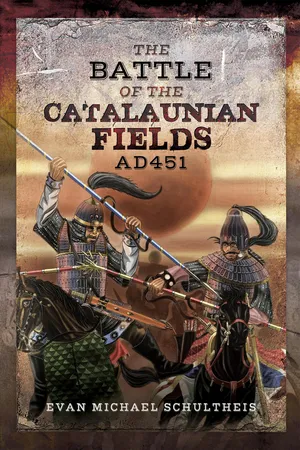
eBook - ePub
The Battle of the Catalaunian Fields AD 451
Flavius Aetius, Attila the Hun and the Transformation of Gaul
- 168 pages
- English
- ePUB (mobile friendly)
- Available on iOS & Android
eBook - ePub
The Battle of the Catalaunian Fields AD 451
Flavius Aetius, Attila the Hun and the Transformation of Gaul
About this book
Information
Chapter 1
Background and Prelude to the War of 451
Any discussion of the Huns, their history and their impact on the migration period seems to require an introductory piece concerning their origins and language. Therefore, a brief overview will be presented in order to conform to this trope, and more importantly to clarify what is meant by the term ‘Hun’ in this volume. The name Hunni, pronounced ‘On:ni’ in Latin, most likely derives from the late old Chinese or early middle Chinese pronunciation of Xiongnū, spelled Xoŋa, pronounced ‘Hoŋ:na’.1 Xoŋa ultimately derives from the older form of Xiōngnú/Xoŋai (pronounced ‘Hoŋ:gai’), which may originate from a combination of the pronunciation of the old Turkic name for the Ongi River in modern Mongolia (most likely spelled Hoŋï and pronounced ‘Hoŋ:gi’), and the pronunciation of the original Xiongnū dynastic family name.2 The Hunnish emperors at least claimed to be descended from this ruling dynasty of the Xiongnū, and the Bulgarian Dulo and Khazar Tü-lü dynasties have been put forward as being etymologically the same as the Xiongnū ‘T’u-ko’, although no dynastic continuity can be conclusively proven. This ultimately goes back to Omeljin Pritsak, in his The Hunnish Language of the Attila Clan, who argues that Dulo and Tü-lü are etymologically similar based on the assumption that they derive from a river of the same name which demarcated the boundary between the western and eastern Turkish qaganates. The royal dynasty of the Xiongnu is variously called ‘Xiōngnú’, ‘T’u-ko’ (D’uo’klo), ‘Luandi’ or ‘Xulianiti’, of which the latter two’s etymological form is unknown.3
Otherwise, archaeologically and etymologically, the Huns have been proven to descend from at least part of the former Xiongnū and have been identified as a continuation of the Xiongnū imperial body. It is also widely accepted that the Hunnish ruling and aristocratic bodies spoke a dialect of Turkic called Oghur, characterized by the use of ‘-r’ rather than ‘-z’ endings, although they may have originally spokenYeniseian .4 Despite recent advances, mainstream scholarship, due in part to the conclusions of Maenchen-Helfen, is only slowly reverting back to De Guignes’ hypothesis of Xiongnū continuity.5 However, scholars are correct in stating that the Huns who entered Europe were not one homogeneous ethnicity, but the ruling class of a heterogeneous body of various Oghur and Iranic-speaking nomads who made up an organized steppe confederation based on the Xiongnū political model. The Huns also conquered or incorporated new Iranic, Tocharian, Oghur and Germanic-speaking vassal peoples into this confederation over the course of their migration and settlement.6 This brings up an important concern: the usage of the ethnonym ‘Hun’. Steppe identity was highly fluid and it seems likely that all Oghur-speaking nomads of the fifth century either adopted the name or were generally labelled as ‘Huns’. It was an advantageous title because it carried with it association to the feared dynasty that had once ruled from Turkmenistan to Manchuria, regardless of whether these peoples were part of the Hun ruling body. This view is confirmed by Procopius, who calls the Hepthaltites ‘of the stock and the name of the Huns’, indicating that there was a Roman concept of a Hunnish ‘stock’ or gens alongside a specific group or polity that bore the name.7 It is in this generic context of the term under which we see the Oghur-speaking peoples and the Hun Empire enter Europe, and from this point forward this book will attempt to make distinctions, some conjectural, between the different Oghur speakers labelled ‘Huns’.
In the early fourth century AD, the Huns could be found ruling the area from the Minusinsk Basin in the north-west Altai to the Kazakh steppes north-east of Sogdia.8 In the third and fourth centuries AD, the various Oghur-speaking nomads were slowly precipitating down from the Altai mountains, displacing the Iranicdominated population, many of whom were under the rule of the Huns.9 The fall of Kangju and the decline of the Kushans was a direct result of the establishment of a Hun power, likely centred near the Syr Darya, who engaged in trade with Bactrian merchants.10 These merchants transmitted their name west to the Kuban region, although the Hun Empire itself had not expanded to the north Caspian to reach the fringes of Roman knowledge.11 However, their Oghur-speaking relatives had, with Alpidzur and Tongur ‘Huns’ ruling over two Iranic groups, the Itimari and Boisci (Rhoboisci), all living around the mouth of the Volga in the early fourth century AD.12 The actual account of the Hun entry into the Roman known world was probably preserved in Priscus, and now lost.13 Ammianus’ tale is now widely discredited, seen as a topos of Herodotus’ description of the Scythians, but he describes the Huns as being from the ‘ice bound ocean’.14 In the sixth century, Jordanes bungles and conflates what may have been originally preserved in Priscus regarding Hunnish origins, telling a strange story of Goths breeding with witches and Huns following a stag across the Maetoic marshes. Jordanes somewhat amalgams his geography in this passage, but if one assumes that he does not differentiate between the north Caspian Sea where the Oghurs were situated and the Sea of Azov, he then preserves a tale of the Huns coming from beyond the Volga, which preserves some truth.15 They emigrated across the Turgai Plateau to the Volga, and according to Heather the Huns probably began fighting the local Oghurs and the Alan kingdom around AD 360.16 This would also coincide with recent studies suggesting high humidity, falling temperatures and glacial expansion at that time, interrupted by severe droughts that reached their peaks in about 360, 460 and 550, which would have spurred nomadic expansion west and south.17 The Huns had subdued the Alans and Greuthungi, and were harassing the Tervingi before 376, sparking a series of events leading to the infamous Battle of Adrianople.18
Hun Military Actions before Attila
In 395, the Hun position was consolidated enough to launch a massive raid down the Roman oriental limes: coming down through the Dariel Pass in the centre of the Caucasus range, they passed along the Cahya mountains near Amida, penetrating as far into Anatolia as Cappadocia and slaughtering the inhabitants of Cilicia, before reaching as far south as Syria Coele via the province of Euphratensis.19 The leaders of these two operations may have been Kursik and Basik, the first known pair of Hun ‘kings’, although the exact date of the campaign mentioned to Priscus is uncertain, and Blockley believes their raid to date to about 422.20 Jerome remarks that the Huns had reached the Euphrates and, having ravaged the countryside near Antioch, he feared they would sack Jerusalem.21 After this, they proceeded not to return to their own lands with the captives they had taken, but instead invaded the Sassanid Empire, reaching as far as Ctesiphon and ravaging the countryside before retreating from the advancing Persian army. The Huns were caught and defeated in Mesopotamia by the Persians, who freed an alleged 18,000 captives they had taken and resettled them near Ardashir and Ctesiphon.22 The invasion would have a lasting impact in the minds of the locals, and have severe repercussions on the career of Rufinus.23 In 397, the Huns would launch a second raid, which was successfully repelled by Eutropius.24
In 400, a Gothic magister militum named Gainas revolted and laid siege to Constantinople, but he was defeated and fled over the Danube, only to be decapitated by a Hun named Uldin (Ultzin), who sent his head to Arcadius. Arcadius then returned the favour with gifts and a treaty between the two parties.25 At this time, it seems the Huns may have begun to move west again, arriving on the Dniester or maybe as far as the Wallachian plain. Their movements would result in another knock-on effect, spurring the invasion of Radagasius in 405, the Rhine crossing in 406 and the establishment of the Burgundians on the Rhine in 411. In 404 and 405, Uldin crossed the Danube and attacked northern Thrace, and simultaneous Hun campaigning in the Carpathian basin that escaped Roman eyes may have triggered the migrations of Radagasius and the Vandals. Uldin seems to have won concessions from the Romans, and in 405–06 is found campaigning with Stilicho against Radagasius, participating at the Battle of Faesulae.26 However, he again reneged on his treaty and in 408 he crossed the Danube with a force of Huns and newly vassalized Sciri, seizing the border market of Castra Martis. After some persuasion and gifts, some of these newly vassalized Germanics turned on him, seeking favourable Roman concessions, and forced him back across the Danube.27 By the 410s, the Huns seem to have begun to settle in the Pannonian basin, and in 409 the Romans sought to hire 10,000 Huns to attack Alaric, who was loose in Italy after defecting Germanic recruits had crippled the Roman Army.28 Two years later, Olympiodorus, in an envoy to the succeeding king Charaton (Qaraton), recounts the deception and illegal execution of Donatus and the Roman attempt to appease Charaton.29 Although Donatus’ execution is usually attributed to an internal rebellion, what is often overlooked here is that, whomever Donatus was, this passage implies that the Romans had been tricked into believing he violated Roman law and Donatus was executed not by his own Huns, but by the Romans. This also implies that Donatus may have been campaigning in Roman service, possibly at the command of the Huns requested by Honorius in 409. Regardless, this seems to have been a diplomatic disaster and may have been the reason for Olympiodorus’ envoy. Charaton’s reign after these events remains somewhat obscure. In 422, the Huns again raid Thrace, likely due to a withdrawal of the field armies for Theodosius II’s war with Persi...
Table of contents
- Cover
- Title
- Copyright
- Contents
- List of Plates
- List of Maps
- Acknowledgements
- Introduction: Scholarship and Primary Sources
- Chapter 1 Background and Prelude to the War of 451
- Chapter 2 The Roman Coalition
- Chapter 3 The Hun Confederation
- Chapter 4 The Campaign of 451
- Chapter 5 The Battle of the Catalaunian Fields
- Chapter 6 The Effects of the Battle
- Conclusion
- Appendix A Chronology
- Appendix B A Force Estimate of the Notitia Dignitatum
- Notes
- Glossary
- Bibliography
- Plate section
Trusted by 375,005 students
Access to over 1.5 million titles for a fair monthly price.
Study more efficiently using our study tools.
Frequently asked questions
Yes, you can cancel anytime from the Subscription tab in your account settings on the Perlego website. Your subscription will stay active until the end of your current billing period. Learn how to cancel your subscription
No, books cannot be downloaded as external files, such as PDFs, for use outside of Perlego. However, you can download books within the Perlego app for offline reading on mobile or tablet. Learn how to download books offline
Perlego offers two plans: Essential and Complete
- Essential is ideal for learners and professionals who enjoy exploring a wide range of subjects. Access the Essential Library with 800,000+ trusted titles and best-sellers across business, personal growth, and the humanities. Includes unlimited reading time and Standard Read Aloud voice.
- Complete: Perfect for advanced learners and researchers needing full, unrestricted access. Unlock 1.5M+ books across hundreds of subjects, including academic and specialized titles. The Complete Plan also includes advanced features like Premium Read Aloud and Research Assistant.
We are an online textbook subscription service, where you can get access to an entire online library for less than the price of a single book per month. With over 1.5 million books across 990+ topics, we’ve got you covered! Learn about our mission
Look out for the read-aloud symbol on your next book to see if you can listen to it. The read-aloud tool reads text aloud for you, highlighting the text as it is being read. You can pause it, speed it up and slow it down. Learn more about Read Aloud
Yes! You can use the Perlego app on both iOS and Android devices to read anytime, anywhere — even offline. Perfect for commutes or when you’re on the go.
Please note we cannot support devices running on iOS 13 and Android 7 or earlier. Learn more about using the app
Please note we cannot support devices running on iOS 13 and Android 7 or earlier. Learn more about using the app
Yes, you can access The Battle of the Catalaunian Fields AD 451 by Evan Michael Schultheis in PDF and/or ePUB format, as well as other popular books in History & Ancient History. We have over 1.5 million books available in our catalogue for you to explore.