Frederick Whirlpool's Victoria Cross is displayed near the entrance to the Hall of Valour at the Australian War Memorial, Canberra. It was the first VC pinned to an Australian uniform, yet almost nothing was known about its enigmatic recipient. Two acts of valor during the Indian Mutiny won him the Victoria Cross, but 17 severe sword wounds ended his career. After migrating to Australia in 1859, he became a volunteer rifleman and school teacher. His VC was presented in Melbourne in 1861. He applied to join the Victorian Police, but corruption and unsolicited political interference prevented it. Repulsed by fame, he fled and hid his cross from the world. Fragments of his story were known, but since 1895, they have been tainted by error and guesswork. This new book reveals his true identity and early life in Ireland, before he joined the East India Company Army and sailed to India. Frederick Whirlpool VC is the fascinating history of an ordinary man, whose life is deserving of factual interpretation. It is a story of heroism, suffering and failure, but this forgotten man will triumph in its telling: the true story of this sad and purposefully enigmatic hero.
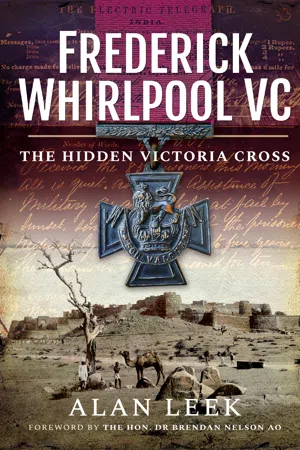
- 248 pages
- English
- ePUB (mobile friendly)
- Available on iOS & Android
eBook - ePub
About this book
Information
Subtopic
Military BiographiesIndex
HistoryCHAPTER ONE
EVENING SHADOWS
‘Our sins, like to our shadowes,
When our day is in its glorie scarce appear:
Towards our evening how great and monstrous they are!’
When our day is in its glorie scarce appear:
Towards our evening how great and monstrous they are!’
Sir John Suckling
‘Aglaura’ 1638
‘Aglaura’ 1638
The old man lived alone; by preference, not necessity or circumstance. He had withdrawn from the world 30 years earlier, kept his own counsel and mostly shunned society. Neighbours considered his behaviour as simply eccentric, and accommodated his foibles, knowing he had contributed as a soldier and schoolteacher. Most were unaware he had once known fame, across the colonies, in India and in Britain, or that he had found public adulation abhorrent and had run from its bitter taste.
A hand hewn slab hut at McGrath’s Hill on the outskirts of Windsor, served as his home. Part of the third European settlement on mainland Australia, it nestled in the abundantly fertile Hawkesbury Valley, at the foot of the Great Australian Divide. Two rooms of slab, some wattle and daub and a shingle roof were adequate and familiar to the times, one of many such settler huts in the area. One room was partitioned to take his cot and palliasse, which he called his charpoy, though his use of bat, or Indian soldier’s slang, would be restrained to deter the inquisitive. The remaining space housed the warming fireplace, which also served as cooking hearth. A small vernacular table, which he had fashioned from packing cases, a rough bodger chair, a table he used for sewing and the detritus of everyday living were his only adornments. The floor was of packed earth, gathered from ant nests and rammed home. It provided an earthy glow to the interior, which was yellowed by smoke from the hearth and his pipe. He was not a man in need of easy comfort. His rudimentary, but comfortable early life in Ireland, the hardship of the great famine and years in the East India Company Army had taught him not to be self-indulgent or wasteful. The ‘lean-to’ clinging precariously to the rear of the structure and held upright by the stacked woodheap, served as a wash room where he could ensure that he and his limited clothing could be cleaned, in keeping with his proud appearance. Beyond that was his rich loam plot for vegetables. He had plenty of time to garden and there was not a weed to be found. He enjoyed his patch and its bounty, but he did not own the land on which he lived. Years earlier, he had lived in nearby Pitt Town, at a place then known as North Rocks, on land belonging to John Dick Smith, a local merchant, who had allowed him use of it quid pro quo or at least at a peppercorn rent. He would never live in the shadow of charity. But he had moved closer to the more populated McGrath’s Hill at the urging of Smith, who saw his ageing friend in need of ready amenity, including regular deliveries of goods he was no longer able to gather for himself.
It was clear life and his past disappointed him, no matter in what guise he lived it. But his time in India as Frederick Whirlpool had been the most agonising, both physically and mentally. He had told his sister, Deborah, in a recent letter, that he was damned and destined to roast, believing that there was no alternative to his descent into Hell.
His letters, the first in sixteen years to his family in England and America, were an attempt to right his abandonment of those who loved him. Deborah’s reply scolded him as only sisters can and beseeched him not to be so reckless with his words. Reckless. Not silly or overstated, but reckless, in case he might be right. Raised in a solid though not pious family, Deborah nonetheless feared an omnipotent Almighty. The old man would never read the letter.
He had taken to his bed early as was his wont. Frugality had no need for candles or lamps, when daylight could facilitate reading. But he was an avid reader and considered well-read by the few who knew him.
As Whirlpool slept, Windsor, not much more than a mile away, was alive with anticipation of a total eclipse of the moon. Nearer still, John Tebbutt, a respected Fellow of the Royal Astronomical Society, was at his telescope, making notes. It was to be the first total eclipse in 19 years and if the weather permitted, valuable observations would be made. Tebbutt had advised the community of the imminent event and gave details of its expected timing on 24 June, 1899. It had been raining for days but the sky gave every appearance that the cloud cover was thinning and the spectacle would be enjoyed.
This was a timely diversion from the clamorous and sometimes rancorous debate, which had divided the community and the colonies ahead of federation. It had come to a head just two days before with the referendum on the Commonwealth Constitution Bill. Supporters of the bill — ‘billites’ — and opponents — ‘anti-billites’ — were among more than 300 people gathered outside the newspaper office of the Windsor and Richmond Gazette, blocking the street to watch the referendum tallies conveyed by telegraph from Sydney, then displayed on blackboards and calico screens.1 The ‘billites’ won an overwhelming victory clearing the way for Australia to be declared a nation 18 months later — January 1, 1901, the start of a new century ushering in a new nation. This was the first time a nation’s constitution had been decided by its people by way of referendum, or at least by some of its people. Women had been enfranchised in South Australia and Western Australia, but would not gain the vote in New South Wales for another three years. Of the 116 electoral rights issued in the country town of Lismore, six were granted to aboriginal men in a foretaste of what would take their people another 60 or more years to fully achieve.2 How sweet the irony, had the referendum been carried by six votes. But it was not to be a close result. A Sydney Morning Herald correspondent reported from the Hawkesbury that, ‘The voting passed off quietly here and very little enthusiasm was displayed. The anti-billites were very demonstrative, but as the Sydney returns continued to give a large majority for the bill they became somewhat silent. Federalist’s were jubilant when it became known that victory was assured.’3
With the vote of the people emphatically in favour of the bill, a new focus was welcome and the community prepared to take in the astronomical event. As the moon slowly melted into Earth’s shadow the town was thrown into total darkness to the wonderment of most and confusion to others who had lost their way in their own gardens, as the Gazette gleefully reported. Tebbutt’s prediction proved sound that the eclipse would allow a beautiful and spectacular view of the Milky Way, not normally visible when the moon was full. The transit of the moon into the shadow of Earth was not a quick affair. It would take hours for the light to return; to those to whom it would return.
* * *
The delivery man from Dick Brothers store in Windsor, had called in his dray that morning with provisions and to take a new order, as he had done two days earlier and would do so again the following day. The deliveries mostly were made twice weekly with forward orders given to the delivery man as required. It was an unhurried arrangement and the purchases rarely exceeded three or four shillings, and varied little, although Whirlpool had indulged in a new sixpenny pipe several weeks earlier. His needs were meagre and delivery days were his main contact with the outside world, though he didn’t dally and had little time for small talk. His account would be settled quarterly in line with his pensions and when he visited his bank in Windsor. The delivery man would be the last person to see him alive.
Despite his isolation, he maintained a friendship with John Dick Smith, his landlord and proprietor of Dick Brothers’ Windsor store. Smith was a native of Glasgow, many years younger than the old man and a devout and active member of the Presbyterian Church. Part of the great 19th century Scottish diaspora, he had come to New South Wales to work for his uncles, eventually buying their store from them. He took an active interest in the old recluse and knew more than anyone about him, but still only what the old man allowed him to know. Smith’s interest would provide the thread that prevented the old man’s story from fading into oblivion. He knew the old man as Humphrey James and knew he had once been known as Frederick Whirlpool. He knew Whirlpool had been awarded the Victoria Cross, but not the manner in which it had been earned. James told him he had lodged it and his Indian Mutiny medal with the pensions office in Sydney. Smith later provided information to the Windsor and Richmond Gazette to enable the observation that he was, ‘...an educated and well-informed man, having been, when in the service, an Army schoolmaster for a portion of his military career. During the Indian Mutiny, he distinguished himself by his valour, and he obtained the highest prize a soldier strives for — the "Victoria Cross". Different to most old soldiers, it was difficult to get him to talk of his achievements — so says one who knew him well.’4 Not about to let the old man’s achievements go unnoticed, Smith would provide further information to the local newspaper as if to ensure the community appreciated that this reclusive eccentric’s life had been worthwhile, indeed substantial.
The cold night drew in and could not be kept from the hut. The old man rugged himself as the fire burnt down, and slumbered, drifting in and out of insomnious sleep. Insomnia had been his burden for many years. He knew sleep shone a light on the immensity and monstrousness of his experiences. He hadn’t felt well for days and had not been up to the walks and calisthenics that he regularly undertook to maintain fitness. He was proud of his straight carriage and ready gait, despite being just over three weeks short of his sixty-eighth birthday. But time was catching up.
No-one can know the memories that visited him, in sleep or awake, but it is clear that Whirlpool was a troubled man. His belief in a fiery eternity might have been influenced by the heat of battle, rough justice and personal sacrifices he had not expected to offer when joining the Honourable East India Company Army, and being immersed in the suppression in what would become known as the Indian Mutiny. He had played a major part in that conflict as a lowly ranked private of the 3rd Bombay European Regiment, under the command of Major-General Sir Hugh Rose and his Central India Field Force.
This night was to be his last. His belief that he was damned and destined for eternal torment was strong; as strong as 19th century religious teachings could make it. Gehenna had been calling him for more than 40 years. He fell back into unconsciousness and as life ebbed from his frail and damaged body, his extremities began to discolour and darken, as if in concert with this darkest of nights when the moon dipped and was lost.
Dick Brothers’ delivery dray arrived the next morning. The driver hammered on the flimsy door but failing to rouse the old man, called his name. When no answer broke the chill silence, he feared the worst and ran for help to the nearby Killarney Inn, known as Carey’s Hotel after its popular licensee. With Carey, he returned to the hut, forcing the door to find the old man dead in his bed. There was no sign of trauma and his lifeless skin now highlighted the elongated weals of old scar tissue on his face, neck and head, where they were not hidden by the wisp of his mutton-chop whiskers. What couldn’t be seen was the silver plate, which had clasped his shattered and trepanned skull in place since he was a young man.5
Police were summoned and Constable James Kell Tate rode out to the hut. He briefly interviewed the delivery man and Carey then entered the hut where experience told him the dark discolouration to the old man’s ears, throat and fingertips were telltale signs of heart failure. Tate arranged for the local undertaker to collect the body. Undertaker Richard Dunstan’s enterprise was displayed in his advertising, providing a glimpse at the balance between dying and the day to day needs of the living in the 19th century colony as he juggled the roles of, ‘Builder and Undertaker. Wall-papering and House-painting done.’6
An inquest was held at Carey’s hotel four days later, with coroner, James Bligh Johnston finding that Humphrey James, also known as Frederick Whirlpool, had died as a result of ‘a failure of the heart to action ...’ Dr. Gibson had certified death, obviating a post-mortem examination and sparing the old man a final indignity. James was also found to have clothing, a bed of little value and £160.5.8. deposited in the savings bank at Windsor.7
Constable Tate interviewed John Dick Smith, who had been distressed to learn from his cart-man of his old friend’s death. His information assisted Tate in completing his report to the Curator of the Estate of Deceased Persons, as James had died intestate. The report informed the curator that Humphrey James was otherwise known as Frederick Whirlpool and that he was an Imperial Army pensioner. It indicated that he was born in Ireland and had not married. A letter found in the hut indicated that he had brothers, Josiah James in Leeds, and Samuel James in Pennsylvania. Other contents of the hut were assiduously listed and a small iron boiler, saucepan, frying pan, bucket, bottles of salad oil, tins of milk, a billy can and six dozen of bottles were deemed worthy of mention. They would later be sold by the curator for ten shillings. Seven shillings and sixpence in cash and a Bank of New South Wales passbook were also found. The report noted briefly that the deceased was said to have left a Victoria Cross Medal at the Pension Office in Sydney.8
In the absence of anyone else, John Dick Smith assumed the role of executor, planning the funeral and seeking to notify James’ known family. His serious approach and Scottish tenacity were called to the fore when dealing with the office of the Curator of Intestate Estates in Sydney. He wrote to the curator on 2 August, 1899 and was refused information, which would enable him to write to James’ relatives. Letters passed back and forth, the curator ceding, enabling Smith to write to Samuel James in Pittsburgh, Pennsylvania.9
In late November 1899, Samuel James replied, thanking Smith for his many kindnesses and for attending to the obsequies of his late brother. He advised that James was survived by brother Josiah in Bradford, England, a sister, Mrs. W Prescott of Dublin [Dinah]; a sister, Mrs. Samuel Manifold of Liverpool [Deborah]; a brother Benjamin ‘who was out in the Indian Mutiny with Humphrey, after which they never met again.’ Benjamin had returned to England before leaving for the United States, serving two terms there in the army and was now a pensioner in Patton, California. He advised that their father had died in 1875 and their mother some years later. He continued. ‘I have not the slightest recollection of his personal appearance, he having joined the army and left home when I was only a baby, or little more. Another brother (Tom) did the same thing almost, only he went to sea and died in Rio de Janeiro, Brazil, and I have practically never seen him either. I have in my pocket Humphrey’s last letter to his relations, written to my brother Josiah; it is on two leaves ... He began it on the 31st January last and finished it on the 4th May, so you see he took his time about it, and he has given us a pen picture of himself, as well as he could, and told us all about his habits and about your man bringing him his weekly supply of groceries; what exercise he took, calisthenics, and moderate walking; said he was as straight in carriage as he ever had been, and we were congratulating ourselves on the fact that he was going to be a regular correspondent and more sociable, when now it is all over and that was the last flare up of the expiring embers and he is gone.
I do not know why he would not go back to England and live within reach of his friends and relatives; why he should choose such a lonesome life is a mystery to me. I know I could not stand it. But then I am married and have a family, and (as far as I know) he was a bachelor. I hope that I shall meet him in the sweet bye and bye, and if I do we certainly will have to be introduced.’
Sadly, Samuel then asked, ‘Had Humphrey no intimate friends; did no-one call at his lonely sh...
Table of contents
- Cover
- Title
- Copyright
- Contents
- Dedication
- Foreword
- Preface
- Introduction
- Chapter One: Evening Shadows
- Chapter Two: Carlow & Dundalk
- Chapter Three: England and the 3rd Bombay European Regiment
- Chapter Four: India
- Chapter Five: Mutiny
- Chapter Six: The Response
- Chapter Seven: Jhansi
- Chapter Eight: Lohari
- Chapter Nine: Victoria
- Chapter Ten: New South Wales
- Chapter Eleven: Teaching, Lower Macdonald River & Wiseman’s Ferry
- Chapter Twelve: Pitt Town, Grono Park School And Beyond
- Chapter Thirteen: Rest
- Epilogue
- Endnotes
- Bibliography
- Annexure A
- Annexure B
- Annexure C
- Acknowledgements
- Glossary
- About The Author
Trusted by 375,005 students
Access to over 1.5 million titles for a fair monthly price.
Study more efficiently using our study tools.
Frequently asked questions
Yes, you can cancel anytime from the Subscription tab in your account settings on the Perlego website. Your subscription will stay active until the end of your current billing period. Learn how to cancel your subscription
No, books cannot be downloaded as external files, such as PDFs, for use outside of Perlego. However, you can download books within the Perlego app for offline reading on mobile or tablet. Learn how to download books offline
Perlego offers two plans: Essential and Complete
- Essential is ideal for learners and professionals who enjoy exploring a wide range of subjects. Access the Essential Library with 800,000+ trusted titles and best-sellers across business, personal growth, and the humanities. Includes unlimited reading time and Standard Read Aloud voice.
- Complete: Perfect for advanced learners and researchers needing full, unrestricted access. Unlock 1.5M+ books across hundreds of subjects, including academic and specialized titles. The Complete Plan also includes advanced features like Premium Read Aloud and Research Assistant.
We are an online textbook subscription service, where you can get access to an entire online library for less than the price of a single book per month. With over 1.5 million books across 990+ topics, we’ve got you covered! Learn about our mission
Look out for the read-aloud symbol on your next book to see if you can listen to it. The read-aloud tool reads text aloud for you, highlighting the text as it is being read. You can pause it, speed it up and slow it down. Learn more about Read Aloud
Yes! You can use the Perlego app on both iOS and Android devices to read anytime, anywhere — even offline. Perfect for commutes or when you’re on the go.
Please note we cannot support devices running on iOS 13 and Android 7 or earlier. Learn more about using the app
Please note we cannot support devices running on iOS 13 and Android 7 or earlier. Learn more about using the app
Yes, you can access Frederick Whirlpool VC by Alan Leek in PDF and/or ePUB format, as well as other popular books in History & Military Biographies. We have over 1.5 million books available in our catalogue for you to explore.