Starting from the issues of globalisation and recent studies about the mechanisms of absorption of cultures into the Roman Empire, this book focuses on the Near East, an area that has received much less attention than the Western part of the Roman empire in the context of the Romanisation debate. Cimadomo seeks to develop new understandings of imperialism and colonialism, highlighting the numerous and multiple cultural elements that existed in the eastern provinces and raising many questions, such as the bilingualism of ancient societies, the relationship between different cultures and the difficulty of using modern terminologies to explain ancient phenomena.
The first focus lies on the area of Galilee and collecting all the evidence for reconstructing the history of the region. The theme of the ethnicity of the Galileans is very complex, as even the literary evidence of the first centuries BC and AD regarding Galilee doesn’t specify anything about their ethnic identities. The question of the Arabs, their origins and ethnicity is also raised, with a particular focus on the Itureans and the Nabateans. Alongside a complete analysis of the territories they occupied, Cimadomo explores the different artefacts: from the sculptures to the pottery, from the temples to the coins, a picture emerges of an area influenced by different cultures where the inhabitants were able to create their own culture, different from all other parts of the Roman empire.
A chapter is devoted to the Decapolis, paying attention to the literary and architectural evidences of each city and their urban development in a little-studied period. An important feature that clearly emerges is the religious nature of the earlier settlements: most of them were probably sanctuaries during the Hellenistic time, and developed only after the coming of the Romans. It was during this development that theatres took a principal role, seemingly the first structures built in every city under Roman rule.
It becomes clear that the problems of homogenization and differentiation were present even in the past. Local inhabitants challenged their identity, adapting and modifying foreign impulses, creating new societies and new ways of being Roman.
eBook - ePub
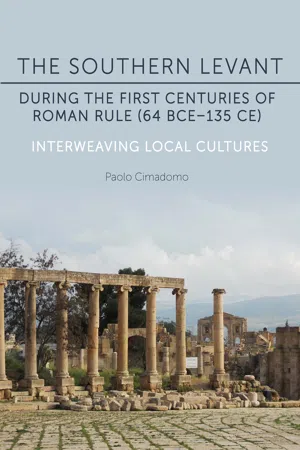
The Southern Levant during the first centuries of Roman rule (64 BCE–135 CE)
Interweaving Local Cultures
- 224 pages
- English
- ePUB (mobile friendly)
- Available on iOS & Android
eBook - ePub
The Southern Levant during the first centuries of Roman rule (64 BCE–135 CE)
Interweaving Local Cultures
About this book
Information
Subtopic
Ancient HistoryIndex
History1
Romanisation(s) in global times
1.1 The Romanisation debate
Romanisation, as well as its sister-concept of Hellenisation, is fundamentally a modern notion. It arose out of national and imperial ideologies born at the end of the 19th century, which first introduced the ideas of nationhood and empire. According to Greg Woolf, this worldview was built on two premises: a belief that not all the human races are equally civilised, and a profoundly Eurocentric vision of the world (Woolf 1998, 5). Some of these visions are still popular, although they have evolved throughout the 20th century, during which concepts like ‘civilisation’ or ‘just war’ are in fact present in current debates.
The first scholar who defined the concept of Romanisation or Romanising was Francis Haverfield in 1923. He built on the works of Theodor Mommsen, who had already explained cultural changes that had occurred across the empire using the word ‘Romanising’: for him, in fact, Roman territories showed a high degree of homogeneity, legitimated by the levelling action of Rome itself (Mommsen 1886, 193). In addition, Rome’s unification of Italy was a good model for German unification (Freeman 1997, 30). However, Mommsen considered this model to be inappropriate for the Greek East.
The romantic interest in the ethnic identities and the emphasis on race as a natural and immutable characteristic constituted the perfect background for the development of these ideas. Further support for these was found in the Darwinian theory of evolution, which led some to believe that biological inequality existed among humans (Hodos 2010, 5).
Haverfield developed Mommsen’s ideas, encouraged by the political situation of Britain at the early 20th century1. In fact, the desire to ‘civilise’ third world countries provided an excellent justification for Britannic imperialism (Wallace-Hadrill 2012,111). The words of the British scholar are clear: ‘Here Rome found races that were not yet civilized, yet were racially capable of accepting her culture’ (Haverfield 1923, 5). Roman terminology and symbols were adopted to create a moral legitimisation of colonisation; it constituted an idealised benevolent power, which carried its superior culture to other regions (Terrenato 2005, 64).
Romanisation was a general, progressive process which involved many, if not all, areas of life, including language, art, religion, architecture and material culture. It allowed the emergence of a common culture and the extinction of differences between Romans and provincials (Haverfield 1923, 18). Romanisation deleted pre-Roman cultures in barbarian Europe as well as the Europeans, in particular the British empire, expanded civilisation ideals among primitive countries. The concept of Romanisation, in fact, has many parallels with the idea of acculturation used in anthropology and sociology during the first half of the 20th century: both ideas developed from the same cultural framework (Jones 1997, 40 ff.). For the Mediterranean East, however, the significance of the term was less certain, because it was usually replaced by a similar term, namely ‘Hellenisation’. The concept of Hellenisation has been ascribed to Droysen, who used ‘hellenism’ and ‘hellenistic’ to characterise a period when Hellenistic culture spread, causing a fusion between East and West (Droysen 1836).
Both ‘Romanisation’ and ‘Hellenisation’ had been considered separate but similar phenomena. Haverfield himself made a clear distinction between the partially romanised East and the more romanised West (Haverfield 1923, 12–13). This approach is clearly teleological, reflecting views of social evolution from a primitive to a civilised state and making a direct connection between Western Europeans and classical Rome (Hingley 2000, 124; 2005, 39). Romanisation was considered inevitable due to the superiority of Roman values. Because of their supposed superiority, colonialist views considered it natural that the colonisers prevailed over colonised natives.
However, Haverfield was aware that the archaeological evidence shows a much more complex picture, including surviving pre-Roman remains (Haverfield 1923, 22; Webster 2001, 211; Hingley 2005, 35). Given this evidence of the enduring presence of native culture and, in some cases, of the revival of ancient tradition during the last phases of Roman dominion in Britain, in the 1930s Robin George Collingwood in the 1930s challenged Haverfield’s vision. In fact, he affirmed that the civilisation of Roman Britain was ‘Romano-British, a fusion of two things into a single thing different from either’ (Collingwood 1932, 92). For him, some natives had never embraced Roman culture and, instead, many country villages were romanised to a very low degree (Webster 2001, 212).
From the 1960s, archaeological excavation and surveys were undertaken throughout Europe. From them, archaeologists found a great variety of settlements testifying many different attitudes to the arrival of the Roman army. The significance of ‘Romanisation’ in the Eastern Mediterranean was also debated. Some argued that it was an individual choice made for advancing a political career (Welles 1965, 44), while other scholars were more sceptical about its use (Bowersock 1965, 72).
In response, the ‘nativist’ movement emerged during the 1970s and 1980s. For the first time, the notion of local resistance to Romanisation appeared clearly. Nativists considered the adoption of Roman elements as a mere façade, while the majority of indigenous people preferred to not become Roman. In this period, new thoughts entered in theoretic debate in archaeological and historical fields, causing the emergence of new historiographic perspectives, usually labelled as post-colonial views. It is not a coincidence that this reaction against Romanisation found a fertile ground in Britain, which was experiencing the effects of post–colonialism. This model, like the Romanisation model, although it has been important for having given attention to submitted people, failed to explain the development of new features that make unique every provincial experience.
The emergence of nativism created two distinct poles and did not let go beyond the dualism that was already evident in Romanisation thinking (Webster 2001, 213; Curchin 2004, 9–10). One of the better developed criticisms of colonial views was postulated by Edward Said. In his book Orientalism, he explained very well that colonial discourses created binary oppositions, favouring colonial cultures, depicted as civilised, dynamic, complex, modern, while depicting the others as inferior, passive, savage, lazy, simple and primitive (Said 1978). Said, in fact, has examined the ways in which the West saw the Orient, that is the Middle East, based on the ideas that European scholars have of eastern Mediterranean people.
From this first phase, other approaches to understanding the way colonised people have been represented were developed in the literature on colonialism and the nature of colonial identities. In particular, many studies about identities flourished, including those exploring the complexities of the relationship between conquerors and subjected people.
The dualism between the Romans and the native people was overemphasised by Martin Millett, who described Romanisation as a ‘dialectical process, determined on the one hand by Roman imperialist policy… and on the other by native responses to Roman structures’ (Millett, Roymans and Slofstra 1995, 2–3). Millett’s model was built on Haverfield’s theories, but attempted to reconcile his views with the nativists’ objections. However, unlike Haverfield, Millett considered local elites as active agents of Romanisation, claiming that the rapid adoption of Roman customs was the result of spontaneous challenge among natives, as Paul Zanker had already pointed out (Zanker 1990, 316).
The Roman empire, indeed, was able to successfully establish patron-client relationships with the local elite. In this way, the rule of very distant and different territories did not require a strong military and administrative intervention (Millett 1990).
Non-elites were ‘romanised’ second-hand through their emulation of the upper classes, who mediated Roman culture. The major weakness of these postulations is that they do not consider the possibility of grey areas. Lower classes appear only as passive recipients that experienced Rome through the mediation of romanised elites (Webster 2001, 216). Furthermore, if Romanisation was primarily a matter of local elites who had to re-negotiate their authority with their new rulers, it is not clear why eastern elites were less romanised than those in the western Mediterranean. Romanisation studies have focused on the western provinces because they offer more visible evidence of changes in material culture, often forgetting that the meaning of objects is not fixed but changes when they pass from hand to hand (Morley 2010, 112–113).
However, according to David Mattingly, these approaches fail to consider how power dynamics operated, because ‘the Romanization paradigm is a classic example of a common tendency to simplify explanation by labelling complex realities with terms that exaggerate the degree of homogeneity’ (Mattingly 2011, 206–207).
From this brief analysis, it is clear that the term Romanisation assumed varied forms during the 20th century and it is still in use, assuming a number of different significances. Furthermore, it seems to be a debate that arose and spread, first of all, among Anglo-Saxon scholars. Miguel John Versluys has recently pointed out that the ‘individual scholar’s view of Romanization appears to greatly depend on the area that he/she studies, as well as on the historical and archaeological sources available for that particular region’ (Versluys 2014, 9). This assumption seems to be confirmed by the fact that Continental scholarship, unlike Anglo-Saxon scholarship, has not rejected the term ‘Romanisation’ at all.
Many of the studies in the 1900s, starting from divergent reactions to Millett’s theories, focused a new attention on the relationships between the imperial power and the local elites. In fact, the promotion of Roman life style was a concern of the Roman administration, yet local elites were not simply assimilated, but actively participated, in the creation of a new social order.
One of the main challenges to archaeology posed by post-colonial theories, there has been a reconsideration of how archaeologists represent the past. Historical archaeologists have often stressed the ability of material culture to give a voice to subaltern people, who are often underrepresented in historic texts. However, the Romanisation approach misreads material cultures, because it fails to take into account the different identities shown by archaeological evidence (Whittaker 2009, 199). As John Moreland has pointed out, ‘objects were actively used in the production and transformation of identities’ (Moreland 2001, 84). Indeed, during the 1990s, archaeologists gave more attention toward the responses of native people.
Among these scholars, Greg Woolf refined Millett’s assumptions, stressing that adopting Roman culture might be a status marker, not of political or ethnic identity (Woolf 1998, 239). He notes that the use of Roman materials did not mean a complete acceptance of all Roman values. The importance of Woolf’s account lays in trying to go beyond the dichotomy between the Romans and the natives, emphasising that Roman experience diverged greatly from one place to another (Woolf 1997, 341). Native people were not merely assimilated into an already constituted order; instead, they actively participated in creating a new one (Woolf 1997, 347). Another important feature of Woolf’s book is the notion that Roman identity is a fluctuating concept that differs from time to time and from place to place and that it has been created in the local context through acts of accommodation.
Nonetheless, Woolf has continued to follow the path traced by Haverfield and Millett, as far as elites’ relationships are concerned. The majority of the inhabitants of the Mediterranean region consisted of lower social actors, like peasants or craftsmen, who showed a great variety of cultures and who were much more conservative than elites.
Woolf also sparked debate about the Romanisation of eastern communities. In his view, Romanisation here involved both cultural and political elements. He was well aware of the semantic confusion and the difficulty in applying this common term to every region of the empire (Woolf 1994, 116–117). Susan Alcock, who completely avoided the use of the term in her valuable volume about the Roman Greece (Alcock 1993), some years later agreed with Woolf about the necessity to re-evaluate and reinterpret the evidence in order to better study the consequences of Roman actions (Alcock 1997, 2–3). However, scholars disagree on how to label the phenomenon surrounding the encounter between Romans and native peoples.
A number of archaeologists started to use the term ‘Creolisation’, taken from the American history, instead. This term indicates that Roman culture did not simply replace previous cultures, but they together created a new, mixed culture. As outlined by Jane Webster, creolisation is a process of negotiation between asymmetric power relations (Webster 2001, 218). The most important assumption of this theory is that it does not explain the adoption of new customs or material goods with the simple desire of a less civilised people to emulate another. On the other end, as noted by David Mattingly, the application of this model to the Roman world risks reading into the historical record a steady resistance through the use of material culture (Mattingly 2011, 41). Mattingly himself has preferred to use the concept of ‘Discrepancy’ to describe not only the existence of different identities in a Roman province, but the full spectrum of distinctive experiences of relationships among peoples (Mattingly 1997b, 12–13; 2011, 216). Scholars have disagreed on labelling this phenomenon, utilising a vast range of words. In fact, in addition to creolisation and discrepancy, many other terms have been used, such as hybridity, middle ground, mestizaje (or métissage), and so on. It appears clear that we are confronting a set of concepts that do not lend themselves an easy definition or consensus. They have been alternatively used for expressing the creation of new transcultural forms, a complex situation of mutual influencing and imitation.2 These new views have tended to recognise a sort of dynamism within cultural processes, which diverge over time and space. They have helped to destabilise boundaries by creating buffer zones where different cultures converge. The idea of a homogeneous and clearly-defined Roman culture, easily recognisable in all its aspects, has now been considered as a modern invention.
In this context, Chris Gosden has examined the interplay of people and material culture. In his analysis, he identifies three forms of colonialism, among which Roman Empire would belong to the second one (Gosden 2004, 31–32). These three models are:
1. Colonialism within a shared cultural milieu. In this case it is difficult to distinguish colonial and non-colonial types of relationship, because the societies involved shares cultural values.
2. Middle-ground colonialism. Cultural change results to be multilateral, because all parties think they are in control.
3. Terra nullius. It is the most violent approach, where pre-existing cultures are not recognised by colonisers, who instead destroy them.
In the middle-ground model, the dominant power does not necessarily displace pre-existing traditions and material cultures; instead, a new set of cultural habits emerges. However, Mattingly has outlined that the Roman expansion was much more complex, covering all the three models shared by Gosden. In the early stages of the extension of its imperium over Italian peninsula, we can talk of Roman colonialism within a shared cultural milieu. However, the terra nullius model would have been shared by many Roman writers, who, according to Brent Shaw, were unable to give a true picture of peoples outside the limes because of their prejudices against barbarians (Shaw 2000, 374).
These approaches have been criticised recently by a number of scholars: Nicola Terrenato, for example, has claimed that ‘some of its key concepts, such as resistance or creolization, assume colonial encounters in which ethnic factors have an overriding importance’ (Terrenato 2005, 70). He has sought to definitely overcome the old view of pre-modern empires as structurally different from the modern ones. From its inception, archaeology had a clear local perspective. Thus, the first target that a new generation of scholars is trying to go beyond post-colonial approaches and to analyse the concept of connectivity, influenced by modern global transformations.
Based on her studies about Roman Greece, Maria Papaioan...
Table of contents
- Cover
- Title
- Copyright
- Contents
- Acknowledgements
- Preface
- 1 Romanisation(s) in global times
- 2 A melting pot of different peoples
- 3 The Arabs in Southern Levant
- 4 The Decapolis: a Greek island?
- 5 Conclusions
- Bibliography
Trusted by 375,005 students
Access to over 1.5 million titles for a fair monthly price.
Study more efficiently using our study tools.
Frequently asked questions
Yes, you can cancel anytime from the Subscription tab in your account settings on the Perlego website. Your subscription will stay active until the end of your current billing period. Learn how to cancel your subscription
No, books cannot be downloaded as external files, such as PDFs, for use outside of Perlego. However, you can download books within the Perlego app for offline reading on mobile or tablet. Learn how to download books offline
Perlego offers two plans: Essential and Complete
- Essential is ideal for learners and professionals who enjoy exploring a wide range of subjects. Access the Essential Library with 800,000+ trusted titles and best-sellers across business, personal growth, and the humanities. Includes unlimited reading time and Standard Read Aloud voice.
- Complete: Perfect for advanced learners and researchers needing full, unrestricted access. Unlock 1.5M+ books across hundreds of subjects, including academic and specialized titles. The Complete Plan also includes advanced features like Premium Read Aloud and Research Assistant.
We are an online textbook subscription service, where you can get access to an entire online library for less than the price of a single book per month. With over 1.5 million books across 990+ topics, we’ve got you covered! Learn about our mission
Look out for the read-aloud symbol on your next book to see if you can listen to it. The read-aloud tool reads text aloud for you, highlighting the text as it is being read. You can pause it, speed it up and slow it down. Learn more about Read Aloud
Yes! You can use the Perlego app on both iOS and Android devices to read anytime, anywhere — even offline. Perfect for commutes or when you’re on the go.
Please note we cannot support devices running on iOS 13 and Android 7 or earlier. Learn more about using the app
Please note we cannot support devices running on iOS 13 and Android 7 or earlier. Learn more about using the app
Yes, you can access The Southern Levant during the first centuries of Roman rule (64 BCE–135 CE) by Paolo Cimadomo in PDF and/or ePUB format, as well as other popular books in History & Ancient History. We have over 1.5 million books available in our catalogue for you to explore.